
Naval Weapon Container Market Outlook: Size, Share, Trends, Growth Analysis, Competitive Landscape & Forecast, 2026–2033

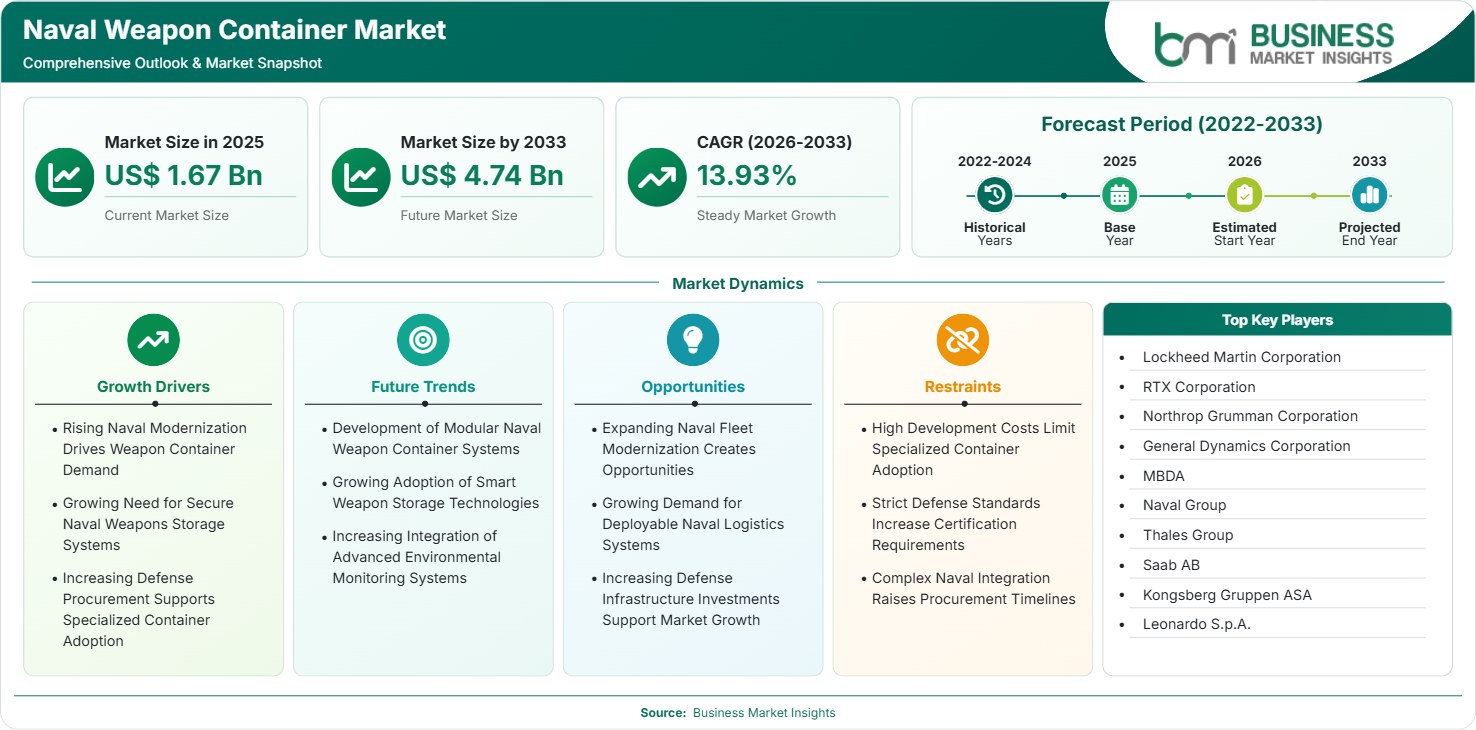
The Naval Weapon Container Market size was valued at US$ 1.67 Billion in 2025 and is projected to reach US$ 4.74 Billion by 2033, growing at a CAGR of 13.93% during 2026–2033, driven by naval modernization, fleet expansion, secure weapons storage requirements, and defense infrastructure investments.

Report Coverage
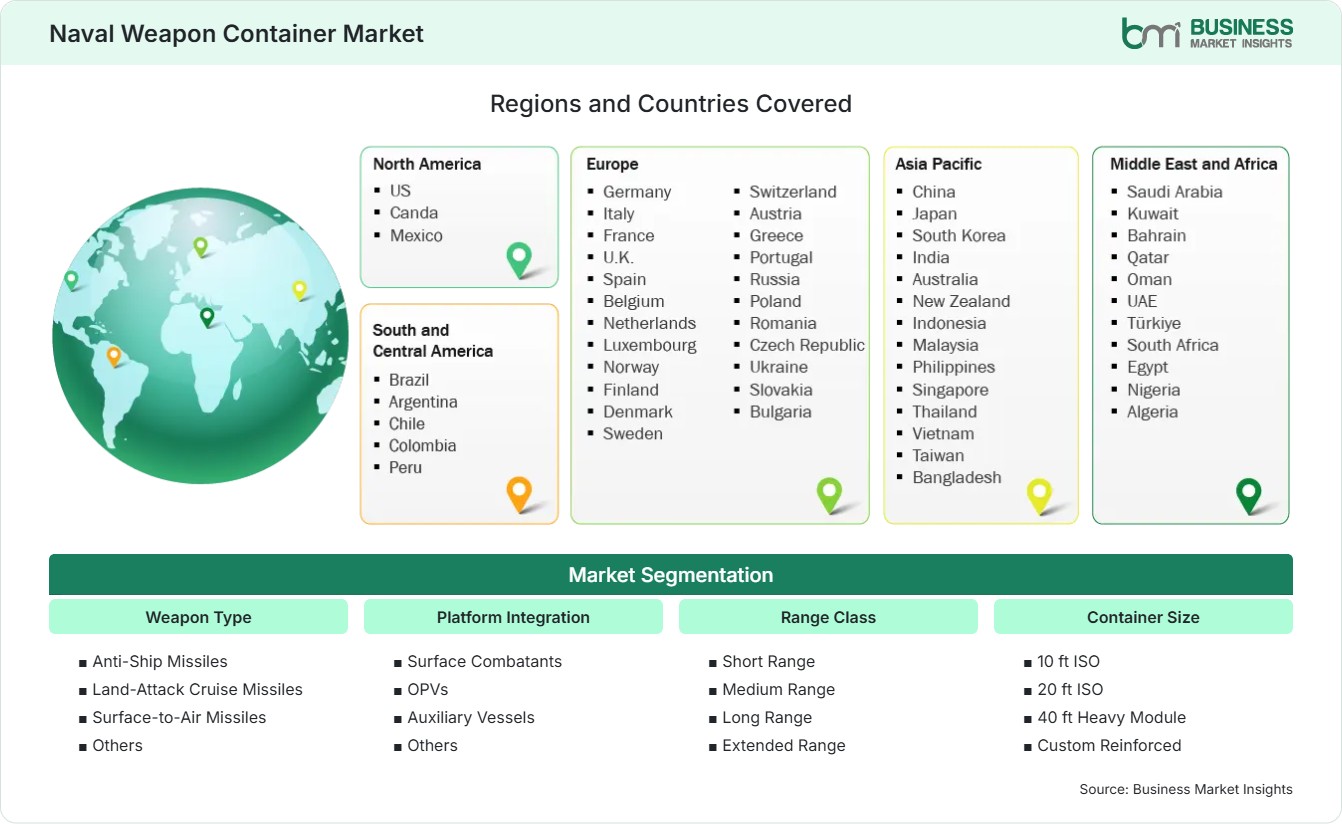
  • Weapon Type: Anti-Ship Missiles, Land-Attack Cruise Missiles, Surface-to-Air Missiles, Others
  • Platform Integration: Surface Combatants, OPVs, Auxiliary Vessels, Others
  • Range Class: Short Range, Medium Range, Long Range, Extended Range
  • Container Size: 10 ft ISO, 20 ft ISO, 40 ft Heavy Module, Custom Reinforced
  • Application: Sea Denial Operations, Power Projection & Land Attack, Others
US$ 1.67 Bn Market size in 2025
US$ 4.74 Bn Market Size by 2033
13.93% CAGR, 2026 - 2033
2026-2033 Forecast Period

AI Overview

Naval Weapon Container Market Summary

  • North America: North America holds a 34%–37% share in 2025, growing at a 11.8%–12.6% CAGR through 2033, supported by naval modernization, missile procurement, fleet readiness programs, and established defense infrastructure. The U.S. market represents a 29%–32% global share and is advancing at a 11.9%–12.7% CAGR, supported by fleet renewal and specialized weapons logistics requirements.
  • Fastest Growing Region: Asia Pacific holds a 24%–27% share in 2025 and is advancing at a 15.0%–16.2% CAGR, supported by naval fleet expansion, maritime security priorities, shipbuilding investments, indigenous defense production, and growing missile inventories.
  • Leading Segment: Anti-Ship Missiles account for a 34%–38% share in 2025 and are advancing at a 13.4%–14.3% CAGR, supported by increasing maritime strike capabilities, sea-denial requirements, and deployment across surface combatants.
  • High Growth Segment: Long Range (200–1,000 km) represents a 28%–32% share in 2025 and is advancing at a 15.2%–16.5% CAGR, supported by growing demand for stand-off capabilities and distributed naval strike logistics.
  • Key Market Opportunity: Fleet modernization is creating opportunities for modular, reinforced, transportable, environmentally protected, and rapidly deployable containerized weapons logistics systems.
  • Major Market Players: Lockheed Martin Corporation, RTX Corporation, Northrop Grumman Corporation, General Dynamics Corporation, MBDA, Naval Group, Thales Group, Saab AB, Kongsberg Gruppen ASA, Leonardo S.p.A.
Strategic Insights

Naval Weapon Container Market: Strategic Insights

Naval Weapon Container Market Strategic Framework
FREE PDF
Request your free sample
Request free sample
Stakeholder View

Key Takeaways

  • Naval modernization programs are increasing demand for specialized containers that support protected storage, controlled handling, transportation, and logistics of weapons across distributed naval infrastructure.
  • Modular container architectures provide greater flexibility for defense organizations managing different vessel classes, weapon configurations, storage locations, and deployment requirements.
  • Long-range naval weapons are creating stronger requirements for reinforced structures, environmental protection, secure handling, and logistics systems capable of supporting extended operational reach.
  • Surface combatants remain a major integration platform because frigates, destroyers, and other combat vessels require reliable weapons-support infrastructure within constrained shipboard environments.
  • Asia Pacific presents an attractive expansion opportunity as regional navies increase fleet capacity, maritime security capabilities, shipbuilding activity, and supporting defense infrastructure.
  • Competitive positioning increasingly depends on structural durability, customization, platform compatibility, security features, environmental protection, certification capabilities, and integration with broader naval logistics programs.
Geographic Outlook

Naval Weapon Container Market Regional Highlights

North America Naval Weapon Container Market

North America holds a 34%–37% share in 2025 and is projected to grow at a 11.8%–12.6% CAGR through 2033. The region benefits from sustained naval procurement, established defense manufacturing, and extensive maritime infrastructure.

  • The U.S. represents the principal contributor, supported by naval fleet modernization, missile procurement, shipbuilding activity, and investment in weapons-support infrastructure.
  • Defense contractors and naval shipbuilders provide an established ecosystem for integrating specialized containers with broader weapons and platform programs.
  • Requirements for standardized logistics, environmental protection, and secure handling support demand for engineered container solutions.
  • Modernization of naval bases and distributed weapons-support infrastructure creates additional procurement opportunities beyond vessel-level applications.

US Naval Weapon Container Market

The U.S. represents a 29%–32% global share in 2025 and is growing at a 11.9%–12.7% CAGR through 2033. Strong defense procurement and naval capability development support continued demand.

  • Fleet modernization programs generate requirements for weapons storage and transportation systems compatible with advanced surface vessels and naval logistics networks.
  • Large defense procurement programs favor suppliers with established engineering, testing, certification, and defense-contracting capabilities.
  • Secure storage requirements across naval bases and logistics facilities create demand beyond containers directly integrated with vessels.
  • Increasing emphasis on distributed maritime operations can support demand for mobile and adaptable weapons-support infrastructure.

Europe Naval Weapon Container Market

Europe accounts for a 25%–28% Naval Weapon Container Market share in 2025 and is advancing at a 12.0%–12.8% CAGR. Fleet renewal and multinational defense initiatives are strengthening regional requirements.

  • European navies are modernizing surface fleets and associated missile capabilities, creating opportunities for platform-compatible weapons logistics equipment.
  • Shipbuilding centers in France, Germany, Italy, Spain, and other European markets support demand through naval platform development and modernization.
  • Multinational procurement programs can favor interoperable container configurations capable of supporting different naval logistics environments.
  • Increasing defense infrastructure investment provides opportunities for reinforced storage systems at naval facilities and ports.

Asia Pacific Naval Weapon Container Market

Asia Pacific represents a 24%–27% share in 2025 and records the fastest growth at a 15.0%–16.2% CAGR. Fleet expansion and maritime security priorities are accelerating procurement.

  • China, India, Japan, South Korea, and Australia are strengthening naval capabilities, supporting requirements for weapons storage, transportation, and handling infrastructure.
  • Indigenous shipbuilding and defense manufacturing can stimulate local demand for specialized containers designed around domestic naval platforms.
  • Expanding maritime security requirements are encouraging investment in surface combatants, missile capabilities, naval bases, and logistics facilities.
  • Regional suppliers can gain opportunities by developing modular solutions suited to diverse vessel configurations and infrastructure requirements.

Rest of World Naval Weapon Container Market

Rest of World holds a 11%–14% share in 2025 and is projected to grow at a 12.0%–13.0% CAGR. Demand is supported by selective fleet modernization and maritime security investments.

South American, Middle Eastern, and African naval operators are upgrading selected vessels and supporting infrastructure. Procurement opportunities are particularly relevant where new missile capabilities require corresponding storage, transportation, and handling arrangements.

  • Middle Eastern Naval Weapon Container Market offer opportunities through maritime security spending, naval fleet modernization, and investment in defense infrastructure.
  • Latin American countries can generate demand through patrol-vessel upgrades, maritime surveillance requirements, and selective weapons modernization.
  • African naval modernization programs provide emerging opportunities for adaptable logistics systems where infrastructure expansion accompanies fleet development.
  • Suppliers offering configurable solutions can address varied vessel sizes, storage environments, and procurement requirements across these markets.
Global Market Geography
FREE PDF
Request your free sample
Request free sample
Segment Analysis

Naval Weapon Container Market Segmentation

Weapon Type

Anti-Ship Missiles lead the weapon structure with a 34%–38% share in 2025 and a 13.4%–14.3% CAGR through 2033. Their importance in maritime strike and sea-denial missions supports specialized logistics requirements.

  • Anti-Ship Missiles: Require protected storage and controlled handling arrangements supporting maritime strike capabilities and deployment aboard naval platforms.
  • Land-Attack Cruise Missiles: Require specialized storage infrastructure supporting secure transportation and logistics for long-range naval strike applications.
  • Surface-to-Air Missiles: Support naval air-defense capabilities and require protected containerized logistics compatible with vessel-based missile handling systems.
  • Others: Include additional naval weapon categories requiring specialized storage, transportation, environmental protection, and handling configurations.

Platform Integration

Surface Combatants account for a 43%–47% share in 2025 and are projected to advance at a 13.7%–14.5% CAGR. Their extensive use in fleet operations supports significant container demand.

  • Surface Combatants: Require weapons-support systems capable of operating within constrained shipboard spaces while maintaining structural and environmental protection.
  • OPVs: Create demand for adaptable logistics systems supporting flexible maritime missions, patrol operations, and selective weapons deployment.
  • Auxiliary Vessels: Use specialized containers for weapons transportation, replenishment, storage, and mission-support logistics.
  • Others: Cover additional naval platforms requiring containerized weapons-support arrangements tailored to specific operational requirements.

Range Class

Long Range (200–1,000 km) represents a major growth category with a 28%–32% share in 2025 and a 15.2%–16.5% CAGR through 2033. Greater stand-off capability strengthens requirements for advanced logistics infrastructure.

  • Short Range (<50 km): Supports compact naval weapon systems requiring efficient storage and rapid access within limited platform space.
  • Medium Range (50–200 km): Serves tactical maritime missions requiring secure storage and dependable transportation infrastructure.
  • Long Range (200–1,000 km): Benefits from greater emphasis on stand-off engagement, extended reach, and distributed naval strike capabilities.
  • Extended Range (>1,000 km): Creates demand for highly reinforced and environmentally protected storage systems supporting specialized long-range weapons logistics.

Container Size

20 ft ISO containers hold an estimated 38%–42% share in 2025, supported by standardized logistics compatibility and practical capacity for defense transportation and storage applications.

  • 10 ft ISO: Provides compact storage and transportation where naval facilities or vessels impose tighter space constraints.
  • 20 ft ISO: Supports standardized transportation, storage, handling, and logistics integration across naval and defense infrastructure.
  • 40 ft Heavy Module: Provides greater capacity for specialized weapons-support equipment and large-scale logistics requirements.
  • Custom Reinforced: Addresses application-specific structural, dimensional, security, environmental, and platform-integration requirements.

Application

Sea Denial Operations represent a 41%–45% share in 2025 and are projected to grow at a 13.8%–14.6% CAGR through 2033. Maritime strike requirements support continued demand.

  • Sea Denial Operations: Support protected weapons logistics for missions designed to restrict or control maritime access.
  • Power Projection & Land Attack: Requires dependable storage and transportation infrastructure for naval weapons supporting extended strike missions.
  • Others: Include additional naval missions requiring secure, transportable, and application-specific weapons storage solutions.
Market Forces

Naval Weapon Container Market Dynamics

Key Market Drivers

Rising Naval Modernization Drives Weapon Container Demand

The navies are launching new surface combatants, updating their fleets, and increasing weapons inventories in response to shifting needs for maritime security. Such programs not only result in the acquisition of weapons and ships but also create additional infrastructure needs. There is a need for special containers that would help store and transport the equipment safely from one navy base or port to another. Modernization of the navy also leads to an update of old systems of storing equipment by using stronger systems suitable for modern weather and operational conditions. The suppliers who provide modules compatible with several platforms can capitalize on modernization projects across the fleet and periodic infrastructure needs.

Growing Need for Secure Naval Weapons Storage Systems

Weapons storage is not just about security from exposure to environmental elements but also about ensuring that they are secured from physical damage, tampering, and mishandling. Containerized storage units are an excellent way of providing secure storage facilities, even as the equipment is being transported to naval facilities that are geographically scattered. All the security and protection aspects may be provided depending on the specifications of the procurement process. With missiles getting diversified, containerized infrastructure makes the logistical task simpler. Consequently, the demand goes beyond mere transportation to engineering solutions that revolve around safety, longevity, efficiency in handling, and preparedness.

Increasing Defense Procurement Supports Specialized Container Adoption

Increased defense procurement allows navies to equip their ships, weaponry, bases, and logistical structures. Containerized systems stand to gain from procurement where weaponry-related equipment is included along with platforms. The design could be tailored specifically to individual missile systems, ship designs, handling equipment, and storage requirements. Procurement authorities pay attention to the importance of reliability, interoperability, performance throughout the life cycle, and compliance with defense standards. Such conditions are favorable for suppliers possessing the skills in engineering as well as the capability of delivering repeatable systems for large-scale fleets.

Key Market Opportunities

Expanding Naval Fleet Modernization Creates Opportunities

The procurement of new frigates, destroyers, corvettes, patrol vessels, and auxiliary vessels will necessitate the development of new weapons logistics facilities to suit new ship designs. New ships can have container requirements that differ from those of existing fleets in terms of size, handling, environmental protection, and integration. Suppliers can explore the possibility of utilizing a modular approach that allows for the support of various ship classes, but ensures logistics compatibility standards. Demand may arise from shipbuilding projects where suppliers of the supporting equipment are contracted along with the ship itself. Suppliers who can combine their container engineering with the platform integration requirements can increase their access to naval modernization programs.

Growing Demand for Deployable Naval Logistics Systems

For flexible operations in naval warfare, logistics need to be in place that could enable the movement of weapons from one base to another, from one port to another, from one auxiliary vessel to another, and from one forward operating location to another. Transportable containers may help with controlled transport without reliance on any fixed logistics infrastructure. Modularity would also provide flexibility to defense agencies to change their logistics capacity based on their needs. This Naval Weapon Container Market trend will benefit those products that combine these five features. Companies can distinguish themselves through systems that are built for quick processing and are compatible with existing defense transport procedures.

Increasing Defense Infrastructure Investments Support Market Growth

Investment in naval bases, ammunition facilities, ports, shipyards, and logistics centers expands opportunities for specialized storage and transportation systems. Infrastructure modernization can replace conventional arrangements with standardized, reinforced, and transportable container solutions. Distributed storage strategies can also increase demand as defense organizations seek to position weapons across multiple facilities while maintaining controlled conditions. Suppliers can address these projects through direct procurement, shipbuilding contractors, and integrated logistics providers. The Naval Weapon Container Market forecast is therefore influenced by infrastructure investment extending beyond vessel acquisition toward broader modernization of naval logistics networks.

Market Restraints and Challenges

High Development Costs Limit Specialized Container Adoption

Factor: Specialized naval containers require reinforced construction, environmental protection, security provisions, testing, and application-specific engineering. Impact: Development and validation expenses can raise acquisition prices and make highly customized systems less attractive for smaller procurement programs. Design modifications for specific weapons or platforms can also increase development timelines. Manufacturers can address this challenge through modular architectures, standardized components, and configurable designs that reduce the need for extensive redesign across different applications.

Strict Defense Standards Increase Certification Requirements

Factor: Naval weapons-support equipment must satisfy demanding structural, environmental, safety, security, testing, and defense procurement requirements. Impact: Certification procedures can increase development costs, documentation requirements, and commercialization timelines. Suppliers entering new defense markets may also encounter different national qualification procedures and procurement specifications. Established testing capabilities, quality systems, engineering expertise, and experience with defense procurement can help companies manage compliance requirements and reduce certification-related delays.

Company Analysis

Competitive Landscape

The Naval Weapon Container Market analysis reflects competition among major aerospace and defense companies with capabilities spanning missile systems, naval platforms, combat systems, defense electronics, and weapons-support technologies. Competitive differentiation depends on engineering capabilities, platform compatibility, structural reliability, defense certifications, customization, and integration with broader naval procurement programs.

Company Name

Overview

Products and Services relevant to this market

Lockheed Martin Corporation

Major defense technology provider with extensive missile and naval-system capabilities supporting large-scale defense procurement.

Naval missile systems, precision weapons, launch systems, defense technologies, and naval platform integration capabilities.

RTX Corporation

Diversified aerospace and defense company with substantial missile, naval weapons, sensors, and integrated defense capabilities.

Naval missile systems, precision weapons, air-defense technologies, sensors, and weapons integration solutions.

Northrop Grumman Corporation

Defense technology company supporting naval platforms, mission systems, advanced weapons, and defense electronics.

Naval systems, missile technologies, mission systems, sensors, and integrated defense technologies.

General Dynamics Corporation

Major defense contractor with significant naval shipbuilding and combat-system capabilities.

Naval platforms, combat systems, weapons integration, mission systems, and shipboard defense technologies.

MBDA

Multinational missile systems company specializing in advanced weapons for maritime, land, and air applications.

Anti-ship missiles, naval air-defense missiles, cruise missiles, launch systems, and weapons integration solutions.

Naval Group

Naval defense company focused on advanced naval vessels, combat systems, and associated maritime capabilities.

Surface combatants, naval combat systems, weapons integration, submarines, and fleet-support technologies.

Thales Group

Defense technology provider delivering naval sensors, combat management, communications, and mission systems.

Naval combat systems, radar, sensors, communications, electronic systems, and weapons integration technologies.

Saab AB

Defense and security company with established capabilities in naval weapons and maritime defense systems.

Naval missile systems, maritime surveillance, combat systems, sensors, and weapons-support technologies.

Kongsberg Gruppen ASA

Technology group providing maritime defense systems, missile solutions, sensors, and naval mission technologies.

Naval strike missiles, maritime sensors, remote weapon systems, command systems, and defense integration solutions.

Leonardo S.p.A.

Aerospace and defense company providing naval electronics, sensors, weapons systems, and integrated mission technologies.

Naval defense electronics, radar, combat systems, sensors, weapon integration, and maritime mission solutions.

Trust & Transparency

Research Methodology

The market analysis combines proprietary research with secondary data from government agencies, company disclosures, regulatory filings, industry databases and expert interviews. Market estimates are validated through data triangulation, cross-market benchmarking and analyst review.

View Full Research Methodology

Questions Answered

Frequently Asked Questions

What does the Naval Weapon Container Market report cover?

The report covers market sizing, regional performance, segmentation by weapon type, platform integration, range class, container size, and application, together with market dynamics, competitive positioning, opportunities, and restraints.

Which region provides the strongest growth opportunity?

Asia Pacific offers the strongest growth potential because naval fleet expansion, maritime security priorities, shipbuilding investment, indigenous defense production, and weapons modernization are increasing logistics infrastructure requirements.

Why are modular containers gaining importance in naval logistics?

Modular containers can accommodate different vessel classes, storage facilities, weapons configurations, and transportation requirements. Their adaptability can reduce redesign requirements and support standardized logistics across multiple applications.

Which weapon type represents a leading opportunity?

Anti-Ship Missiles represent a leading category because of their strategic relevance to maritime strike and sea-denial operations. Their deployment across surface combatants supports associated storage and handling requirements.

What factors are driving Naval Weapon Container Market growth?

Naval modernization, expanding weapons inventories, increasing requirements for secure storage, defense procurement, fleet renewal, and investment in naval logistics infrastructure are key growth factors.

Access the Full Naval Weapon Container Market Report

Get segment-level forecasts, regional estimates, competitive benchmarking, company profiles and downloadable Excel datasets.

Access the full Naval Weapon Container Market Report
350 pages PDF & Excel | 2026-09-15
Similar Research

Related Market Reports