Market Summary
Executive Summary and Global Market Analysis
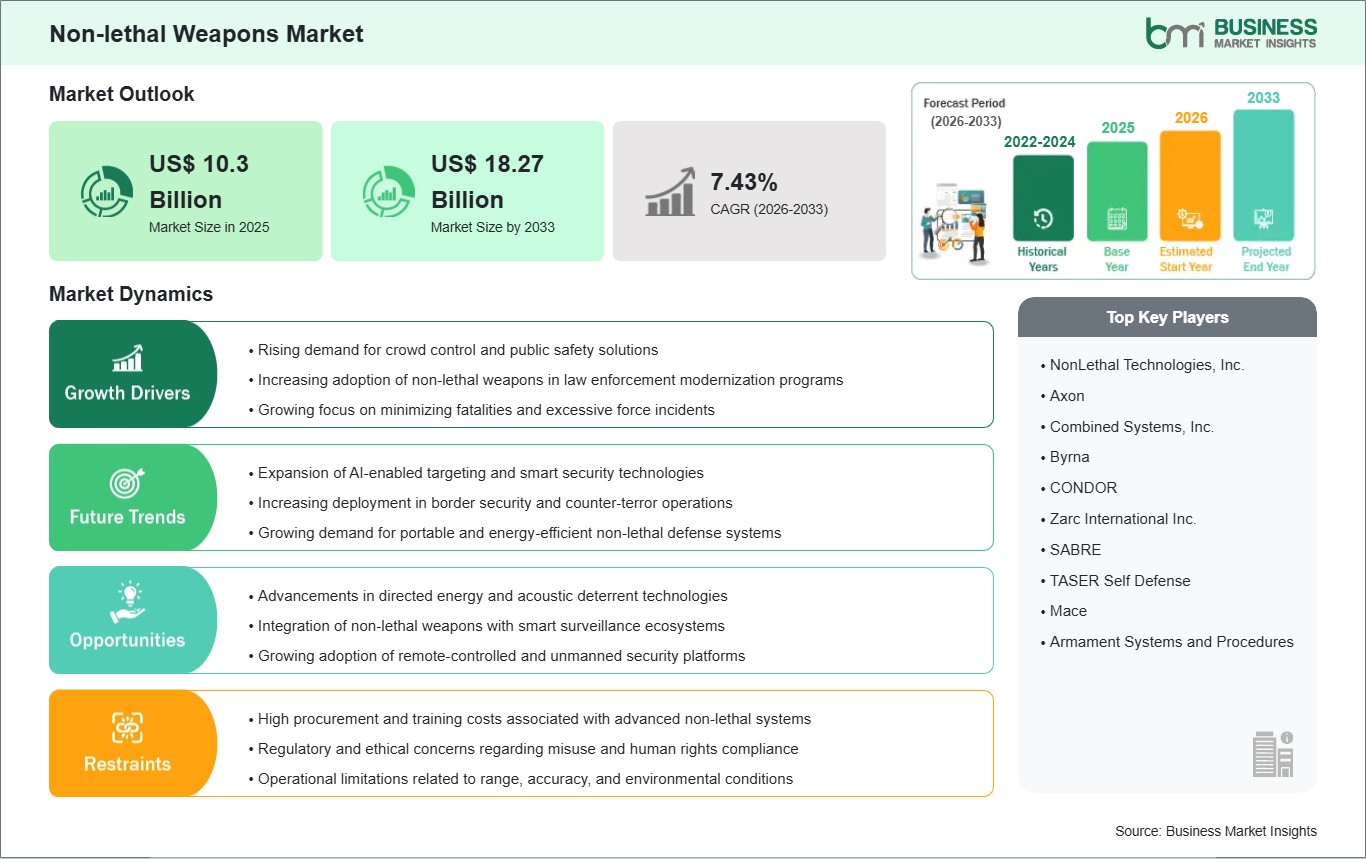
Non-Lethal Weapons refer to advanced defense and security systems designed to incapacitate, deter, or control individuals or groups while minimizing the risk of permanent injury or fatality. These systems utilize technologies such as acoustic devices, electrical incapacitation systems, chemical irritants, kinetic impact projectiles, and directed energy systems to achieve controlled force application in law enforcement, military, and crowd management operations. By leveraging precision delivery mechanisms and controlled energy output, non-lethal weapon technologies enable effective threat neutralization, riot control, perimeter security, and suspect apprehension in complex operational environments. This technology is becoming an important component of modern defense and internal security frameworks, particularly within law enforcement agencies, military units, border control operations, and critical infrastructure protection systems. Market expansion is being driven by increasing global emphasis on civilian safety, rising demand for riot control and crowd management solutions, and the growing adoption of advanced law enforcement modernization programs.
However, several factors may restrain market progression. The high cost of advanced non-lethal weapon systems, including directed energy devices, tasers, and acoustic deterrent systems, remains a significant barrier for large-scale procurement, particularly in developing regions. The industry also faces technical and operational challenges related to effectiveness variability under different environmental and crowd conditions, including weather interference, range limitations, and accuracy concerns. Ethical concerns and regulatory restrictions surrounding the use of force and potential misuse further complicate deployment, as global frameworks impose strict guidelines on law enforcement conduct and human rights compliance. Additionally, training requirements for safe and effective usage increase operational complexity and limit rapid scalability. Integration challenges with existing security infrastructure and concerns regarding unintended injuries or escalation risks further elevate procurement scrutiny and adoption barriers.
Despite these challenges, the market outlook remains highly favorable as the sector transitions toward technology-enabled, precision-based security solutions. Opportunities are emerging through the integration of artificial intelligence, advanced sensing technologies, and remote-controlled deployment systems, enabling more accurate threat assessment and proportional response mechanisms. The expansion of smart policing initiatives and urban security modernization programs is accelerating demand for next-generation non-lethal solutions. Furthermore, advancements in directed energy systems, electromagnetic pulse technologies, and smart projectile control are enhancing operational precision and reducing collateral risks. The growing focus on de-escalation strategies in law enforcement and crowd management is also supporting wider acceptance of non-lethal alternatives. Collectively, these developments position the non-lethal weapons market for sustained growth as a critical enabler of modern security, defense innovation, and public safety infrastructure.
Segment Analysis
Non-lethal Weapons Market Segmentation
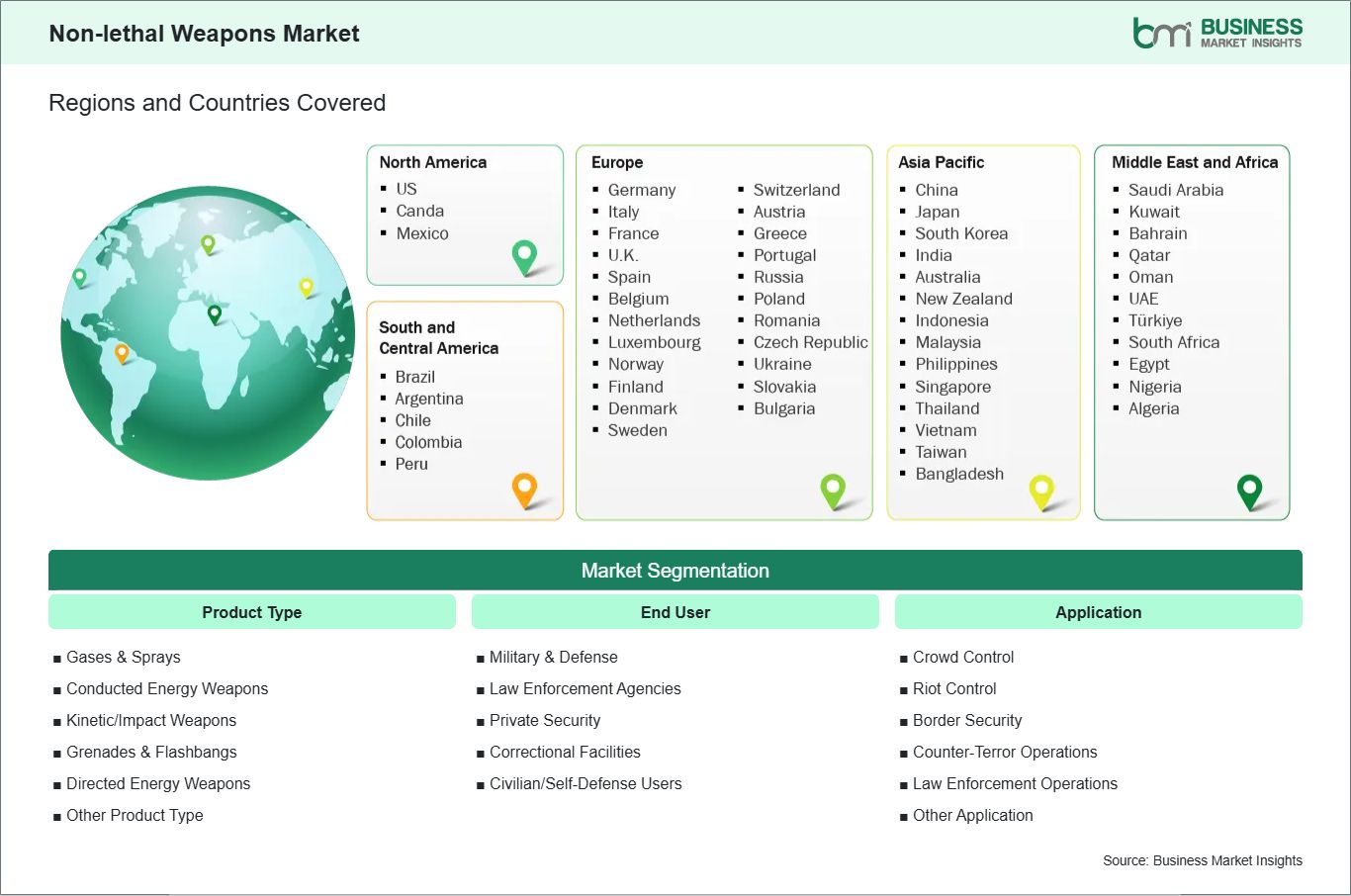
The non-lethal weapons market is segmented based on product type, end user, and application, reflecting the growing deployment of controlled-force and incapacitation technologies across defense, law enforcement, and security operations.
By Product Type
- Gases & Sprays: Includes pepper spray, tear gas, and chemical irritants used for temporary incapacitation and crowd control
- Conducted Energy Weapons: Utilizes electric shock-based devices such as tasers to temporarily disable targets with minimal long-term harm
- Kinetic/Impact Weapons: Includes rubber bullets, batons, and bean bag rounds designed to control or deter individuals through blunt force
- Grenades & Flashbangs: Non-lethal explosive devices used to disorient, disperse crowds, or support tactical operations
- Directed Energy Weapons: Uses electromagnetic, acoustic, or laser-based systems for crowd deterrence and area denial applications
- Other Product Type: Includes emerging non-lethal technologies such as water cannons and advanced restraint systems
By End User
- Military & Defense: Utilized in tactical operations, perimeter security, and non-lethal engagement scenarios
- Law Enforcement Agencies: Widely used for riot control, suspect apprehension, and public order management
- Private Security: Deployed for facility protection, event security, and threat deterrence in commercial environments
- Correctional Facilities: Used for inmate control, riot suppression, and maintaining institutional safety
- Civilian/Self-Defense Users: Includes personal protection tools designed for non-lethal self-defense applications
By Application
- Crowd Control: Used to manage large gatherings and prevent escalation of public disturbances
- Riot Control: Applied during civil unrest situations to disperse and control violent groups
- Border Security: Supports surveillance and deterrence operations along national boundaries
- Counter-Terror Operations: Used in specialized missions requiring controlled force engagement
- Law Enforcement Operations: Covers routine policing activities including arrests and threat neutralization
- Other Application: Includes specialized uses such as infrastructure protection and emergency response scenarios
Market Forces
Non-lethal Weapons Market Drivers and Opportunities
Rising Demand for Public Safety, Riot Control, and Modern Law Enforcement Solutions
The Non-Lethal Weapons market is being driven by the increasing need for effective crowd management, public safety enhancement, and controlled-force engagement across military and law enforcement operations. Unlike conventional lethal weapon systems, non-lethal weapons utilize technologies such as conducted energy devices, chemical irritants, kinetic impact systems, and acoustic deterrents to temporarily incapacitate or disperse threats while minimizing the risk of permanent injury or fatality. The growing emphasis on human rights compliance and de-escalation strategies is significantly accelerating demand, as governments and security agencies focus on reducing civilian casualties during law enforcement and tactical operations. Rising incidents of civil unrest, protests, and border security threats are further strengthening adoption across global markets. Additionally, increasing modernization programs within defense and policing sectors are driving procurement of technologically advanced non-lethal systems for operational flexibility and public safety management.
In military and homeland security applications, non-lethal weapons are gaining strong traction due to their ability to support peacekeeping missions, checkpoint security, and urban conflict management without excessive force escalation. The development of integrated surveillance and smart security ecosystems is further supporting adoption by enabling coordinated response and threat mitigation strategies. Technological advancements in directed energy systems, smart munitions, and portable conducted energy weapons are improving operational precision while reducing collateral damage risks. Collectively, these factors are driving sustained market growth, supported by increasing investments in defense modernization, public order management, and advanced tactical response technologies.
Rising Integration of AI, Directed Energy Technologies, and Smart Security Ecosystems
Opportunities in the Non-Lethal Weapons market are expanding through the integration of artificial intelligence, advanced targeting systems, and next-generation directed energy technologies. AI-enabled systems are supporting enhanced situational awareness, threat identification, and precision targeting, significantly improving operational effectiveness for military and law enforcement personnel. The adoption of smart sensor integration and automated response systems is enhancing weapon accuracy and reducing unintended harm in complex operational environments.
The evolution of smart city security infrastructure and intelligent border management systems is creating strong opportunities for advanced non-lethal weapon deployment. Additionally, the growing demand for remote-controlled and unmanned security systems is opening new applications for non-lethal deterrence technologies in high-risk environments. Increasing investments in electromagnetic, acoustic, and laser-based deterrent systems are further accelerating innovation across the market. The emergence of lightweight, portable, and energy-efficient non-lethal devices is also improving scalability and field deployment capabilities. Furthermore, advancements in AI-assisted targeting and predictive threat analysis are enhancing operational reliability while supporting compliance with evolving safety regulations. Collectively, the convergence of AI, smart security infrastructure, and precision-controlled defense technologies is positioning the non-lethal weapons market for sustained long-term expansion.
Size and Share Analysis
Non-lethal Weapons Market Size and Share Analysis
The Non-lethal Weapons Market is projected to grow from US$ 10.3 Billion in 2025 to US$ 18.27 Billion by 2033 , registering a CAGR of 7.43% from 2026 to 2033.
By product type, conducted energy weapons account for a significant share as they provide effective temporary incapacitation with reduced risk of fatal injury, making them widely adopted by law enforcement agencies and security personnel. Gases and sprays continue to witness strong demand due to their effectiveness in crowd dispersal, riot management, and personal defense applications. Kinetic/impact weapons are gaining traction as they offer controlled-force engagement capabilities for riot control and perimeter security operations. Grenades and flashbangs are expanding steadily with increasing deployment in tactical missions, hostage rescue operations, and military training exercises. Directed energy weapons are also experiencing growing adoption due to advancements in acoustic, laser, and electromagnetic technologies that enable precision deterrence and area denial capabilities with minimal collateral damage.
By end user, law enforcement agencies dominate adoption due to the increasing need for crowd management, suspect apprehension, and non-lethal engagement solutions in urban policing operations. Military and defense sectors are witnessing strong growth as armed forces increasingly deploy non-lethal weapons for peacekeeping missions, border security, counter-terror operations, and conflict de-escalation scenarios. Private security, correctional facilities, and civilian/self-defense users are also contributing to market expansion as demand rises for effective non-lethal protection and threat management solutions across commercial and personal security applications.
Report Coverage
Non-lethal Weapons Market Report Coverage and Deliverables
The "Non-lethal Weapons Market Size and Forecast (2022–2033)" report provides a detailed analysis of the market covering below areas:
- Non-lethal weapons market size and forecast at global, regional, and country levels for all market segments covered under the scope
- Non-lethal weapons market trends, as well as drivers, restraints, and opportunities
- Non-lethal weapons market analysis covering key trends, global and regional framework, major players, regulations, and recent developments
- Industry landscape and competition analysis covering market concentration, heat map analysis, prominent players, and recent developments for the non-lethal weapons market
- Detailed company profiles, including SWOT analysis
Geographic Insights
Non-lethal Weapons Market Geographic Insights
The Non-Lethal Weapons Market shows diverse regional adoption patterns influenced by rising security concerns, increasing focus on public safety, and growing investments in advanced defense and law enforcement technologies across military and civilian applications.
North America, being a highly advanced defense and security-driven region, holds a strong position in the market due to the presence of major defense contractors, law enforcement modernization programs, and advanced security technology providers. The United States and Canada are witnessing increasing deployment of non-lethal weapons across police forces, border security agencies, correctional facilities, and military operations. The region is heavily focused on improving public safety, crowd management capabilities, and tactical response efficiency while minimizing civilian casualties and excessive force incidents. Strong investments in conducted energy weapons, directed energy systems, and AI-enabled security technologies are further supporting market expansion. Additionally, well-established defense infrastructure and rising adoption of smart surveillance and homeland security systems are accelerating deployment across diverse operational environments.
Asia Pacific is experiencing significant growth, driven by increasing defense modernization initiatives, rising urbanization, and growing investments in internal security and border protection systems. Countries such as China, India, Japan, and South Korea are actively expanding procurement of non-lethal weapons to strengthen riot control, counter-terrorism operations, and law enforcement capabilities. The region’s expanding manufacturing capabilities and cost-competitive defense production ecosystem are enabling wider deployment of conducted energy weapons, kinetic impact systems, and crowd control technologies. Rising incidents of civil unrest, cross-border tensions, and large-scale public events are further contributing to market demand. Additionally, increasing government spending on smart policing infrastructure, surveillance technologies, and advanced tactical equipment is supporting continuous innovation across the region.
Both regions are contributing significantly to the growth of the Non-Lethal Weapons Market, driven by technological advancements, increasing emphasis on public safety, and rising adoption of controlled-force security solutions across military, law enforcement, and civilian security applications.
Industry Activity
Recent Developments
The non-lethal weapons market is evaluated by gathering qualitative and quantitative data post primary and secondary research, which includes important corporate publications, association data, and databases. A few of the key developments in the non-lethal weapons market are:
- In February 2024, AARDVARK is excited to announce a new partnership with Combined Systems, Inc. for the sale and distribution of Combined Tactical Systems Less-Lethal Products and Penn Arms Launchers. This partnership represents a brand shift in AARDVARK's less-lethal product offerings as it follows a move from a 25-year exclusive brand partnership with another manufacturer.
- In October 2023, Byrna Technologies Inc. ("Byrna" or the "Company") (Nasdaq: BYRN), a personal defense technology company specializing in the development, manufacture, and sale of innovative less-lethal personal security solutions, announced a significant expansion of its presence in Argentina where the discourse surrounding less-lethal law enforcement methods and calls to equip police with less lethal weapons have taken center stage in the midst of presidential, provincial, and municipal elections.
Trust & Transparency
Research Methodology
The market analysis combines proprietary research with secondary data from government agencies, company disclosures, regulatory filings, industry databases and expert interviews. Market estimates are validated through data triangulation, cross-market benchmarking and analyst
review.
View Full Research Methodology
Key Sources Referred:
World Bank – Global Trade Indicators
World Trade Organization (WTO)
(International Monetary Fund )IMF
International Trade Administration (ITA)
Company website
Company annual reports
Company investor presentations