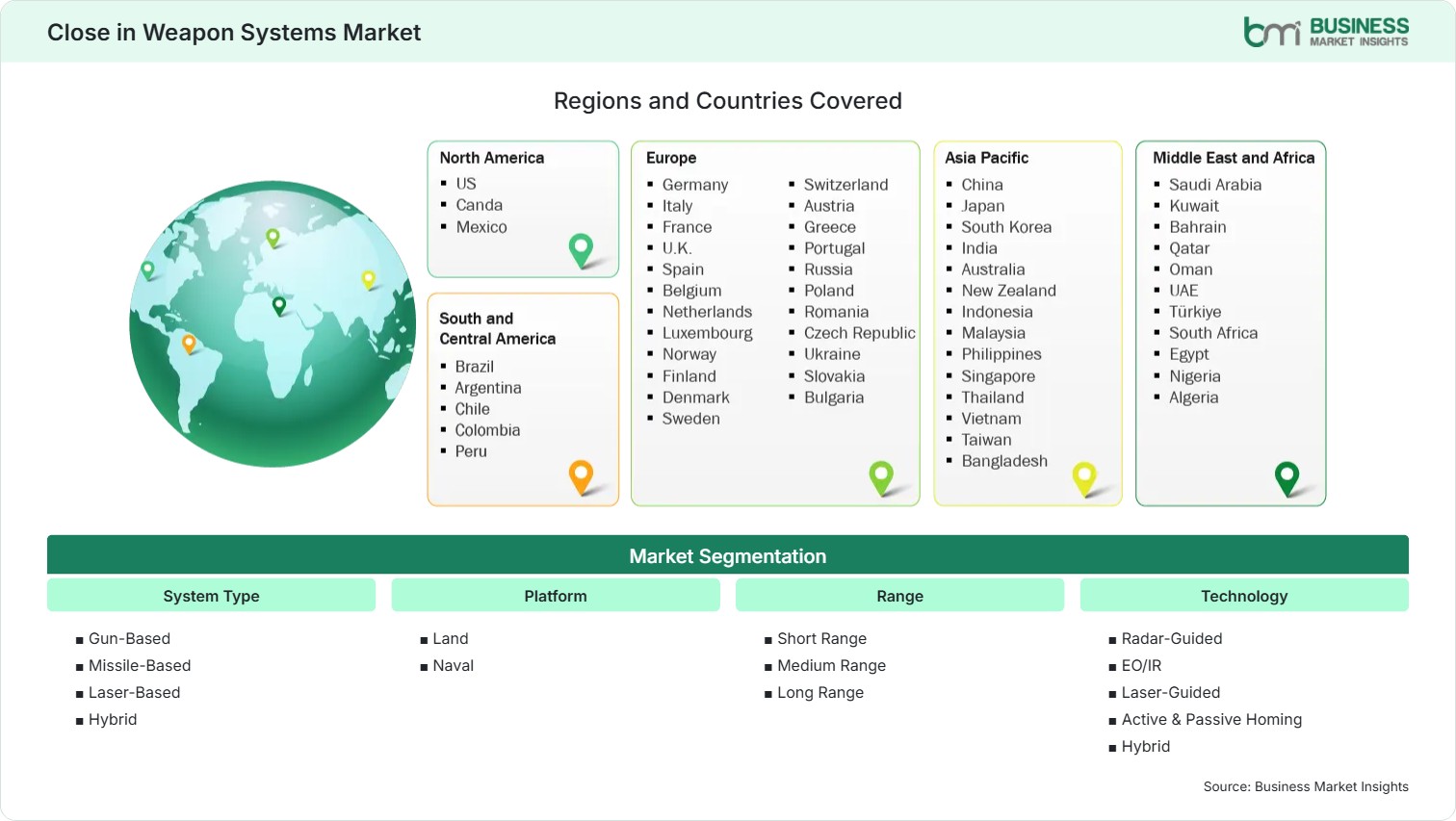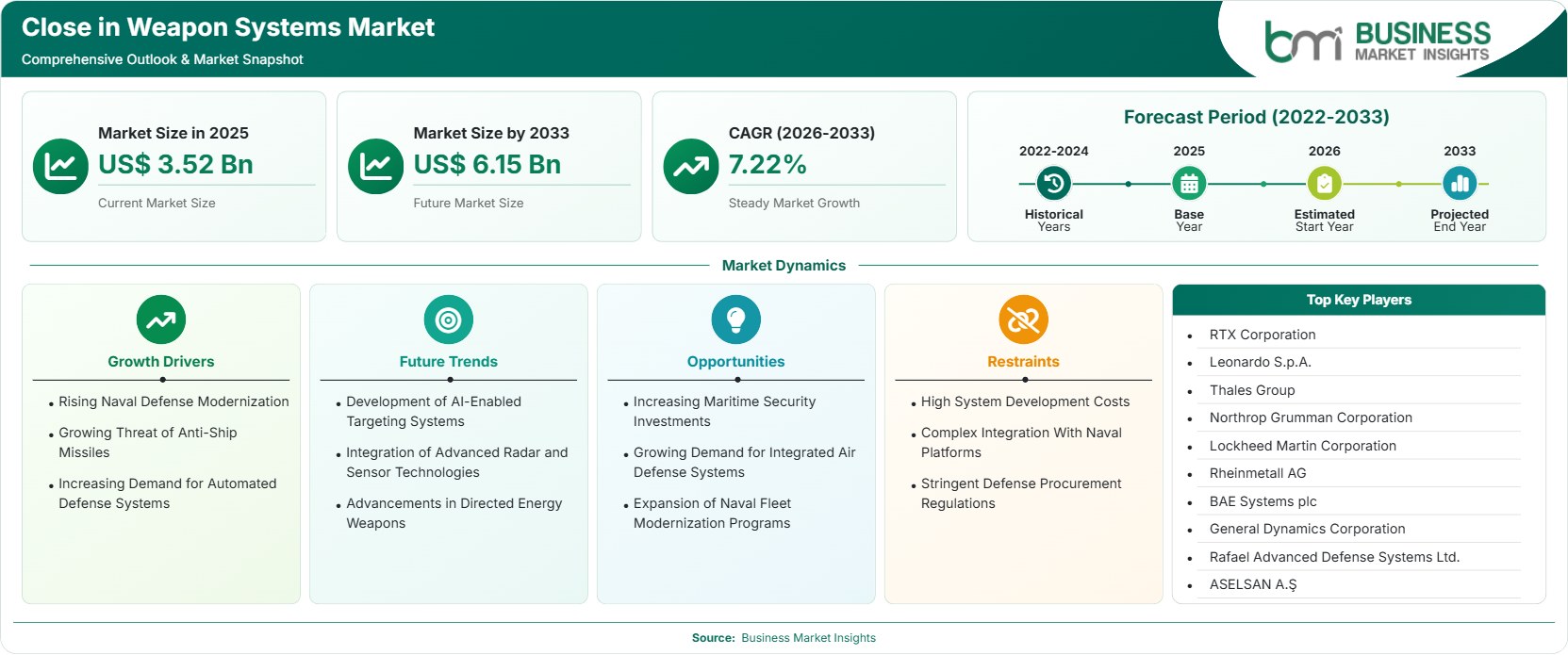
Close in Weapon Systems Market Regional Highlights
North America Close in Weapon Systems Market
North America accounted for approximately 34%–37% of global revenue in 2025 and is projected to register a CAGR of 6.5%–7.2% through 2033. The region maintains leadership through sustained defense expenditure, advanced naval combat capabilities, and continuous modernization of maritime security infrastructure. The Close in Weapon Systems Market share remains concentrated among established defense contractors supporting domestic and allied military requirements.
- U.S. naval modernization sustains demand for rapid-fire guns, missile-based terminal interceptors, upgraded sensors, and retrofit packages across destroyers, amphibious vessels, and emerging surface combatants.
- Canada and Mexico contribute smaller demand pools, while North American suppliers benefit from shared standards, established maintenance infrastructure, domestic production, and interoperability requirements.
- Autonomous target detection and engagement are gaining importance as naval operators confront faster, lower-signature threats and compressed decision cycles requiring integrated sensor and fire-control architectures.
- Directed-energy programs create a longer-term technology pathway, particularly where ships possess sufficient electrical generation, cooling capacity, and combat-management integration for high-power laser systems.
US Close in Weapon Systems Market
The United States Close in Weapon Systems Market represents approximately 78%–82% of North American demand in 2025 and is expected to record a CAGR of 6.8%–7.5% through 2033. Naval dominance objectives, investment in hypersonic defense preparedness, and increasing emphasis on distributed maritime operations continue supporting procurement activity.
- Continuous upgrades to destroyers, carriers, amphibious ships, and support vessels sustain long-term procurement opportunities for advanced ship-defense technologies and supporting combat systems.
- Strong research funding encourages testing of directed-energy weapons, autonomous engagement systems, and next-generation radar capabilities designed for future operational environments.
- Alliances and international defense cooperation create export opportunities for domestic manufacturers while expanding interoperability requirements among partner naval forces.
- Emerging drone and missile threats are accelerating adoption of multi-layered defense concepts integrating kinetic and non-kinetic engagement capabilities across fleet assets.
Europe Close in Weapon Systems Market
Europe held approximately 27%–30% share in 2025 and is forecast to expand at a CAGR of 7.0%–7.8% through 2033. Germany remains the leading national market, while Poland demonstrates the fastest growth trajectory with an estimated CAGR exceeding regional averages.
- Collaborative European defense programs support technology development, cost sharing, and standardization efforts that improve interoperability across allied naval forces.
- Germany benefits from strong manufacturing capabilities, advanced naval engineering expertise, and continuing investments in defensive weapon modernization.
- Poland records accelerated procurement activity due to expanding naval modernization programs and broader military capability enhancement initiatives.
- Increased focus on Baltic, Mediterranean, and North Sea security requirements continues supporting deployment of advanced ship-protection solutions.
Asia Pacific Close in Weapon Systems Market
Asia Pacific represented approximately 24%–27% of global revenue in 2025 and is anticipated to achieve a CAGR of 8.3%–9.1% through 2033. The region delivers the strongest Close in Weapon Systems Market growth due to expanding naval fleets, maritime security investments, territorial surveillance requirements, and increasing indigenous defense production initiatives.
- China continues leading procurement activity through extensive shipbuilding initiatives and development of advanced defensive weapon technologies.
- India experiences strong growth supported by domestic manufacturing efforts, naval modernization programs, and increasing defense budget allocations.
- Growing deployment of unmanned systems and precision-guided munitions increases demand for advanced last-line defensive protection technologies.
- Indigenous production and technology transfer initiatives create significant opportunities for domestic and international defense contractors.
Rest of World Close in Weapon Systems Market
Rest of World accounted for approximately 10%–12% of global Close in Weapon Systems Market demand in 2025 and is projected to grow at a CAGR of 7.4%–8.2% through 2033. Middle East and Africa remain the dominant contributor due to strategic maritime investments and security requirements. Saudi Arabia leads regional procurement, while the United Arab Emirates demonstrates fast growth. In South and Central America, Brazil remains the leading market supported by naval modernization and maritime asset protection initiatives.
- Gulf countries continue strengthening naval defensive capabilities to protect critical maritime infrastructure and strategic shipping routes from emerging security threats.
- Saudi Arabia sustains robust procurement activity through long-term military modernization strategies and domestic defense industrial development objectives.
- The United Arab Emirates demonstrates increasing investment in advanced maritime defense technologies emphasizing interoperability and operational flexibility.
- Brazil supports regional demand through fleet modernization programs focused on coastal defense, maritime surveillance, and protection of offshore economic assets.