Market Summary
Executive Summary and Global Market Analysis
The Hypersonic Weapons Market focuses on advanced defense systems capable of traveling at extremely high speeds while maintaining maneuverability. These weapons are designed to support precision strike missions, strategic deterrence programs, and rapid-response military operations. Defense agencies are prioritizing hypersonic technologies to strengthen operational readiness and improve response flexibility across multiple combat environments. The competitive environment remains shaped by government-backed contracts, long-term research collaborations, and defense modernization priorities. Market participants are concentrating on prototype testing, launch integration capabilities, and advanced engineering solutions. Strategic partnerships between defense agencies and technology developers continue supporting innovation efforts and strengthening the industry’s long-term operational framework.
Rising geopolitical tensions and modernization initiatives are influencing procurement strategies among defense organizations worldwide. Governments are strengthening investments in next-generation missile technologies to address evolving security concerns and changing warfare dynamics. Military planners are also evaluating advanced systems capable of overcoming conventional interception methods and supporting coordinated defense operations. Technology development within the market is centered on propulsion efficiency, thermal protection systems, and advanced guidance mechanisms. Defense programs are integrating sophisticated navigation capabilities and enhanced targeting precision into evolving hypersonic platforms. Research institutions and contractors are also focusing on material durability and aerodynamic stability to improve operational reliability under extreme flight conditions.
Segment Analysis
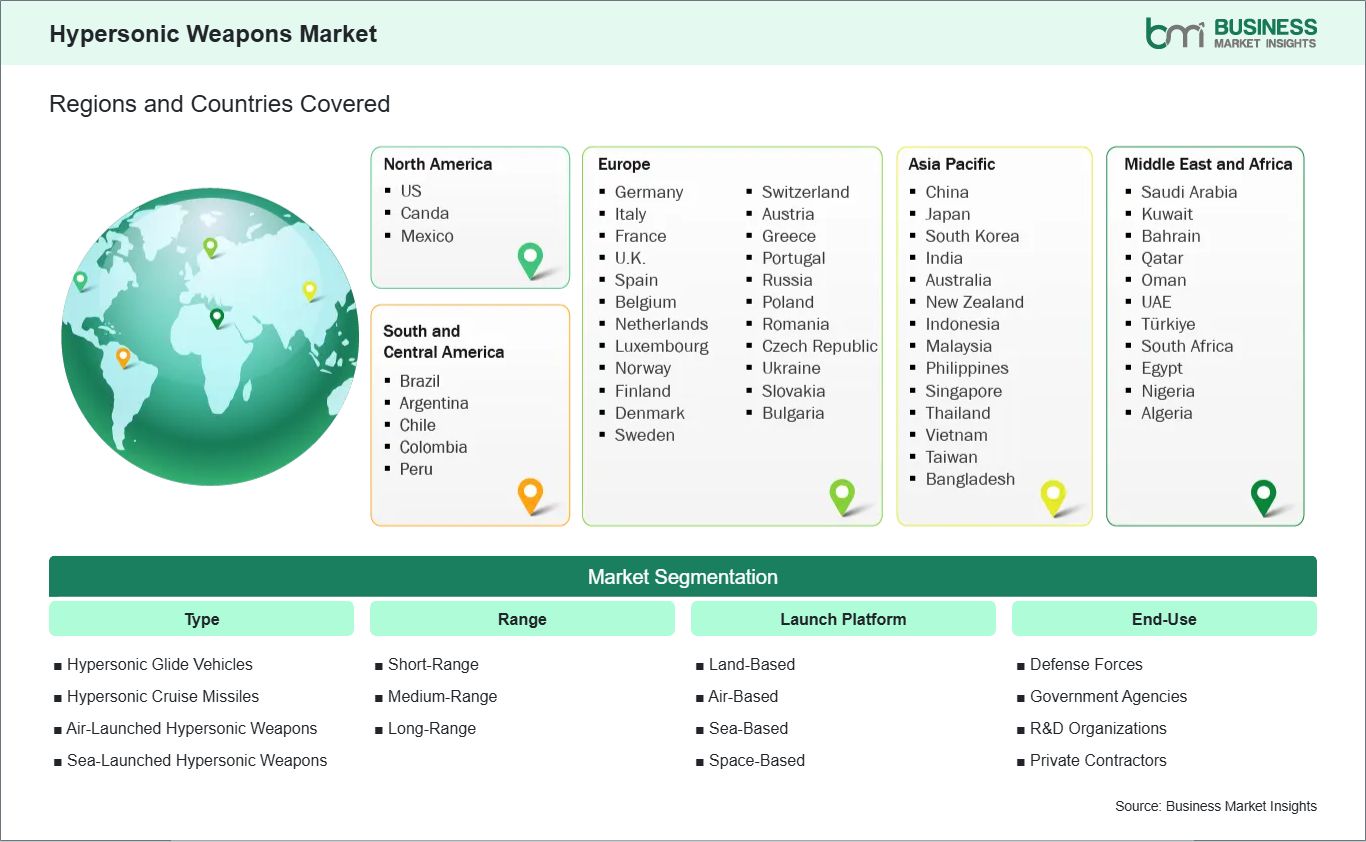
Hypersonic Weapons Market Segmentation
The Hypersonic Weapons market structure reflects strategic deployment priorities, operational range requirements, and evolving defense platform integration.
By Type
- Hypersonic Glide Vehicles – Strong focus on maneuverability during high-speed flight
- Hypersonic Cruise Missiles – Preferred for sustained propulsion-based operations
- Air-Launched Hypersonic Weapons – Supports flexible tactical deployment strategies
- Sea-Launched Hypersonic Weapons – Expands naval strike and deterrence capabilities
By Range
- Short-Range – Suitable for localized tactical engagement requirements
- Medium-Range – Aligns with regional operational mission planning
- Long-Range – Supports strategic defense and deterrence objectives.
By Launch Platform
- Land-Based – Integrated into fixed and mobile defense systems
- Air-Based – Enhances deployment responsiveness across operational zones
- Sea-Based – Strengthens maritime strike positioning and coverage
- Space-Based – Explored for future strategic surveillance applications
By End-Use
- Defense Forces – Primary procurement segment across military operations
- Government Agencies – Supports national security modernization programs
- R&D Organizations – Focused on propulsion and testing advancements
- Private Contractors – Contributes engineering and integration expertise.
Market Forces
Hypersonic Weapons Market Drivers and Opportunities
Defense Modernization and Strategic Preparedness
Defense organizations are strengthening modernization programs to address evolving security environments and tactical requirements. Hypersonic weapons support rapid-response operations and advanced strike capabilities across complex military scenarios. Governments are integrating these technologies into long-term defense planning to improve operational flexibility, strengthen deterrence strategies, and maintain technological competitiveness within modern warfare structures.
Regulatory oversight and national security frameworks continue influencing development priorities across the industry. Military agencies are emphasizing advanced propulsion systems, precision guidance technologies, and reliable testing procedures to improve deployment readiness. These efforts reinforce the relevance of hypersonic systems within strategic defense planning and support broader military transformation initiatives worldwide.
Advancement of Multi-Domain Defense Systems
The industry shift toward integrated defense architectures is creating new opportunities for hypersonic weapon deployment. Military operations increasingly require systems capable of coordinated performance across air, land, sea, and emerging space-based environments. This transition encourages innovation in launch integration, navigation systems, and operational compatibility across multiple defense platforms.
Future opportunities may expand through collaborative research programs and defense infrastructure development initiatives. Emerging defense technologies are encouraging broader experimentation with advanced flight systems and high-speed operational frameworks. Long-term deployment potential remains linked to evolving military doctrines focused on strategic responsiveness, rapid engagement capabilities, and technologically adaptive defense systems.
Size and Share Analysis
Hypersonic Weapons Market Size and Share Analysis
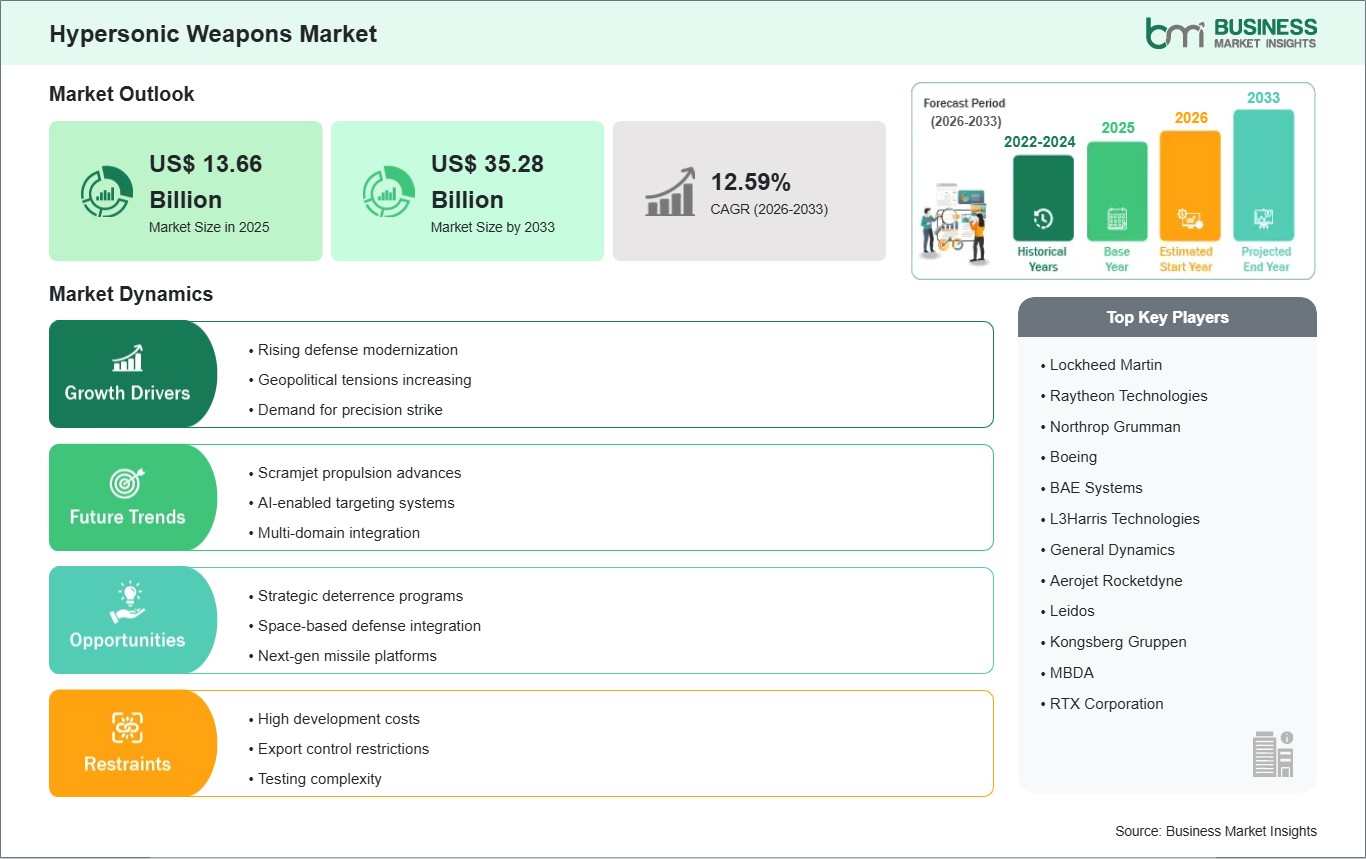
The Hypersonic Weapons Market is projected to grow from US$ 13.66 Billion in 2025 to US$ 35.28 Billion by 2033 , registering a CAGR of 12.59% from 2026 to 2033.
The Hypersonic Weapons Market Outlook (2022-2033) was valued at USD 7.69 Billion in 2025 and is projected to reach USD 18.38 Billion by 2033, expanding at a CAGR of 11.5% from 2026 to 2034. Market progression reflects sustained investment in advanced military technologies and continuous focus on strengthening strategic defense capabilities across major economies.
Among product categories, hypersonic glide vehicles maintain a strong position due to their maneuverability advantages and strategic operational flexibility. Long-range systems also continue receiving considerable attention because they align with national deterrence objectives and advanced military preparedness requirements across defense organizations.
Defense forces represent the leading end-use segment as military agencies continue prioritizing high-speed precision strike capabilities. Air-based and sea-based deployment platforms are also contributing significantly to market activity due to their mobility advantages and tactical deployment adaptability across diverse operational environments.
Report Coverage
Hypersonic Weapons Market Report Coverage and Deliverables
The "Hypersonic Weapons Market Size and Forecast (2022–2033)" report provides a detailed analysis of the market covering:
- Hypersonic Weapons market size and forecast at global, regional, and country levels for all the key market segments covered under the scope
- Market trends, dynamics such as drivers, restraints, and key opportunities
- Industry landscape and competition analysis covering market concentration, heat map analysis, prominent players, and recent developments
- Detailed company profiles, including SWOT analysis
Geographic Insights
Hypersonic Weapons Market Geographic Insights
The Hypersonic Weapons market is divided into geographic segments, which include North America, Asia Pacific, Europe, Middle East & Africa, and South & Central America. Countries are evaluating hypersonic capabilities within broader national security frameworks and long-term strategic planning objectives. Regional procurement structures differ according to operational requirements, defense budgets, and technological development capabilities.
North America continues maintaining a prominent position due to advanced aerospace infrastructure and extensive defense research programs. The United States remains focused on strengthening strategic deterrence capabilities through ongoing testing and system integration initiatives. Canada also participates in defense technology collaboration efforts supporting aerospace innovation and regional security coordination.
Asia-Pacific demonstrates substantial market activity driven by regional security concerns and military modernization agendas. China continues advancing hypersonic technology development across strategic defense applications and aerospace programs. India, Japan, and South Korea are also strengthening research initiatives and defense preparedness programs to improve operational readiness and regional defense coordination capabilities.
Europe maintains active participation through collaborative defense projects and aerospace engineering advancements. Countries including France, Germany, and the United Kingdom are supporting research programs focused on advanced missile technologies and defense system integration. Meanwhile, Middle Eastern nations are evaluating strategic defense enhancements, while South American countries are observing technological developments and regional security requirements with increasing interest.
Industry Activity
Recent Developments
The Hypersonic Weapons market is evaluated by gathering qualitative and quantitative data post primary and secondary research, which includes important corporate publications, association data, and databases. A few of the key developments in the Hypersonic Weapons market are:
- In May 2026, ARRW was the Air Force’s first major effort to field a hypersonic weapon. Developed by prime contractor Lockheed Martin, the AGM-183A is a boost-glide missile that is launched from bombers such as the B-52 Stratofortress and the B-1B Lancer.
- In December 2025, Lockheed Martin (LMT.N), opened a hypersonics system integration lab at its Huntsville campus as it pushes to develop next-generation weapons. Hypersonic weapons, which can travel at more than five times the speed of sound and evade traditional defenses, are at the centre of an arms race between the United States and China.
Trust & Transparency
Research Methodology
The market analysis combines proprietary research with secondary data from government agencies, company disclosures, regulatory filings, industry databases and expert interviews. Market estimates are validated through data triangulation, cross-market benchmarking and analyst
review.
View Full Research Methodology
Key Sources Referred:
Government energy efficiency publications
National building and environmental policy documents
Industry white papers on thermal management technologies
Research publications covering tire material innovation and efficiency trends
Company website
Company annual reports
Company investor presentations