
Automatic Weapons Market Outlook: Size, Share, Trends, Growth Analysis, Competitive Landscape & Forecast, 2026-2033

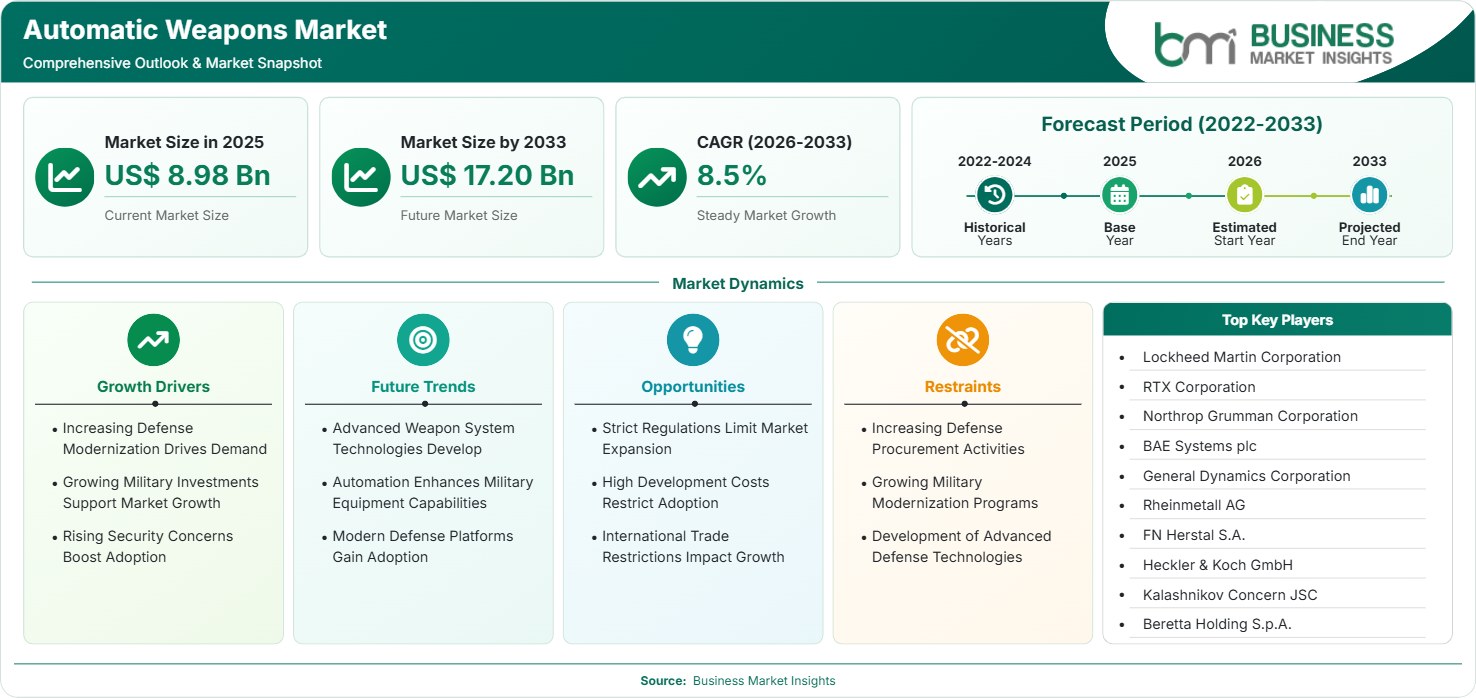
The Automatic Weapons Market size was valued at US$ 8.98 billion in 2025 and is projected to reach US$ 17.20 billion by 2033, growing at a CAGR of 8.5% during 2026–2033, driven by modernization programs, defense expenditure growth, military technology upgrades, replacement demand, and increasing focus on advanced defense capabilities.

Report Coverage
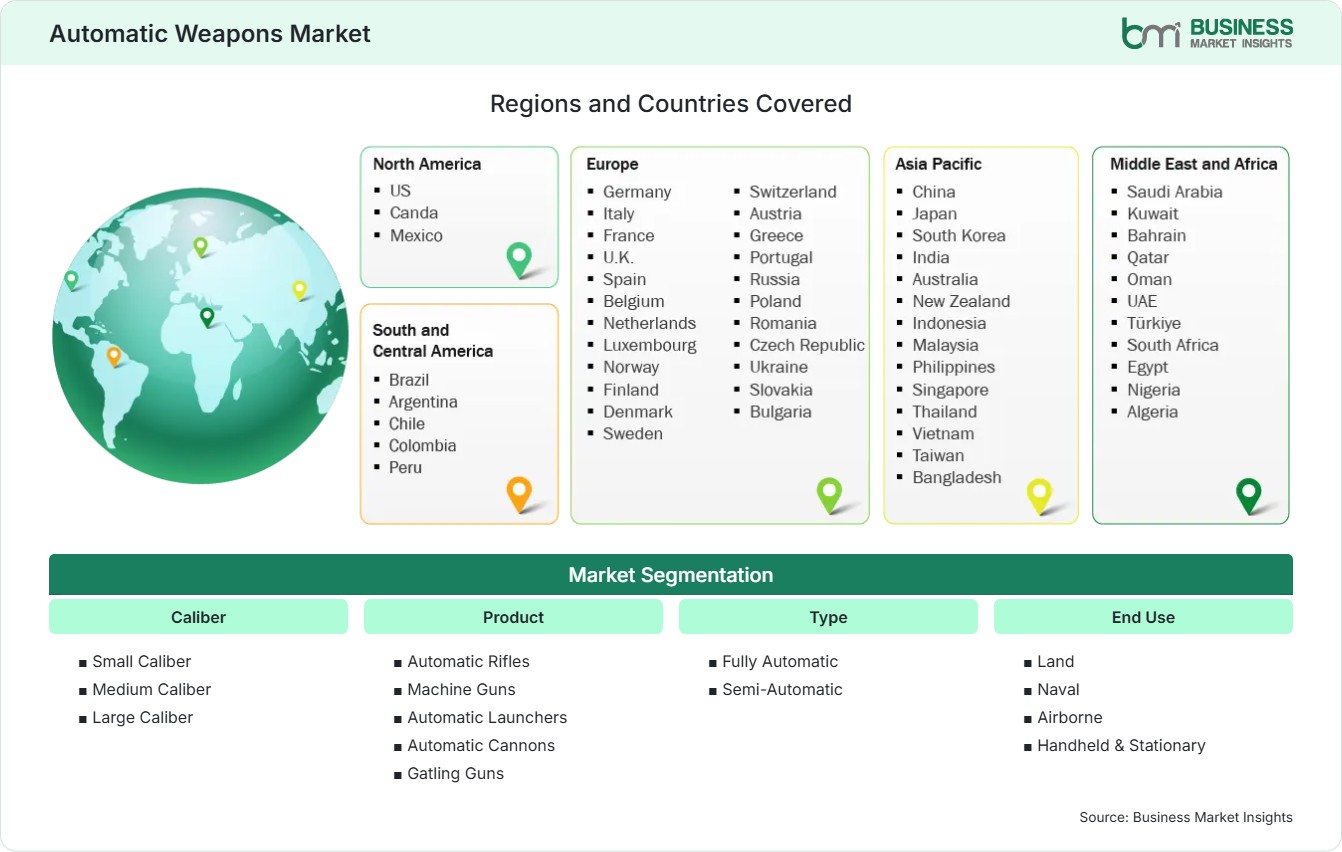
  • Caliber: Small Caliber, Medium Caliber, Large Caliber
  • Product: Automatic Rifles, Machine Guns, Automatic Launchers, Automatic Cannons, Gatling Guns
  • Type: Fully Automatic, Semi-Automatic
  • End Use: Land, Naval, Airborne, Handheld & Stationary
US$ 8.98 Bn Market size in 2025
US$ 17.20 Bn Market Size by 2033
8.5% CAGR, 2026 - 2033
2026-2033 Forecast Period

AI Overview

Automatic Weapons Market Summary

  • North America Region: North America holds a market share of 35%–38% in 2025, growing with a CAGR of 7%–9% influenced by defense modernization programs, military procurement initiatives, and technological upgrades. The US market demonstrates strong demand through defense investments and replacement programs, registering a CAGR of 7%–9% between 2026–2033.
  • Fastest Growing Region: Asia Pacific accounts for a share of 27%–30% in 2025, expanding with a CAGR of 10%–12% supported by defense spending increases, military modernization initiatives, and regional security priorities across emerging economies.
  • Leading Segment: Small Caliber represents the leading caliber segment with a share of 45%–48% in 2025, expanding at a CAGR of 8%–10% due to widespread military applications, infantry modernization, and replacement requirements.
  • High Growth Segment: Automatic Cannons represent a high-growth product segment with a share of 14%–17% in 2025, achieving a CAGR of 10%–12% driven by armored systems modernization, naval platforms, and advanced defense applications.
  • Key Market Opportunity: Modernization of defense fleets, replacement of legacy systems, integration of advanced technologies, and increasing investments in military capabilities are creating opportunities for defense manufacturers.
  • Major Market Players: Lockheed Martin Corporation, RTX Corporation, Northrop Grumman Corporation, BAE Systems plc, General Dynamics Corporation, Rheinmetall AG, FN Herstal S.A., Heckler & Koch GmbH, Kalashnikov Concern JSC, and Beretta Holding S.p.A.
Strategic Insights

Automatic Weapons Market: Strategic Insights

Automatic Weapons Market Strategic Framework
FREE PDF
Request your free sample
Request free sample
Stakeholder View

Key Takeaways

  • The market ecosystem is structured around defense manufacturers, technology suppliers, government procurement agencies, and military organizations involved in development, production, and lifecycle support.
  • Modernization programs and replacement of legacy defense systems are creating growth opportunities across multiple product categories and military applications.
  • Innovation is focused on improving system integration, operational efficiency, automation capabilities, and compatibility with evolving defense platforms.
  • Asia Pacific provides a significant investment opportunity due to increasing defense expenditure, regional security priorities, and domestic defense manufacturing initiatives.
  • Companies are strengthening market positions through strategic partnerships, defense contracts, research investments, and expansion of advanced product portfolios.
  • Government-led defense initiatives and industrial cooperation programs are influencing long-term market development strategies.
Geographic Outlook

Automatic Weapons Market Regional Highlights

North America Automatic Weapons Market

North America represents the leading regional market with a share of 35%–38% in 2025 and is projected to grow at a CAGR of 7%–9% during 2026–2033. Strong defense infrastructure, modernization programs, and advanced military technology capabilities support regional growth. Automatic Weapons Market share remains concentrated in the United States due to extensive defense procurement activities and established manufacturing capabilities.

  • The United States maintains strong demand through military modernization and defense investment programs.
  • Defense manufacturers are focusing on technology upgrades and advanced system development initiatives.
  • Government procurement activities continue supporting domestic defense industry capabilities.
  • Canada is strengthening defense capabilities through modernization and equipment improvement programs.

US Automatic Weapons Market

The US market holds a share of 32%–35% in 2025 and is estimated to register a CAGR of 7%–9% from 2026–2033. The country remains a major contributor due to significant defense expenditure, advanced manufacturing capabilities, and continuous military modernization programs. Demand is supported by replacement cycles, defense contracts, and technology advancement initiatives.

  • Military modernization programs are supporting demand for upgraded defense systems.
  • Defense companies are investing in research and production capabilities.
  • Government contracts continue influencing market development and procurement activities.
  • Advanced manufacturing capabilities support domestic defense supply chains.

Europe Automatic Weapons Market

Europe accounts for a share of 22%–25% in 2025 and is expected to expand at a CAGR of 8%–10% during 2026–2033. The region benefits from increased defense investments, modernization requirements, and industrial cooperation among European nations. Germany, France, and the United Kingdom represent leading markets, while Poland and Italy demonstrate expanding defense capabilities.

  • Germany is increasing defense investments through military modernization initiatives.
  • France is supporting domestic defense manufacturing and capability development programs.
  • The United Kingdom is expanding defense technology investments and procurement activities.
  • Poland is strengthening military capabilities through equipment modernization efforts.

Asia Pacific Automatic Weapons Market

Asia Pacific represents the fastest-growing regional market with a share of 27%–30% in 2025 and a projected CAGR of 10%–12% during 2026–2033. Automatic Weapons Market growth is supported by rising defense expenditure, military modernization, and regional security considerations. China, India, Japan, and South Korea are key contributors, with India and South Korea showing increasing defense industry development.

  • China is expanding defense manufacturing capabilities and military modernization programs.
  • India is increasing domestic defense production and procurement initiatives.
  • Japan is investing in advanced defense capabilities and technology upgrades.
  • South Korea is strengthening defense systems through industrial development programs.

Rest of World Automatic Weapons Market

Rest of World markets represent a share of 12%–15% in 2025 and are projected to grow at a CAGR of 8%–10% during 2026–2033. Latin America, Middle East, and Africa markets are influenced by defense modernization needs, security requirements, and military capability development. Brazil, Saudi Arabia, UAE, and South Africa represent important regional contributors.

  • Brazil is developing defense capabilities through modernization and industrial initiatives.
  • Saudi Arabia is increasing defense investments and technology acquisition programs.
  • UAE is expanding military capabilities through advanced defense procurement.
  • South Africa is supporting regional defense development through modernization activities.
Global Market Geography
FREE PDF
Request your free sample
Request free sample
Segment Analysis

Automatic Weapons Market Segmentation

Caliber

The caliber segment defines the classification of automatic weapons based on ammunition size and operational applications across defense platforms. The segment accounted for a share of 100% in 2025 and is projected to expand at a CAGR of 8%–10% between 2026–2033. Demand is supported by military modernization, replacement programs, and evolving requirements for infantry, vehicle-mounted, and platform-based defense systems.

  • Small Caliber: Small caliber systems represent widely deployed solutions for infantry applications and personal defense requirements. Demand is supported by military personnel modernization programs, replacement cycles, and operational flexibility.
  • Medium Caliber: Medium caliber systems are used across specialized military platforms requiring enhanced range and effectiveness. Adoption is supported by modernization initiatives and increasing demand for versatile defense capabilities.
  • Large Caliber: Large caliber systems support heavy defense applications and platform integration requirements. Growth is influenced by investments in advanced military platforms and capability enhancement programs.

Product

The product segment includes automatic rifles, machine guns, automatic launchers, automatic cannons, and Gatling guns used across multiple defense applications. The segment represented a share of 100% in 2025 and is expected to grow at a CAGR of 8%–10% during 2026–2033. Automatic Weapons Market scope is expanding through modernization programs, technology improvements, and increasing demand for advanced defense equipment.

  • Automatic Rifles: Automatic rifles continue to support infantry modernization requirements. Demand is influenced by the replacement of aging systems, improved operational capabilities, and military equipment upgrade programs.
  • Machine Guns: Machine guns remain important for defense applications requiring sustained operational capability. Adoption is supported by military procurement programs and modernization of ground-based defense systems.
  • Automatic Launchers: Automatic launchers are gaining attention for advanced defense applications and platform integration. Growth is supported by modernization initiatives and increasing focus on enhanced battlefield capabilities.
  • Automatic Cannons: Automatic cannons are utilized in advanced defense platforms requiring increased operational effectiveness. Demand is supported by naval, armored, and airborne system modernization programs.
  • Gatling Guns: Gatling guns are used in specialized defense applications requiring high-rate operational performance. Development efforts focus on improving reliability and integration with advanced platforms.

Type

The type segment categorizes systems into fully automatic and semi-automatic configurations based on operational characteristics and application requirements. The segment accounted for a share of 100% in 2025 and is projected to grow at a CAGR of 8%–10% during 2026–2033. Military modernization, procurement programs, and evolving defense strategies are influencing demand across both categories.

  • Fully Automatic: Fully automatic systems are primarily utilized in military applications requiring continuous operational capability. Demand is supported by defense modernization programs and replacement of legacy equipment.
  • Semi-Automatic: Semi-automatic systems support specific defense and security applications requiring controlled operation. Adoption is influenced by regulatory environments and specialized end-use requirements.

End Use

The end-use segment covers land, naval, airborne, and handheld & stationary applications across defense environments. The segment represented a share of 100% in 2025 and is forecast to expand at a CAGR of 8%–10% between 2026–2033. Increasing defense spending and modernization efforts are supporting demand across multiple military platforms.

  • Land: Land-based applications represent a major usage area due to infantry systems, armored platforms, and ground defense requirements. Modernization programs continue supporting adoption.
  • Naval: Naval applications are expanding through defense fleet upgrades and maritime security initiatives. Investments in advanced platforms are supporting integration of specialized systems.
  • Airborne: Airborne applications are supported by aircraft modernization and platform capability enhancement programs. Demand is influenced by increasing focus on advanced defense aviation systems.
  • Handheld & Stationary: Handheld and stationary applications support diverse defense requirements. Growth is driven by military modernization, operational flexibility needs, and replacement activities.
Market Forces

Automatic Weapons Market Dynamics

Key Market Drivers

Increasing Defense Modernization Drives Demand

Defense modernization programs are increasing the demand for upgraded military equipment as governments seek to improve operational capabilities and replace aging systems. Governments are investing in advanced platforms and upgrading defense equipment through technological interventions to prepare their militaries for any eventuality. Automatic Weapons Market trends are driven by modernization efforts in land, naval, and aerial defense systems. There is an increased focus on compatibility, reliability, and improved performance during the procurement process. The market trends suggest increased emphasis on advanced manufacturing, platform integration, and lifecycle improvement programs.

Growing Military Investments Support Market Growth

With increased military investments, markets are expanding as resources are allocated to build the defense force's capabilities and develop its technology. With rising budgetary allocations across regions for the defense forces, there is an opportunity for producers of advanced military products. The investment has helped facilitate procurement, research, and industrial development. Nations are increasing their capacity to manufacture their own defenses to reduce dependence on foreign producers. The defense industries have expanded their manufacturing capacity and technological innovation in response to changing demands.

Rising Security Concerns Boost Adoption

Growing security concerns have been affecting the approach to developing defensive mechanisms. Geopolitical uncertainties, along with regional security concerns and shifts in defense needs, are driving the upgrade of military systems. Various countries are reviewing their current equipment and modernization programs to boost their readiness. Reliability of systems for different operating environments is a key priority for defense organizations.

Key Market Opportunities

Increasing Defense Procurement Activities

Increasing defense procurement activities are creating opportunities for manufacturers as governments continue upgrading military equipment and expanding defense capabilities. Procurement programs are supporting the replacement of older systems and the adoption of advanced solutions across different military applications. Developing nations are making greater investments in defense to enhance their security and build their military infrastructure. Companies specializing in defense that have manufacturing facilities and technological experience are well-placed to take advantage of such contracts and supply agreements. Opportunities are also arising due to international collaboration and business partnerships. Future procurement programs are likely to foster innovation and increased production.

Growing Military Modernization Programs

Increasing military modernization programs have created opportunities for firms engaged in developing defense technology and manufacturing equipment. The armed forces globally have been concentrating on increasing their capability by updating old systems and introducing new technologies. Military modernization programs have been generating demand for new solutions in several areas of defense. Firms have been investing in R&D, manufacturing improvements, and technology collaboration to meet new demands. Government-backed military modernization policies have been fostering future market opportunities by promoting defense production and development.

Development of Advanced Defense Technologies

The development of defense technologies is creating business opportunities through the adoption of advanced manufacturing techniques, system design, and greater platform compatibility. Defense industry players are conducting research and development to meet their changing needs and enhance the performance of their equipment. The advancement of technology is playing an important role in future defense solutions through efficient utilization and integration capabilities. Increased collaboration among government, defense industries, and technology providers is helping to advance the technologies. Those companies that are making advanced solutions through effective engineering can take advantage of market opportunities.

Market Restraints and Challenges

Strict Regulations Limit Market Expansion

Factor: Strict government regulations, export controls, and compliance requirements limit international market expansion. Impact: Regulatory complexities may lead to delays in product approval, restrictions on cross-border transactions, and compliance costs for manufacturers. Defense companies have to navigate various regulations across regions and operate efficiently. The licensing process and regulations affect access to the markets and the procurement process. The companies are now focusing on compliance and regulatory issues. Although regulations are necessary for regulated market operations, complexities in the approval process can impact expansion plans.

High Development Costs Restrict Adoption

Factor: High research, development, manufacturing, and testing costs increase financial requirements for advanced defense system development. Impact: Elevated costs can limit adoption among budget-constrained organizations and delay modernization initiatives. Defense manufacturers require significant investments in engineering, production facilities, and quality assurance processes. Governments may face challenges balancing modernization goals with available defense budgets. Companies are focusing on manufacturing efficiency, partnerships, and technology optimization to manage expenses. Cost considerations remain an important factor influencing procurement decisions and market accessibility across different regions.

Company Analysis

Competitive Landscape

The Automatic Weapons Market analysis highlights a competitive ecosystem comprising defense contractors, military equipment manufacturers, weapons system developers, and technology providers. Market participants are focusing on advanced defense platforms, precision engineering, product modernization, and integration capabilities. Companies are strengthening their positions through government contracts, strategic collaborations, research initiatives, and manufacturing expansion to support evolving military requirements across land, naval, airborne, and specialized defense applications.

Company Name

Overview

Products and Services relevant to this market

Lockheed Martin Corporation

Global aerospace and defense company providing advanced military systems.

Defense systems, weapon platforms, military technologies, and integrated defense solutions.

RTX Corporation

Defense technology company specializing in aerospace and military solutions.

Advanced defense systems, weapon technologies, missile solutions, and military platforms.

Northrop Grumman Corporation

Aerospace and defense company developing advanced security technologies.

Military systems, defense technologies, weapon integration, and battlefield solutions.

BAE Systems plc

Global defense company providing military equipment and security solutions.

Combat systems, weapon platforms, military vehicles, and defense technologies.

General Dynamics Corporation

Defense manufacturer supporting military platforms and combat systems.

Armament systems, military vehicles, defense equipment, and integrated solutions.

Rheinmetall AG

Defense technology company specializing in military equipment and systems.

Weapon systems, ammunition technologies, military vehicles, and defense solutions.

FN Herstal S.A.

Firearms manufacturer serving military and security organizations worldwide.

Automatic rifles, machine guns, small arms, and military firearm systems.

Heckler & Koch GmbH

Defense manufacturer specializing in small arms technologies.

Automatic rifles, military firearms, security weapons, and tactical systems.

Kalashnikov Concern JSC

Defense company producing military firearms and related systems.

Assault rifles, automatic weapons, firearms systems, and defense equipment.

Beretta Holding S.p.A.

Global firearms company providing defense and security solutions.

Military firearms, automatic systems, tactical weapons, and security products.

Industry Activity

Recent Developments

December 2025

Heckler & Koch GmbH delivered the first G95A1 assault rifles (HK416A8 variant) to the German Armed Forces (Bundeswehr) as part of the replacement program for the G36 service rifle. The initial delivery marked the beginning of series production of the new standard assault rifle system, strengthening Heckler & Koch’s position in the military small arms market.

September 2025

FN Herstal S.A., FN UK, a subsidiary of FN Herstal, was awarded a 10-year contract by the UK Ministry of Defence (MoD) to upgrade and provide through-life support for the L111A1 Heavy Machine Gun (FN M2HB-QCB) fleet used by the British Armed Forces.

June 2025

BAE Systems plc secured a contract with the Swedish Armed Forces for the supply of BONUS 155mm artillery munitions through its BAE Systems Bofors business. The order strengthened BAE Systems’ position in advanced ammunition and weapon systems manufacturing, supporting continued expansion of its land warfare capabilities.

April 2025

BAE Systems plc received a $162 million contract from the U.S. Army for new M777 lightweight howitzer structures, supporting continued production capability for artillery weapon systems. The work includes manufacturing titanium structures through BAE Systems’ UK and U.S. supply chains, reinforcing the company’s land weapons manufacturing capacity.

Trust & Transparency

Research Methodology

The market analysis combines proprietary research with secondary data from government agencies, company disclosures, regulatory filings, industry databases and expert interviews. Market estimates are validated through data triangulation, cross-market benchmarking and analyst review.

View Full Research Methodology

Questions Answered

Frequently Asked Questions

What insights does the Automatic Weapons Market Report provide?

The market report provides analysis of market size, segmentation trends, regional developments, competitive strategies, procurement activities, and factors influencing future industry growth.

What challenges affect automatic weapons adoption?

Strict regulations, export controls, high development costs, complex procurement procedures, and budget limitations can influence market expansion and adoption rates, shaping the automatic weapons market forecast over the coming years.

How are modernization programs influencing automatic weapons demand?

Military modernization programs are encouraging the replacement of legacy equipment, integration of improved technologies, and development of advanced systems to enhance operational capabilities.

Which segment dominates the market?

Small caliber systems represent a leading segment due to extensive infantry applications, widespread military deployment, and continuous replacement demand across defense organizations.

What factors are driving the Automatic Weapons Market growth?

The market is driven by defense modernization programs, increasing military investments, rising security concerns, replacement of aging systems, and demand for advanced military capabilities.

Access the Full Automatic Weapons Market Report

Get segment-level forecasts, regional estimates, competitive benchmarking, company profiles and downloadable Excel datasets.

Access the full Automatic Weapons Market Report
350 pages PDF & Excel | 2026-08-03
Similar Research

Related Market Reports