
Naval Actuator Market Outlook: Size, Share, Trends, Growth Analysis, Competitive Landscape & Forecast, 2026-2033

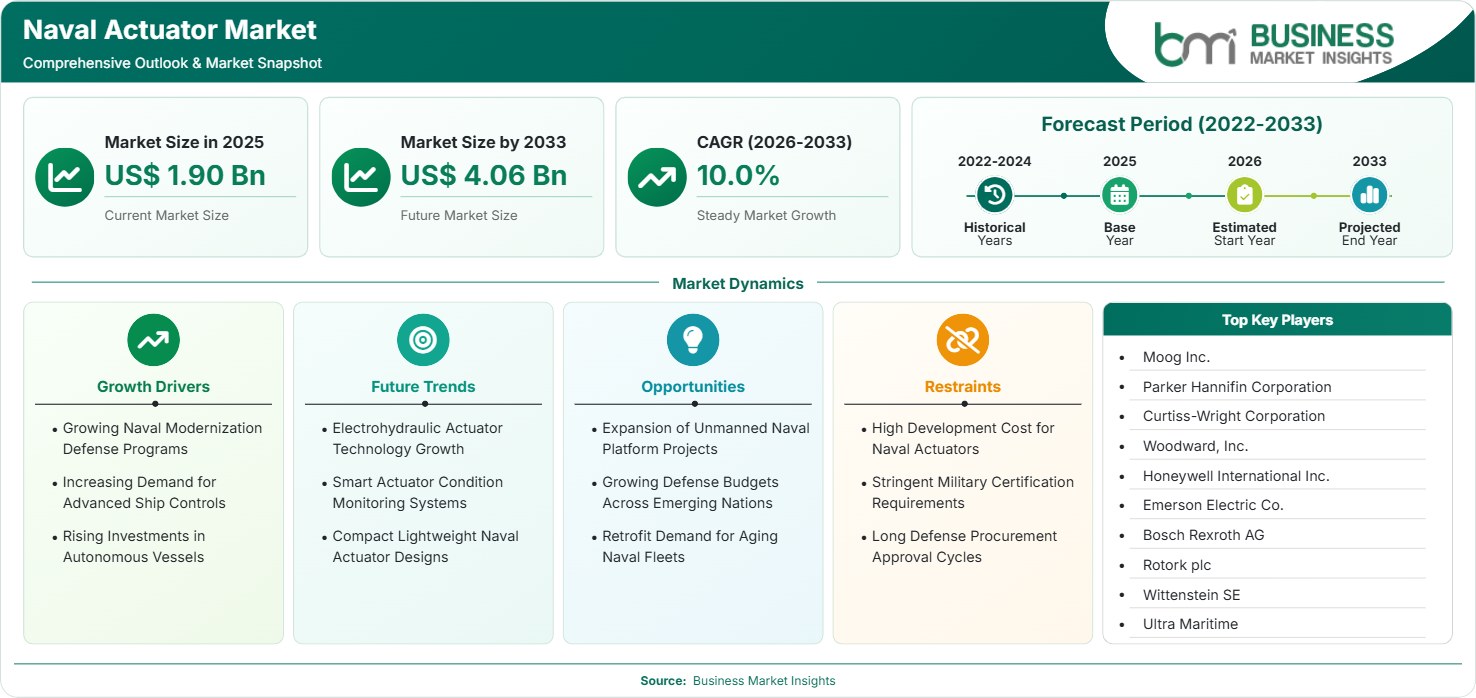
The Naval Actuator Market size was valued at US$ 1.90 billion in 2025 and is projected to reach US$ 4.06 billion by 2033, growing at a CAGR of 10.0% from 2026 to 2033. Market expansion is driven by increasing naval modernization initiatives, rising defense investments, growing demand for advanced ship control systems, expansion of autonomous naval platforms, and increasing requirements for reliable actuation solutions in military vessels.

Report Coverage
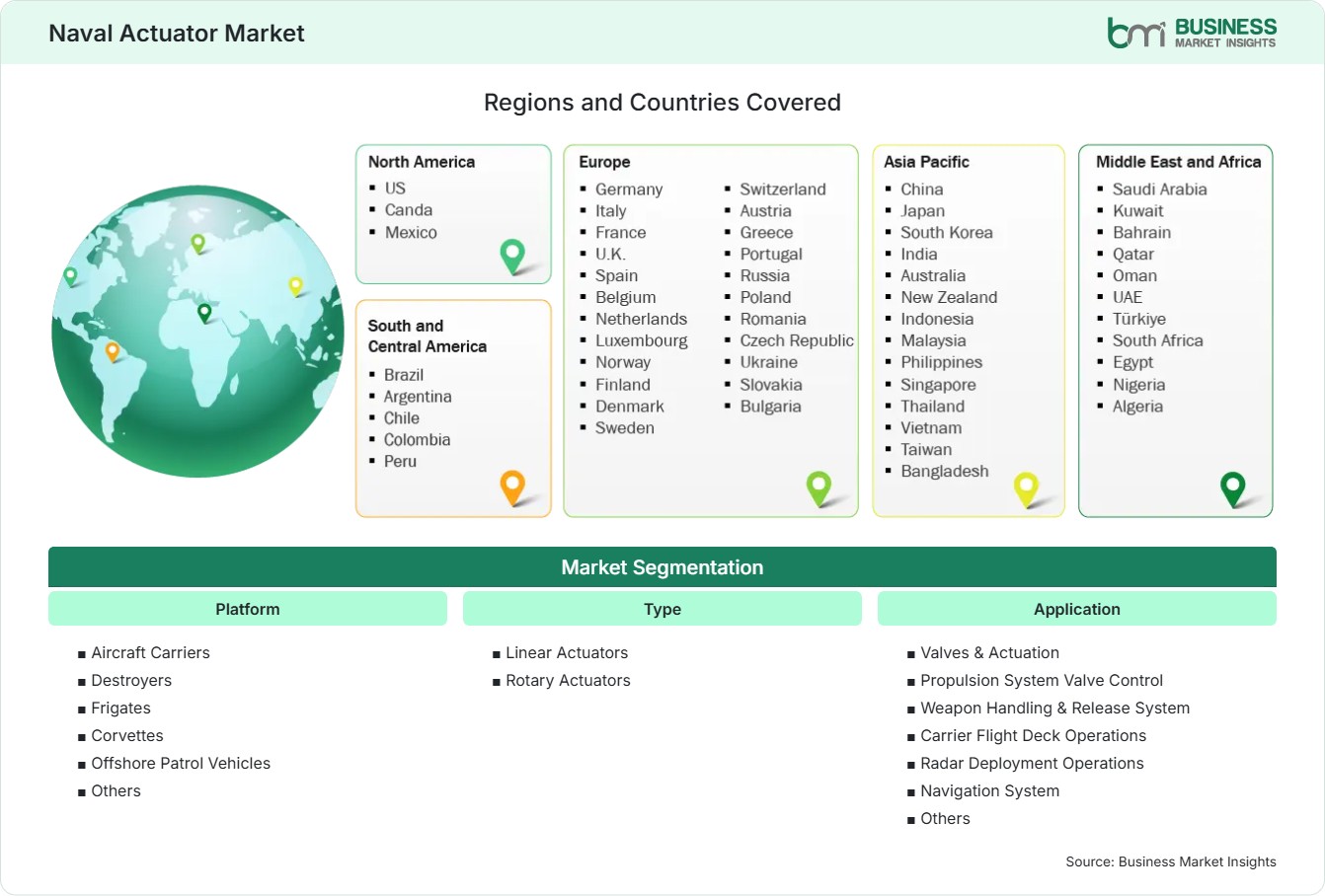
  • Platform: Aircraft Carriers, Destroyers, Frigates, Corvettes, Offshore Patrol Vehicles, Others
  • Type: Linear Actuators, Rotary Actuators
  • Application: Valves & Actuation, Propulsion System Valve Control, Weapon Handling & Release System, Carrier Flight Deck Operations, Radar Deployment Operations, Navigation System, Others
US$ 1.90 Bn Market size in 2025
US$ 4.06 Bn Market Size by 2033
10.0% CAGR, 2026 - 2033
2026-2033 Forecast Period

AI Overview

Naval Actuator Market Summary

  • North America Region: North America accounted for 31%–34% share in 2025 and is projected to grow at a CAGR of 9.6%–10.1% from 2026–2033. Growth is supported by naval fleet modernization programs, advanced military shipbuilding activities, defense technology investments, and increasing deployment of automated naval systems. The US market is expected to register a CAGR of 9.7%–10.2% during the forecast period.
  • Fastest Growing Region: Asia Pacific held 33%–37% share in 2025 and is anticipated to expand at a CAGR of 10.5%–11.1% from 2026–2033. Rising maritime security concerns, expanding naval fleets, defense modernization programs, and increasing investments in advanced warships are accelerating regional market growth.
  • Leading Segment: Destroyers represented 27%–31% share in 2025 and are projected to grow at a CAGR of 9.9%–10.4% from 2026–2033 due to increasing procurement of advanced surface combat vessels equipped with sophisticated control and actuation systems.
  • High Growth Segment: Autonomous naval platform applications accounted for 18%–22% share in 2025 and are expected to grow at a CAGR of 11.2%–11.8% from 2026–2033, supported by rising investments in unmanned surface vessels and autonomous maritime defense technologies.
  • Key Market Opportunity: Expansion of unmanned naval platforms, modernization of aging fleets, increasing defense budgets, and demand for advanced ship automation systems are creating significant growth opportunities.
  • Major Market Players: Moog Inc., Parker Hannifin Corporation, Curtiss-Wright Corporation, Woodward, Inc., Honeywell International Inc., Emerson Electric Co., Bosch Rexroth AG, Rotork plc, Wittenstein SE, and Ultra Maritime.
Strategic Insights

Naval Actuator Market: Strategic Insights

Naval Actuator Market Strategic Framework
FREE PDF
Request your free sample
Request free sample
Stakeholder View

Key Takeaways

  • The market ecosystem includes naval equipment manufacturers, defense contractors, actuator technology providers, shipbuilders, military organizations, and system integrators.
  • Naval modernization programs, autonomous vessel development, and advanced ship control requirements are major growth factors influencing market expansion.
  • Innovation is focused on lightweight actuator systems, electric actuation technologies, advanced control systems, predictive maintenance, and automation capabilities.
  • Asia Pacific provides significant growth potential due to expanding naval capabilities, maritime security investments, and increasing defense procurement activities.
  • Leading companies are strengthening their market positions through defense contracts, technology development, strategic partnerships, and customized naval solutions.
  • Future competitiveness will depend on reliability, precision control, integration with autonomous systems, operational durability, and compliance with military standards.
Geographic Outlook

Naval Actuator Market Regional Highlights

North America Naval Actuator Market

North America accounted for 31%–34% share in 2025 and is projected to grow at a CAGR of 9.6%–10.1% from 2026–2033. The region benefits from strong naval defense infrastructure, advanced shipbuilding capabilities, continuous fleet modernization programs, and significant defense spending. The United States remains the dominant Naval Actuator market due to investments in aircraft carriers, destroyers, autonomous naval systems, and advanced maritime technologies.

  • The United States is expanding naval actuator adoption through fleet modernization and advanced warship development programs.
  • Defense contractors are developing high-performance actuator systems for next-generation naval platforms.
  • Autonomous maritime technologies are increasing demand for advanced control and actuation solutions.
  • Naval maintenance and upgrade programs are supporting retrofit opportunities for existing fleets.

US Naval Actuator Market

The US represented 28%–31% of the Naval Actuator Market share in 2025 and is expected to grow at a CAGR of 9.7%–10.2% from 2026–2033. Growth is supported by naval modernization initiatives, investments in advanced combat vessels, increasing adoption of automated ship systems, and replacement of aging fleet components. The demand for reliable actuation technologies is increasing across aircraft carriers, destroyers, submarines, and unmanned maritime platforms.

  • The US Navy continues investing in advanced vessel automation and control technologies.
  • Modern warship programs are increasing demand for high-performance actuator systems.
  • Defense modernization initiatives are supporting replacement and upgrade of existing naval equipment.
  • Autonomous vessel development is creating new applications for intelligent actuation systems.

Europe Naval Actuator Market

Europe accounted for 22%–25% share in 2025 and is projected to grow at a CAGR of 9.5%–10.0% from 2026–2033. The region is supported by naval fleet modernization initiatives, maritime security investments, advanced shipbuilding capabilities, and increasing focus on next-generation defense platforms. Countries such as the United Kingdom, France, Germany, Italy, and Spain are investing in advanced naval vessels equipped with automated control systems and precision actuation technologies.

  • The United Kingdom is increasing demand through naval fleet renewal programs and advanced maritime defense projects.
  • France is supporting Naval Actuator market growth through investments in aircraft carriers, frigates, and naval automation technologies.
  • Germany is expanding adoption through advanced shipbuilding programs and defense equipment modernization.
  • Italy is increasing actuator demand through naval vessel development and maritime security initiatives.
  • European defense organizations are focusing on automation and digitalization of naval platforms to improve operational efficiency.

Asia Pacific Naval Actuator Market

Asia Pacific represented 33%–37% share in 2025 and is expected to register a CAGR of 10.5%–11.1% from 2026–2033, making it the fastest-growing regional market. Rising geopolitical tensions, maritime security concerns, naval expansion programs, and increasing defense budgets are accelerating adoption of advanced naval actuator systems. China, India, Japan, South Korea, and Australia are major contributors due to ongoing investments in modern warships, unmanned maritime systems, and fleet enhancement programs.

  • China is expanding naval capabilities through advanced vessel procurement and indigenous shipbuilding programs.
  • India is increasing investments in naval modernization and development of advanced maritime defense platforms.
  • Japan is adopting advanced naval technologies to enhance fleet capability and maritime security.
  • South Korea is strengthening naval programs through next-generation warship development.
  • Australia is increasing investments in maritime defense infrastructure and advanced naval systems.

Rest of World Naval Actuator Market

Rest of World accounted for 8%–11% share in 2025 and is projected to grow at a CAGR of 9.8%–10.4% from 2026–2033. Latin America, the Middle East, and Africa are witnessing increasing demand for naval actuator systems due to fleet modernization programs, maritime security requirements, and defense capability enhancement initiatives. Emerging nations are investing in naval platforms to strengthen coastal protection and operational readiness.

Middle Eastern countries are expanding naval capabilities through defense procurement programs, while Latin American nations are focusing on modernization of existing fleets. African markets are gradually increasing investments in maritime security and coastal defense systems.

  • Saudi Arabia is investing in naval modernization and advanced maritime defense capabilities.
  • Brazil is upgrading naval fleets through vessel modernization and defense infrastructure programs.
  • Mexico is enhancing maritime security capabilities through naval equipment investments.
  • South Africa is focusing on fleet maintenance and modernization initiatives.
  • Emerging economies are creating opportunities through defense spending growth and naval capability development.
Global Market Geography
FREE PDF
Request your free sample
Request free sample
Segment Analysis

Naval Actuator Market Segmentation

Platform

Platform segmentation includes aircraft carriers, destroyers, frigates, corvettes, offshore patrol vehicles, and others. The segment accounted for 100% share in 2025 and is projected to grow at a CAGR of 10.0% from 2026–2033. Increasing naval fleet expansion, replacement of aging vessels, and rising adoption of automated ship systems are driving demand for advanced actuator solutions across multiple naval platforms.

  • Aircraft Carriers: Aircraft carriers represent a significant segment due to extensive use of actuators in flight deck operations, aircraft handling systems, weapon systems, and advanced control mechanisms.
  • Destroyers: Destroyers account for a leading share due to continuous procurement of advanced surface combat vessels requiring reliable propulsion control, weapon handling, and navigation systems.
  • Frigates: Frigate applications are expanding as countries invest in multi-role vessels equipped with modern automation and defense systems.
  • Corvettes: Corvettes support market growth through increasing adoption among nations seeking cost-effective maritime defense platforms.
  • Offshore Patrol Vehicles: Offshore patrol vehicles are witnessing rising demand due to growing focus on coastal surveillance, maritime security, and border protection.
  • Others: Other platforms include submarines, unmanned vessels, and specialized naval systems requiring precision actuation technologies.

Type

Type segmentation includes linear actuators and rotary actuators. The segment accounted for 100% share in 2025 and is projected to grow at a CAGR of 10.0% from 2026–2033. Increasing demand for accurate motion control, automated ship systems, and advanced naval equipment is supporting adoption of both actuator types across modern naval platforms.

  • Linear Actuators: Linear actuators hold a major share due to extensive applications in valve control, weapon systems, flight deck operations, and mechanical positioning systems.
  • Rotary Actuators: Rotary actuators are gaining adoption due to their use in steering systems, radar deployment mechanisms, propulsion controls, and rotational motion applications.

Application

Application segmentation includes valves & actuation, propulsion system valve control, weapon handling & release system, carrier flight deck operations, radar deployment operations, navigation system, and others. The segment accounted for 100% share in 2025 and is projected to grow at a CAGR of 10.0% from 2026–2033. Increasing integration of automated systems, advanced naval electronics, and precision control technologies across military vessels is driving demand for reliable actuator solutions.

  • Valves & Actuation: Valves and actuation applications represent a leading segment due to widespread usage in hydraulic systems, fuel systems, cooling systems, and other critical ship operations requiring precise flow control.
  • Propulsion System Valve Control: Propulsion system valve control applications are expanding due to increasing demand for efficient vessel operation, improved maneuverability, and enhanced propulsion system reliability.
  • Weapon Handling & Release System: Weapon handling and release systems are witnessing growth as modern naval platforms require accurate, responsive, and automated mechanisms for defense operations.
  • Carrier Flight Deck Operations: Carrier flight deck operations utilize advanced actuators for aircraft handling, launch systems, and deck equipment, supporting demand from aircraft carrier modernization programs.
  • Radar Deployment Operations: Radar deployment operations are increasing with growing adoption of advanced surveillance systems requiring accurate positioning and automated deployment mechanisms.
  • Navigation System: Navigation system applications are supported by increasing demand for precise control systems that improve vessel navigation accuracy and operational efficiency.
  • Others: Other applications include stabilization systems, communication equipment, automated ship controls, and specialized naval mechanisms requiring advanced actuation technologies.
Market Forces

Naval Actuator Market Dynamics

Key Market Drivers

Growing Naval Modernization Defense Programs

Growing naval modernization defense programs are significantly driving the Naval Actuator Market as countries worldwide invest in upgrading fleets with advanced vessels, automation systems, and improved operational capabilities. Modern naval platforms require reliable actuators for propulsion systems, weapon mechanisms, radar systems, and critical ship controls. Increasing replacement of aging fleets and development of next-generation warships are encouraging defense organizations to adopt advanced actuation technologies. Rising maritime security concerns and strategic investments in naval capabilities are expected to support continued market expansion throughout the forecast period.

Increasing Demand for Advanced Ship Controls

Increasing demand for advanced ship control systems is accelerating adoption of naval actuators across military vessels. Modern warships increasingly integrate automated navigation, propulsion management, weapon control, and monitoring systems that require precise and dependable actuation solutions. Advanced actuators improve operational accuracy, reduce manual intervention, and enhance overall vessel efficiency. As naval forces continue transitioning toward digitally integrated platforms, demand for intelligent control technologies is increasing. These developments are strengthening Naval Actuator Market trends by creating opportunities for manufacturers offering high-performance and mission-critical actuation systems.

Rising Investments in Autonomous Vessels

Rising investments in autonomous vessels are creating new growth opportunities for naval actuator technologies. Unmanned surface vessels and autonomous maritime platforms require advanced actuation systems for navigation, propulsion control, surveillance equipment, and automated mission operations. Defense organizations are increasing investments in autonomous technologies to improve operational flexibility, reduce human risk, and enhance maritime monitoring capabilities. The growing adoption of unmanned naval platforms is expected to increase demand for compact, efficient, and highly reliable actuator solutions designed for autonomous environments.

Key Market Opportunities

Expansion of Unmanned Naval Platform Projects

The expansion of unmanned naval platform projects presents significant opportunities for naval actuator manufacturers. Autonomous surface vessels and unmanned underwater systems require advanced control mechanisms capable of supporting navigation, propulsion, surveillance, and mission-specific operations. Growing defense interest in reducing operational risks and enhancing maritime intelligence is accelerating investments in unmanned technologies. Companies developing lightweight, energy-efficient, and digitally integrated actuators can benefit from increasing demand across next-generation autonomous naval platforms.

Growing Defense Budgets Across Emerging Nations

Growing defense budgets across emerging nations are creating substantial opportunities for the Naval Actuator Market forecasts. Countries across Asia Pacific, the Middle East, and Latin America are increasing investments in maritime security, fleet expansion, and naval modernization programs. New vessel procurement and existing fleet upgrades are generating demand for advanced actuator systems used in propulsion, weapon handling, navigation, and automation applications. Increasing focus on strengthening naval capabilities is expected to support long-term market growth in developing defense markets.

Retrofit Demand for Aging Naval Fleets

Demands for retrofitting aging naval fleets are emerging as a new source of growth, driven by defense firms' need to extend the operational life cycles of vessels. Retrofitting old vessels with new actuators, automated systems, and equipment allows navies to improve performance without necessarily replacing the entire fleet. Growing maintenance needs and modernization efforts are driving increased demand for replacement parts for actuators and other systems. This trend is encouraging manufacturers to develop adaptable solutions compatible with existing naval platforms.

Market Restraints and Challenges

High Development Cost for Naval Actuators

Factor: Naval actuators require advanced engineering, specialized materials, high reliability standards, extensive testing, and customized designs to withstand harsh marine operating environments. Impact: High research, development, and manufacturing costs can increase product prices and limit adoption among defense organizations with constrained budgets. Manufacturers must balance technological innovation with cost efficiency to maintain competitiveness in the market.

Stringent Military Certification Requirements

Factor: Naval actuator systems must comply with strict military standards related to reliability, safety, environmental resistance, performance, and operational durability. Impact: Complex certification processes can extend product development timelines, increase testing expenses, and create entry barriers for new market participants. Companies must invest significantly in compliance capabilities and quality assurance to meet defense procurement requirements.

Company Analysis

Competitive Landscape

The Naval Actuator Market analysis is characterized by competition among defense technology providers, industrial automation companies, and specialized actuator manufacturers. Companies are focusing on developing high-performance actuation systems capable of supporting modern naval platforms, autonomous vessels, and advanced ship control applications. Key strategies include defense contract expansion, product innovation, integration of electro-mechanical technologies, and development of lightweight, reliable, and digitally connected actuator solutions. Increasing naval modernization programs and demand for automated maritime systems are encouraging companies to strengthen partnerships with shipbuilders and defense organizations worldwide.

Company Name

Overview

Products and Services relevant to this market

Moog Inc.

Aerospace and defense technology company specializing in precision motion control solutions.

Naval actuators, electro-hydraulic systems, precision control technologies, and motion control solutions for defense platforms.

Parker Hannifin Corporation

Motion and control technology provider serving aerospace, defense, and industrial markets.

Hydraulic actuators, electro-mechanical actuation systems, fluid control technologies, and naval system components.

Curtiss-Wright Corporation

Defense technology company providing engineered solutions for military platforms.

Naval actuators, control systems, propulsion-related components, and defense-grade motion solutions.

Woodward, Inc.

Control systems manufacturer serving aerospace, defense, and energy industries.

Actuation systems, propulsion control technologies, electronic controls, and military application solutions.

Honeywell International Inc.

Technology company providing aerospace and defense systems.

Advanced control systems, actuation technologies, navigation solutions, and defense electronics.

Emerson Electric Co.

Industrial technology company specializing in automation and control solutions.

Valve actuators, automation technologies, control systems, and marine industrial solutions.

Bosch Rexroth AG

Motion and automation technology provider offering hydraulic and electric drive solutions.

Hydraulic actuators, drive systems, automation solutions, and marine control technologies.

Rotork plc

Industrial actuator manufacturer specializing in valve automation solutions.

Electric actuators, hydraulic actuators, valve control systems, and marine automation solutions.

Wittenstein SE

Precision engineering company focused on advanced motion control systems.

Servo actuators, precision drive systems, and customized motion control solutions.

Ultra Maritime

Defense technology company providing maritime systems and solutions.

Naval systems, underwater technologies, defense electronics, and integrated maritime solutions.

Industry Activity

Recent Developments

July 2026

Curtiss-Wright Corporation announced an USD 80 million multi-year investment to expand its manufacturing operations in Pennsylvania, increasing production capacity for critical defense and naval technologies, including precision actuation and control solutions.

April 2026

Rolls-Royce announced that its MT30 marine gas turbine was selected to power Australia's upgraded Mogami-class frigates, supporting advanced naval propulsion and integrated ship control systems that rely on high-performance actuators.

February 2026

Curtiss-Wright Corporation reported strong growth in its Naval Defense business, driven by increased production for the Columbia-class and Virginia-class submarine programs and higher aftermarket fleet services, reflecting continued demand for naval actuation and motion control systems.

May 2025

KONGSBERG signed a comprehensive partnership agreement with Naval Group to collaborate on naval combat systems, maintenance, drones, naval cyber, and other advanced naval technologies, strengthening its position in next-generation naval platforms that incorporate advanced actuation systems.

Trust & Transparency

Research Methodology

The market analysis combines proprietary research with secondary data from government agencies, company disclosures, regulatory filings, industry databases and expert interviews. Market estimates are validated through data triangulation, cross-market benchmarking and analyst review.

View Full Research Methodology

Questions Answered

Frequently Asked Questions

What does the Naval Actuator Market Report cover?

The Market Report covers market size, regional analysis, segmentation, competitive landscape, industry trends, growth drivers, opportunities, restraints, recent developments, and forecasts through 2033.

How are autonomous vessels influencing naval actuator demand?

Autonomous vessels require advanced actuator systems for automated navigation, propulsion management, surveillance operations, and mission control, creating demand for compact, efficient, and intelligent actuation technologies.

Why are naval actuators important for modern vessels?

Naval actuators enable precise control of critical systems including valves, propulsion mechanisms, weapon handling equipment, radar systems, and navigation technologies, improving vessel performance and operational reliability.

Which platform segment holds a leading position in the Naval Actuator Market?

Destroyers represent a leading platform segment due to increasing procurement of advanced surface combat vessels requiring reliable actuation systems for propulsion, weapon handling, navigation, and automated ship operations.

What factors are driving the Naval Actuator Market growth?

The market is driven by growing naval modernization programs, increasing demand for advanced ship control systems, rising investments in autonomous vessels, fleet replacement initiatives, and expansion of maritime defense capabilities.

Access the Full Naval Actuator Market Report

Get segment-level forecasts, regional estimates, competitive benchmarking, company profiles and downloadable Excel datasets.

Access the full Naval Actuator Market Report
350 pages PDF & Excel | 2026-08-04
Similar Research

Related Market Reports