
Naval Vessels and Surface Combatants Market Outlook: Size, Share, Trends, Growth Analysis, Competitive Landscape & Forecast, 2026-2033

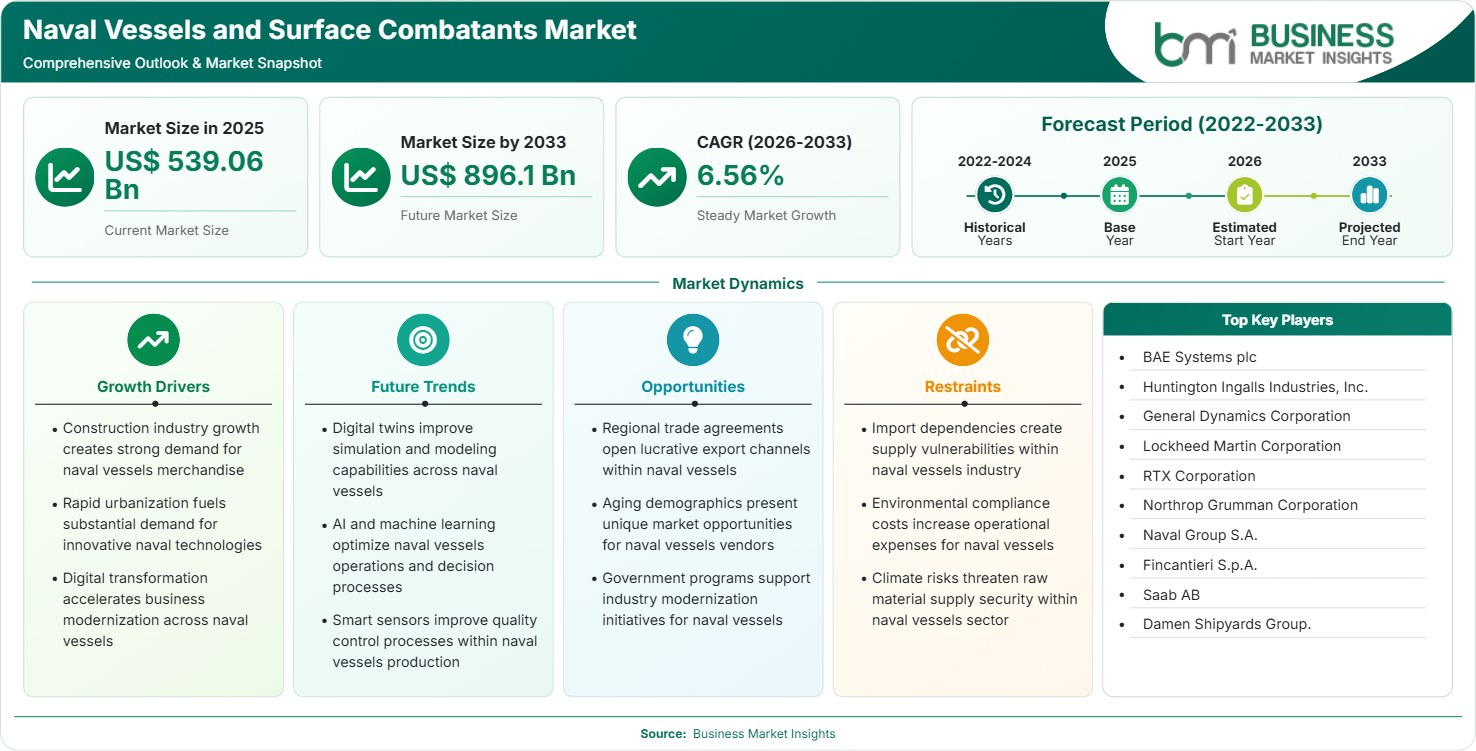
The Naval Vessels and Surface Combatants Market size was valued at US$ 539.06 Billion in 2025 and is projected to reach US$ 896.1 Billion by 2033, growing at a CAGR of 6.56% during 2026–2033. Growth is supported by naval modernization programs, fleet expansion initiatives, maritime security concerns, digital warfare capabilities, autonomous platforms, and rising defense investments across strategic sea routes.

Report Coverage
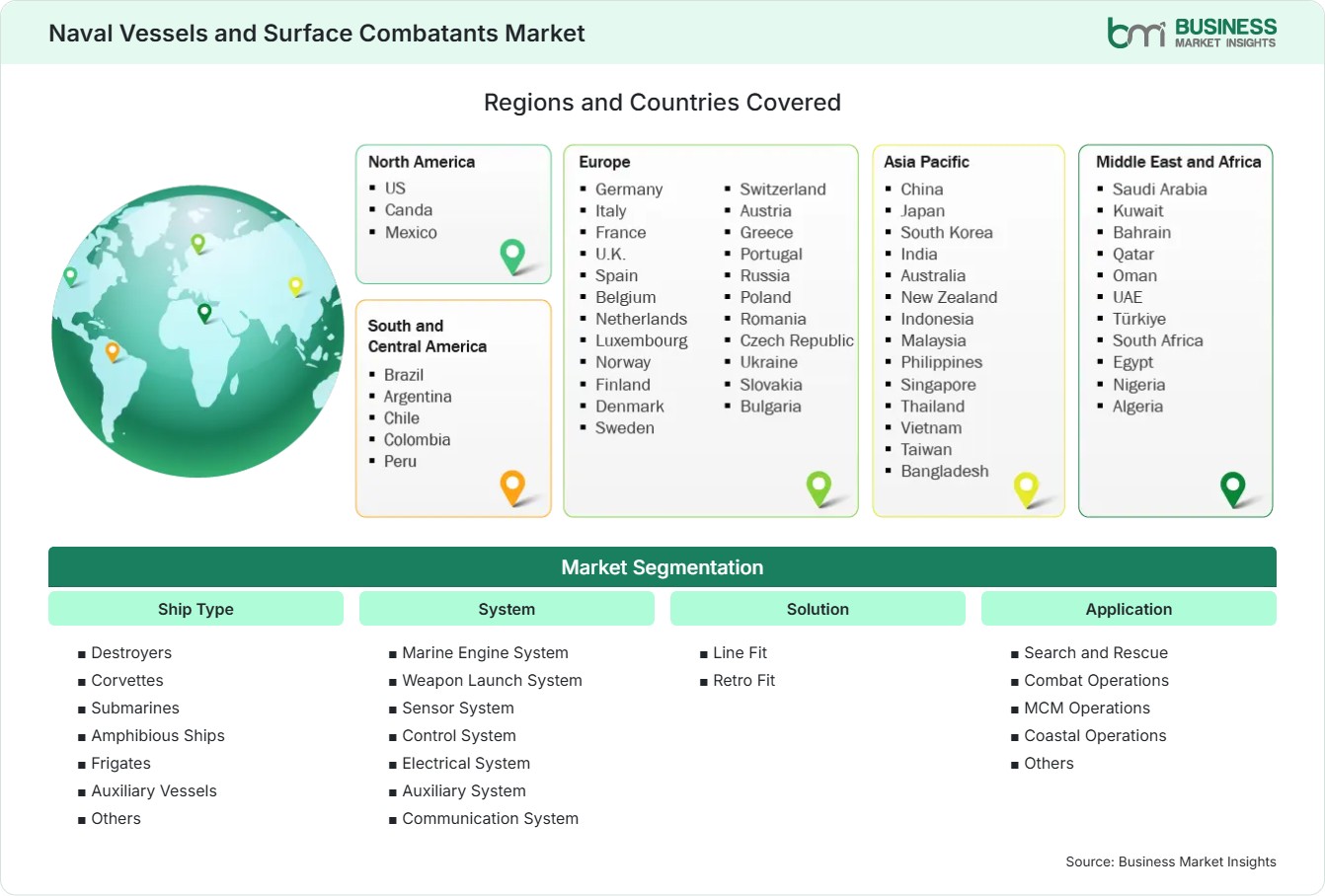
  • Ship Type: Destroyers, Corvettes, Submarines, Amphibious Ships, Frigates, Auxiliary Vessels, Others
  • System: Marine Engine System, Weapon Launch System, Sensor System, Control System, Electrical System, Auxiliary System, Communication System
  • Solution: Line Fit, Retro Fit
  • Application: Search and Rescue, Combat Operations, MCM Operations, Coastal Operations, Others
US$ 539.06 Bn Market size in 2025
US$ 896.1 Bn Market Size by 2033
6.56% CAGR, 2026 - 2033
2026-2033 Forecast Period

AI Overview

Naval Vessels and Surface Combatants Market Summary

  • North America Region: North America holds a market share of 34%–37% in 2025, growing at a CAGR of 5.8%–6.2% during 2026–2033. Growth is supported by submarine recapitalization, fleet modernization, missile-defense investments, digital combat systems, industrial shipbuilding upgrades, autonomous vessel deployment, maritime deterrence priorities, allied procurement cooperation, and sustainment contracts. US market remains dominant across regional demand, supported by fleet replacement programs and approximately 6.0%–6.4% CAGR.
  • Fastest Growing Region: Asia Pacific holds a Naval Vessels and Surface Combatants Market share of 28%–31% in 2025, growing at a CAGR of 7.5%–8.1% during 2026–2033. Demand is driven by regional maritime disputes, indigenous shipbuilding expansion, naval power projection objectives, advanced destroyer procurement, submarine acquisition programs, coastal security requirements, and growing defense budgets.
  • Leading Segment: Ship Type accounts for 41%–44% share in 2025 and advances at 6.2%–6.7% CAGR. Procurement of multi-mission vessels, fleet replenishment requirements, enhanced survivability features, modular architectures, long-range deployment capabilities, and interoperability initiatives continue shaping spending priorities across defense organizations.
  • High Growth Segment: Sensor System represents 16%–19% of the Naval Vessels and Surface Combatants Market share in 2025 and records 7.8%–8.4% CAGR. Rising adoption of integrated radar networks, sonar modernization, electronic warfare suites, AI-enabled situational awareness, maritime surveillance upgrades, and network-centric operations supports sustained technology investment worldwide.
  • Key Market Opportunity: Integration of autonomous systems, digital combat management platforms, predictive maintenance technologies, advanced sensors, and open-architecture mission systems creates opportunities for lifecycle upgrades, interoperability enhancement, and fleet readiness improvements.
  • Major Market Players: BAE Systems plc, Huntington Ingalls Industries, Inc., General Dynamics Corporation, Lockheed Martin Corporation, RTX Corporation, Northrop Grumman Corporation, Naval Group S.A., Fincantieri S.p.A., Saab AB, Damen Shipyards Group.
Strategic Insights

Naval Vessels and Surface Combatants Market: Strategic Insights

Naval Vessels and Surface Combatants Market Strategic Framework
FREE PDF
Request your free sample
Request free sample
Stakeholder View

Key Takeaways

  • The industry operates through a complex ecosystem involving shipbuilders, propulsion providers, combat-system integrators, radar manufacturers, weapons suppliers, and long-term maintenance partners, creating substantial aftermarket revenue streams.
  • Sensor-intensive upgrades and maritime surveillance applications present some of the strongest revenue opportunities as navies prioritize situational awareness across contested operating environments.
  • Research spending increasingly targets autonomous surface vessels, digital twins, cybersecurity architectures, AI-enabled command systems, and integrated battle management platforms.
  • Asia Pacific offers a compelling investment case due to indigenous naval expansion programs in India, South Korea, Japan, and Australia.
  • Strategic partnerships, technology-sharing agreements, and shipyard consolidation activities continue reshaping competitive positioning and capacity availability across major maritime-defense markets.
  • Lifecycle modernization spending is becoming a critical procurement category as governments extend operational service lives while enhancing mission effectiveness.
Geographic Outlook

Naval Vessels and Surface Combatants Market Regional Highlights

North America Naval Vessels and Surface Combatants Market

The North American region holds a 34%-37% in the Naval Vessels and Surface Combatants Market share in 2025 and is expected to grow at a 5.8%-6.2% CAGR till 2033. Procurement in the region is driven by fleet modernization, ballistic missile defense systems, submarine renewal, and the adoption of combat systems. The region has strong industrial capacity, naval shipbuilding yards, and defense budget provisions, which provide visibility for the projects. Demand also benefits from cybersecurity integration, electronic warfare upgrades, and growing deployment of unmanned maritime platforms across defense operations.

  • Fleet expansion programs continue supporting procurement of destroyers, submarines, amphibious platforms, and support vessels while strengthening domestic shipbuilding capacities and supplier networks.
  • Advanced radar, sonar, and combat-management integration remains central to modernization spending, improving maritime-domain awareness and mission flexibility.
  • Defense-industrial investments target workforce expansion, shipyard digitization, and maintenance infrastructure modernization to reduce delivery bottlenecks.
  • Allied interoperability requirements encourage adoption of common communications systems and integrated mission architectures.

US Naval Vessels and Surface Combatants Market

The United States is the largest regional consumer market, accounting for 78%-82% of total regional demand, with growth expected at a CAGR of 6.0%-6.4%. The key investment areas will revolve around distributed maritime operations, undersea warfare superiority, and digital fleet transformation. Large naval procurement projects provide reliable growth prospects for platform makers, subsystem suppliers, and service providers. Ongoing modernization priorities include missile-defense integration, electronic warfare resilience, and the expanded adoption of autonomous maritime technologies to support operational readiness.

  • Columbia-class and Virginia-class programs continue driving industrial activity across shipbuilding and defense electronics ecosystems.
  • Long-term maintenance and sustainment expenditures account for a rising proportion of naval budgets.
  • Autonomous vessels and AI-supported operational planning receive increasing procurement attention.

Europe Naval Vessels and Surface Combatants Market

Europe commands a market share of 24%-27% in 2025 with an estimated CAGR of 6.1%-6.7%. The region will be driven by factors such as naval recapitalization, readiness goals, and maritime security programs. Advanced frigates, mine countermeasures ships, and surveillance are among the areas receiving priority in the region. The UK has been the largest market, whereas Poland and Norway have recorded significant growth due to modernization efforts and increased defense spending expansion. Indigenous shipbuilding remains strategically important across regional procurement decisions.

  • NATO capability targets continue supporting fleet renewal and interoperability-focused investments.
  • Frigate and mine warfare modernization programs generate opportunities for specialized contractors.
  • Digital combat systems and naval cybersecurity solutions gain importance in procurement frameworks.
  • Poland records among the strongest growth rates, supported by comprehensive maritime defense modernization.

Asia Pacific Naval Vessels and Surface Combatants Market

Asia Pacific represents a 28%–31% share in 2025 and records the fastest regional CAGR of 7.5%–8.1% through 2033. Expanding naval budgets, maritime disputes, and domestic shipbuilding strategies accelerate procurement activities. China is the largest regional market, while India demonstrates one of the strongest growth rates. Governments increasingly invest in destroyers, submarines, amphibious vessels, maritime surveillance systems, and indigenous combat technologies to strengthen regional deterrence and power-projection capabilities.

  • Indigenous manufacturing programs support supply-chain localization and technology development across major economies.
  • Naval fleets increasingly adopt advanced sensors, networked communications, and unmanned systems.
  • India benefits from shipbuilding expansion and strong domestic procurement initiatives.
  • Australia advances fleet modernization through long-term strategic maritime investment programs.

Rest of World Naval Vessels and Surface Combatants Market

The Rest of World segment accounts for 10%–13% of the market and is expected to register a 6.3%–6.9% CAGR. The Middle Eastern nations are still investing in coastal defense, increasing patrols, and securing maritime infrastructure.

South and Central America offer selective purchasing opportunities focused on patrol vessels, surveillance capabilities, and fleet sustainment. Saudi Arabia is the leading purchaser in the region, whereas Brazil shows greater growth potential.

  • Energy infrastructure protection drives naval investment across Gulf economies.
  • Coastal monitoring and anti-smuggling operations support procurement of surveillance-enabled vessels.
  • Brazil continues pursuing fleet modernization and local manufacturing participation.
  • Strategic maritime trade routes stimulate investments in mission-ready naval capabilities.
Global Market Geography
FREE PDF
Request your free sample
Request free sample
Segment Analysis

Naval Vessels and Surface Combatants Market Segmentation

Ship Type

Ship Type market share is 41%-44% in 2025 and experiences a growth rate of 6.2%-6.7% CAGR. The scope of the Naval Vessels and Surface Combatants Market is significantly affected by the need to modernize fleets, support deterrence strategies, and replace existing assets. Multi-role ships are in high demand due to the need for flexibility and operational sustainability.

  • Destroyers: Equipped with advanced missile-defense and multi-mission capabilities, destroyers remain central to blue-water naval operations and long-range force projection requirements.
  • Corvettes: Cost-effective vessels supporting coastal patrol, surveillance, and maritime security missions, particularly attractive for emerging naval modernization programs.
  • Submarines: Demand benefits from strategic deterrence priorities, underwater intelligence gathering, and growing investment in advanced propulsion technologies.
  • Amphibious Ships: Increasing focus on expeditionary operations and humanitarian missions supports procurement across several defense organizations.
  • Frigates: Multi-role flexibility, anti-submarine capabilities, and interoperability advantages sustain demand across developed and developing naval fleets.
  • Auxiliary Vessels: Logistics, replenishment, and support functions remain essential for sustained maritime operations and global deployment readiness.

System

System solutions hold a market share of 30%-33% and are expected to grow at a CAGR of 7.0%–7.6%. The term Naval Vessels and Surface Combatants Market trends finds significant expression in the domains of digital sensors, combat electronics, integration platforms, and network-centric technologies.

  • Marine Engine System: Focus remains on efficiency, reliability, endurance, and reduced maintenance requirements across mission profiles.
  • Weapon Launch System: Modern missile integration and precision-strike capabilities support sustained procurement activity.
  • Sensor System: Enhanced radar, sonar, and surveillance technologies improve threat detection and tactical awareness.
  • Control System: Digital command structures strengthen coordination, mission planning, and fleet interoperability.
  • Electrical System: Electrification trends support improved onboard power management and future weapon integration.
  • Auxiliary System: Supportive onboard infrastructure enhances operational resilience and vessel availability.
  • Communication System: Secure networking capabilities enable real-time information sharing and multi-domain coordination.

Solution

Solution offerings have a market share of 13% to 16% and a CAGR of 6.8% to 7.4%. Platform acquisition alongside fleet extension plans ensures balanced demand for procurement and modernization.

  • Line Fit: Installed during vessel construction, supporting seamless integration of advanced mission systems and platform architectures.
  • Retro Fit: Growing demand stems from service-life extension strategies and cost-effective capability enhancements across existing fleets.

Application

Application-based demand accounts for 14%-17% of the market share and grows at a CAGR of 6.5%-7.1%. While combat readiness has remained dominant, maritime safety and surveillance, and other mission-specific applications have been gaining importance.

  • Search and Rescue: Maritime emergency preparedness drives investment in capable and rapidly deployable vessels.
  • Combat Operations: High-priority spending supports weapons integration, survivability enhancements, and mission effectiveness.
  • MCM Operations: Mine-countermeasure missions require specialized platforms and advanced detection technologies.
  • Coastal Operations: Growing maritime-security obligations sustain regional procurement and surveillance requirements.
Market Forces

Naval Vessels and Surface Combatants Market Dynamics

Key Market Drivers

Rising Global Defense Expenditure and Maritime Security Priorities

Military spending worldwide was estimated by SIPRI at more than US$2.4 trillion, with naval platform procurement among the key areas of funding. The need for competition at sea, sea lane security, and deterrence continues to drive the purchase of state-of-the-art combat and service vessels. Governments wish to boost their forces’ readiness both in surface and underwater spheres and increase their flexibility. The rising need for integrated systems of weapons, communications, and surveillance is a direct driver of naval platform procurement and modernization. Long-term budgets for the armed forces provide a clear financial perspective for technology producers and providers. These conditions continue to reinforce sustained investment cycles across naval capabilities and strengthen international demand for next-generation combat platforms.

Expansion of Fleet Modernization Programs

Many naval fleets consist of legacy platforms that need to be replaced or updated. Modernization efforts today tend to concentrate on digital combat systems, state-of-the-art propulsion systems, sensor fusion systems, and survivability enhancements. Open architecture solutions help facilitate future modernization efforts and simplify lifecycle management. Cyber protection, unmanned systems compatibility, and mission management have also become key factors in procurement strategies. Fleet modernization efforts are most notable in North America, Europe, and the Asia-Pacific region. Given the need for operational effectiveness alongside efficient budgeting, many modernization programs create significant business opportunities for shipyards, integrators, and subsystem suppliers across multiple technology categories.

Growing Adoption of Integrated Sensor and Electronic Warfare Suites

The success of a mission now hinges on information superiority. Modern radars, sonar equipment, electronic support measures, and AI-driven data analytics contribute to improved situation awareness. Modern navies tend to deploy multi-sensor systems to address the threats encountered within contested maritime areas. Better networking enables faster communication between ships, planes, and command centers. The need for electronic warfare protection continues to fuel system upgrade efforts. This ensures operational success without increasing fleet size, making such procurement worthwhile.

Key Market Opportunities

Autonomous and Unmanned Maritime Platforms

Autonomous surface ships and unmanned missions offer significant prospects for technology companies and defense contractors. Such technology aids surveillance, logistics, reconnaissance, and risk-oriented missions while minimizing risks to personnel. The ongoing experiments by major naval nations demonstrate the feasibility of future procurement. The integration of such technology with current fleet structures enhances versatility and minimizes costs over time. With the maturation of autonomy regulations and growing confidence in its operations, the number of deployments is anticipated to rise. Commercialization possibilities lie in software, navigation, communications, and mission management solutions.

Digital Twin and Predictive Maintenance Deployment

Digital engineering systems offer avenues to enhance readiness, reduce maintenance costs, and ensure optimal vessel performance. Predictive analytics play an important role in identifying failures early on and improving asset usage. As ship manufacturers consider incorporating lifecycle data management into their modernization strategies, governments seeking more available vessels have begun investing in condition-based maintenance. Companies that can integrate digital data platforms, cybersecurity systems, and vessel monitoring systems are well-placed to capitalize on these trends and growing sustainment expenditures.

Export-Oriented Shipbuilding and Strategic Partnerships

According to The Naval Vessels and Surface Combatants Market Forecasts, there is an excellent opportunity for international cooperation programs, localization agreements, and industrial defense partnerships. Nations interested in sovereignty usually opt for technology transfer coupled with participation in domestic manufacturing operations. This opens new markets for shipbuilders and subsystem suppliers. Collaborative projects reduce costs and increase compatibility among allied forces. Export-driven procurement generates long-term income streams covering manufacturing, training, maintenance, and modernization services.

Market Restraints and Challenges

High Procurement Costs and Budget Allocation Pressures

Factor: Modern naval platforms require sophisticated weapons, sensors, communication systems, and propulsion technologies that increase acquisition and lifecycle costs. Impact: Budget constraints can delay procurement schedules, reduce order volumes, or extend replacement timelines. Large-scale programs frequently span several years and remain vulnerable to economic pressures or changes in political priorities. Cost escalation can affect supplier planning and industrial utilization rates. Governments often balance naval investments against competing defense requirements, creating uncertainty in procurement execution and project sequencing.

Shipbuilding Capacity Constraints and Supply Chain Complexity

Factor: Naval construction depends on specialized labor, critical materials, advanced electronics, and long-duration industrial processes. Impact: Production bottlenecks may delay vessel delivery, increase program costs, and reduce procurement efficiency. Growing demand for sophisticated components has intensified pressure on suppliers across propulsion, electronics, and systems integration categories. Workforce shortages in certain shipbuilding regions further complicate execution timelines. Maintaining resilient supply chains and expanding industrial capacity remain persistent challenges for manufacturers pursuing large modernization contracts.

Company Analysis

Competitive Landscape

The competitive environment remains moderately concentrated, with leading defense contractors competing across shipbuilding, combat systems, electronics integration, and lifecycle support services. This Naval Vessels and Surface Combatants Market analysis highlights the importance of technological differentiation, sovereign manufacturing capabilities, and long-term defense partnerships.

Company Name

Overview

Products and Services relevant to this market

BAE Systems plc

Major defense contractor with extensive naval platform, shipbuilding, and systems integration expertise.

Frigates, combat systems, naval electronics, weapon integration, support and modernization services.

Huntington Ingalls Industries, Inc.

Leading U.S. naval shipbuilder serving critical fleet programs and sustainment activities.

Aircraft carriers, destroyers, amphibious ships, maintenance, fleet support solutions.

General Dynamics Corporation

Diversified defense company with advanced naval and submarine capabilities.

Nuclear submarines, combat systems, mission technologies, lifecycle services.

Lockheed Martin Corporation

Global defense integrator with strong maritime systems portfolio.

Combat management systems, radar systems, missile integration, naval electronics.

RTX Corporation

Defense technology provider specializing in sensors and mission systems.

Radar, communications, weapons integration, surveillance solutions.

Northrop Grumman Corporation

Advanced defense technology company focused on mission-critical systems.

C4ISR solutions, autonomous technologies, naval mission systems.

Naval Group S.A.

European naval defense specialist supporting domestic and export customers.

Submarines, frigates, combat systems, maintenance services.

Fincantieri S.p.A.

Major shipbuilder serving defense and commercial maritime sectors.

Surface combatants, patrol vessels, support ships, modernization programs.

Saab AB

Technology-focused defense company with maritime expertise.

Naval combat systems, sensors, surveillance, electronic warfare capabilities.

Damen Shipyards Group

International shipbuilder with broad naval vessel portfolio.

Patrol ships, frigates, support vessels, integration and maintenance services.

Trust & Transparency

Research Methodology

The market analysis combines proprietary research with secondary data from government agencies, company disclosures, regulatory filings, industry databases and expert interviews. Market estimates are validated through data triangulation, cross-market benchmarking and analyst review.

View Full Research Methodology

Questions Answered

Frequently Asked Questions

What does this Naval Vessels and Surface Combatants Market Report help stakeholders evaluate?

It supports assessment of demand trends, competitive positioning, growth segments, regional opportunities, technology developments, and long-term procurement priorities.

How does technology affect future competition?

AI-enabled systems, integrated sensors, autonomous vessels, cybersecurity solutions, and digital fleet-management tools increasingly differentiate suppliers.

Why are retrofit solutions gaining importance?

Many governments seek to extend vessel service lives through modernization programs that improve mission capability without requiring immediate fleet replacement.

Which region creates the strongest long-term demand potential?

Asia Pacific presents the strongest growth outlook due to naval expansion initiatives, regional security considerations, and increased indigenous shipbuilding investments.

What are the primary factors influencing procurement decisions in naval programs?

Capability requirements, maritime threats, lifecycle cost efficiency, interoperability, domestic industrial participation, and technological superiority are typically the most important procurement considerations.

Access the Full Naval Vessels and Surface Combatants Market Report

Get segment-level forecasts, regional estimates, competitive benchmarking, company profiles and downloadable Excel datasets.

Access the full Naval Vessels and Surface Combatants Market Report
350 pages PDF & Excel | 2026-08-31