
Directed Infrared Countermeasure (DIRCM) Market Outlook: Size, Share, Trends, Growth Analysis, Competitive Landscape & Forecast, 2026-2033

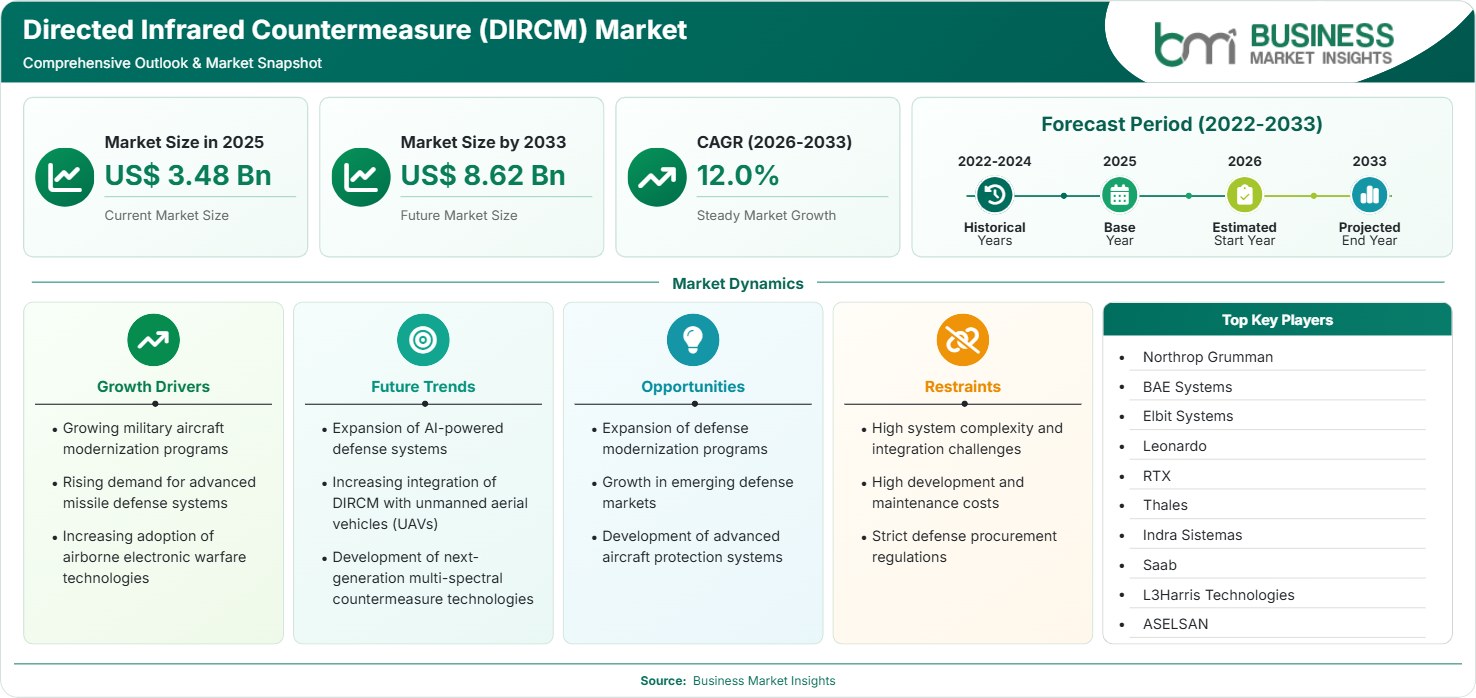
The Directed Infrared Countermeasure (DIRCM) Market size was valued at US$ 3.48 Billion in 2025 and is projected to reach US$ 8.62 Billion by 2033, growing at a CAGR of 12.0% from 2026 to 2033, supported by aircraft modernization programs, increasing electronic warfare investments, advanced missile defense requirements, and development of next-generation airborne protection technologies.

Report Coverage
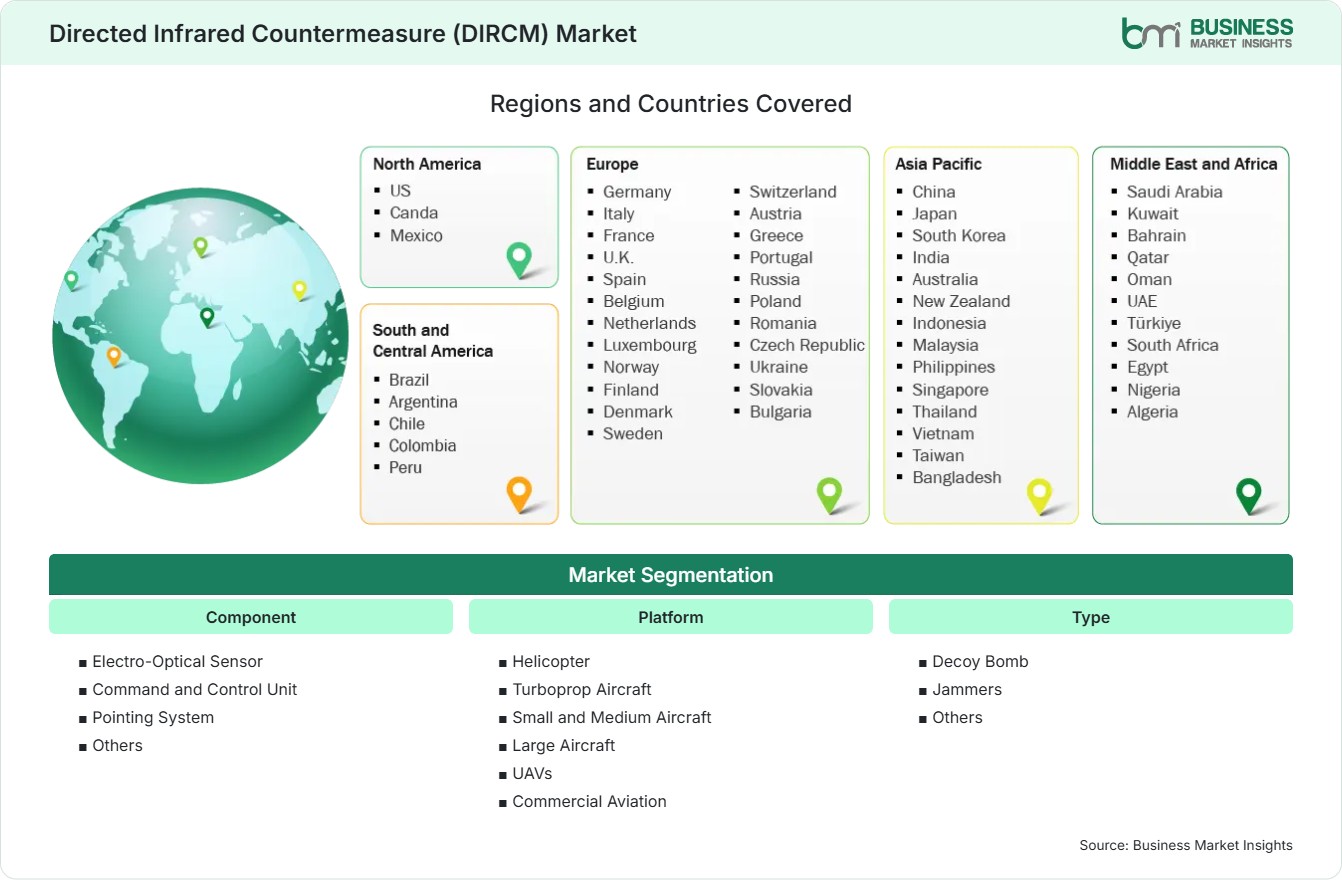
  • Component: Electro-Optical Sensor, Command and Control Unit, Pointing System, Others
  • Platform: Helicopter, Turboprop Aircraft, Small and Medium Aircraft, Large Aircraft, UAVs, Commercial Aviation
  • Type: Decoy Bomb, Jammers, Others
US$ 3.48 Bn Market size in 2025
US$ 8.62 Bn Market Size by 2033
12.0% CAGR, 2026 - 2033
2026-2033 Forecast Period

AI Overview

Directed Infrared Countermeasure (DIRCM) Market Summary

  • North America Region: North America holds a market share of 38%–42% in 2025, growing with a CAGR of 11%–13% influenced by defense aviation modernization, military aircraft upgrades, electronic warfare investments, and advanced infrared threat protection requirements. The US market demonstrates strong adoption, with a CAGR of 11%–13% from 2026–2033 supported by rotary-wing fleet upgrades, strategic aircraft programs, and advanced survivability technology procurement.
  • Fastest Growing Region: Asia Pacific accounts for a share range of 24%–28% in 2025, expanding with a CAGR of 14%–16% due to increasing defense expenditure, indigenous aerospace development, aircraft fleet expansion, and rising adoption of advanced airborne countermeasure systems across regional military forces.
  • Leading Segment: Electro-Optical Sensor (EOS) represents the leading component segment with a 32%–36% share in 2025 and a CAGR of 12%–14% driven by improved infrared detection accuracy, threat identification capabilities, sensor miniaturization, and integration with aircraft electronic warfare systems.
  • High Growth Segment: UAVs represent the high-growth platform segment with a 16%–20% share in 2025 and a CAGR of 15%–17% supported by increasing unmanned aircraft deployment, surveillance operations, autonomous mission requirements, and demand for enhanced protection against infrared-guided missile threats.
  • Key Market Opportunity: Defense modernization initiatives, expansion of unmanned aviation, and development of lightweight artificial intelligence-enabled aircraft protection systems are creating opportunities for companies developing scalable DIRCM technologies for diverse operational environments.
  • Major Market Players: Northrop Grumman, BAE Systems, Elbit Systems, Leonardo S.p.A., RTX Corporation, Thales, Indra Sistemas, Saab AB, L3Harris Technologies, ASELSAN.
Strategic Insights

Directed Infrared Countermeasure (DIRCM) Market: Strategic Insights

Directed Infrared Countermeasure (DIRCM) Market Strategic Framework
FREE PDF
Request your free sample
Request free sample
Stakeholder View

Key Takeaways

  • The market ecosystem is evolving through collaboration among defense contractors, aircraft manufacturers, electronic warfare specialists, sensor technology providers, and government procurement agencies. Successful suppliers increasingly require capabilities across hardware integration, software development, testing, and lifecycle support.
  • Growth opportunities are concentrated in helicopter modernization programs, UAV protection applications, and next-generation military aircraft platforms. Demand is increasing for lightweight and modular DIRCM solutions that can be installed across different aircraft categories without extensive redesign requirements.
  • Innovation strategies are shifting toward advanced infrared sensors, artificial intelligence-assisted threat identification, improved laser systems, and automated response mechanisms. Companies investing in faster processing capabilities and multi-platform compatibility are positioned to strengthen their competitive advantage.
  • Asia Pacific presents a strong investment opportunity due to expanding military aviation fleets, rising defense budgets, and increasing emphasis on domestic aerospace manufacturing. Countries including India, China, Japan, and South Korea are strengthening indigenous defense capabilities.
  • Defense industry partnerships and technology collaborations are becoming increasingly important as companies seek to combine specialized capabilities. Strategic agreements between electronic warfare providers and aerospace manufacturers are supporting faster development and deployment of advanced aircraft protection systems.
  • Long-term market positioning depends on the ability to provide affordable lifecycle management, maintenance support, and upgrade pathways. Defense users are increasingly evaluating total ownership costs rather than only initial procurement expenses.
Geographic Outlook

Directed Infrared Countermeasure (DIRCM) Market Regional Highlights

North America Directed Infrared Countermeasure (DIRCM) Market

North America accounted for a 38%–42% of the Directed Infrared Countermeasure (DIRCM) Market share in 2025 and is projected to grow at a CAGR of 11%–13% during 2026–2033. The region maintains leadership due to extensive military aviation infrastructure, established defense manufacturing capabilities, and continuous investment in aircraft survivability technologies. The United States represents the dominant contributor, supported by large aircraft fleets, advanced electronic warfare programs, and defense modernization initiatives.

  • The United States continues driving regional demand through military aircraft upgrades, helicopter modernization programs, and procurement of advanced missile protection technologies.
  • Defense contractors in North America are focusing on integrated solutions combining infrared sensors, laser systems, and electronic warfare capabilities.
  • Canada is strengthening aerospace defense capabilities through modernization initiatives and increased focus on advanced aviation protection systems.
  • Strong research and development infrastructure supports innovation in infrared detection, threat analysis, and automated countermeasure technologies.

US Directed Infrared Countermeasure (DIRCM) Market

The US accounted for a 32%–36% share of the Directed Infrared Countermeasure (DIRCM) Market in 2025 and is estimated to expand at a CAGR of 11%–13% from 2026–2033. The country remains a leading defense technology hub due to high military expenditure, advanced aerospace manufacturing, and continued investment in aircraft protection systems. Procurement programs focused on survivability and electronic warfare capabilities are supporting sustained adoption.

  • US defense agencies are prioritizing aircraft survivability improvements due to increasing complexity of infrared-guided missile threats.
  • Military aviation programs are integrating DIRCM technologies into helicopters, transport aircraft, and specialized mission platforms.
  • Defense companies are investing in advanced sensors and automated threat response systems for next-generation aircraft.
  • The country benefits from strong collaboration between government agencies, aerospace manufacturers, and technology developers.

Europe Directed Infrared Countermeasure (DIRCM) Market

Europe represented a 20%–24% share of the Directed Infrared Countermeasure (DIRCM) Market in 2025 and is expected to register a CAGR of 10%–12% during 2026–2033. The regional market is supported by defense modernization programs, multinational aircraft initiatives, and increasing focus on electronic warfare capabilities. The United Kingdom, France, Germany, and Italy are major contributors due to established aerospace industries and ongoing military technology investments.

  • The United Kingdom is strengthening aircraft protection capabilities through defense technology investments and military aviation modernization.
  • France is expanding aerospace defense programs with emphasis on advanced electronic warfare and survivability solutions.
  • Germany is increasing investment in defense electronics and aircraft modernization requirements.
  • Italy benefits from strong aerospace manufacturing capabilities and participation in multinational defense programs.

Asia Pacific Directed Infrared Countermeasure (DIRCM) Market

Asia Pacific held a 24%–28% share of the Directed Infrared Countermeasure (DIRCM) Market in 2025 and is projected to grow at a CAGR of 14%–16% between 2026–2033. The region represents the fastest-growing market due to increasing defense budgets, aircraft fleet expansion, and rising investment in domestic aerospace capabilities. China, India, Japan, and South Korea are leading contributors as governments strengthen military aviation infrastructure.

  • China is investing in advanced aircraft technologies, electronic warfare capabilities, and indigenous defense system development.
  • India is expanding military modernization programs and promoting domestic aerospace manufacturing initiatives.
  • Japan is increasing adoption of advanced defense technologies to improve aircraft survivability capabilities.
  • South Korea is developing indigenous defense platforms requiring advanced protection and electronic warfare solutions.

Rest of World Directed Infrared Countermeasure (DIRCM) Market

South America, the Middle East, and Africa accounted for a 10%–14% share of the Directed Infrared Countermeasure (DIRCM) Market in 2025 and are expected to grow at a CAGR of 12%–14% during 2026–2033. Regional demand is supported by aircraft fleet modernization, security requirements, and defense investment programs. Brazil, Saudi Arabia, the UAE, and selected African countries are increasing their focus on advanced aviation protection technologies.

  • Brazil is upgrading defense aviation capabilities through modernization programs and improved aircraft protection requirements.
  • Saudi Arabia is investing in advanced defense systems to strengthen military aviation capabilities and operational readiness.
  • The UAE is developing aerospace defense infrastructure through strategic procurement and technology partnerships.
  • African countries are gradually increasing aviation security investments through international defense cooperation programs.
Global Market Geography
FREE PDF
Request your free sample
Request free sample
Segment Analysis

Directed Infrared Countermeasure (DIRCM) Market Segmentation

Component

The component segment represents the technological foundation of the Directed Infrared Countermeasure (DIRCM) Market, with Electro-Optical Sensor (EOS) maintaining the leading position with a 32%–36% share in 2025 and a CAGR of 12%–14% during 2026–2033. Increasing demand for accurate infrared threat detection, faster response mechanisms, and integration with aircraft electronic warfare systems is accelerating component innovation. The segment is benefiting from defense organizations seeking modular, lightweight, and highly reliable protection architectures for multiple aircraft platforms.

  • Electro-Optical Sensor (EOS): Electro-Optical Sensor systems provide critical infrared detection and tracking capabilities by identifying missile signatures and enabling rapid threat assessment during aircraft operations.
  • Command and Control Unit (CCU): Command and Control Units process information from sensors, coordinate defensive responses, and enable communication between DIRCM components and aircraft mission systems.
  • Pointing System: Pointing Systems provide precise laser positioning capabilities required for effective countermeasure deployment against incoming infrared-guided threats.

By Platform

The platform segment demonstrates broad adoption across military and specialized aviation applications, with helicopters and large aircraft representing important demand areas due to their operational value and exposure to missile threats. The segment is estimated to expand at a CAGR of 12%–14% during 2026–2033 as defense forces modernize aircraft fleets and integrate advanced survivability systems. Increasing UAV deployment is also creating new opportunities for compact DIRCM solutions.

  • Helicopter: Helicopters represent a significant application segment because low-altitude missions increase vulnerability to infrared-guided weapons and require advanced protection systems.
  • Turboprop Aircraft: Turboprop aircraft utilize DIRCM technologies for enhanced survivability during transport, surveillance, reconnaissance, and special mission operations.
  • Small and Medium Aircraft: Small and Medium Aircraft platforms are adopting compact countermeasure technologies to improve mission reliability and operational safety.
  • Large Aircraft: Large Aircraft require advanced DIRCM systems due to their strategic importance and need for protection against sophisticated airborne threats.
  • UAVs: UAV platforms represent a high-growth application area as unmanned systems increasingly require lightweight defense technologies for contested operational environments.
  • Commercial Aviation: Commercial Aviation applications represent an emerging opportunity as selected high-value aircraft operators evaluate advanced protection technologies for enhanced security.

Type

The type segment highlights different approaches used for infrared threat mitigation, including active and passive countermeasure technologies. Jammers represent a major technology category due to their capability to disrupt infrared missile guidance systems. The segment is expected to grow at a CAGR of 11%–13% during 2026–2033, supported by increasing defense investments and rising demand for advanced electronic warfare solutions. The Directed Infrared Countermeasure (DIRCM) Market trends indicate movement toward integrated systems combining detection, tracking, and response functions.

  • Decoy Bomb: Decoy Bomb systems provide diversion capabilities by creating alternative infrared signatures that reduce the probability of successful missile targeting.
  • Jammers: Jammers use directed energy approaches to interfere with infrared-guided missile systems and improve aircraft survivability during high-risk operations.
Market Forces

Directed Infrared Countermeasure (DIRCM) Market Dynamics

Key Market Drivers

Growing Military Aircraft Modernization Programs

Growing military aircraft modernization programs are a primary contributor to the Directed Infrared Countermeasure (DIRCM) Market growth as defense organizations upgrade aging aircraft fleets with advanced survivability technologies. Worldwide military forces are focusing on protection against emerging infrared-guided weapons by integrating electronic warfare technology into their aviation platforms. According to procurement trends in the global defense industry, modernization budgetary allocations have been increasing significantly due to the need to enhance aircraft protection through sensors, countermeasures, and mission equipment. The Directed Infrared Countermeasure (DIRCM) trends reflect a growing demand for adaptable solutions that support multiple aircraft platforms, including helicopters, transport aircraft, and unmanned systems.

Rising Demand for Advanced Missile Defense Systems

Greater demand for more sophisticated missile defense systems has been driving the adoption of DIRCM technology as defense agencies seek to protect their military from attacks by modern missiles. Modern-day combat zones have made it more critical than ever for military airplanes to remain safe from threats to their operations. The DIRCM technology uses infrared sensors and directed-energy systems to automatically detect any threat. Defense agencies are investing in these systems to reduce vulnerability of high-value aircraft assets and improve operational effectiveness during complex missions.

Increasing Adoption of Airborne Electronic Warfare Technologies

There is an increasing trend towards the adoption of airborne EW technologies as armed forces move towards implementing an integrated, net-centric operational model. DIRCM technologies have been increasingly viewed as essential components of larger electronic warfare frameworks, integrating threat detection, communication, and response capabilities into one. The evolution in computer processing, sensors, and artificial intelligence is facilitating faster decision-making and greater adaptability of the systems. This is prompting military organizations to invest in sophisticated aircraft protection systems that can operate effectively against changing threat environments.

Key Market Opportunities

Expansion of Defense Modernization Programs

Expanding defense modernization programs present considerable opportunities for DIRCM manufacturers as governments continue upgrading their military aviation assets. Many nations are planning to upgrade and modernize their systems and aircraft with advanced technology to improve their survivability. The modernization efforts for helicopters, transport aircraft, and unmanned aerial vehicles will require effective solutions adaptable to different aircraft types. Companies providing scalable designs, simplified installation, and comprehensive lifecycle support are well-positioned to benefit, reinforcing the Directed Infrared Countermeasure (DIRCM) market forecasts through rising defense procurement activities.

Growth in Emerging Defense Markets

The growth of emerging defense markets presents new opportunities amid rising military expenditures and indigenous aerospace capabilities. Many nations in the Asia-Pacific, Middle East, and Latin America are investing to improve their aircraft and defense technologies and increase readiness for action. Emerging defense markets need reliable aircraft protection systems to effectively support new acquisitions and improvements. International partnerships, technology transfers, and local manufacturing collaborations are expected to support broader adoption of DIRCM.

Development of Advanced Aircraft Protection Systems

Development of advanced aircraft protection systems represents a major opportunity through integration of artificial intelligence, improved infrared sensors, and automated countermeasure technologies. Future DIRCM systems are expected to become lighter, more efficient, and easier to integrate across different aircraft categories. Defense organizations are seeking solutions capable of operating within complex electronic warfare environments, creating demand for companies investing in advanced research, laser technology, and next-generation threat detection capabilities.

Market Restraints and Challenges

High System Complexity and Integration Challenges

Factor: DIRCM systems require sophisticated integration between infrared sensors, laser components, aircraft avionics, and electronic warfare networks. Impact: Complex integration processes can increase deployment timelines, testing requirements, and overall implementation costs for defense operators. Each aircraft platform requires customized engineering solutions to ensure compatibility, reliability, and mission effectiveness. These technical challenges can limit adoption among countries with limited aerospace integration capabilities and may require extensive collaboration between aircraft manufacturers and defense technology providers.

High Development and Maintenance Costs

Factor: DIRCM technologies involve significant research investment, specialized components, advanced manufacturing requirements, and continuous maintenance activities. Impact: High lifecycle costs can restrict adoption among defense organizations with limited procurement budgets and increase long-term operational expenses. Development of high-performance infrared sensors, laser systems, and electronic components requires substantial engineering expertise and testing resources. Defense users must evaluate capability improvements against financial constraints, particularly in emerging markets with competing modernization priorities.

Company Analysis

Competitive Landscape

The Directed Infrared Countermeasure (DIRCM) Market analysis reveals intense competition among global defense players, aerospace technology firms, electronic warfare experts, and sophisticated sensor manufacturers. The market players are working to make their product systems more integrated, lightweight, efficient at detecting infrared, and flexible enough for use on multiple aircraft. Competition is also driven by long-term defense deals, technological alliances, lifecycle support, and integration capability with aircraft survivability systems.

Company Name

Overview

Products and Services relevant to this market

Northrop Grumman

Global aerospace and defense company specializing in advanced military technologies and mission systems.

Aircraft survivability solutions, infrared countermeasures, electronic warfare systems, defense integration services.

BAE Systems

International defense technology provider focused on aerospace, electronic warfare, and military systems.

Aircraft protection technologies, electronic warfare solutions, countermeasure systems, defense electronics.

Elbit Systems

Defense electronics company providing advanced airborne and military technology solutions.

DIRCM systems, electro-optical sensors, aircraft protection technologies, mission systems.

Leonardo S.p.A.

Aerospace and defense company with expertise in military aircraft and security technologies.

Infrared countermeasure solutions, airborne defense systems, electronic technologies, aircraft systems.

RTX Corporation

Defense and aerospace company developing advanced military and aviation technologies.

Missile warning systems, electronic warfare capabilities, aircraft survivability technologies.

Thales

Global technology company serving aerospace, defense, and security industries.

Sensors, electronic warfare systems, aircraft protection solutions, defense communication technologies.

Indra Sistemas

Technology and defense solutions provider supporting aerospace and security applications.

Defense electronics, surveillance systems, mission systems, aircraft protection technologies.

Saab AB

Aerospace and defense company developing advanced military platforms and technologies.

Electronic warfare solutions, sensors, defense systems, aircraft survivability technologies.

L3Harris Technologies

Defense technology company providing communication, electronic warfare, and aerospace solutions.

Mission systems, electronic warfare technologies, aircraft protection systems.

ASELSAN

Defense electronics company developing advanced military communication and sensor systems.

Electro-optical technologies, electronic warfare systems, defense electronics solutions.

Industry Activity

Recent Developments

January 2026

Elbit Systems secured contracts worth approximately US$ 275 million to supply advanced airborne electronic warfare (EW) suites, including its Mini-MUSIC Directed Infrared Countermeasure (DIRCM) system, for a helicopter platform operated by an Asia-Pacific country. The five-year contracts include DIRCM technology designed to detect, track, and defeat infrared-guided missile threats, expanding Elbit’s global airborne self-protection business.

January 2026

Elbit Systems received additional contracts worth approximately US$ 150 million to supply DIRCM self-protection systems for aircraft fleets operated by European customers, including NATO member countries. The orders strengthen deployment of Elbit’s J-MUSIC DIRCM technology for protecting transport and high-value aircraft against infrared-guided missile threats.

July 2025

Elbit Systems was awarded a contract worth approximately US $260 million by Airbus Defence and Space to supply its J-MUSIC DIRCM self-protection systems for Germany’s Air Force A400M transport aircraft fleet. The six-year program follows a procurement decision by Germany’s Federal Office of Equipment, Information Technology and In-Service Support (BAAINBw) and expands DIRCM adoption within European military aviation.

July 2025

Leonardo announced that its Miysis DIRCM system was selected to protect Germany’s Air Force C-130J Super Hercules fleet. The program will equip six aircraft with Miysis DIRCM systems following competitive evaluation by Lockheed Martin, strengthening Leonardo’s position in airborne infrared missile protection solutions.

Trust & Transparency

Research Methodology

The market analysis combines proprietary research with secondary data from government agencies, company disclosures, regulatory filings, industry databases and expert interviews. Market estimates are validated through data triangulation, cross-market benchmarking and analyst review.

View Full Research Methodology

Questions Answered

Frequently Asked Questions

What challenges affect DIRCM adoption?

High system complexity, integration requirements, expensive development processes, and lifecycle maintenance costs remain key challenges influencing procurement decisions among defense organizations.

What does the Directed Infrared Countermeasure (DIRCM) Market Report indicate about future opportunities?

The market report indicates increasing opportunities from defense modernization programs, emerging aerospace markets, UAV adoption, and development of lightweight aircraft protection technologies.

How are technological advancements influencing DIRCM systems?

Technological advancements in electro-optical sensors, laser systems, artificial intelligence, and automated threat recognition are improving detection accuracy, response speed, and operational effectiveness of DIRCM solutions.

Which aircraft platforms are creating strong demand for DIRCM systems?

Helicopters, large military aircraft, UAVs, and special mission platforms are generating strong demand because these platforms require enhanced survivability against increasingly sophisticated infrared-guided weapons.

What is driving the growth of the Directed Infrared Countermeasure (DIRCM) Market?

The market growth is primarily driven by aircraft modernization programs, rising demand for missile defense technologies, increasing electronic warfare investments, and the need to protect military aircraft from advanced infrared-guided threats.

Access the Full Directed Infrared Countermeasure (DIRCM) Market Report

Get segment-level forecasts, regional estimates, competitive benchmarking, company profiles and downloadable Excel datasets.

Access the full Directed Infrared Countermeasure (DIRCM) Market Report
350 pages PDF & Excel | 2026-08-04
Similar Research

Related Market Reports