Market Summary
Executive Summary and Global Market Analysis
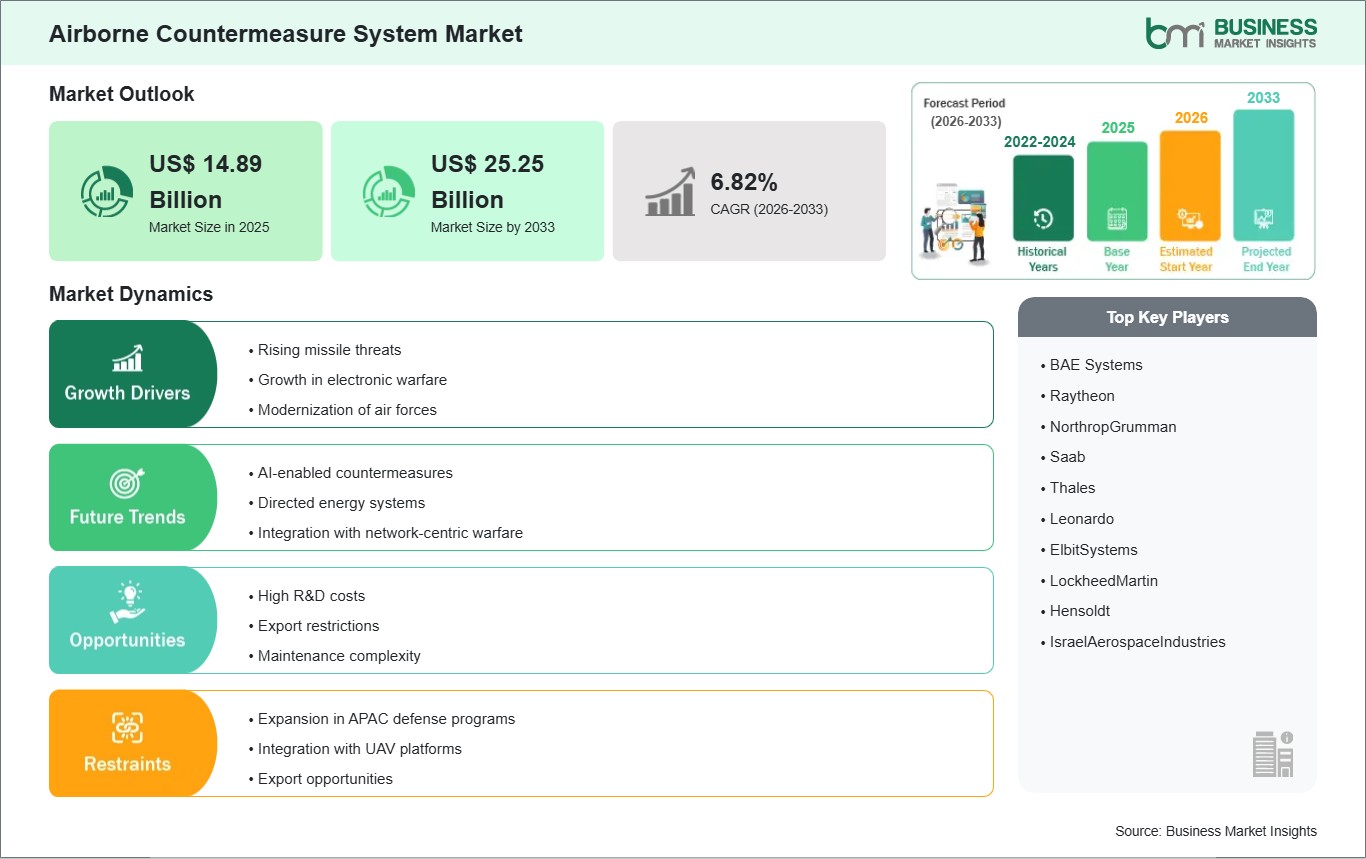
Airborne countermeasure systems are defensive technologies installed on aircraft to detect, prevent, and neutralize threats such as missiles, radar tracking systems, and electronic attacks. These systems include electronic countermeasures, infrared countermeasures, radar jamming technologies, and advanced warning systems that improve aircraft survivability during combat and surveillance operations. The Airborne Countermeasure System market is growing steadily due to increasing geopolitical tensions, modernization of military aircraft fleets, and rising investments in advanced defense technologies. Air forces and homeland security agencies are increasingly adopting integrated protection systems that can respond quickly to evolving airborne threats. The growing use of unmanned aerial vehicles and next-generation combat aircraft is also supporting demand for advanced airborne defense systems with improved detection and response capabilities.
Several challenges continue to affect market growth and deployment. The development and integration of airborne countermeasure systems involve high costs due to advanced electronics, software complexity, and strict defense standards. Many defense organizations face budget limitations when upgrading older aircraft with modern protection systems. The rapid evolution of missile guidance technologies and electronic warfare capabilities also creates continuous pressure for innovation and frequent system upgrades. In addition, interoperability issues between legacy aircraft platforms and new digital defense systems can delay deployment timelines. Strict export regulations and long procurement cycles in the defense sector may further limit market expansion in certain regions.
Despite these challenges, the market is expected to expand due to increasing focus on aircraft survivability and electronic warfare preparedness. Advances in artificial intelligence, sensor fusion, and automated threat detection are creating new opportunities for intelligent airborne defense systems. Defense agencies are increasingly investing in lightweight, compact, and multi-functional countermeasure technologies that improve operational efficiency without significantly affecting aircraft performance. The market is also benefiting from growing international defense collaborations and modernization programs aimed at strengthening air defense capabilities. Competitive activity remains strong, with companies focusing on integrated protection suites, advanced jamming technologies, and next-generation electronic warfare solutions.
Segment Analysis
Airborne Countermeasure System Market Segmentation
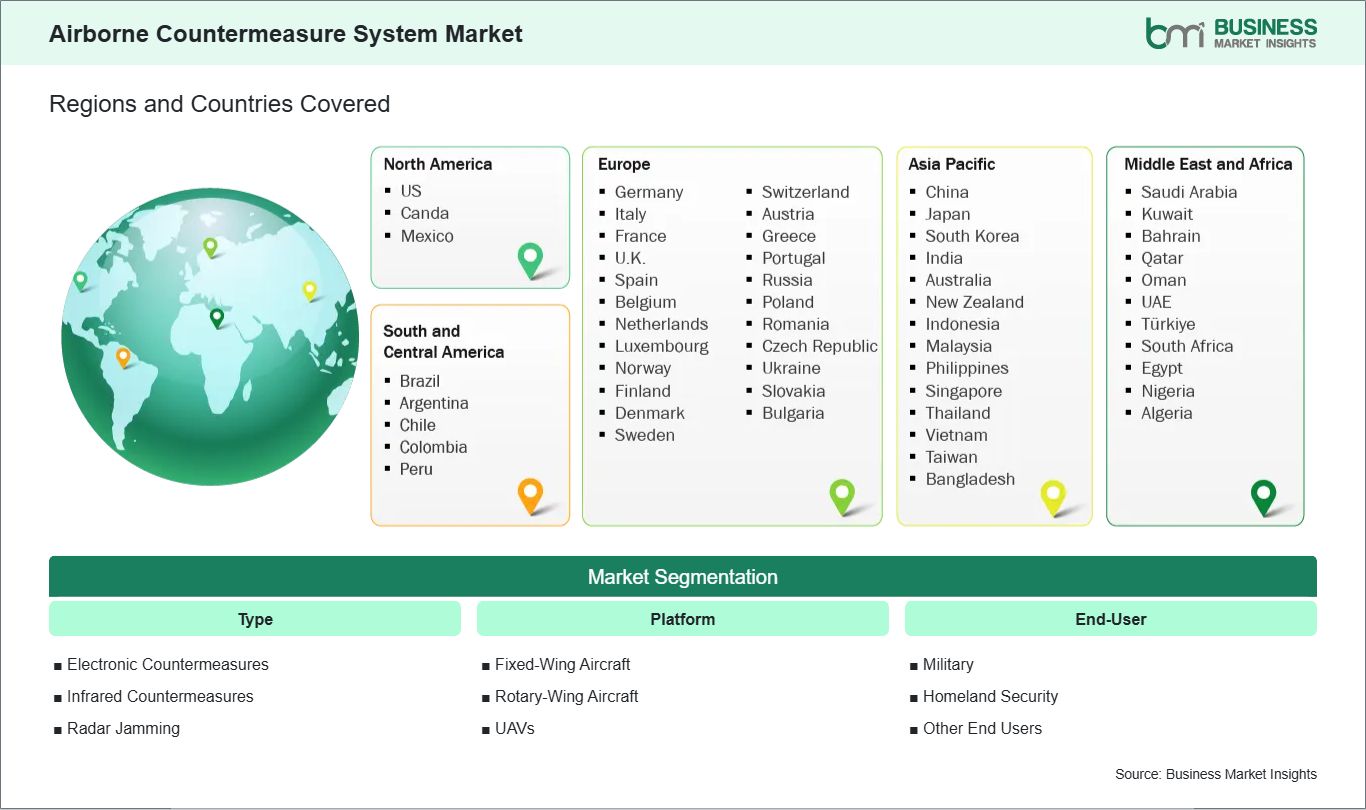
The Airborne Countermeasure System market is segmented based on type, platform, and end-user. Increasing investments in aircraft protection technologies and electronic warfare capabilities are supporting demand across major market segments.
By Type
- Electronic Countermeasures: Electronic countermeasures are used to disrupt enemy radar and communication systems during combat operations.
- Infrared Countermeasures: Infrared countermeasures help protect aircraft from heat-seeking missile threats through advanced detection and diversion systems.
- Radar Jamming: Radar jamming systems interfere with hostile radar signals to improve aircraft survivability in contested airspace.
By Platform
- Fixed-Wing Aircraft: Fixed-wing aircraft represent a major segment due to extensive deployment in military surveillance and combat missions.
- Rotary-Wing Aircraft: Rotary-wing aircraft use countermeasure systems for protection during tactical and low-altitude operations.
- UAVs: UAV platforms are increasingly adopting lightweight countermeasure technologies for secure intelligence and reconnaissance missions.
By End-User
- Military: Military organizations dominate the market due to continuous modernization of defense aircraft and electronic warfare systems.
- Homeland Security: Homeland security agencies utilize airborne countermeasure systems for border surveillance and threat response operations.
- Other End Users: Other end users include specialized defense units and government aviation security agencies.
Market Forces
Airborne Countermeasure System Market Drivers and Opportunities
Rising Focus on Aircraft Survivability and Electronic Warfare
The growing emphasis on aircraft survivability and electronic warfare preparedness is a major factor driving the Airborne Countermeasure System market. Modern combat environments involve advanced missile systems, radar-guided weapons, and electronic attacks that require highly responsive airborne defense technologies. Defense agencies are investing in advanced countermeasure systems to improve threat detection, avoid targeting, and ensure mission success during combat operations. Increasing geopolitical tensions and rising defense modernization programs are further supporting the adoption of integrated aircraft protection solutions across military aviation fleets.
Modern airborne countermeasure systems are becoming more intelligent and automated, allowing aircraft crews to respond quickly to multiple threats in complex operational environments. The demand for real-time threat identification and rapid electronic response capabilities is increasing as warfare technologies continue to evolve. In addition, there is an upgrading of old air forces with digital security devices to increase their effectiveness and longevity. Additionally, innovations in radar warning receivers, infrared detectors, and electronic jammers are contributing to improving the efficiency of the defense systems. Multirole combat aircraft and surveillance aircraft are likely to remain the dominant factors in demanding advanced airborne security systems.
Integration of AI and Lightweight Defense Technologies
The integration of artificial intelligence and lightweight defense technologies is creating significant opportunities for the Airborne Countermeasure System market. Modern defense programs are focusing on intelligent systems capable of autonomous threat analysis, predictive response, and faster electronic decision-making. Artificial intelligence and machine learning technologies are helping improve the accuracy of threat detection and reduce response time during airborne operations. These technologies also support efficient management of complex electronic warfare environments by analyzing multiple threat signals simultaneously.
The increasing deployment of UAVs (unmanned aerial vehicles) and future combat aircraft is motivating the design of small and light countermeasure devices. There is an emphasis by manufacturers on decreasing the dimensions and energy requirements of the system while at the same time increasing their efficiency. Opportunities are emerging for networking capabilities needed in the strategy of network-centric warfare. The increasing demand for modular and upgradeable systems is supporting innovation in flexible airborne defense technologies. In addition, international defense partnerships and modernization initiatives in developing economies are expected to create new long-term growth opportunities for airborne countermeasure system providers.
Size and Share Analysis
Airborne Countermeasure System Market Size and Share Analysis
The Airborne Countermeasure System Market is projected to grow from US$ 14.89 Billion in 2025 to US$ 25.25 Billion by 2033 , registering a CAGR of 6.82% from 2026 to 2033.
By type, electronic countermeasures account for a significant share due to their critical role in disrupting radar systems and improving aircraft defense capabilities. Infrared countermeasures are witnessing growing demand with the increasing threat from heat-seeking missile systems, while radar jamming technologies continue to expand as military organizations invest in advanced electronic warfare solutions.
By platform, fixed-wing aircraft dominate the market owing to their extensive deployment in combat, surveillance, and intelligence operations. Rotary-wing aircraft are also adopting advanced countermeasure systems for tactical missions and low-altitude operations. UAVs represent a growing segment as defense agencies increasingly integrate protection systems into unmanned platforms used for reconnaissance and surveillance. Military organizations remain the leading end users due to continuous investments in aircraft modernization and advanced defense preparedness programs.
Report Coverage
Airborne Countermeasure System Market Report Coverage and Deliverables
The "Airborne Countermeasure System Size and Forecast (2022-2033)" report provides a detailed analysis of the market covering below areas:
- Market size and forecast at global, regional, and country levels for all the key market segments covered under the scope
- Market trends, as well as market dynamics such as drivers, restraints, and key opportunities
- Market analysis covering key market trends, global and regional framework, major players, regulations, and recent market developments
- Industry landscape and competition analysis covering market concentration, heat map analysis, prominent players, and recent developments for the market
- Detailed company profiles, including SWOT analysis
Geographic Insights
Airborne Countermeasure System Market Geographic Insights
The Airborne Countermeasure System Market shows diverse regional adoption patterns influenced by defense modernization programs, increasing geopolitical tensions, and rising investments in advanced electronic warfare technologies.
North America, being a developed region, has a highly advanced defense infrastructure and strong adoption of airborne protection technologies. The region comprises the United States and Canada, where defense agencies continue investing in aircraft survivability systems and next-generation electronic warfare capabilities. The region focuses on integrating advanced radar warning systems, infrared countermeasures, and intelligent jamming technologies into military aircraft fleets. Defense funding, aerospace industry capabilities, and constant modernization efforts facilitate the introduction of airborne countermeasure systems on both fixed winged aircrafts, helicopters, and unmanned aerial vehicles. Furthermore, this region is known to be involved in the research and development of warfare in cyberspace and air defense systems.
Asia Pacific is growing significantly, driven by increasing regional security concerns and expanding military aviation capabilities. The region comprises countries such as China, India, Japan, and South Korea, where governments are investing in modern combat aircraft and advanced airborne defense technologies. The region is concentrating its efforts on enhancing its readiness in the field of national defense and protecting its aircraft from any missile attacks. Growing procurement trends for UAVs and multirole fighter aircraft have also been instrumental in driving the growth of the market. Investments in indigenous development of aerospace industries and their defense mechanisms have also played an important role.
Both regions are contributing significantly to the growth of the Airborne Countermeasure System Market, focusing on defense modernization, aircraft survivability enhancement, and the development of advanced electronic warfare capabilities.
Industry Activity
Recent Developments
The Airborne Countermeasure System Market is analyzed using a mix of primary and secondary research sources, including corporate publications, industry associations, and verified databases. This approach ensures accurate tracking of innovation trends and strategic developments influencing the market.
- In April 2024, Northrop Grumman announced progress in the development of advanced infrared countermeasure systems designed to improve aircraft survivability against evolving missile threats. The company highlighted enhancements in threat detection accuracy and automated response capabilities for military aircraft applications.
- In September 2023, BAE Systems introduced upgraded electronic warfare and radar jamming technologies for airborne defense platforms. The development focused on improving electronic protection capabilities and supporting modern combat aircraft operating in complex threat environments.
Trust & Transparency
Research Methodology
The market analysis combines proprietary research with secondary data from government agencies, company disclosures, regulatory filings, industry databases and expert interviews. Market estimates are validated through data triangulation, cross-market benchmarking and analyst
review.
View Full Research Methodology
Key Sources Referred:
World Bank - Global Trade Indicators World Trade Organization (WTO) International Monetary Fund (IMF) International Trade Administration (ITA) Company Websites Company Annual Reports Company Investor Presentations