Market Summary
Executive Summary and Global Market Analysis
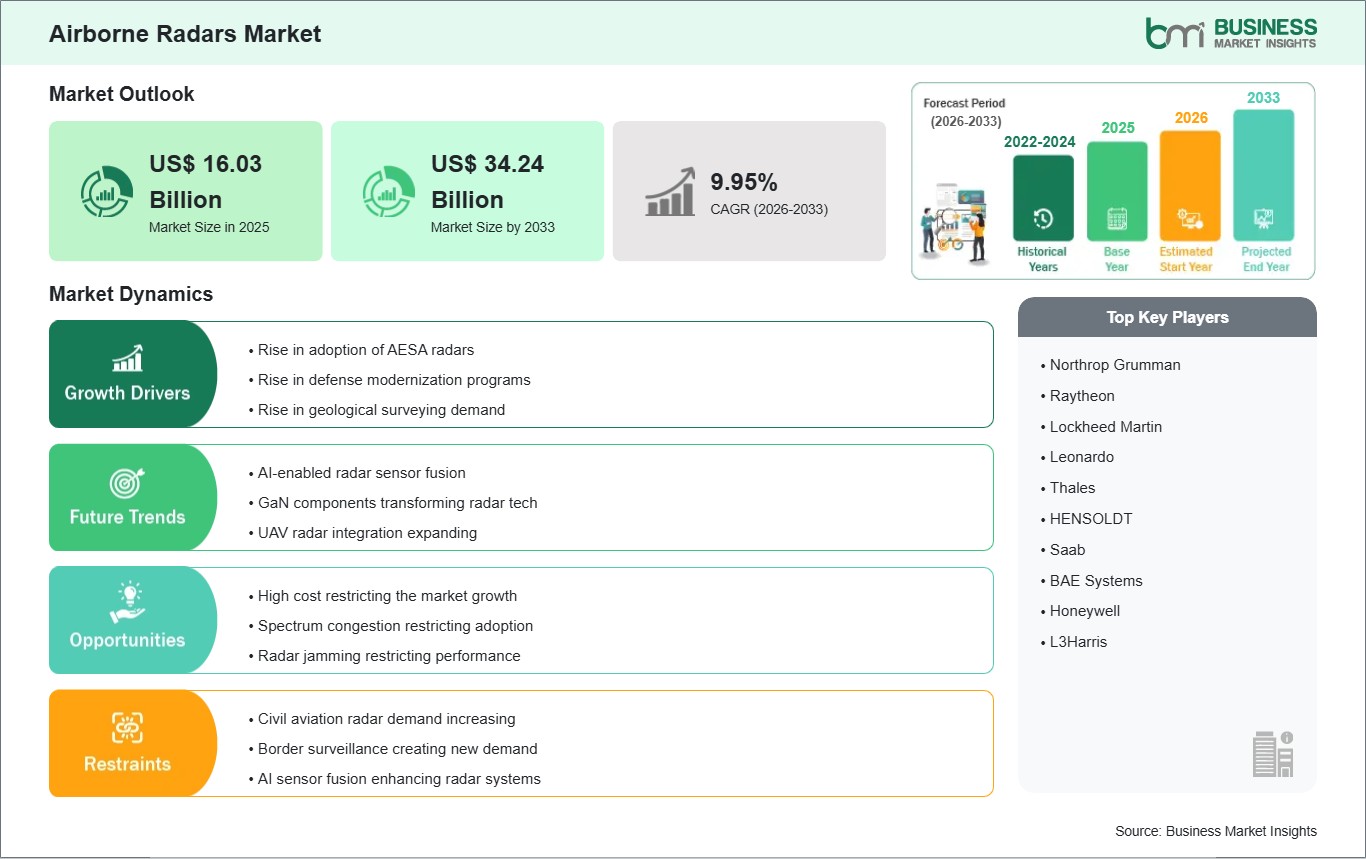
Airborne radars are advanced detection and surveillance systems installed on aircraft to identify, track, and monitor objects in the air, on land, and at sea. These systems are widely used in military aircraft, commercial aviation, border surveillance, and intelligence missions. Modern airborne radars support navigation, target acquisition, weather monitoring, collision avoidance, and reconnaissance activities. The market is expanding steadily due to rising defense modernization programs, increasing deployment of unmanned aerial vehicles, and growing demand for real-time situational awareness. The adoption of electronically scanned array technologies and compact radar architectures is also improving operational performance across different aircraft platforms.
Several challenges continue to influence market growth. High development and integration costs associated with advanced radar technologies can limit adoption, especially in cost-sensitive aviation programs. Complex maintenance requirements and the need for regular software upgrades also increase operational expenses. In military environments, airborne radars must operate effectively against electronic warfare systems and signal interference, creating additional technical challenges. Regulatory approval processes for airborne systems and compatibility requirements with existing aircraft infrastructure can further delay deployments. Limited availability of skilled personnel for radar integration and system calibration also affects implementation timelines in some regions.
Despite these challenges, the market is expected to benefit from continued investments in next-generation surveillance and defense systems. Opportunities are increasing with the growing use of active electronically scanned array radars, artificial intelligence-enabled tracking systems, and lightweight radar solutions for UAVs. Defense agencies are focusing on multi-mission aircraft equipped with advanced sensing technologies to improve operational efficiency. Commercial aviation is also adopting improved airborne weather and navigation radars to support flight safety and route optimization. Continuous innovation in signal processing, sensor fusion, and autonomous aircraft operations is expected to create long-term growth opportunities for the Airborne Radars market.
Segment Analysis
Airborne Radars Market Segmentation
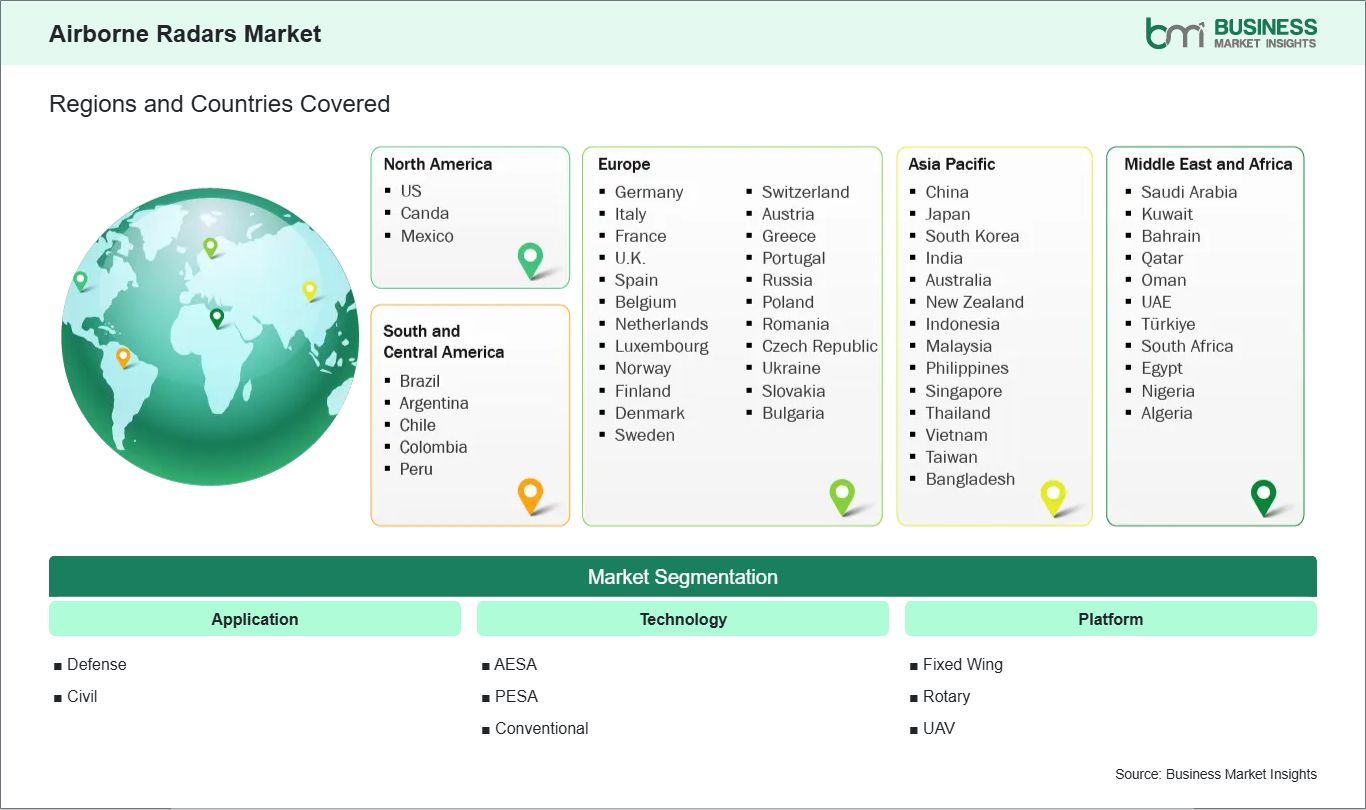
The Airborne Radars market is segmented based on application, technology, and platform. Growing demand for surveillance, tracking, and navigation systems across defense and civil aviation sectors is supporting the adoption of advanced airborne radar technologies.
By Application
- Defense: Defense applications account for a major share due to increasing military modernization programs, border surveillance activities, and airborne combat operations.
- Civil: Civil aviation uses airborne radars for weather detection, navigation support, collision avoidance, and air traffic monitoring.
By Technology
- AESA: AESA radars are gaining strong adoption because of their superior tracking capability, faster target detection, and resistance to electronic interference.
- PESA: PESA systems continue to be used in several military aircraft due to their operational reliability and established deployment history.
- Conventional: Conventional radar technologies remain relevant in older aircraft fleets and cost-sensitive aviation applications.
By Platform
- Fixed Wing: Fixed-wing aircraft represent a major platform segment due to their extensive use in combat, reconnaissance, and surveillance missions.
- Rotary: Rotary-wing aircraft use airborne radars for tactical navigation, maritime surveillance, and search-and-rescue operations.
- UAV: UAV platforms are increasingly integrating lightweight radar systems for intelligence gathering and autonomous monitoring missions.
Market Forces
Airborne Radars Market Drivers and Opportunities
Rising Defense Modernization and Surveillance Requirements
The increasing focus on national security and airspace monitoring is driving demand for advanced airborne radar systems across military aviation sectors. Governments are investing in modern fighter aircraft, airborne early warning systems, maritime patrol aircraft, and intelligence platforms to strengthen defense capabilities. Airborne radars help military forces detect aerial threats, monitor borders, and improve battlefield awareness in real time. The growing use of network-centric warfare and integrated defense operations is also increasing the need for high-performance radar systems that can support multiple missions simultaneously.
Technological improvements in radar range, target identification, and electronic protection are making airborne systems more efficient and reliable. Modern radar platforms are designed to operate in complex combat environments while reducing detection risks. Regulatory focus on airspace safety and strategic defense preparedness is further encouraging investment in radar-equipped aircraft. Increasing geopolitical tensions and rising demand for advanced surveillance infrastructure are expected to continue supporting long-term market growth. The integration of radar systems with artificial intelligence and advanced communication networks is also improving operational decision-making and mission effectiveness across military aviation programs.
Expansion of UAV and Smart Aviation Technologies
The growing deployment of unmanned aerial vehicles and smart aviation technologies is creating significant opportunities for the Airborne Radars market. UAVs are increasingly used for reconnaissance, environmental monitoring, border patrol, disaster response, and commercial surveying activities. These platforms require compact and lightweight radar systems capable of delivering accurate detection and tracking capabilities. Advances in miniaturized electronics and sensor integration are supporting the development of efficient radar solutions for small and medium-sized UAVs.
Commercial aviation is also moving toward smarter navigation and automated flight operations, increasing the demand for advanced airborne sensing technologies. Radar systems integrated with real-time analytics and predictive monitoring tools can improve flight safety, weather forecasting, and operational efficiency. The growing use of autonomous aircraft and urban air mobility platforms is expected to create new application areas for airborne radar technologies. Research activities focused on enhanced imaging resolution, low-power radar systems, and multi-function sensing platforms are further expanding innovation opportunities. Increasing adoption of connected aviation ecosystems and digital airspace management systems is likely to support future market expansion across both defense and civil aviation sectors.
Size and Share Analysis
Airborne Radars Market Size and Share Analysis
The Airborne Radars Market is projected to grow from US$ 16.03 Billion in 2025 to US$ 34.24 Billion by 2033 , registering a CAGR of 9.95% from 2026 to 2033.
By application, defense accounts for a significant share due to the increasing deployment of radar-equipped combat aircraft, surveillance platforms, and airborne early warning systems. Civil aviation is also witnessing steady growth with rising demand for advanced navigation, weather monitoring, and collision avoidance systems to improve operational safety and flight efficiency.
By technology, AESA radars dominate the market because of their superior tracking accuracy, faster scanning capability, and improved resistance to electronic warfare systems. PESA radars continue to maintain demand in several established military platforms, while conventional radar systems remain relevant in legacy aircraft fleets and cost-sensitive aviation programs. By platform, fixed-wing aircraft lead the market owing to their extensive use in long-range surveillance and defense operations, while UAV platforms are expanding rapidly with the increasing adoption of autonomous aerial monitoring systems.
Report Coverage
Airborne Radars Market Report Coverage and Deliverables
The "Airborne Radars Size and Forecast (2022-2033)" report provides a detailed analysis of the market covering below areas:
- Market size and forecast at global, regional, and country levels for all the key market segments covered under the scope
- Market trends, as well as market dynamics such as drivers, restraints, and key opportunities
- Market analysis covering key market trends, global and regional framework, major players, regulations, and recent market developments
- Industry landscape and competition analysis covering market concentration, heat map analysis, prominent players, and recent developments for the market
- Detailed company profiles, including SWOT analysis
Geographic Insights
Airborne Radars Market Geographic Insights
The Airborne Radars Market shows diverse regional adoption patterns influenced by defense modernization programs, aviation infrastructure development, security priorities, and technological advancement across military and civil aviation sectors.
North America remains one of the most mature markets for airborne radars due to strong investments in military aviation, surveillance systems, and aerospace innovation. The United States continues to deploy advanced radar systems across fighter aircraft, reconnaissance platforms, and unmanned aerial vehicles to strengthen national defense capabilities. Canada is also focusing on improving airborne surveillance infrastructure and upgrading defense aircraft systems. The region benefits from established aerospace manufacturing capabilities, advanced research programs, and high adoption of electronically scanned radar technologies. Civil aviation operators in North America are increasingly integrating advanced weather and navigation radar systems to improve operational efficiency and flight safety.
Asia Pacific is witnessing rapid growth in the Airborne Radars market due to increasing defense budgets, expanding aircraft fleets, and rising geopolitical tensions. Countries such as China, India, Japan, and South Korea are investing in airborne surveillance systems, modern combat aircraft, and UAV technologies to strengthen regional security operations. The growing focus on indigenous aerospace manufacturing and defense modernization is supporting demand for advanced radar technologies across the region. Increasing airport expansion projects and improvements in aviation infrastructure are also encouraging the adoption of airborne navigation and weather radar systems. Rising interest in border monitoring and maritime surveillance further supports long-term market development in Asia Pacific.
Industry Activity
Recent Developments
The Airborne Radars Market is analyzed using a mix of primary and secondary research sources, including corporate publications, industry associations, and verified databases. This approach ensures accurate tracking of innovation trends and strategic developments influencing the market.
- In February 2024, RTX announced the successful flight testing of its PhantomStrike airborne fire-control radar. The radar was designed to provide advanced sensing capability in a smaller and lighter configuration suitable for modern combat aircraft and UAV applications. The development highlighted increasing industry focus on compact AESA radar technologies for next-generation airborne platforms.
- In June 2023, Leonardo expanded its global tactical radar footprint by entering into a strategic joint development agreement with Hanwha Systems at the Paris Air Show. The joint venture seeks to develop an AESA radar specifically for the very dynamic LCA export market. This strategy is part of the current trends in global defense where major companies merge their sensor capabilities to overcome costly production costs and secure market shares in multi-role military aviation.
Trust & Transparency
Research Methodology
The market analysis combines proprietary research with secondary data from government agencies, company disclosures, regulatory filings, industry databases and expert interviews. Market estimates are validated through data triangulation, cross-market benchmarking and analyst
review.
View Full Research Methodology
Key Sources Referred:
World Bank - Global Trade Indicators World Trade Organization (WTO) International Monetary Fund (IMF) International Trade Administration (ITA) Company Websites Company Annual Reports Company Investor Presentations