
Coherent Radar Market Outlook: Size, Share, Trends, Growth Analysis, Competitive Landscape & Forecast, 2026-2033

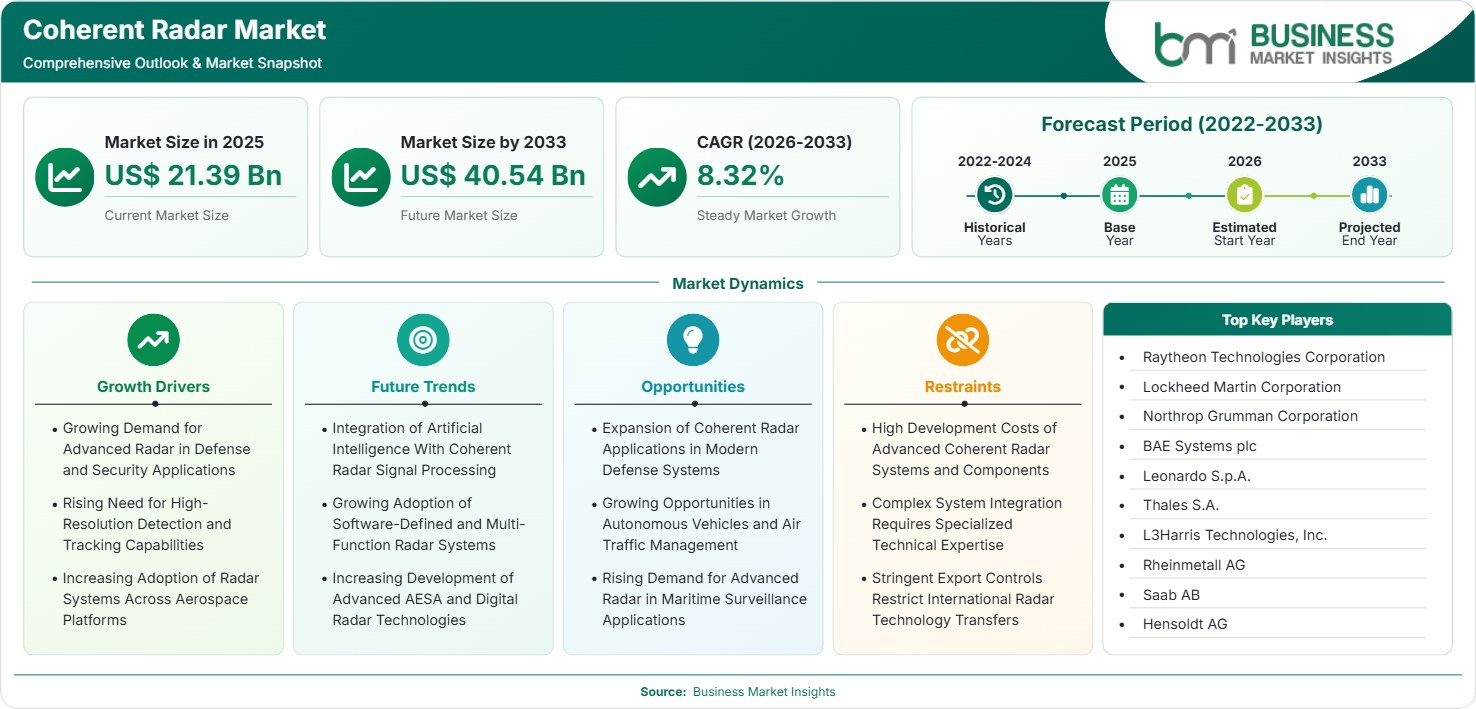
The Coherent Radar Market size was valued at US$ 21.39 Billion in 2025 and is projected to reach US$ 40.54 Billion by 2033, growing at a CAGR of 8.32% during 2026–2033, driven by defense modernization, counter-UAS deployment, high-resolution tracking, aerospace upgrades, maritime security, and air-traffic management.

Report Coverage
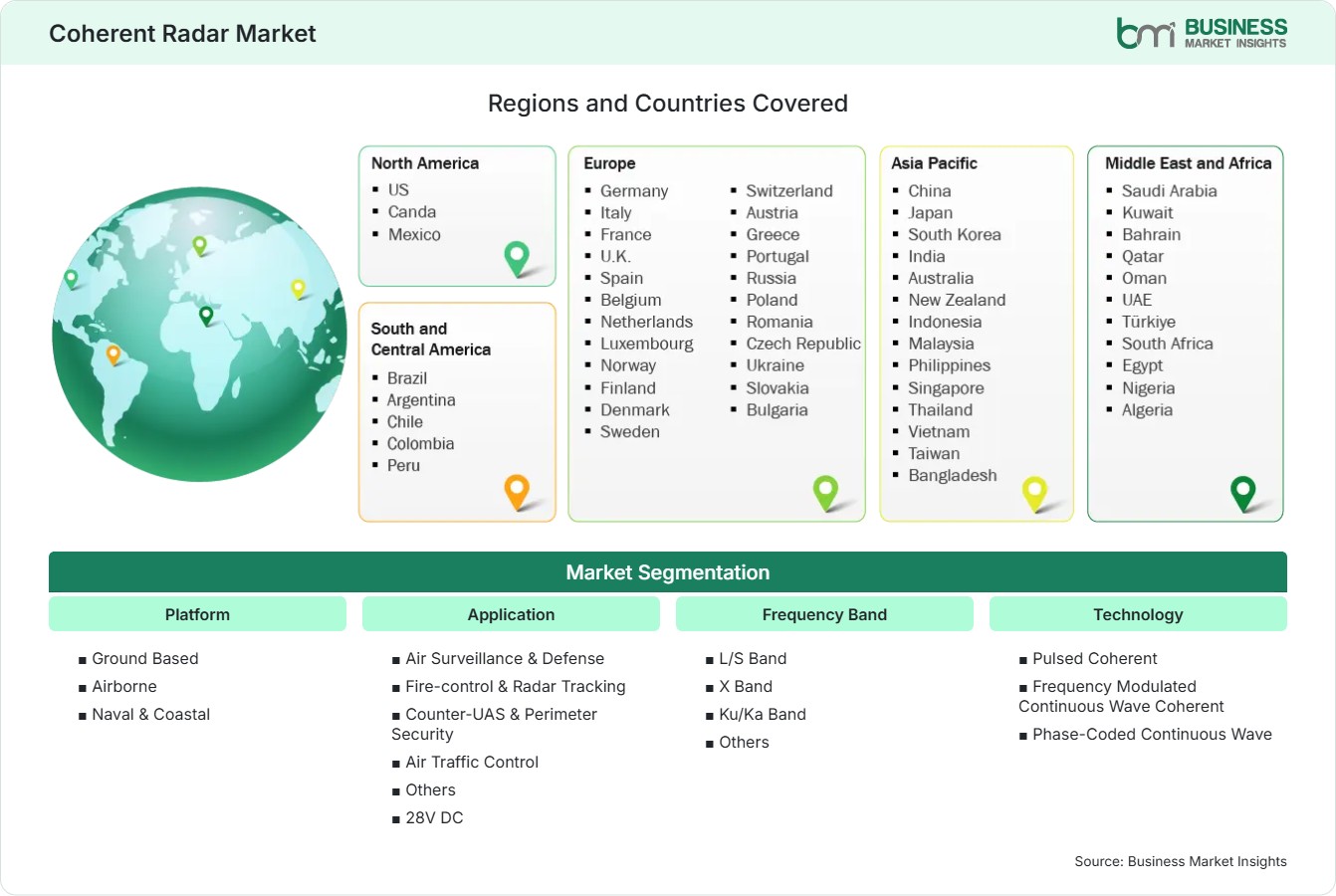
  • Platform: Ground Based, Airborne, Naval & Coastal
  • Application (Air Surveillance & Defense, Fire-control & Radar Tracking, Counter-UAS & Perimeter Security, Air Traffic Control, Others), 28V DC
  • Frequency Band (L/S Band, X Band, Ku/Ka Band, Others
  • Technology: Pulsed Coherent, Frequency Modulated Continuous Wave Coherent, Phase-Coded Continuous Wave
  • Component: Antenna, Receiver & Processor, Transmitter, Others
US$ 21.39 Bn Market size in 2025
US$ 40.54 Bn Market Size by 2033
8.32% CAGR, 2026 - 2033
2026-2033 Forecast Period

AI Overview

Coherent Radar Market Summary

  • North America Region: North America holds market share of 34%–38% in 2025, growing with a CAGR of 7.5%–8.3%, supported by defense modernization, missile defense, counter-UAS systems, airborne platforms, and advanced air surveillance. The US market holds 30%–34% share, with a CAGR of 7.7%–8.5%, driven by high defense spending, next-generation radar procurement, and modernization of layered air-defense systems.
  • Fastest Growing Region: Asia Pacific holds market share of 23%–27% in 2025, growing with a CAGR of 9.0%–10.0%, driven by defense modernization, territorial surveillance, airborne radar deployment, maritime security, and increasing investment in indigenous radar manufacturing capabilities.
  • Leading Segment: Ground Based holds market share of 43%–47% in 2025, growing with a CAGR of 7.6%–8.4%, supported by integrated air defense, long-range surveillance, counter-UAS requirements, border security, and persistent detection capabilities.
  • High Growth Segment: Counter-UAS & Perimeter Security holds market share of 12%–16% in 2025, growing with a CAGR of 10.0%–11.0%, driven by drone proliferation, critical-infrastructure protection, low-altitude threat detection, and demand for rapid multi-target tracking.
  • Key Market Opportunity: Defense modernization, autonomous platforms, maritime surveillance, and air-traffic management are expanding coherent radar applications, creating opportunities for software-defined architectures, AI-enabled processing, multifunction systems, and scalable sensor networks.
  • Major Market Players: Raytheon Technologies Corporation, Lockheed Martin Corporation, Northrop Grumman Corporation, BAE Systems plc, Leonardo S.p.A., Thales S.A., L3Harris Technologies, Inc., Rheinmetall AG, Saab AB, and HENSOLDT AG.
Strategic Insights

Coherent Radar Market: Strategic Insights

Coherent Radar Market Strategic Framework
FREE PDF
Request your free sample
Request free sample
Stakeholder View

Key Takeaways

  • The supply ecosystem is moving toward vertically integrated radar architectures combining antennas, transmitters, receivers, processors, software, and electronic warfare capabilities. Companies with control over signal processing and system integration are better positioned to capture higher-value contracts.
  • Counter-UAS and perimeter security represent a particularly attractive growth avenue as defense agencies and critical-infrastructure operators require affordable detection and tracking against increasingly numerous low-altitude unmanned threats.
  • Software-defined radar, AI-enabled signal classification, GaN-based transmitters, digital beamforming, and multifunction AESA architectures are reshaping product development by increasing adaptability while reducing the need for hardware-specific mission configurations.
  • Asia Pacific provides a compelling investment opportunity because defense modernization, maritime disputes, border surveillance requirements, and domestic radar manufacturing programs are creating demand across ground, airborne, and naval platforms.
  • The competitive landscape is increasingly influenced by long-term defense contracts, technology partnerships, and domestic production initiatives. Recent procurement activity indicates growing investment in advanced radar for air defense, counter-UAS, and next-generation combat aircraft.
Geographic Outlook

Coherent Radar Market Regional Highlights

North America Coherent Radar Market

North America represents a Coherent Radar Market share of 34%–38% in 2025 and records a CAGR of 7.5%–8.3% during 2026–2033. The region benefits from substantial defense procurement, advanced aerospace manufacturing, missile-defense modernization, and counter-UAS deployment. The US accounts for most regional demand, supported by layered air-defense investments and advanced sensor development. Canada contributes through aerospace and surveillance programs. Demand is increasingly directed toward multifunction systems combining detection, tracking, electronic warfare, and networked data sharing.

  • Defense modernization programs are increasing demand for advanced ground-based and airborne radar capable of tracking cruise missiles, unmanned systems, and complex aerial threats.
  • Counter-UAS requirements are expanding procurement opportunities as military installations and critical infrastructure require persistent detection of small, low-altitude targets.
  • The US remains the principal regional market, supported by sustained investment in missile defense, next-generation combat aircraft, air surveillance, and integrated sensor networks.

US Coherent Radar Market

The US represents market share of 30%–34% in 2025 and US Coherent Radar Market forecast to grow CAGR of 7.7%–8.5% through 2033. Demand is supported by high defense expenditure, modernization of air and missile defense, and increasing counter-UAS requirements.

  • Advanced air-defense procurement is sustaining demand for radar with improved detection, tracking, discrimination, and simultaneous engagement-support capabilities.
  • Counter-UAS deployment is increasing demand for mobile radar systems that can detect small targets and integrate with layered defensive architectures.
  • The market is moving toward software-defined and multifunction radar, enabling electronic warfare, surveillance, and spectrum-management functions within flexible architectures.

Europe Coherent Radar Market

Europe accounts for a Market share of 21%–25% in 2025 and records a CAGR of 8.0%–8.8% through 2033. Germany, the UK, France, Italy, and Sweden remain leading markets, while Poland and the Nordic region provide higher-growth opportunities. Rising defense procurement and renewed emphasis on air defense are strengthening demand for surveillance and tracking systems.

  • Germany remains a leading market because of defense-electronics capabilities, air-defense modernization, and increasing investment in integrated surveillance systems.
  • The UK is strengthening airborne radar capabilities through Typhoon modernization, with ECRS Mk2 designed to detect, identify, and track multiple air and ground targets.
  • Poland represents a high-growth market at a CAGR of 10.0%–11.0%, supported by defense modernization and investment in layered air-defense capabilities.
  • Sweden and Nordic markets offer growth at 9.0%–10.0%, driven by regional security priorities and demand for mobile surveillance and air-defense radar.

Asia Pacific Coherent Radar Market

Asia Pacific represents a market share of 23%–27% in 2025 and achieves a CAGR of 9.0%–10.0% through 2033. China, Japan, South Korea, India, and Australia remain leading demand centers, while India and Southeast Asia offer higher-growth opportunities. Growing emphasis on long-range detection and integrated air defense is increasing the need for advanced coherent radar across ground, airborne, and naval platforms.

  • China remains a major regional market because of extensive investment in air defense, aerospace systems, maritime surveillance, and indigenous radar technologies.
  • India offers a CAGR of 10.0%–11.0%, supported by defense modernization, domestic manufacturing initiatives, border surveillance, and increasing demand for advanced air-defense systems.
  • Japan and South Korea maintain sophisticated radar ecosystems focused on missile detection, air surveillance, maritime security, and integrated defense networks.
  • Southeast Asia provides a CAGR of 9.5%–10.5%, supported by maritime-domain awareness, territorial surveillance, and modernization of national security infrastructure.

Rest of World Coherent Radar Market

South and Central America account for approximately 6%–9% of regional demand in 2025 and record a CAGR of 6.5%–7.5%. Brazil and Mexico represent leading markets, supported by border surveillance, airspace monitoring, maritime security, and modernization of defense assets. The Middle East and Africa represent approximately 8%–11% share in 2025 and achieve a CAGR of 8.0%–9.0%. Saudi Arabia, the UAE, Israel, and Türkiye remain important markets, while Gulf states provide high-value opportunities through air defense, maritime surveillance, and critical-infrastructure security.

  • Brazil remains a leading Latin American market, with radar demand supported by border monitoring, airspace surveillance, and protection of strategic infrastructure.
  • Mexico provides growth opportunities through maritime security, border surveillance, and increasing adoption of modern security technologies.
  • Saudi Arabia and the UAE represent high-value markets, with demand focused on integrated air defense, critical infrastructure, and advanced surveillance.
  • Türkiye and Israel maintain strong technology ecosystems, supporting regional innovation in radar, electronic warfare, and autonomous defense applications.
Global Market Geography
FREE PDF
Request your free sample
Request free sample
Segment Analysis

Coherent Radar Market Segmentation

Platform

Ground Based accounted for a Coherent Radar market share of 43%–47% in 2025 and is projected to grow at a CAGR of 7.6%–8.4% between 2026–2033. Ground-based platforms remain central to persistent surveillance, air defense, border monitoring, and counter-UAS operations. Naval and coastal platforms benefit from maritime-domain awareness and vessel tracking requirements.

  • Ground Based: Ground systems provide persistent long-range surveillance and air-defense coverage, supporting missile detection, counter-UAS operations, border monitoring, and critical-infrastructure protection.
  • Airborne: Airborne radar supports fighter aircraft, surveillance platforms, and unmanned systems, with demand driven by compact AESA architectures and improved multi-target tracking.
  • Naval & Coastal: Naval and coastal systems enable maritime surveillance, vessel detection, fire control, and coastal monitoring, benefiting from rising maritime-security requirements and autonomous vessel activity.

Application

Air Surveillance & Defense remains the leading application, representing a Coherent Radar Market share of 38%–42% in 2025 and expanding at a CAGR of 7.8%–8.6% between 2026–2033. Demand is driven by integrated air-defense networks, missile threats, and increasingly complex aerial environments.

  • Air Surveillance & Defense: Advanced radar enables continuous monitoring, target classification, and threat prioritization, supporting integrated defense networks and protection against complex aerial threats.
  • Fire-control & Radar Tracking: High-precision tracking supports weapon guidance and engagement decisions, with demand driven by improved accuracy requirements and multi-target operational environments.
  • Counter-UAS & Perimeter Security: Small-drone proliferation is increasing demand for high-resolution detection and tracking systems capable of identifying low-altitude threats near sensitive facilities.
  • Air Traffic Control: Radar supports aircraft separation and airspace management, while modernization programs encourage digital processing and improved surveillance coverage.

Frequency Band

L/S Band accounted for a Coherent Radar Market share of 32%–36% in 2025 and is projected to grow at a CAGR of 7.4%–8.2% between 2026–2033. Lower-frequency systems provide advantages in long-range surveillance and detection applications. X Band remains important for high-resolution tracking and fire-control functions. Frequency selection increasingly depends on mission requirements, target characteristics, atmospheric conditions, and spectrum availability.

  • L/S Band: Lower-frequency radar supports long-range surveillance and early warning, making it important for air-defense networks and wide-area detection requirements.
  • X Band: X Band provides high-resolution detection and tracking, supporting fire control, maritime surveillance, weather applications, and precision target monitoring.
  • Ku/Ka Band: Higher-frequency systems enable compact architectures and fine-resolution sensing, supporting specialized tracking, imaging, autonomous platforms, and short-range security applications.

Technology

Pulsed Coherent systems represented a Coherent Radar Market share of 54%–58% in 2025 and are projected to grow at a CAGR of 7.5%–8.3% between 2026–2033. Their established use in long-range surveillance and defense supports continued adoption. Software-defined processing is increasingly influencing all three technology categories.

  • Pulsed Coherent: Pulsed systems support long-range detection and military surveillance, benefiting from mature architectures and established integration across defense platforms.
  • Frequency Modulated Continuous Wave Coherent: FMCW systems offer continuous sensing and strong range-resolution capabilities, supporting compact radar applications, autonomous systems, and short-range security.
  • Phase-Coded Continuous Wave: Phase-coded systems provide waveform flexibility and improved signal processing opportunities, supporting advanced detection, interference management, and specialized defense applications.

Component

Receiver & Processor represented a Coherent Radar Market share of 28%–32% in 2025 and is projected to grow at a CAGR of 8.2%–9.0% between 2026–2033. Processing capabilities increasingly determine radar performance as AI, digital beamforming, and advanced signal classification become integrated. Antennas remain essential for coverage and beam steering, while transmitters benefit from GaN technology and improvements in power efficiency.

  • Antenna: Advanced antennas support electronic beam steering, wider coverage, and multi-target tracking, with AESA architectures gaining importance across modern defense platforms.
  • Receiver & Processor: High-performance processing enables Doppler analysis, target classification, clutter rejection, and AI-assisted detection, making this component central to radar intelligence.
  • Transmitter: Modern transmitters increasingly use GaN and solid-state architectures to improve power density, reliability, efficiency, and multifunction performance.

End Use

Defense & Security represented a Coherent Radar Market share of 72%–76% in 2025 and is projected to grow at a CAGR of 8.0%–8.8% between 2026–2033. Defense remains the largest end-use segment because coherent radar supports air defense, surveillance, fire control, missile warning, and counter-UAS operations. Aerospace demand is supported by fighter aircraft upgrades and airborne surveillance. Other applications include air traffic management, maritime safety, weather monitoring, and specialized industrial surveillance, providing diversification beyond military procurement.

  • Defense & Security: Defense organizations deploy coherent radar for surveillance, air defense, fire control, missile warning, border monitoring, and counter-UAS missions across complex operational environments.
  • Aerospace: Aerospace applications include fighter aircraft, airborne early warning, surveillance aircraft, and unmanned systems requiring precise target detection and tracking.
Market Forces

Coherent Radar Market Dynamics

Key Market Drivers

Growing Demand for Advanced Radar in Defense and Security Applications

Defense modernization is one of the key drivers since governments aim to build stronger capability against cruise missiles, hypersonic threat, UAVs, and LO threats. Coherent processing enhances Doppler estimation, clutter rejection, and target classification and hence its importance in layered air-defense systems. Increased purchase of mobile surveillance platforms and multifunction AESA radars is creating more business chances for well-known defense companies. This coherent radar market trend in the number of drones is driving need for radars that can detect small and slow targets.

Rising Need for High-Resolution Detection and Tracking Capabilities

Modern operational environments, it is necessary for radar systems to differentiate between multiple targets that function in a cluttered or contested electromagnetic environment. Coherent processing aids in better estimation of Doppler frequencies and allows discrimination, and digital beamforming and enhanced signal processing lead to resolution and tracking capabilities. With small and multiple threats emerging, it is becoming necessary to have high-resolution detection capability, and it is leading to development in receiver technology.

Increasing Adoption of Radar Systems Across Aerospace Platforms

Aerospace platforms are using more advanced radar due to the increasing complexity of the missions that aircraft carry out and the need for enhanced situational awareness. Advanced radar technology is needed in fighter aircraft due to the need for multiple targets detection, tracking and electronic warfare, and the same applies to surveillance aircraft to enable continuous surveillance within a wide operating area. Radar modernization is being achieved through software, digital processing and electronically scanned array advancements. This modernization cycle supports demand for high-performance coherent radar across aerospace fleets.

Key Market Opportunities

Expansion of Coherent Radar Applications in Modern Defense Systems

The integration of coherent radar into networked defense architectures creates opportunities for suppliers offering multifunction and software-defined systems. Modern military networks increasingly connect radar sensors with command-and-control platforms, electronic warfare systems, missile batteries, and other surveillance assets. This architecture allows radar data to support multiple missions and enables distributed sensing across wider areas. Vendors that develop open architectures, modular processing, and upgradeable software can capture recurring modernization revenue while reducing customer dependence on complete system replacement.

Growing Opportunities in Autonomous Vehicles and Air Traffic Management

Autonomous mobility and air traffic management create commercial opportunities for coherent radar beyond traditional defense procurement. Autonomous vehicles require accurate object detection and velocity measurement under adverse visibility, while advanced air traffic systems require reliable surveillance and tracking across increasingly complex airspace. Autonomous aerial systems also require compact radar for navigation and obstacle detection. Suppliers capable of adapting defense-grade signal processing to cost-sensitive commercial platforms can access new markets, although certification, safety requirements, and system economics remain important considerations.

Rising Demand for Advanced Radar in Maritime Surveillance Applications

Maritime surveillance presents an expanding opportunity as governments seek improved monitoring of territorial waters, ports, offshore infrastructure, and commercial shipping routes. Modern coastal radar can provide persistent detection of small vessels and support maritime-domain awareness across complex environments. Growing offshore energy infrastructure and increasing concerns around maritime security can expand demand for advanced radar networks. Suppliers offering modular systems with flexible installation, 360-degree coverage, and software upgrades are well positioned to address diverse coastal surveillance requirements.

Market Restraints and Challenges

High Development Costs of Advanced Coherent Radar Systems and Components

Factor: Advanced coherent radars entail considerable costs for high-performance antennas, transmitters, receivers, processors, semiconductor electronics, software, electromagnetic compatibility testing, and environmental qualification. The use of AESA design and gallium nitride technology may further increase development and production costs. Impact: High initial costs prevent small technology firms from participating and extend the time required to make the product profitable. Defense customers may also require extensive testing and certification, thereby increase program costs and delay procurement.

Complex System Integration Requires Specialized Technical Expertise

Factor: Coherent radar must incorporate antennas, radio-frequency electronics, signal processors, software, communications networks, command systems, and electronic warfare capabilities so that they all work together under difficult environmental conditions. Successful integration demands particular expertise in radio frequency engineering, signal processing, cyber security, spectrum management, and systems integration. Impact: The complexity of integration may lead to longer procurement times, higher implementation costs, and difficulties interoperating with other systems due to the need to connect the radar systems to existing defense or civil infrastructure.

Company Analysis

Competitive Landscape

Coherent Radar Market analysis indicates intense competition among defense primes and specialized radar developers, with differentiation increasingly centered on AESA technology, digital signal processing, electronic warfare integration, counter-UAS capabilities, software-defined architectures, and platform-specific integration. Long-term defense contracts and domestic procurement programs remain important competitive advantages.

Company Name

Overview

Products and Services relevant to this market

Raytheon Technologies Corporation

Major US aerospace and defense technology provider with extensive radar, sensor, missile-defense, and naval-system capabilities.

Advanced air-defense radar, naval radar, AESA systems, counter-UAS sensing, surveillance, tracking, and software-defined radar technologies.

Lockheed Martin Corporation

Global defense prime specializing in integrated sensors, missile defense, aerospace systems, and advanced radar architectures.

Sentinel A4, air and missile defense radar, surveillance, fire control, target tracking, and integrated sensor systems.

Northrop Grumman Corporation

US defense technology company with extensive expertise in airborne radar, electronic warfare, and integrated sensing systems.

AESA radar, airborne surveillance, fire-control systems, sensor processing, electronic warfare, and integrated defense architectures.

BAE Systems plc

Global defense company providing radar, electronic warfare, combat aircraft systems, and advanced sensing capabilities.

ECRS Mk2, airborne radar, electronic warfare, surveillance, tracking, and integrated mission systems.

Leonardo S.p.A.

Italian aerospace and defense company with capabilities spanning airborne, ground-based, naval, and surveillance radar systems.

Multifunction radar, air-defense radar, airborne systems, maritime surveillance, fire control, and integrated sensor solutions.

Thales S.A.

Global technology and defense group specializing in radar, air defense, air traffic management, and surveillance systems.

Ground-based radar, naval radar, air surveillance, air traffic control, counter-UAS, and advanced signal processing technologies.

L3Harris Technologies, Inc.

US defense technology company supplying sensors, communications, electronic warfare, and surveillance systems to military customers.

Radar subsystems, surveillance sensors, signal processing, electronic warfare, air defense, and integrated command-and-control solutions.

Rheinmetall AG

European defense technology company expanding its air-defense portfolio and integrated counter-drone capabilities.

Air-defense radar, surveillance, target tracking, counter-UAS systems, fire control, and integrated protection solutions.

Saab AB

Swedish defense and aerospace company with established radar capabilities across ground, airborne, naval, and coastal applications.

Giraffe radar family, airborne radar, coastal surveillance, air defense, counter-UAS, and maritime monitoring systems.

HENSOLDT AG

German sensor specialist focused on defense electronics, radar, surveillance, and multi-domain situational awareness.

SPEXER radar, air surveillance, ground-based radar, counter-UAS sensing, maritime surveillance, and advanced sensor fusion.

Trust & Transparency

Research Methodology

The market analysis combines proprietary research with secondary data from government agencies, company disclosures, regulatory filings, industry databases and expert interviews. Market estimates are validated through data triangulation, cross-market benchmarking and analyst review.

View Full Research Methodology

Questions Answered

Frequently Asked Questions

What does the Market Report cover?

The Coherent Radar Market Report evaluates platform, application, frequency band, technology, component, and end-use segments, alongside regional demand, and emerging procurement trends.

What role does radar play in maritime surveillance?

Coastal and naval radar provides persistent detection of vessels, supports maritime-domain awareness, and protects ports and offshore infrastructure.

How are software-defined architectures changing radar procurement?

Software-defined architectures allow radar functions to be updated or reconfigured through software, enabling multi-mission operation and extending system lifecycles.

Why is counter-UAS an important application for coherent radar?

Small drones can operate at low altitude and within cluttered environments, making detection difficult for conventional sensors.

What is driving demand for coherent radar systems in defense?

Defense organizations require greater accuracy in detecting and tracking cruise missiles, drones, aircraft, and other complex threats.

Access the Full Coherent Radar Market Report

Get segment-level forecasts, regional estimates, competitive benchmarking, company profiles and downloadable Excel datasets.

Access the full Coherent Radar Market Report
350 pages PDF & Excel | 2026-08-10
Similar Research

Related Market Reports