
Surveillance Radars Market Outlook: Size, Share, Trends, Growth Analysis, Competitive Landscape & Forecast, 2026-2033

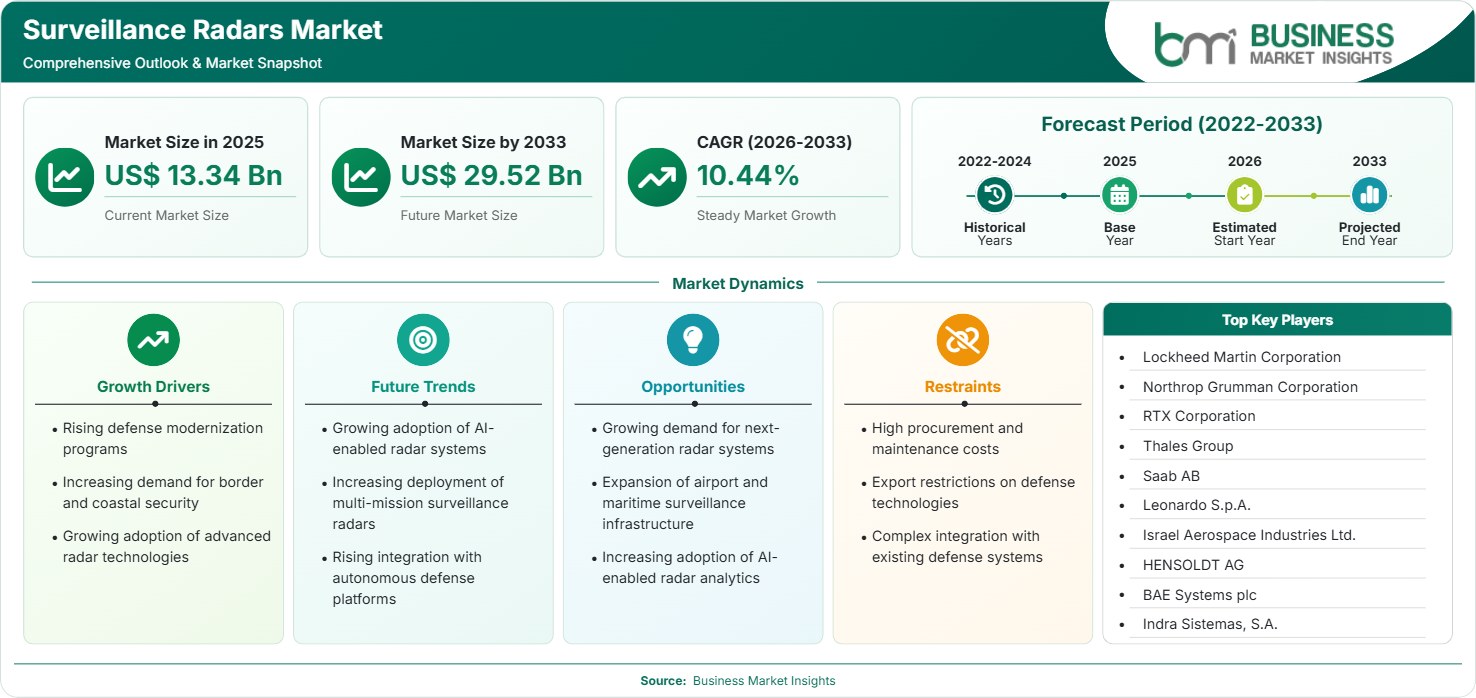
The Surveillance Radars Market size was valued at US$ 13.34 Billion in 2025 and is projected to reach US$ 29.52 Billion by 2033, growing at a CAGR of 10.44% during 2026–2033. Rising defense modernization initiatives, expanding border surveillance investments, increasing deployment of advanced radar technologies, and growing adoption of AI-enabled sensing platforms are accelerating market expansion, while airport modernization and integrated surveillance networks continue creating long-term growth opportunities.

Report Coverage
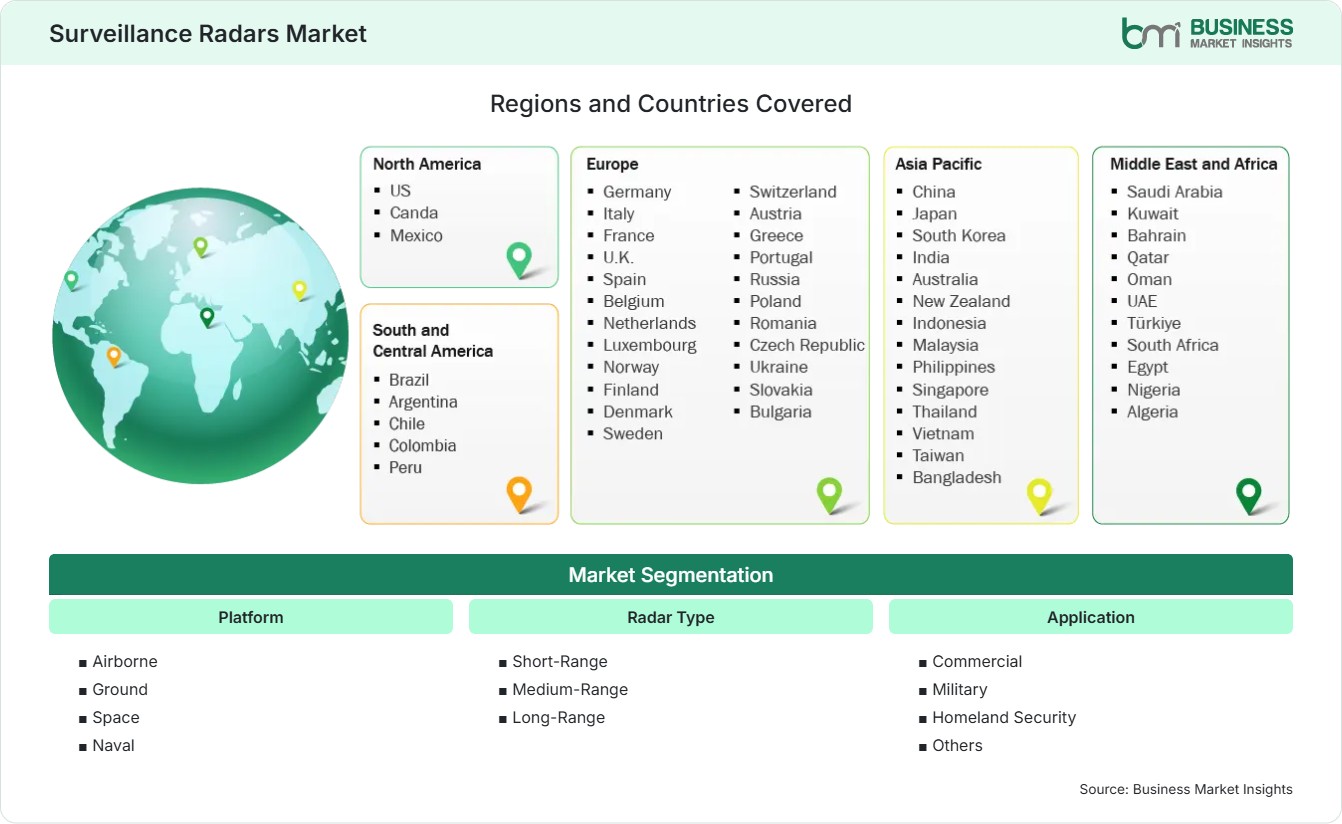
  • Platform: Airborne, Ground, Space, Naval
  • Radar Type: Short-Range, Medium-Range, Long-Range
  • Application: Commercial, Military, Homeland Security, Others
US$ 13.34 Bn Market size in 2025
US$ 29.52 Bn Market Size by 2033
10.44% CAGR, 2026 - 2033
2026-2033 Forecast Period

AI Overview

Surveillance Radars Market Summary

  • North America Region: North America holds 37%–40% share in 2025 and is projected to grow at a 9.9%–10.6% CAGR during 2026–2033, supported by defense modernization, homeland security investments, and advanced aerospace programs. The US market is expected to register a 10.2%–10.9% CAGR, driven by sustained military procurement, air defense modernization, and continuous investment in AI-enabled surveillance capabilities.
  • Fastest Growing Region: Asia Pacific accounts for 27%–30% share in 2025 and is anticipated to expand at a 11.4%–12.1% CAGR through 2033 as governments strengthen border security, maritime surveillance, indigenous radar production, and integrated defense capabilities.
  • Leading Segment: Ground platforms represent 40%–43% share in 2025 and are forecast to grow at a 10.1%–10.8% CAGR, supported by extensive deployment for border monitoring, military operations, homeland security, and protection of critical infrastructure.
  • High Growth Segment: Long-Range radar systems account for 30%–33% share in 2025 and are expected to record a 11.5%–12.2% CAGR, driven by increasing demand for early warning systems, missile detection, and integrated air defense networks.
  • Key Market Opportunity: Increasing investments in AI-powered radar analytics, multi-domain surveillance systems, and software-defined radar architectures are creating significant opportunities for manufacturers supplying next-generation surveillance technologies.
  • Major Market Players: Lockheed Martin Corporation, Northrop Grumman Corporation, RTX Corporation, Thales Group, Saab AB, Leonardo S.p.A., Israel Aerospace Industries Ltd., HENSOLDT AG, BAE Systems plc, and Indra Sistemas, S.A.
Strategic Insights

Surveillance Radars Market: Strategic Insights

Surveillance Radars Market Strategic Framework
FREE PDF
Request your free sample
Request free sample
Stakeholder View

Key Takeaways

  • Modern surveillance ecosystems increasingly combine radar platforms, artificial intelligence, sensor fusion, and command-and-control software to improve operational effectiveness across defense and civil security applications.
  • Ground surveillance, long-range radar deployment, and integrated border monitoring programs continue offering the strongest long-term investment opportunities across government procurement projects.
  • Digital radar architectures, gallium nitride semiconductors, AI-enabled signal processing, and electronically scanned arrays remain the primary areas of technological innovation.
  • Asia Pacific offers substantial investment potential due to expanding defense budgets, indigenous manufacturing capabilities, and modernization of air, maritime, and land surveillance infrastructure.
  • Strategic collaborations between defense contractors, governments, and technology developers continue accelerating radar innovation while strengthening domestic manufacturing capabilities and export competitiveness.
Geographic Outlook

Surveillance Radars Market Regional Highlights

North America Surveillance Radars Market

North America represents 37%–40% Surveillance Radars Market share in 2025 and is expected to expand at a 9.9%–10.6% CAGR during 2026–2033. The region benefits from high defense expenditure, advanced aerospace manufacturing capabilities, and continuous investments in homeland security technologies. Ongoing modernization of integrated air defense systems, missile warning infrastructure, and border surveillance programs continues supporting procurement of advanced radar platforms across military and civil applications.

  • Defense modernization initiatives continue driving procurement of next-generation surveillance radar platforms supporting multi-domain operational capabilities.
  • Homeland security agencies are expanding integrated border surveillance systems using advanced radar, AI-powered analytics, and real-time monitoring technologies.
  • Airport modernization projects are increasing deployment of digital surveillance radar systems supporting safer and more efficient air traffic management.
  • Leading defense contractors continue investing in electronically scanned array technologies to improve detection accuracy and operational flexibility.
  • Integration of radar systems with cyber-resilient command networks is strengthening overall defense infrastructure against evolving security threats.

US Surveillance Radars Market

The United States accounts for 31%–34% regional share in 2025 and is projected to grow at a 10.2%–10.9% CAGR through 2033. Strong federal defense funding, continuous aerospace innovation, and modernization of homeland security capabilities support sustained demand for advanced surveillance radar systems. The country remains a global leader in radar research, electronic warfare technologies, and integrated defense platforms.

  • Military modernization programs continue replacing aging radar infrastructure with advanced digitally integrated surveillance solutions.
  • Border protection agencies are strengthening monitoring capabilities through long-range radar deployment and AI-supported threat detection.
  • Airport surveillance upgrades continue improving airspace safety, operational efficiency, and aircraft traffic management capabilities.
  • Defense technology investments are accelerating development of multi-function radar platforms supporting future operational requirements.

Europe Surveillance Radars Market

Europe accounts for 24%–27% share in 2025 and is anticipated to expand at a 10.0%–10.7% CAGR during 2026–2033. Rising geopolitical tensions, higher defense spending, and modernization of NATO surveillance capabilities continue supporting demand across the region. Germany remains the leading contributor due to strong defense manufacturing capabilities, while Poland represents the fastest-growing national market with a 11.0%–11.7% CAGR driven by increasing procurement of advanced defense technologies.

  • NATO defense modernization initiatives continue encouraging deployment of interoperable surveillance and air defense radar systems.
  • Germany remains the regional leader through investments in advanced defense electronics and indigenous radar development.
  • Poland is strengthening national surveillance capabilities through sustained military modernization and strategic procurement programs.
  • Airport modernization projects across Western Europe continue supporting adoption of digital air surveillance technologies.
  • Investments in electronic warfare and integrated command systems are expanding demand for advanced multi-function radar platforms.

Asia Pacific Surveillance Radars Market

Asia Pacific represents 27%–30% share in 2025 and is forecast to register the highest 11.4%–12.1% CAGR through 2033. Increasing regional security concerns, defense modernization programs, and investments in indigenous manufacturing continue accelerating demand. China remains the largest regional market, while India records the strongest growth at 11.8%–12.5% CAGR owing to expanding defense budgets, border security initiatives, and domestic radar development programs.

  • Governments continue increasing procurement of advanced surveillance technologies to strengthen territorial security and strategic deterrence.
  • Maritime surveillance investments are expanding rapidly across Indo-Pacific nations to improve coastal monitoring capabilities.
  • Indigenous defense manufacturing initiatives continue supporting development of advanced radar technologies.
  • Commercial airport expansion projects are increasing demand for modern air traffic surveillance infrastructure.
  • Artificial intelligence integration is improving target detection, tracking precision, and operational efficiency across surveillance networks.

Rest of World Surveillance Radars Market

Rest of World contributes 8%–10% share in 2025 and is projected to grow at a 10.5%–11.2% CAGR during the forecast period. Countries across the Middle East are strengthening integrated air defense systems, while Latin America continues investing in border security and maritime monitoring capabilities. The United Arab Emirates records a 11.3%–12.0% CAGR due to sustained defense modernization and advanced surveillance infrastructure investments.

  • Middle Eastern defense modernization programs continue strengthening integrated air and missile defense capabilities.
  • Latin American governments are expanding surveillance infrastructure for border monitoring and critical asset protection.
  • Maritime security investments continue increasing across coastal economies supporting radar deployment.
  • Smart defense infrastructure programs are encouraging adoption of AI-enabled surveillance technologies.
  • Growing regional security cooperation is strengthening procurement of advanced long-range surveillance systems.
Global Market Geography
FREE PDF
Request your free sample
Request free sample
Segment Analysis

Surveillance Radars Market Segmentation

Platform

The platform segment represents the largest deployment category as radar systems support surveillance across land, air, sea, and space environments. Ground platforms maintain leadership because of extensive deployment for border monitoring, battlefield awareness, homeland security, and critical infrastructure protection. The segment accounted for 40%–43% share in 2025 and is projected to register a 10.1%–10.8% CAGR during 2026–2033. The Surveillance Radars Market scope continues expanding as governments increasingly adopt integrated multi-domain surveillance architectures.

  • Airborne: Airborne surveillance platforms provide persistent monitoring, reconnaissance, early warning, and target tracking while supporting military aircraft and airborne command missions.
  • Ground: Ground radar systems strengthen border surveillance, air defense, infrastructure security, and tactical battlefield monitoring with reliable all-weather operational capabilities.
  • Space: Space-based radar technologies enhance strategic intelligence, persistent Earth observation, and wide-area surveillance supporting defense and national security operations.
  • Naval: Naval radar platforms improve maritime domain awareness by enabling vessel detection, coastal surveillance, fleet protection, and navigation safety.

Radar Type

Radar type selection depends on mission requirements, detection range, and operational objectives. Long-range systems remain the fastest-growing category because governments increasingly prioritize early warning and strategic air surveillance capabilities. This segment accounted for 30%–33% share in 2025 and is expected to expand at a 11.5%–12.2% CAGR through 2033, supported by modernization of integrated defense networks.

  • Short-Range: Short-range radar systems support perimeter security, airport monitoring, tactical operations, and industrial surveillance requiring rapid localized target detection.
  • Medium-Range: Medium-range radars provide balanced surveillance capabilities suitable for border monitoring, coastal security, and regional airspace management applications.
  • Long-Range: Long-range radar solutions enable missile warning, strategic surveillance, early threat detection, and comprehensive airspace monitoring across extensive operational areas.

Application

Application diversity continues increasing as radar technologies support military operations, commercial aviation, homeland security, and critical infrastructure protection. Military deployment remains the largest contributor because governments continue expanding surveillance and defense modernization initiatives worldwide. The application segment represented 46%–49% share in 2025 and is projected to grow at a 10.6%–11.3% CAGR through 2033, supported by increasing adoption of integrated surveillance networks.

  • Commercial: Commercial organizations utilize surveillance radar for airport operations, weather observation, industrial safety, and transportation infrastructure monitoring.
  • Military: Military applications include air defense, battlefield surveillance, missile detection, reconnaissance, and integrated command-and-control operations requiring continuous situational awareness.
  • Homeland Security: Homeland security agencies deploy radar technologies for border monitoring, coastal surveillance, disaster response, and protection of critical national infrastructure.
Market Forces

Surveillance Radars Market Dynamics

Key Market Drivers

Rising defense modernization programs

Governments around the world have been providing more budget allocations towards defense in order to enhance the security of their nations and military preparedness. The acquisition of state-of-the-art surveillance radars is rising since militaries are upgrading their old equipment to new digitally integrated equipment that can be used in multi-domain operations. Upgrades in active electronically scanned array technology, missile defense systems, and command and control systems have made the operations more effective through land, sea, and air missions. As per SIPRI, global military expenditure went above US$ 2.7 trillion in 2024. The Surveillance radars market growth will be influenced by such modernization efforts in the years to come.

Increasing demand for border and coastal security

Growing cross-border security concerns, illegal trafficking, unauthorized maritime activities, and unmanned aerial threats are encouraging governments to strengthen surveillance infrastructure. Border agencies and coast guards are deploying advanced radar systems capable of continuous monitoring under diverse environmental conditions. Integration with electro-optical sensors, communication networks, and automated command centers improves operational awareness while reducing response times. Increasing investments in coastal surveillance also support protection of critical energy assets, commercial shipping routes, and exclusive economic zones, making surveillance radars an essential component of national security strategies.

Growing adoption of advanced radar technologies

Innovations in digital signal processing, gallium nitride semiconductors, electronically steered arrays, and artificial intelligence are revolutionizing the performance capabilities of radar. New radar systems have increased detection ranges, rapid target recognition, resistance to jamming, and greater operational flexibility. Surveillance radars market trends indicate that software-defined radar architectures and AI-enabled analytics are becoming standard requirements for new procurement programs. These technologies improve mission effectiveness while enabling defense organizations to monitor increasingly complex operational environments using integrated surveillance platforms.

Key Market Opportunities

Growing demand for next-generation radar systems

Governments are increasingly procuring state-of-the-art surveillance systems that would enable air defense, missile defense, multi-target tracking, and network-centric warfare. Radar firms are making investments in advanced semiconductor technology, modularity, and software-enabled features that increase scalability and efficiency. Replacement of obsolete surveillance systems in developed countries is opening up many avenues for manufacturers. Surveillance radars market forecasts indicate that demand for intelligent radar systems will continue expanding as defense organizations seek greater operational efficiency, interoperability, and lifecycle value from future surveillance platforms.

Expansion of airport and maritime surveillance infrastructure

An increasing trend in the air passenger movement, airport modernization programs, and the maritime sector making investments in the area of maritime security are contributing to the emergence of favorable circumstances for the installation of surveillance radar. Aviation regulatory bodies are improving the air traffic management system by introducing digital radars that enhance monitoring and safety of aircraft and runways. Maritime companies continue their investment in the development of the coastal surveillance network in order to secure the sea routes and offshore energy sources.

Increasing adoption of AI-enabled radar analytics

Artificial intelligence is improving radar efficiency by enabling automated target classification, predictive threat assessment, anomaly detection, and real-time data interpretation. AI-supported analytics reduce operator workload while enhancing surveillance accuracy across military and homeland security operations. Manufacturers are integrating machine learning capabilities into radar platforms to improve decision-making, reduce false alarms, and strengthen mission effectiveness. Growing digital transformation within defense organizations is expected to accelerate adoption of intelligent surveillance solutions throughout the forecast period.

Market Restraints and Challenges

High procurement and maintenance costs

Factor: Advanced surveillance radar systems require significant investment in sophisticated electronics, phased-array antennas, software integration, installation, and long-term maintenance. Impact: The expense in both acquiring the system and its lifespan cost can delay procurement programs in those nations that do not have much defense budgets. Companies should consider developing skills for their staff members, upgrading and modernizing the infrastructure. Radar manufacturers are overcoming these issues by incorporating modular design, predictive maintenance, and scalable radars to reduce costs.

Export restrictions on defense technologies

Factor: International defense trade is governed by strict export control regulations, security approvals, and technology transfer restrictions for advanced surveillance systems. Impact: Export control laws may delay procurement processes, affect cross-border collaborations, and may prevent market entry into some international markets. Companies have to abide by licensing laws without revealing any technology secrets. In order to deal with such problems, manufacturers have started forming regional collaborations, manufacturing plants and industrial partnerships within governments..

Company Analysis

Competitive Landscape

The competitive environment is characterized by continuous investment in electronically scanned array technologies, AI-enabled signal processing, digital radar architectures, and integrated surveillance platforms. Surveillance radars market analysis shows that leading companies are strengthening their positions through defense modernization contracts, product innovation, strategic alliances, and expansion of multi-domain surveillance capabilities.

Company Name

Overview

Products and Services Relevant to this Market

Lockheed Martin Corporation

Global defense company specializing in integrated surveillance and missile defense technologies.

Air surveillance radars, missile warning systems, command-and-control solutions, defense sensors.

Northrop Grumman Corporation

Aerospace and defense company focused on advanced radar innovation.

AESA radars, airborne surveillance systems, battlefield monitoring, integrated sensor solutions.

RTX Corporation

Defense technology provider delivering advanced radar and sensing platforms.

Air defense radars, naval surveillance systems, fire control radars, integrated defense technologies.

Thales Group

International technology company supplying advanced surveillance solutions.

Ground surveillance radars, airport surveillance systems, naval radar platforms, security technologies.

Saab AB

Defense manufacturer developing multi-domain surveillance systems.

Airborne early warning radars, naval surveillance, battlefield monitoring, command systems.

Leonardo S.p.A.

Aerospace company delivering integrated defense electronics.

Multi-function radars, surveillance sensors, electronic warfare technologies, defense solutions.

Israel Aerospace Industries Ltd.

Defense manufacturer specializing in advanced radar technologies.

Air defense radars, border surveillance systems, intelligence platforms, missile detection technologies.

HENSOLDT AG

European defense electronics company focused on sensor innovation.

Air surveillance radars, coastal monitoring systems, military sensors, integrated surveillance platforms.

BAE Systems plc

Global defense company providing advanced security technologies.

Battlefield surveillance radars, defense electronics, mission systems, intelligence solutions.

Indra Sistemas, S.A.

Technology company specializing in surveillance and transportation systems.

Air traffic surveillance radars, defense radar systems, command-and-control solutions, monitoring technologies.


Trust & Transparency

Research Methodology

The market analysis combines proprietary research with secondary data from government agencies, company disclosures, regulatory filings, industry databases and expert interviews. Market estimates are validated through data triangulation, cross-market benchmarking and analyst review.

View Full Research Methodology

Questions Answered

Frequently Asked Questions

What information does the Surveillance Radars Market Report provide?

The Report provides comprehensive insights into market size, segmentation, regional performance, competitive landscape, technology advancements, investment opportunities, regulatory developments, and strategic outlook through 2033.

How is artificial intelligence improving surveillance radar performance?

Artificial intelligence enhances radar efficiency through automated target recognition, predictive threat analysis, anomaly detection, adaptive signal processing, and reduced false alarms. These capabilities improve operational awareness while enabling faster and more accurate decision-making across military and homeland security operations.

Why are long-range surveillance radars witnessing higher adoption?

Long-range radar systems support early warning, missile detection, strategic airspace monitoring, maritime surveillance, and multi-target tracking over extensive operational areas. Their ability to improve situational awareness makes them a priority for modern defense modernization programs.

Which platform segment holds the largest market share?

Ground platforms account for the largest share because they are extensively deployed for border surveillance, homeland security, military operations, critical infrastructure protection, and integrated air defense applications requiring continuous all-weather monitoring capabilities.

What factors are driving the Surveillance Radars Market?

The market is primarily driven by defense modernization initiatives, increasing border and coastal surveillance requirements, growing deployment of AI-enabled radar technologies, expandiang airport surveillance infrastructure, and rising investments in integrated air and missile defense systems worldwide.

Access the Full Surveillance Radars Market Report

Get segment-level forecasts, regional estimates, competitive benchmarking, company profiles and downloadable Excel datasets.

Access the full Surveillance Radars Market Report
350 pages PDF & Excel | 2026-08-04