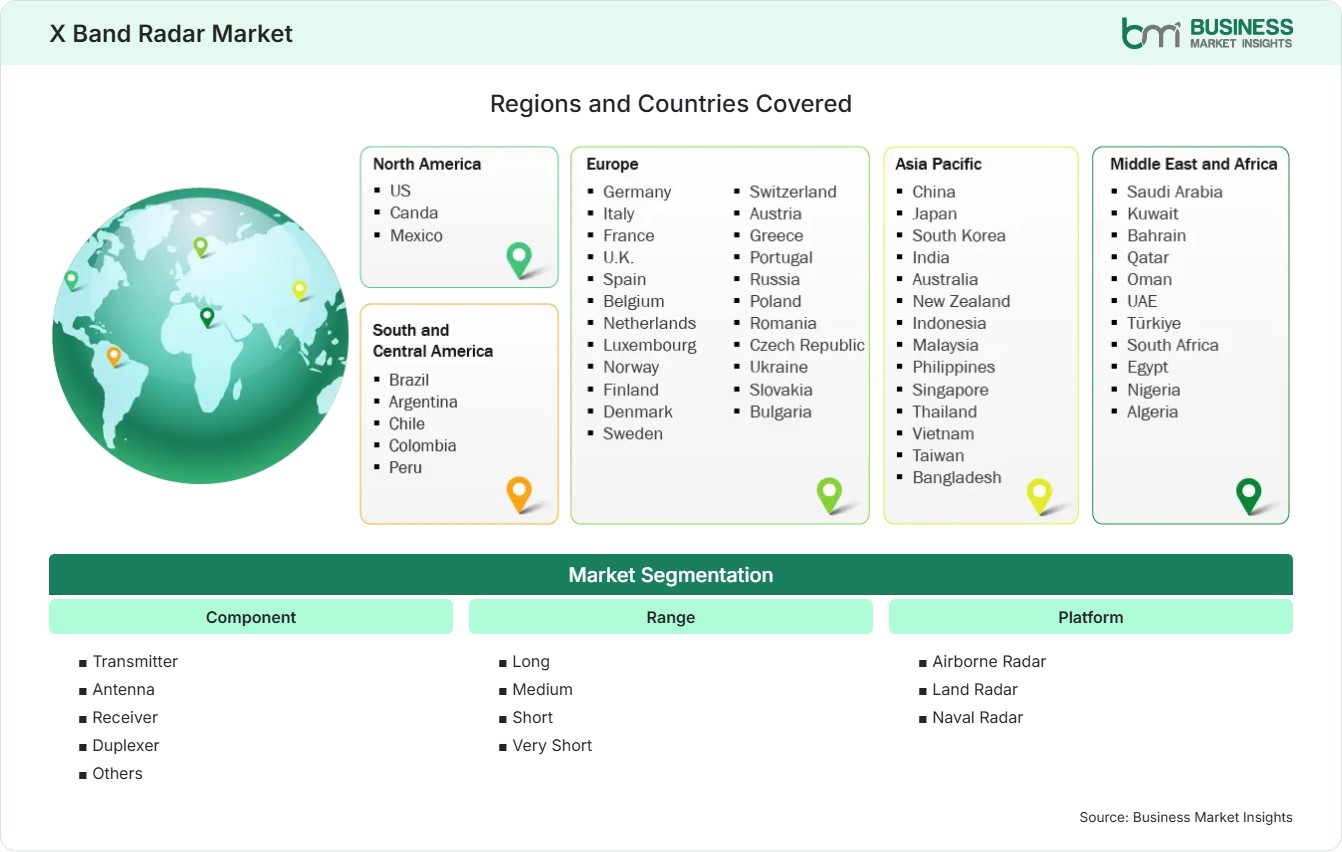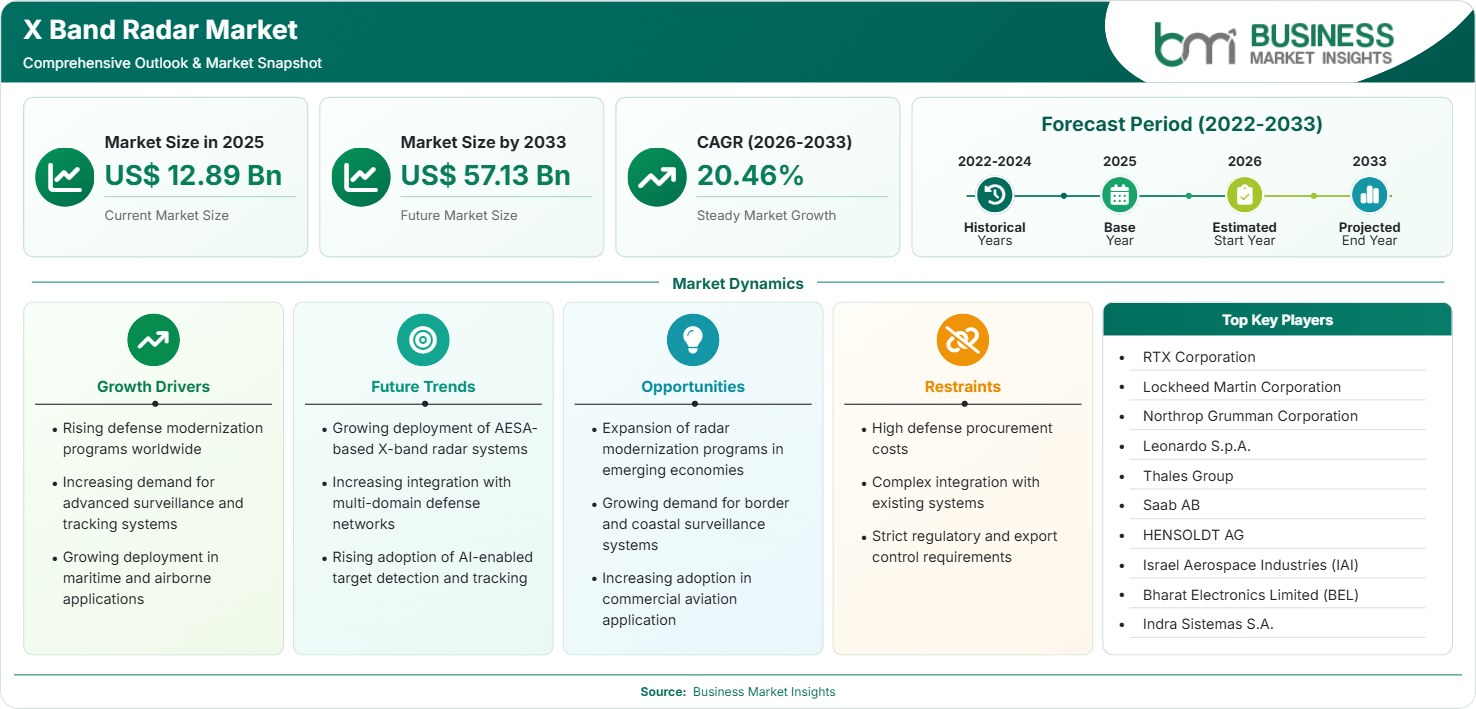
X Band Radar Market Regional Highlights
North America X Band Radar Market
North America accounted for 38%–42% of the market share in 2025 and is projected to register a CAGR of 20.1%–20.8% during 2026–2033. The region benefits from sustained defense spending, rapid deployment of next-generation surveillance systems, and continuous investments in missile defense, naval modernization, and aerospace technologies. The United States dominates regional demand, while Canada continues strengthening coastal surveillance and Arctic security capabilities. The X Band Radar Market share remains the highest globally due to advanced defense procurement programs and continuous technological innovation.
- Missile defense modernization is driving demand for advanced X-band radar for long-range tracking and threat detection.
- Naval modernization is boosting adoption of shipborne radar for maritime surveillance and coastal security.
- Investments in airborne platforms and UAVs are increasing demand for compact, high-precision radar systems.
- Homeland security spending on border and airspace surveillance continues to support radar adoption.
US X Band Radar Market
The United States accounted for 80%–84% of North America's market share in 2025 and is expected to grow at a CAGR of 20.3%–20.9% during 2026–2033. Continuous defense modernization, advanced aerospace programs, and investments in integrated air and missile defense systems position the country as the leading adopter of high-performance X-band radar technologies. Strong domestic manufacturing capabilities and government-funded defense innovation programs continue supporting sustained X Band Radar market expansion.
- Large-scale investments in missile defense architecture are driving procurement of advanced radar platforms capable of tracking hypersonic missiles, ballistic threats, and multiple aerial targets simultaneously.
- Expansion of naval fleet modernization programs supports increased deployment of radar technologies across destroyers, aircraft carriers, and coastal defense systems requiring enhanced situational awareness.
- Growth in military UAV deployments is creating demand for lightweight radar solutions that improve navigation, surveillance, reconnaissance, and autonomous mission performance.
- Public-private collaborations among defense agencies, research institutions, and radar manufacturers continue accelerating innovation in digital signal processing, artificial intelligence integration, and electronically scanned array technologies.
Europe X Band Radar Market
Europe held 24%–28% of the market share in 2025 and is anticipated to expand at a CAGR of 19.7%–20.3% during 2026–2033. Rising geopolitical concerns, NATO defense commitments, and increasing investments in integrated air defense systems are supporting regional market growth. Germany and the United Kingdom remain leading markets, while Poland is emerging as one of the fastest-growing countries through expanding defense procurement and modernization initiatives in X Band Radar Market.
- Germany continues strengthening radar manufacturing capabilities through investments in advanced surveillance systems supporting integrated air defense and military modernization programs.
- The United Kingdom is expanding naval radar deployment across maritime security, aircraft carrier modernization, and coastal defense initiatives supporting regional security objectives.
- Poland is witnessing rapid procurement of advanced radar systems driven by border security priorities, NATO interoperability requirements, and military infrastructure expansion.
- European defense collaboration programs continue supporting joint radar development projects, improving technology sharing and strengthening regional defense capabilities.
Asia Pacific X Band Radar Market
Asia Pacific represented 28%–32% of the market share in 2025 and is projected to record the fastest CAGR of 21.0%–21.8% during 2026–2033. China leads overall demand, while India is expected to register the highest growth due to expanding domestic defense manufacturing and border surveillance investments in X Band Radar Market.
- China continues investing in integrated air defense systems, naval modernization, and advanced surveillance infrastructure supporting large-scale deployment of indigenous radar technologies.
- India is expanding radar manufacturing under domestic defense initiatives while strengthening border security, coastal monitoring, and aerospace surveillance capabilities.
- Japan and South Korea continue upgrading missile defense networks with advanced radar technologies capable of supporting multi-domain surveillance and regional security operations.
- Increasing investments in commercial aviation infrastructure and airport modernization are creating additional demand for advanced radar systems beyond traditional defense applications.
Rest of World X Band Radar Market
The Rest of the World accounted for 8%–12% of the market share in 2025 and is expected to grow at a CAGR of 18.9%–19.6% during 2026–2033. South & Central America is gradually increasing investments in border surveillance and airspace monitoring, while the Middle East & Africa continues strengthening defense capabilities through advanced radar procurement and integrated security infrastructure. The X Band Radar Market growth across these regions is supported by rising security concerns and expanding defense modernization initiatives.
- Brazil leads South & Central America through investments in border surveillance, airspace monitoring, and defense modernization programs supporting advanced radar deployment.
- Saudi Arabia and the United Arab Emirates continue expanding procurement of integrated radar systems for air defense, coastal surveillance, and critical infrastructure protection.
- South Africa is gradually strengthening radar capabilities for maritime surveillance, border security, and aviation safety through defense modernization initiatives.
- Increasing government investment in critical infrastructure protection and coastal monitoring continues creating long-term opportunities for advanced radar manufacturers across emerging markets.