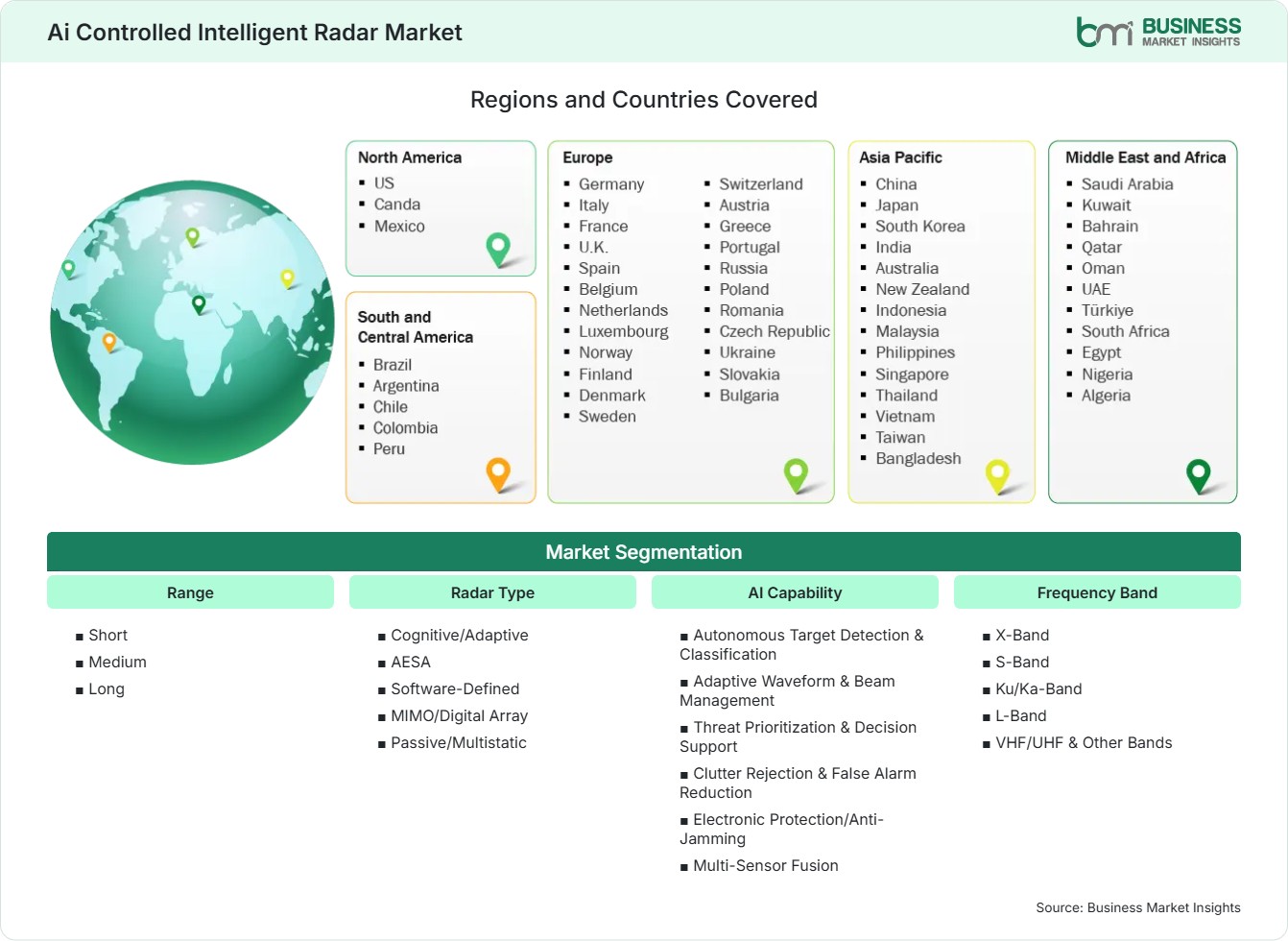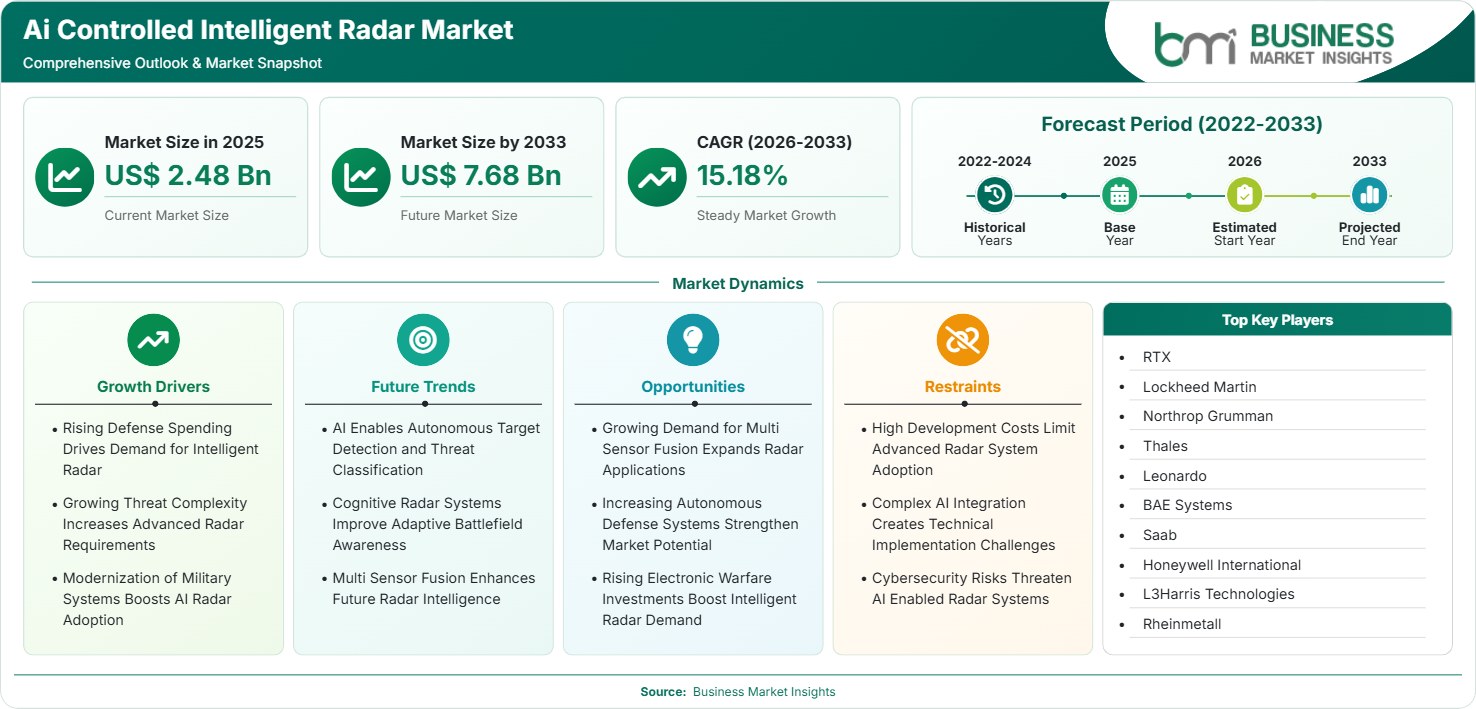
AI Controlled Intelligent Radar Market Regional Highlights
North America AI Controlled Intelligent Radar Market
North America holds a 38%–43% share in 2025 and is projected to expand at a 14.0%–16.0% CAGR during 2026–2033. The US leads regional demand, supported by defense procurement, missile defense, autonomous platforms, and electronic warfare modernization. AI Controlled Intelligent Radar Market share benefits from strong R&D capabilities.
- US modernization programs support radar demand for complex threat detection, tracking, classification, and integrated defense operations.
- Electronic warfare investment is encouraging adaptive radar technologies capable of maintaining performance against interference and jamming.
- AI-enabled processing is improving target classification, threat prioritization, and operator support across high-volume surveillance missions.
US AI Controlled Intelligent Radar Market
The US represents a 33%–38% share of the global market in 2025 and is projected to grow at a 14.5%–16.5% CAGR through 2033. Demand is supported by defense modernization, missile defense, air surveillance, autonomous platforms, and electronic warfare. Investment in military AI and advanced sensing is encouraging development of radar systems with autonomous target recognition, adaptive beam management, and multi-sensor integration.
- Integrated air and missile defense modernization is supporting advanced radar systems for detecting and tracking sophisticated airborne threats.
- Autonomous defense programs are increasing demand for radar capable of supporting machine-assisted target identification and real-time platform decisions.
- Electronic warfare investment is encouraging adaptive radar development for contested electromagnetic environments.
Europe AI Controlled Intelligent Radar Market
Europe accounts for a 22%–27% share in 2025 and is forecast to expand at a 12.5%–14.5% CAGR during 2026–2033. Germany, the UK, France, Italy, and Sweden are leading AI Controlled Intelligent Radar Markets, while Poland offers strong growth potential. Germany is projected to grow at a 13.0%–15.0% CAGR, while Poland could reach a 16.0%–18.0% CAGR. Defense modernization and electronic warfare investment support regional adoption.
- European modernization programs are increasing demand for integrated surveillance and air defense radar systems.
- Germany and France provide opportunities through defense technology development, while Poland benefits from increased defense investment.
- European suppliers are advancing AI-assisted processing, electronic protection, and sensor fusion for complex operational environments.
Asia Pacific AI Controlled Intelligent Radar Market
Asia Pacific represents a 24%–29% share in 2025 and is projected to register a 16.5%–18.5% CAGR during 2026–2033, making it the fastest-growing region. China, India, Japan, South Korea, and Australia lead demand. India is projected to grow at a 18.0%–20.0% CAGR, while South Korea could reach a 16.5%–18.5% CAGR. Military modernization and indigenous defense development support adoption.
- India is investing in advanced surveillance, air defense, and electronic warfare capabilities, creating opportunities for intelligent radar suppliers.
- Japan and South Korea are strengthening advanced sensing capabilities for sophisticated threats and networked defense architectures.
- China remains a major market supported by military modernization, autonomous systems, integrated air defense, and domestic AI development.
- Australia offers opportunities through defense modernization and maritime surveillance requirements.
Rest of World AI Controlled Intelligent Radar Market
South and Central America account for a 5%–8% share in 2025 and are projected to grow at a 9.0%–11.0% CAGR, supported by surveillance and modernization. Brazil, Mexico, and Colombia represent leading opportunities. The Middle East and Africa account for a 7%–11% AI Controlled Intelligent Radar Market share and are expected to expand at an 11.0%–13.0% CAGR, supported by defense investment and advanced surveillance requirements.
- Brazil and Mexico offer modernization opportunities, while Middle Eastern countries are investing in integrated air defense and advanced sensing. Saudi Arabia and the UAE are leading markets, while Türkiye provides technology development potential. African opportunities remain focused on border security and airspace monitoring.
- Middle Eastern defense investment is supporting demand for radar used in air defense, missile tracking, surveillance, and electronic warfare.
- Saudi Arabia and the UAE offer opportunities through modernization programs and advanced sensing investments.
- Brazil provides potential for radar modernization across surveillance and security applications.
- Emerging African markets offer longer-term potential through border monitoring and airspace awareness initiatives.