
Coastal Surveillance Market Outlook: Size, Share, Trends, Growth Analysis, Competitive Landscape & Forecast, 2026-2033

Historic Data: 2022-2024   |   Base Year: 2025   |   Forecast Period: 2026-2033
Report Content: Market Scope, Market Segmentation, Market Dynamics, and Competitive Analysis

Report Coverage:
  • Technology (Radar, EO/IR, AIS, UAV)
  • Structure (National, Regional, Port)
  • Application (C2, ISR, EW)
  • End-use (Naval, Coast Guard)

No. of Pages: 400
Report Code: BMIPUB00035332
Category: Aerospace and Defense
Coastal Surveillance Market

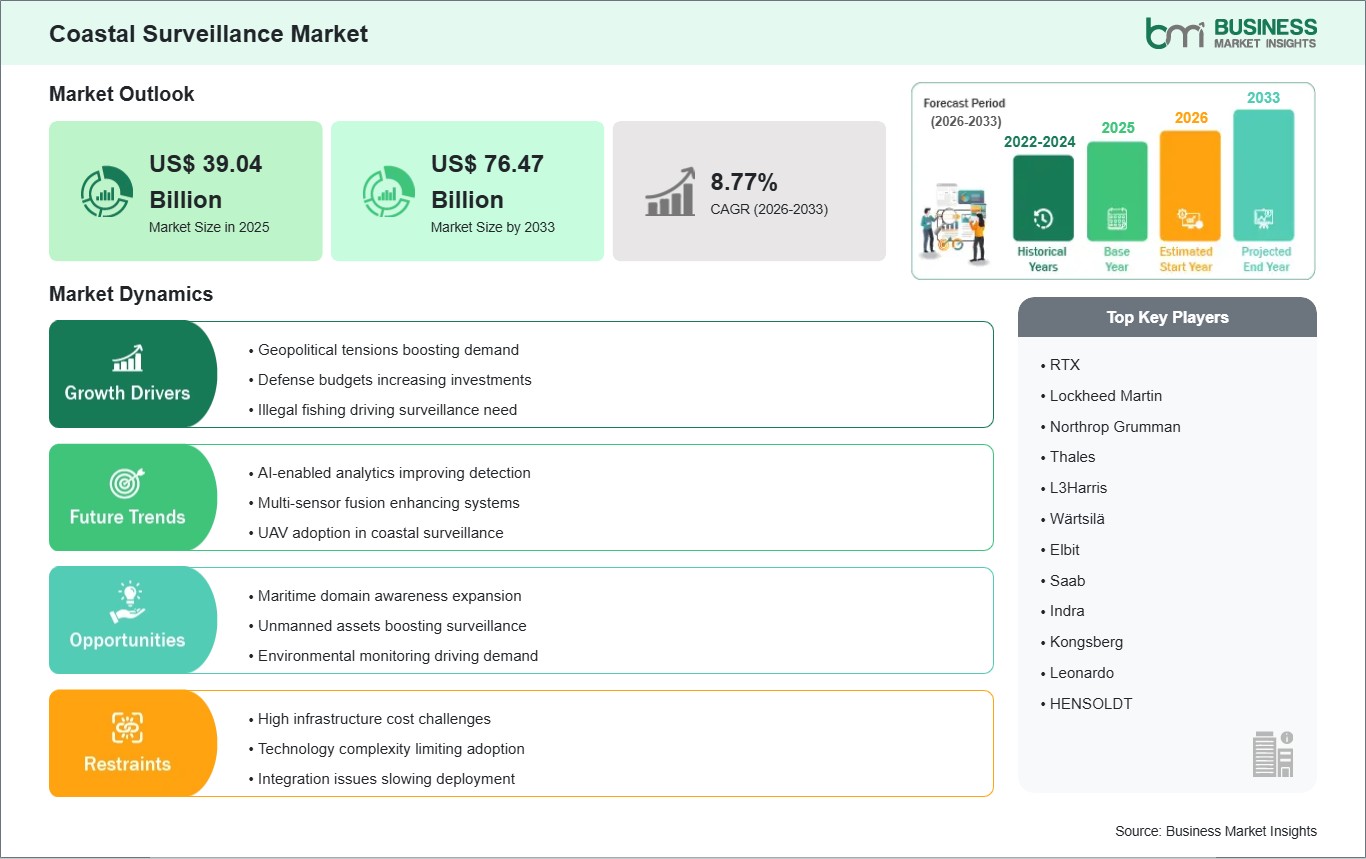
The Coastal Surveillance Market size is expected to reach US$ 76.47 Billion by 2033 from US$ 39.04 Billion in 2025.The market is estimated to record a CAGR of 8.77% from 2026 to 2033.

Executive Summary and Global Market Analysis:

Coastal surveillance market can be defined as advanced technology systems that are deployed at the coastline, territorial waters, ports, and maritime borders. Such technologies enable the detection and monitoring of any kind of activity in the sea or water. Commonly, such advanced technological surveillance involves integration of various systems like radars, electro-optic systems, automatic identification system (AIS), satellite imagery, UAVs, and other command-and-control applications that monitor maritime situations on a continuous basis.

Internationally, the market for coastal surveillance is growing due to increasing focus on maritime border security, combating piracy, preventing traffic, and securing important maritime infrastructure like oil rigs, submarine communication lines, and maritime trade routes. The operation of surveillance in the Western Indian Ocean conducted through EU NAVFOR Operation Atalanta in 2024 the mission expanded its maritime surveillance activities in the Western Indian Ocean using coordinated naval patrols and aerial reconnaissance systems to deter piracy and protect commercial shipping routes.

The market is mainly propelled by modernization of naval defense capabilities, increased defense and homeland security spending, and fast-paced integration of maritime domain awareness platforms. There are investments in networked surveillance systems, which incorporate land-based radar stations along with sensors placed offshore, as well as satellite intelligence.

Moreover, advancements in AI-enabled threat identification technology, autonomous patrol ships, and long-range sensor fusion technology are boosting the efficiency of these operations. Some limitations associated with the growth of the global maritime surveillance system include expensive implementation and maintenance costs, difficulties in data integration from various sources, and reliance on interagency cooperation, which may limit efficient operation in some locations.

Coastal Surveillance Market - Strategic Insights:

global-market-strategic-framework
Get more information on this report

Coastal Surveillance Market Segmentation Analysis:

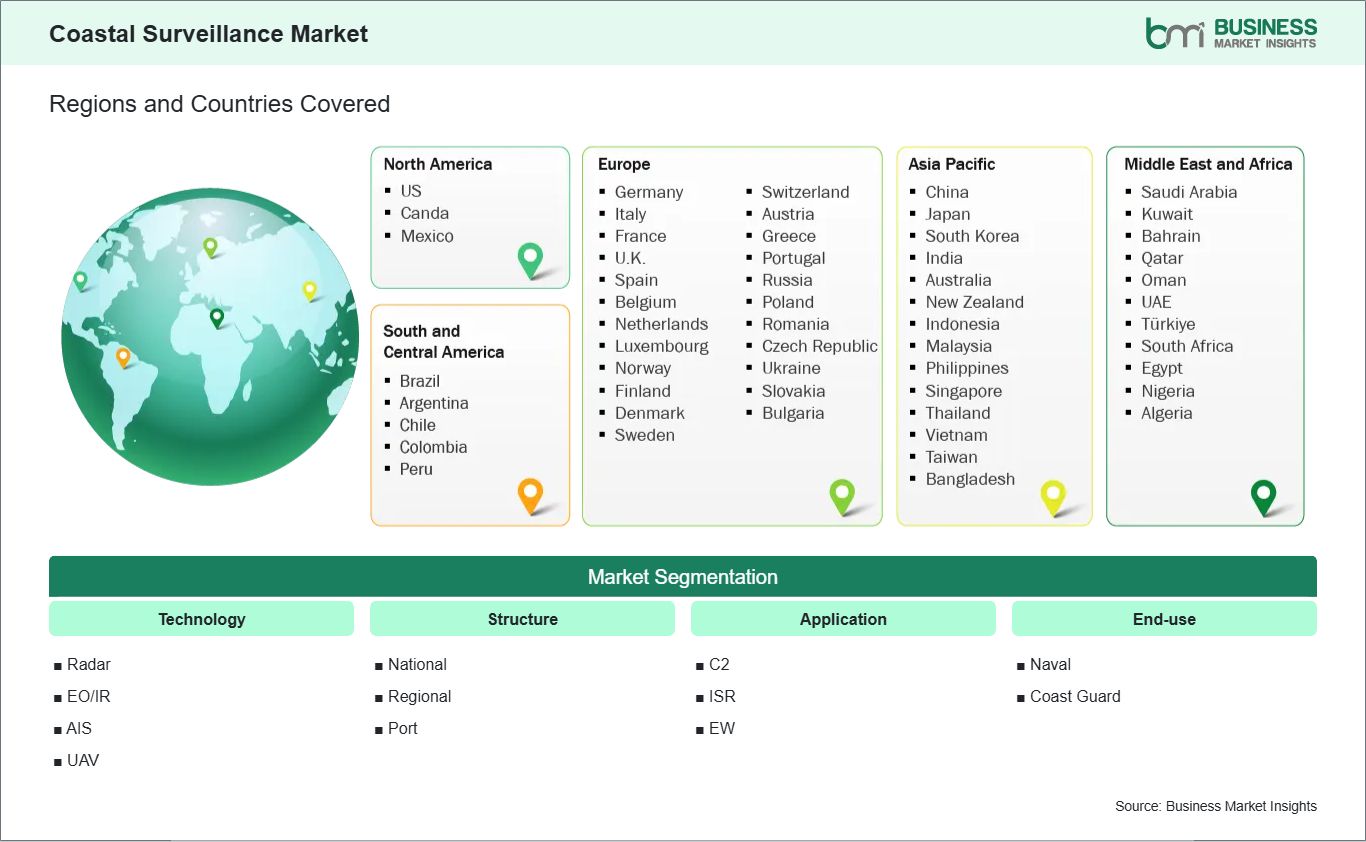
The costal surveillance market is segmented based on technology, structure, application, and end use reflecting the increasing demand for lightweight, high-strength protective solutions across defense, security, and civilian sectors.

By Technology

  • Radar: Popular for its ability to detect long distances, all-weather performance, and efficiency in identifying ships and surface targets in the coastal regions.
  • EO/IR (Electro-Optical/Infrared): Extensively applied for visual detection, identification of targets, and night vision operations to increase situational awareness in coastal surveillance systems.
  • AIS (Automatic Identification System): Provides ship tracking and identification services using real-time navigation information exchange between ships and shore stations.
  • UAVs (Unmanned Aerial Vehicles): Emerging area that is utilized for flexible aerial surveillance, border monitoring, and rapid-response operations in coastal regions.

By Structure

  • National: Large-scale integrated surveillance networks operated at the country level to ensure maritime border security and strategic coastal monitoring.
  • Regional: Systems deployed across specific coastal zones or maritime regions to enhance localized surveillance and operational coordination.
  • Port: Focused surveillance infrastructure designed to secure ports, harbors, and critical maritime entry points against illegal activities and threats.

By Application

  • C2 (Command and Control): Centralized systems that integrate surveillance data for decision-making, coordination, and operational command in maritime security operations.
  • ISR (Intelligence, Surveillance, and Reconnaissance): Used for continuous monitoring, data collection, and threat assessment across coastal and maritime domains.
  • EW (Electronic Warfare): Applied for detecting, disrupting, or countering hostile electronic signals and communication threats in maritime environments.

By End-Use

  • Naval Forces: Largest segment driven by increasing naval modernization programs, maritime defense operations, and strategic coastal protection initiatives.
  • Coast Guard: Plays a critical role in law enforcement, search and rescue, anti-smuggling operations, and coastal security enforcement activities.
Coastal Surveillance Market Drivers and Opportunities:

Geopolitical Tensions Boosting Demand

Growth in the global coastal surveillance market has been driven by escalating geopolitical tensions and maritime boundary disputes that have prompted governments to enhance their coastal surveillance capabilities through the installation of advanced technologies such as radar, electro-optics, and satellites. Coastal surveillance is currently becoming increasingly important for countries due to the strategic nature of maritime routes, energy facilities, and naval chokepoints from a security perspective.

Within the Indo-Pacific region, disputes in strategically located sea passages have led to an increased focus on establishing sophisticated coastal radar and identification systems. Countries like India, Japan, and Australia have invested in developing surveillance capabilities to track naval movement and secure maritime passages. In addition, countries in Southeast Asia have also invested heavily in developing coastal surveillance networks due to territorial disputes in highly congested waterways.

In Europe, increased security issues in the Baltic Sea and Mediterranean are becoming an impetus for creating more sophisticated systems for maritime surveillance. The member nations of NATO have decided to improve their intelligence-sharing system to counteract such challenges as smuggling, piracy, and other non-conventional threats at sea. Meanwhile, in North America, the United States has embarked upon upgrading its own coastal surveillance capabilities on both sides, including the development of unmanned aerial vehicle (UAV)-assisted monitoring and AI-based anomaly detection.

Maritime Domain Awareness Expansion

The worldwide coastal surveillance market will also witness the influence of the fast-paced growth of maritime domain awareness (MDA) initiatives focused on increasing visibility in coastal and offshore areas. Networked surveillance ecosystems involving coastal radar systems, AIS (automatic identification systems), unmanned aerial vehicles (drones), and satellite imagery are now adopted by governments around the globe for establishing a complete picture of operations on the water.

In Asia-Pacific, investments in smart port infrastructure and advanced coastal surveillance systems are made for growing volumes of marine commerce. China, South Korea, and Singapore are installing AI-driven analytical tools to ensure safe traffic monitoring of vessels in ports. The development of coast radar chains takes place in India for better coordination between the navy and civilian maritime authorities of the country on both the eastern and western seaboards.

Coastal surveillance systems in the Middle East are mainly associated with securing energy supplies. Nations of the Gulf region deploy advanced monitoring technologies around oil depots and offshore drilling platforms. African coastal nations are developing their MDA resources to protect from piracy and illegal fishing, receiving assistance from international programs. Digital platforms that would unite several coastal agencies in a single surveillance network are being developed in Europe. Overall, modernization of coastal surveillance through the introduction of digital technologies creates the globally connected maritime security environment.

Coastal Surveillance Market Size and Share Analysis:

The Coastal Surveillance Market is projected to grow from US$ 39.04 Billion in 2025 to US$ 76.47 Billion by 2033 , registering a CAGR of 8.77% from 2026 to 2033.

By Technology, radar dominates the market due to its ability to provide continuous, long-range detection and tracking of vessels in all weather and sea conditions. It forms the core backbone of coastal surveillance systems, enabling uninterrupted maritime domain awareness and early threat detection across vast coastal areas.

By Structure, national dominate the market as governments increasingly invest in integrated maritime domain awareness networks to ensure centralized, real-time monitoring of extensive coastlines. These systems enhance coordination between multiple agencies and strengthen overall coastal and border security management.

By Application, Command and Control (C2) dominates the market as it integrates data from multiple surveillance platforms and sensors into a unified operational picture. It enables real-time decision-making, rapid response coordination, and effective management of maritime security threats.

By End-use, naval dominate the market as they play a primary role in maritime defense, strategic surveillance, and coastal security operations. Continuous modernization programs and rising geopolitical tensions further drive investments in advanced coastal monitoring systems.

Coastal Surveillance Market Report Highlights:

Report Attribute Details
Market size in 2025 US$ 39.04 Billion
Market Size by 2033 US$ 76.47 Billion
Global CAGR (2026 - 2033)8.77%
Historical Data 2022-2024
Forecast period 2026-2033
Segments Covered By Technology
  • Radar
  • EO/IR
  • AIS
  • UAV
By Structure
  • National
  • Regional
  • Port
By Application
  • C2
  • ISR
  • EW
By End-use
  • Naval
  • Coast Guard
Regions and Countries Covered
North America US, Canada, Mexico
Europe Germany, Italy, France, U.K., Spain, Belgium, Netherlands, Luxembourg, Norway, Finland, Denmark, Sweden, Switzerland, Austria, Greece, Portugal, Russia, Poland, Romania, Czech Republic, Ukraine, Slovakia, Bulgaria
Asia-Pacific China, Japan, South Korea, India, Australia, New Zealand, Indonesia, Malaysia, Philippines, Singapore, Thailand, Vietnam, Taiwan, Bangladesh
South and Central America Brazil, Argentina, Chile, Colombia, Peru
Middle East and Africa Saudi Arabia, United Arab Emirates, Kuwait, Bahrain, Qatar, Oman, Turkiye, South Africa, Egypt, Nigeria, Algeria
Market leaders and key company profiles
  • RTX
  • Lockheed Martin
  • Northrop Grumman
  • Thales
  • L3Harris
  • Wärtsilä
  • Elbit
  • Saab
  • Indra
  • Kongsberg
  • Leonardo
  • HENSOLDT
Get more information on this report

Coastal Surveillance Market Report Coverage and Deliverables:

The "Costal Surveillance Market Size and Forecast (2022 and 2033)" report provides a detailed analysis of the market covering below areas:

  • The market size and forecast at global, regional, and country levels for all market segments covered under the scope
  • The market trends, as well as drivers, restraints, and opportunities
  • The market analysis covering key trends, global and regional framework, major players, regulations, and recent developments
  • Industry landscape and competition analysis covering market concentration, heat map analysis, prominent players, and recent developments for the costal surveillance market
  • Detailed company profiles, including SWOT analysis

Coastal Surveillance Market Geographic Insights:

Coastal surveillance market exhibits heterogeneous adoption trends due to various factors such as escalating marine security concerns, increased incidences of piracy and smuggling, disputes over territories, and the development of advanced surveillance technologies. Coastal surveillance systems are being used extensively around the globe for gaining real-time information about the situation, securing the borders, and ensuring protection of critical assets.

North America is an advanced technologically and defense-focused continent, it is highly active in terms of coastal surveillance systems' implementation. North America consists of two countries: the USA and Canada, both of which make considerable efforts towards development of maritime domain awareness systems, homeland security programs, and naval modernization initiatives. The continent is mainly focused on implementation of advanced radar systems, satellite observation technology, unmanned aerial and surface vehicles, and AI-powered analysis solutions to increase effectiveness in real-time tracking and response activities. Thanks to well-developed homeland security agencies, it will be easy to implement coastal surveillance solutions in the region.

The Asia Pacific region is developing rapidly due to long coastlines, high maritime trading, growing territorial issues, and naval modernizations. The region features nations like China, India, Japan, South Korea, and Australia, where governments are spending considerable amounts of money on sophisticated coastal surveillance systems. In the region, priority is given to bolstering the security of maritime borders, securing EEZs, and responding to piracy and fishing and smuggling-related threats. The rapid adoption of radar systems, coastal sensors, satellite monitoring, and command-and-control technology is contributing positively to the market's development. In addition, the development of new partnerships in maritime security, increase in defense spending, and investments in advanced monitoring systems will further stimulate the growth of the coastal surveillance market in the region.

These regions will contribute considerably to the coastal surveillance market because of their focus on innovation in radars and sensors, use of artificial intelligence, deployment of smart technologies for monitoring, and expansion of maritime security infrastructure.

global-market-geography
Get more information on this report

Coastal Surveillance Market Research Report Guidance:

  • The report includes qualitative and quantitative data for the costal surveillance market across technology, structure, application, end use, and geography.
  • The report starts with the key takeaways (chapter 2), highlighting the key trends and outlook of the costal surveillance market.
  • Chapter 3 focuses on the research methodology of the study.
  • Chapter 4 includes ecosystem analysis.
  • Chapter 5 highlights the major industry dynamics in the costal surveillance market, including factors that are driving the market, prevailing deterrents, potential opportunities, as well as future trends. Impact analysis of these drivers and restraints is also covered in this section.
  • Chapter 6 discusses the costal surveillance market scenario, in terms of historical market revenues, and forecast till the year 2033.
  • Chapters 7 to 11 cover costal surveillance market segments by technology, structure, application, end use, and geography across North America, Europe, Asia Pacific, Middle East and Africa, and South and Central America. They cover the market revenue, forecast, and factors driving the market.
  • Chapter 12 describes the competitive analysis along with the heat map analysis for the key players operating in the market.
  • Chapter 13 describes the industry landscape analysis. It provides detailed descriptions of business activities such as market initiatives, new developments, mergers, and joint ventures globally, along with a competitive landscape.
  • Chapter 14 provides detailed profiles of the major companies operating in the costal surveillance market. Companies have been profiled on the basis of their key facts, business descriptions, products and services, financial overview, SWOT analysis, and key developments.
  • Chapter 15, i.e., the appendix, is inclusive of a brief overview of the company, list of abbreviations, and disclaimer.

Coastal Surveillance Market News and Key Development:

The costal surveillance market is evaluated by gathering qualitative and quantitative data post primary and secondary research, which includes important corporate publications, association data, and databases. A few of the key developments in the costal surveillance market are:

  • In April 2026, HENSOLDT UK announced that it secured contracts to supply 50 coastal surveillance radars to be integrated into SRT Marine Systems’ maritime domain awareness platforms, supporting coastal security, border protection, and vessel tracking operations across multiple regions.
  • In May 2023, SRT Marine Systems announced that it signed a US$ 180 million contract to deliver a national-scale integrated maritime surveillance and intelligence system for a Coast Guard customer, combining coastal sensors, vessel tracking, drones, and command-and-control infrastructure.

Key Sources Referred:

  • World Bank-Global Trade Indicators
  • World Trade Organization (WTO)
  • International Maritime Organization (IMO)
  • United Nations Convention on the Law of the Sea (UNCLOS)
  • International Hydrographic Organization (IHO)
  • Stockholm International Peace Research Institute (SIPRI)
  • Department of Homeland Security (DHS)
  • Coast Guard
  • European Maritime Safety Agency (EMSA)
  • Company Websites
  • Company Annual Reports
  • Company Investor Presentations
The List of Companies - Coastal Surveillance Market
  • RTX
  • Lockheed Martin
  • Northrop Grumman
  • Thales
  • L3Harris
  • Wärtsilä
  • Elbit
  • Saab
  • Indra
  • Kongsberg
  • Leonardo
  • HENSOLDT
Frequently Asked Questions
How big is the Coastal Surveillance Market?

The Coastal Surveillance Market is valued at US$ 39.04 Billion in 2025, it is projected to reach US$ 76.47 Billion by 2033.

What is the CAGR for Coastal Surveillance Market by (2026 - 2033)?

As per our report Coastal Surveillance Market, the market size is valued at US$ 39.04 Billion in 2025, projecting it to reach US$ 76.47 Billion by 2033. This translates to a CAGR of approximately 8.77% during the forecast period.

What segments are covered in this report?

The Coastal Surveillance Market report typically cover these key segments-

  • Technology (Radar, EO/IR, AIS, UAV)
  • Structure (National, Regional, Port)
  • Application (C2, ISR, EW)
  • End-use (Naval, Coast Guard)

What is the historic period, base year, and forecast period taken for Coastal Surveillance Market?

The historic period, base year, and forecast period can vary slightly depending on the specific market research report. However, for the Coastal Surveillance Market report:

  • Historic Period : 2022-2024
  • Base Year : 2025
  • Forecast Period : 2026-2033
  • Who are the major players in Coastal Surveillance Market?

    The Coastal Surveillance Market is populated by several key players, each contributing to its growth and innovation. Some of the major players include:

  • RTX
  • Lockheed Martin
  • Northrop Grumman
  • Thales
  • L3Harris
  • Wärtsilä
  • Elbit
  • Saab
  • Indra
  • Kongsberg
  • Leonardo
  • HENSOLDT
  • Who should buy this report?

    The Coastal Surveillance Market report is valuable for diverse stakeholders, including:

    • Investors: Provides insights for investment decisions pertaining to market growth, companies, or industry insights. Helps assess market attractiveness and potential returns.
    • Industry Players: Offers competitive intelligence, market sizing, and trend analysis to inform strategic planning, product development, and sales strategies.
    • Suppliers and Manufacturers: Helps understand market demand for components, materials, and services related to concerned industry.
    • Researchers and Consultants: Provides data and analysis for academic research, consulting projects, and market studies.
    • Financial Institutions: Helps assess risks and opportunities associated with financing or investing in the concerned market.

    Essentially, anyone involved in or considering involvement in the Coastal Surveillance Market value chain can benefit from the information contained in a comprehensive market report.

    Available Report Formats

    pdf-format excel-format pptx-format
    Buy Now
    Sales Assistance
    +1 646 791 7070 (US & UK)
    Customization Form

    Please tell us your area of interest
    (Market Segments/ Regions and Countries/ Companies)