
Surveillance Systems Manufacturing Equipment Market Outlook: Size, Share, Trends, Growth Analysis, Competitive Landscape & Forecast, 2026-2033

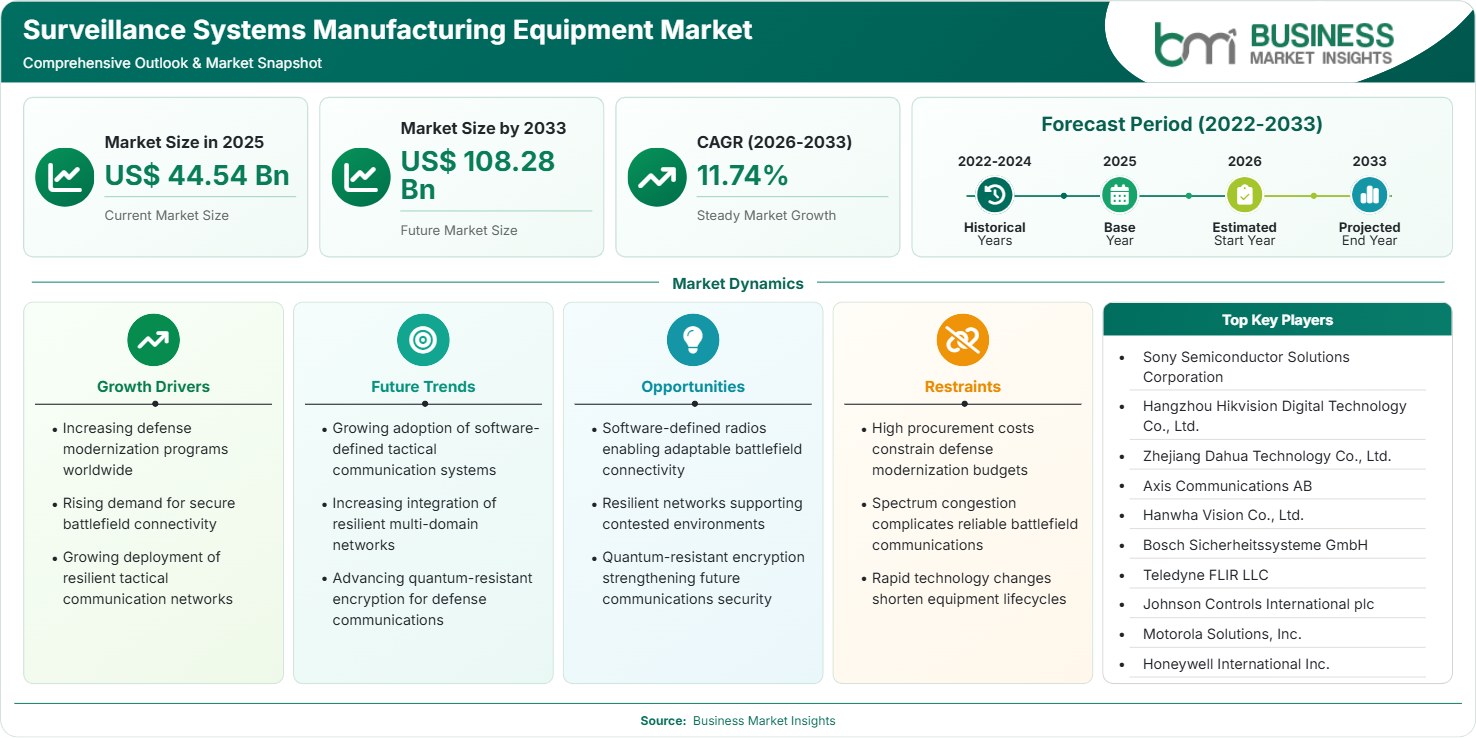
The Surveillance Systems Manufacturing Equipment Market size was valued at US$ 44.54 Billion in 2025 and is projected to reach US$ 108.28 Billion by 2033, growing at a CAGR of 11.74% during 2026–2033, supported by AI-enabled imaging, semiconductor investment, smart infrastructure, industrial automation, and security modernization.

Report Coverage
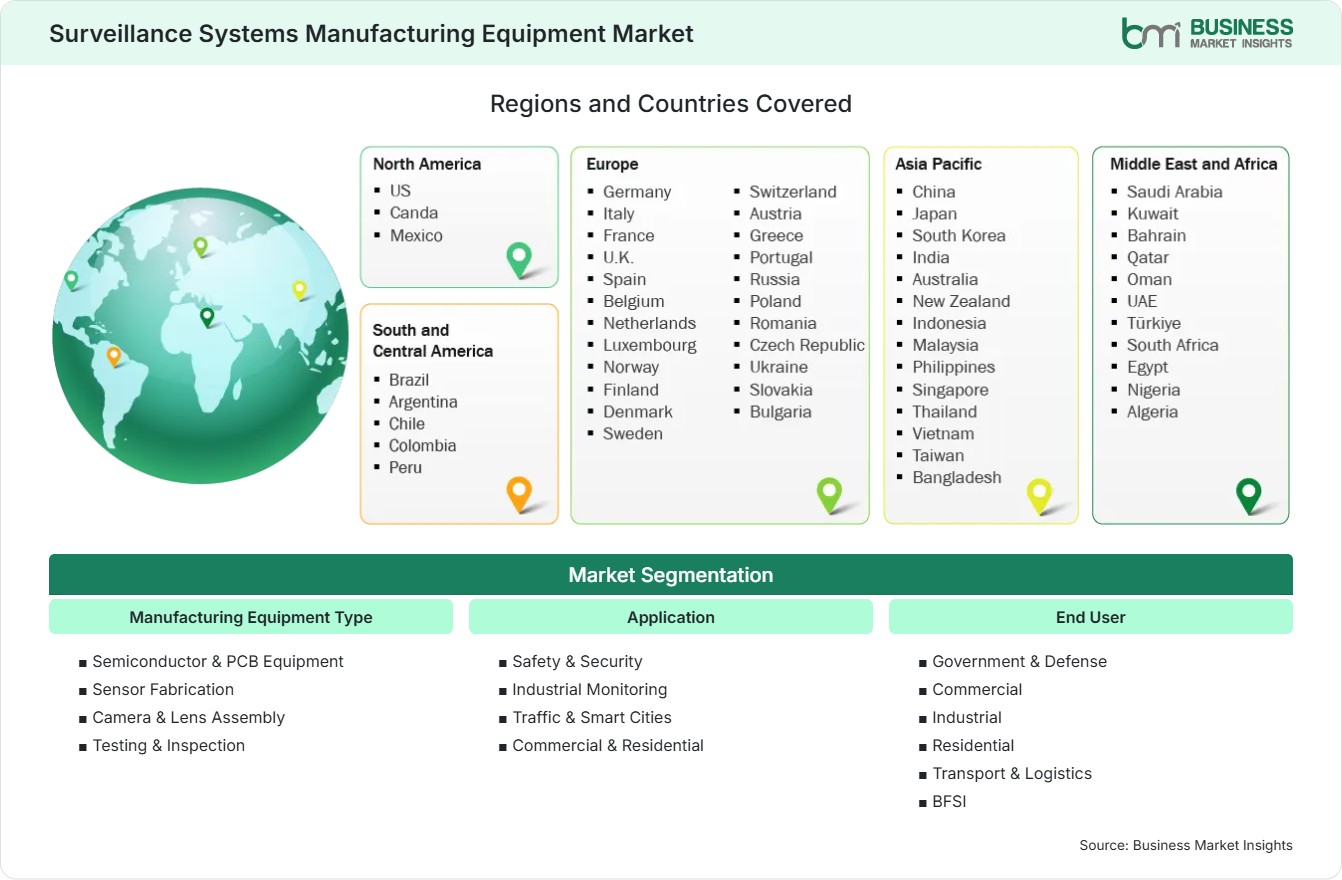
  • Manufacturing Equipment Type: Semiconductor & PCB Equipment, Sensor Fabrication, Camera & Lens Assembly, Testing & Inspection
  • Application: Safety & Security, Industrial Monitoring, Traffic & Smart Cities, Commercial & Residential
  • End User: Government & Defense, Commercial, Industrial, Residential, Transport & Logistics, BFSI
US$ 44.54 Bn Market size in 2025
US$ 108.28 Bn Market Size by 2033
11.74% CAGR, 2026 - 2033
2026-2033 Forecast Period

AI Overview

Surveillance Systems Manufacturing Equipment Market Summary

  • North America Region: North America holds a Surveillance Systems Manufacturing Equipment market share of 31%–34% in 2025, growing with a CAGR of 10.8%–11.4%, influenced by AI-enabled video, critical infrastructure modernization, semiconductor localization, cloud security adoption, and federal procurement. The US market is expanding at a 10.9%–11.5% CAGR, supported by public safety spending, data-center protection, and enterprise security upgrades.
  • Fastest Growing Region: Asia Pacific holds a market share of 29%–32% in 2025, growing with a CAGR of 13.0%–13.7%, driven by electronics manufacturing capacity, smart-city deployments, industrial automation, domestic semiconductor programs, expanding transport infrastructure, and increasing surveillance requirements across major urban centers.
  • Leading Segment: Video Surveillance holds a market share of 42%–45% in 2025, growing with a CAGR of 11.2%–11.8%, supported by network-camera migration, higher-resolution sensors, AI analytics, edge processing, video management modernization, and demand for integrated monitoring across industrial, commercial, transport, and government environments.
  • High Growth Segment: Software & Analytics holds a Surveillance Systems Manufacturing Equipment market share of 15%–18% in 2025, growing with a CAGR of 15.0%–16.0%, supported by edge AI, object detection, automated alerts, behavioral analytics, cloud video management, predictive monitoring, and demand for actionable intelligence from increasingly large camera networks.
  • Key Market Opportunity: Manufacturers can capture value by supplying AI-ready production equipment, high-precision sensor fabrication systems, automated camera assembly, optical inspection platforms, and testing equipment compatible with rapidly evolving intelligent surveillance architectures.
  • Major Market Players: Sony Semiconductor Solutions Corporation, Hangzhou Hikvision Digital Technology Co., Ltd., Zhejiang Dahua Technology Co., Ltd., Axis Communications AB, Hanwha Vision Co., Ltd., Bosch Sicherheitssysteme GmbH, Teledyne FLIR LLC, Johnson Controls International plc, Motorola Solutions, Inc., and Honeywell International Inc.
Strategic Insights

Surveillance Systems Manufacturing Equipment Market: Strategic Insights

Surveillance Systems Manufacturing Equipment Market Strategic Framework
FREE PDF
Request your free sample
Request free sample
Stakeholder View

Key Takeaways

  • The value chain is moving from standalone equipment procurement toward integrated manufacturing ecosystems linking semiconductor fabrication, sensor packaging, PCB production, optics, automated assembly, calibration, testing, and software validation. Equipment vendors that connect these stages can improve production yield and shorten qualification cycles for surveillance manufacturers.
  • Software-enabled surveillance hardware creates a higher-value equipment opportunity because AI-capable cameras require improved processing, thermal management, sensor quality, memory, and testing. Production equipment supporting edge-computing architectures can therefore capture stronger demand than conventional assembly machinery.
  • Sensor engineering is becoming a central differentiator. Higher dynamic range, low-light sensitivity, global shutter performance, infrared capability, and smaller pixels allow surveillance cameras to deliver more reliable machine-readable imagery. Sony’s recent security and industrial sensor developments illustrate this shift toward higher performance at compact form factors.
  • Asia Pacific offers the strongest investment case because semiconductor manufacturing, electronics assembly, camera production, and smart-city deployment are developing simultaneously. China, Japan, South Korea, Taiwan, and India provide complementary capabilities across the manufacturing ecosystem.
  • Consolidation is increasingly focused on combining video, access control, analytics, remote monitoring, and communications. Motorola Solutions’ acquisition of Blue Eye in November 2025 strengthened its AI-powered remote video monitoring capabilities, illustrating the strategic value of integrated security ecosystems.
  • Equipment suppliers should design flexible production platforms that accommodate frequent sensor, lens, processor, and firmware upgrades. Long qualification cycles can otherwise make manufacturing assets obsolete before surveillance product generations mature.
Geographic Outlook

Surveillance Systems Manufacturing Equipment Market Regional Highlights

North America Surveillance Systems Manufacturing Equipment Market

North America accounted for a 31%–34% Surveillance Systems Manufacturing Equipment market share in 2025 and is projected to register a 10.8%–11.4% CAGR through 2033. The region benefits from critical-infrastructure protection, public-safety modernization, data-center construction, border security, and demand for secure domestic technology supply chains. The US represents the dominant regional market because federal agencies, enterprises, transportation operators, and utilities increasingly deploy AI-enabled surveillance. Manufacturing investments increasingly prioritize secure components, automated testing, cybersecurity validation, and high-performance image processing.

  • US procurement supports sophisticated camera, access-control, analytics, and testing requirements across public safety and critical infrastructure.
  • Data-center expansion increases demand for perimeter monitoring, thermal imaging, access control, and automated security validation equipment.
  • Semiconductor localization initiatives strengthen opportunities for sensor fabrication, packaging, testing, and electronics manufacturing equipment.
  • Enterprise customers increasingly prefer interoperable systems that integrate cameras, analytics, access control, and incident management.

US Surveillance Systems Manufacturing Equipment Market

The United States accounted for 75%–79% of North America's sales in 2025 and is expected to grow at a CAGR of 10.9%–11.5% until 2033. Drivers of demand include infrastructure security, government procurement, industry facilities, logistics facilities, and commercial buildings. The need for domestically manufactured products has also been considered to enable automation, which allows for traceable and secure manufacturing processes. Motorola Solutions continues to enhance its video security solutions in both public safety and enterprise markets, whereas Johnson Controls integrates video security with access control and building security solutions.

  • Government and defense buyers emphasize resilient, secure, and traceable equipment supply chains for surveillance manufacturing and system integration.
  • Industrial facilities increasingly require cameras and analytics capable of supporting safety, perimeter protection, process monitoring, and operational intelligence.
  • Commercial security modernization is increasing demand for automated camera assembly, electronics testing, calibration, and network-device validation equipment.

Europe Surveillance Systems Manufacturing Equipment Market

Europe accounted for 24% to 2of the market share in 2025 and is estimated to witness a 10.9% to 11.5% CAGR in the Surveillance Systems Manufacturing Equipment market till 2033. Germany dominates the regional market owing to its industrial automation foundation and security technologies. The UK and France remain the key markets for both commercial and government applications, while Italy and Spain show strong growth prospects due to increasing investment in smart infrastructure, transport security, and urban surveillance.

  • Germany benefits from industrial automation expertise and demand for high-precision inspection, camera assembly, sensor testing, and machine-vision equipment.
  • The UK market is supported by transport security, commercial surveillance modernization, and growing deployment of intelligent video analytics.
  • France combines public infrastructure protection with airport, transport, retail, and industrial surveillance requirements.
  • Spain is positioned for faster growth as smart-city investments and tourism-related security requirements stimulate intelligent monitoring deployments.

Asia Pacific Surveillance Systems Manufacturing Equipment Market

Asia Pacific region held 29%-32% of the market in 2025 and will register the fastest regional growth, at a CAGR of 13.0%-13.7% during 2033. The region is led by China in production capacity, while Japan and South Korea contribute advanced sensing, optics, electronics, and manufacturing technologies. India is becoming an emerging manufacturing hub due to electronics localization, infrastructure development, smart city projects, and technological advancements. The concentration of component suppliers creates opportunities for automated assembly and inspection equipment.

  • China benefits from extensive electronics manufacturing capacity, camera production, smart-city deployments, and domestic semiconductor investment.
  • Japan provides advanced image-sensor, optics, automation, and precision-manufacturing capabilities supporting high-value surveillance equipment production.
  • South Korea benefits from semiconductor expertise, electronics manufacturing, and demand for intelligent security systems across commercial and industrial facilities.
  • India presents strong growth potential from electronics manufacturing, transport infrastructure, urban security, and localization initiatives.

Rest of World Surveillance Systems Manufacturing Equipment Market

South & Central America Surveillance Systems Manufacturing Equipment accounted for a significant share of Rest of World demand, underpinned by applications in urban, transportation, retail, and industrial surveillance. Brazil is the key regional market, and Mexico reaps benefits from manufacturing and logistics activities. The Middle East & Africa contribute to the Rest of World demand through airports, ports, energy infrastructures, commercial developments, and smart cities. In these regions, the trend towards scalable solutions combining video surveillance, access control, analytics, and central monitoring is increasingly common.

The share of Rest of World in 2025 was estimated at 11%–14%, and a CAGR of 9.7%–10.4% is expected through 2033. The UAE and Saudi Arabia will benefit from investments in smart cities and infrastructure, and Brazil is a significant Latin American country.

  • Brazil benefits from urban security requirements, transport monitoring, industrial facilities, and large commercial surveillance deployments.
  • Mexico offers opportunities through manufacturing plants, logistics infrastructure, border-related security, and industrial monitoring.
  • Saudi Arabia is accelerating intelligent infrastructure investment, creating demand for advanced cameras, analytics, access control, and testing equipment.
  • The UAE benefits from airport, hospitality, commercial, and smart-city projects requiring integrated surveillance architectures.
Global Market Geography
FREE PDF
Request your free sample
Request free sample
Segment Analysis

Surveillance Systems Manufacturing Equipment Market Segmentation

Equipment Type

The Equipment Type is the base technology level that provides the necessary support for the manufacturing of surveillance equipment, with the Video Surveillance segment accounting for 42%–45% market share in 2025 and experiencing a 11.2%–11.8% CAGR. This will be influenced by greater adoption of cameras, artificial intelligence, edge computing, better storage, and the requirement for security solutions. The Surveillance Systems Manufacturing Equipment Market scope increasingly spans equipment that supports complete intelligent monitoring ecosystems.

  • Video Surveillance: Camera production equipment supports optical alignment, sensor integration, PCB assembly, calibration, and enclosure assembly for fixed, PTZ, thermal, and specialized surveillance cameras.
  • Storage & Recording: Manufacturing demand reflects network video recorders, storage hardware, memory components, and validation systems designed for continuous high-resolution video retention.
  • Access Control: Production systems support readers, controllers, biometric devices, credentials, and integrated hardware requiring electronics assembly, functional testing, and secure communications validation.
  • Intrusion Detection: Equipment supports alarms, sensors, perimeter detection devices, controllers, and communication modules requiring reliability testing and environmental validation.
  • Software & Analytics: Software-focused production requires computing modules, AI accelerators, firmware validation, application testing, and deployment infrastructure for automated detection and video intelligence.

Manufacturing Equipment Type

The type of Manufacturing Equipment will determine manufacturing efficiency, productivity, and product consistency across surveillance devices. Camera & Lens Assembly emerges as the dominant equipment type in 2025, with a market share of 30%-34%. Automated testing and inspection will grow in importance as cameras become more complex.

  • Semiconductor & PCB Equipment: Fabrication and assembly equipment enables sensor packaging, processor integration, PCB production, soldering, component placement, and electrical validation for surveillance electronics.
  • Sensor Fabrication: Advanced fabrication equipment supports CMOS imaging, infrared sensing, signal processing, packaging, and testing required for high-resolution and low-light surveillance applications.
  • Camera & Lens Assembly: Automated alignment, bonding, focusing, calibration, and enclosure systems improve optical consistency and production throughput across multiple camera architectures.
  • Testing & Inspection: Automated optical inspection, functional testing, environmental testing, and calibration systems reduce defects while validating image quality, connectivity, durability, and security performance.

Application

Applications are increasingly broadening beyond traditional security to include operational intelligence, safety, traffic management, and smart infrastructure. Safety & Security will be the dominant application, with 45%–48% of the Surveillance Systems Manufacturing Equipment market share by 2025, while traffic and smart-city applications offer greater value through analytics-driven monitoring and decision support systems.

  • Safety & Security: Security installations require reliable cameras, access control, intrusion detection, analytics, and recording systems across public and private facilities.
  • Industrial Monitoring: Industrial users deploy cameras for worker safety, process observation, perimeter security, quality monitoring, and operational analytics.
  • Traffic & Smart Cities: Intelligent transport systems use cameras, sensors, analytics, and edge computing for traffic management, incident detection, and urban monitoring.
  • Commercial & Residential: Offices, retail locations, housing complexes, and homes increasingly adopt connected cameras, access control, remote monitoring, and cloud-based security services.

End User

End-user demand indicates the growing convergence between surveillance and operational technology. Government & Defense comprises 27%-30% of the Surveillance Systems Manufacturing Equipment market share in 2025, with applications in public safety, border security, critical infrastructure, and defense. Commercial and industrial customers are becoming increasingly interested in scalable systems that converge physical security, analytics, building systems, and operational processes.

  • Government & Defense: Agencies require secure cameras, ruggedized equipment, analytics, access control, and testing systems for infrastructure, border, and mission-critical environments.
  • Commercial: Enterprises prioritize integrated surveillance, access management, analytics, and remote monitoring across offices, retail, hospitality, healthcare, and campuses.
  • Industrial: Manufacturers deploy surveillance for safety, perimeter protection, process monitoring, asset security, and compliance-related observation.
  • Residential: Connected cameras and smart access systems expand demand for compact, low-power, easy-to-install surveillance manufacturing solutions.
  • Transport & Logistics: Airports, ports, railways, warehouses, and distribution centers require cameras, analytics, access control, and monitoring equipment.
  • BFSI: Banks and financial institutions use high-resolution cameras, access systems, transaction-area monitoring, and analytics to protect facilities and assets.
Market Forces

Surveillance Systems Manufacturing Equipment Market Dynamics

Key Market Drivers

AI-Enabled Video Analytics Raises Equipment Complexity

AI-based surveillance is leading to increased demand for high-resolution sensors, fast processors, edge computing, thermal management, and automatic calibration. Modern cameras not only record but also identify, classify, track, and count objects. Axis Communications illustrates this technological trend by implementing edge-based analytics that process video directly on compatible cameras, enabling various detection scenarios. This technological evolution creates strong tailwinds for the Surveillance Systems Manufacturing Equipment Market growth, as production lines need to test computing, imaging, and networking capabilities simultaneously. Moreover, equipment manufacturers need to conduct rigorous testing to ensure that analytics work accurately across varying lighting and environmental conditions. With the growing focus on real-time intelligence in the surveillance market, equipment providers can benefit from integrated functional testing, image-quality analysis, AI accelerator validation, and automated calibration.

Expansion of Smart Infrastructure and Connected Security

Networked cameras in smart city initiatives, connected transport networks, industrial parks, and digital building solutions are contributing to a rising deployment of networked surveillance equipment. Network cameras are increasingly serving as IoT sensors that provide data for traffic management, security, occupancy tracking, and optimization. According to Axis Communications, contemporary network cameras can serve as sensors, generating actionable data through analytics. This creates an opportunity for the Surveillance Systems Manufacturing Equipment Market trends, as there will be increased demand for network cameras that offer reliable networking, processing, storage, and sensing capabilities. The manufacturing equipment used will therefore have to incorporate higher electronics density and stringent quality control procedures.

Rising Image Quality Requirements Accelerate Sensor Innovation

Surveillance customers are becoming increasingly demanding when it comes to achieving identification in dark environments, under contrasting lighting, at long distances, and in the presence of moving objects. Such a trend has led sensor companies to employ advanced technologies such as CMOS, dynamic range, infrared, global shutter, and higher pixel counts. The 4K surveillance camera with 1.45 µm LOFIC pixels by Sony Semiconductor Solutions was launched in March 2026. Within its range of industrial cameras is the 105-megapixel global-shutter camera that operates up to 100 fps. These trends make equipment necessary for wafers, sensors, packaging, optical systems assembly, calibration, and quality control more demanding. Surveillance Systems Manufacturing Equipment Market growth is increasingly dependent on the capability of manufacturing processes to handle these sensors.

Key Market Opportunities

Automated Camera and Optical Assembly Platforms

Camera structures are becoming smaller in size but include high-resolution sensor chips, multiple lenses, infrared components, processors, and communication modules. That opens the opportunity for equipment manufacturers to design flexible assembly platforms that can automatically align the lenses, focus, bond, calibrate, and test camera functionality. Optical systems automation may help avoid inconsistencies and ensure consistent image quality, even at high production volumes. Machine vision technology may be integrated into equipment providers' manufacturing platforms to detect potential alignment errors before final testing. The opportunity applies to Asia-Pacific, given the strong ecosystem for camera and electronics production; these ecosystems support scale manufacturing in the Surveillance Systems Manufacturing Equipment market forecasts. Modular equipment that can quickly switch between dome, bullet, PTZ, thermal, and compact camera designs can improve asset utilization. Such platforms can also help manufacturers respond faster to changing surveillance product specifications.

Integrated Testing for AI and Cybersecure Devices

Integration of camera sensors, processors, analytical software, networking capabilities, and access controls provides the foundation for developing integrated testing platforms. Traditional electrical testing cannot accurately confirm the functionality of an intelligent system across varying system conditions, lighting conditions, network scenarios, processor loads, and cybersecurity settings. Device manufacturers may create testing environments that will incorporate image quality testing, network testing, firmware testing, artificial intelligence testing, thermal testing, and cybersecurity testing. Such capability will be especially useful in government, military, financial, and infrastructure applications where reliability is essential. Testing integration will allow device manufacturers to generate digital documentation of the manufacturing process. The collected information can be used for predictive maintenance, process optimization, suppliers’ qualification, and fast root cause analysis.

Localized Manufacturing and Supply-Chain Resilience

With increased geopolitical risk and technology security concerns, there is an impetus for surveillance system producers to consider diversifying component sources and developing regional manufacturing capability. This presents an opportunity for equipment providers to develop local manufacturing capability for sensors, PCBs, camera modules, and security electronics. Production lines built with flexibility in component sourcing would be able to switch to alternate processors, memories, sensors, and communications components post-qualification. The equipment companies can facilitate this by offering programmable placement machines, inspection equipment, universal testing interfaces, and digital traceability. Asia Pacific continues to present the greatest opportunity for scaled manufacturing, while North America and Europe offer higher-value opportunities focused on secure supply chains and critical infrastructure. Local manufacturing would also lower transportation risk and provide a quick turnaround to meet government procurement specifications.

Market Restraints and Challenges

High Capital Intensity and Longer Equipment Payback

Factor: The development of advanced semiconductor, optical assembly, testing, and inspection technologies entails significant capital investment, particularly when a manufacturer chooses to establish automated manufacturing lines with machine vision and data processing capabilities. Impact: Small surveillance manufacturing firms may delay purchasing new equipment and opt for semi-automated processes due to the high upfront costs of high-quality equipment. The high cost of machinery is accompanied by the cost of qualifications, engineering, training, software licensing, and maintenance. Moreover, manufacturing equipment needs to be flexible because cameras, sensors, processors, and communication standards change quickly. Inability to make modifications to the product being manufactured would shorten the economic lifespan of the production line. Manufacturers may minimize this barrier through modular solutions and other innovations.

Component and Technology Fragmentation and Production Complexity

Factor: The surveillance system uses sensors, lenses, processors, memory chips, networking, firmware, and other technologies in its construction. Impact: The manufacturing processes will require complex qualification, interoperability, calibration, and testing of components. Component replacement is likely to affect the device's electrical, thermal, optical, or software aspects. This problem is likely to become even more complex when the supplier caters to different regional standards and government procurement systems. The manufacturing process will therefore need to have the capability for a programmable test interface, flexible fixtures, software-assisted inspection, and traceability. The supplier that cannot accommodate the changing component mix may become uncompetitive in the emerging surveillance systems.

Company Analysis

Competitive Landscape

The Surveillance Systems Manufacturing Equipment market analysis indicates that competition extends across imaging components, surveillance hardware, analytics, access control, and integrated security platforms. The leading ecosystem includes both specialized technology providers and diversified security companies.

Company Name

Overview

Products and Services relevant to this market

Sony Semiconductor Solutions Corporation

Japan-based semiconductor technology company with extensive image-sensor capabilities serving security and industrial imaging applications.

CMOS image sensors, security camera sensors, industrial global-shutter sensors, image-processing technologies, and sensor development platforms.

Hangzhou Hikvision Digital Technology Co., Ltd.

Major video-surveillance technology provider with broad camera, recording, analytics, and intelligent security portfolios.

Network cameras, thermal cameras, NVRs, video management, AI analytics, access control, and integrated surveillance solutions.

Zhejiang Dahua Technology Co., Ltd.

Security technology company focused on intelligent video, sensing, analytics, and connected security infrastructure.

IP cameras, PTZ cameras, thermal imaging, storage, access control, video management, and AI-enabled security technologies.

Axis Communications AB

Network-camera specialist emphasizing edge analytics, imaging quality, cybersecurity, and open security platforms.

Network cameras, video encoders, analytics, access control, audio, video management, and image-health technologies.

Hanwha Vision Co., Ltd.

South Korean vision-security specialist developing cameras and intelligent monitoring technologies for enterprise and infrastructure applications.

AI cameras, NVRs, video management, thermal cameras, analytics, storage, and specialized surveillance solutions.

Bosch Sicherheitssysteme GmbH

Security technology provider combining video, intrusion detection, access control, and building-security capabilities.

CCTV cameras, video analytics, recording, intrusion detection, access control, and integrated security platforms.

Teledyne FLIR LLC

Imaging technology company specializing in thermal imaging and sensing for security, industrial, and public-safety applications.

Thermal cameras, visible-light imaging, sensors, analytics, rugged surveillance systems, and specialized imaging technologies.

Johnson Controls International plc

Diversified building technology company offering integrated security products across video, access, intrusion, and monitoring.

IP cameras, VMS, NVRs, analytics, access control, intrusion detection, and integrated security management platforms.

Motorola Solutions, Inc.

Public-safety technology company integrating video security, communications, analytics, and incident-response capabilities.

Fixed and mobile cameras, AI analytics, video management, access control, remote monitoring, and command-center technologies.

Honeywell International Inc.

Diversified technology company serving building, industrial, aerospace, and security applications through connected systems.

Video surveillance, access control, intrusion technologies, building security systems, analytics, and integrated monitoring solutions.

Trust & Transparency

Research Methodology

The market analysis combines proprietary research with secondary data from government agencies, company disclosures, regulatory filings, industry databases and expert interviews. Market estimates are validated through data triangulation, cross-market benchmarking and analyst review.

View Full Research Methodology

Questions Answered

Frequently Asked Questions

How can manufacturers reduce production risks?

Manufacturers can reduce risks through modular equipment, automated inspection, digital traceability, programmable testing, supplier diversification, preventive maintenance, and flexible tooling. These approaches help production lines adapt to changing sensors, processors, lenses, firmware, and surveillance product configurations.

What role do image sensors play in surveillance equipment manufacturing?

Image sensors determine sensitivity, resolution, dynamic range, low-light performance, and motion capture quality. Advances in CMOS architecture therefore influence camera design, optical alignment, calibration requirements, production testing, and the manufacturing equipment needed to maintain consistent performance.

How does AI affect surveillance manufacturing requirements?

AI increases requirements for higher-quality image data, faster processors, edge computing, memory, thermal management, and reliable software validation. Manufacturers consequently need more comprehensive testing and calibration systems capable of validating both hardware and intelligent functions.

Why is Asia Pacific becoming important for surveillance equipment production?

Asia Pacific combines semiconductor manufacturing, electronics assembly, optical components, camera production, and large domestic surveillance deployments. This concentration allows equipment suppliers to serve multiple production stages while benefiting from expanding smart-city and industrial investments.

What manufacturing technologies are most important for intelligent surveillance equipment?

Automated optical assembly, CMOS sensor testing, PCB inspection, calibration, functional testing, thermal validation, firmware verification, and AI-performance testing are increasingly important because surveillance devices combine imaging, computing, networking, and analytics functions.

Access the Full Surveillance Systems Manufacturing Equipment Market Report

Get segment-level forecasts, regional estimates, competitive benchmarking, company profiles and downloadable Excel datasets.

Access the full Surveillance Systems Manufacturing Equipment Market Report
350 pages PDF & Excel | 2026-09-10
Similar Research

Related Market Reports