Market Summary
Executive Summary and Global Market Analysis
The video surveillance in the commercial aircraft market comprises systems that offer surveillance to enhance cabin security, cockpit access control, cargo protection, and aircraft exterior surveillance. Video surveillance systems play a crucial role in aviation safety by providing continuous monitoring to enhance safety in various aircraft settings.
The use of these surveillance systems is fueled by increasing safety measures for passengers, securing cockpit access, and improving situational awareness. Airline companies are adopting modern surveillance technologies to improve surveillance and compliance with safety measures in aviation.
The major segments in the commercial aircraft video surveillance market include different kinds of systems that have unique applications. The system's components, which include cameras, recording devices, display screens, and networking systems, among others, provide a platform for integrating the surveillance systems. Different types of aircraft, such as narrow-body aircraft, wide-body aircraft, regional jets, and business jets, have unique fitting and installation options.
The development of technology has been accompanied by the incorporation of elements such as digital recordings, high-definition imaging, and connectivity via networks. Uses of the technology include passenger monitoring, cargo monitoring, and external monitoring of the aircraft, thus showcasing the move towards surveillance systems by the aviation industry.
The competitive landscape features system manufacturers that develop modular systems in addition to innovation based on compliance. Partnerships with OEMs as well as aftermarket companies will contribute significantly to success in this sector.
Segment Analysis
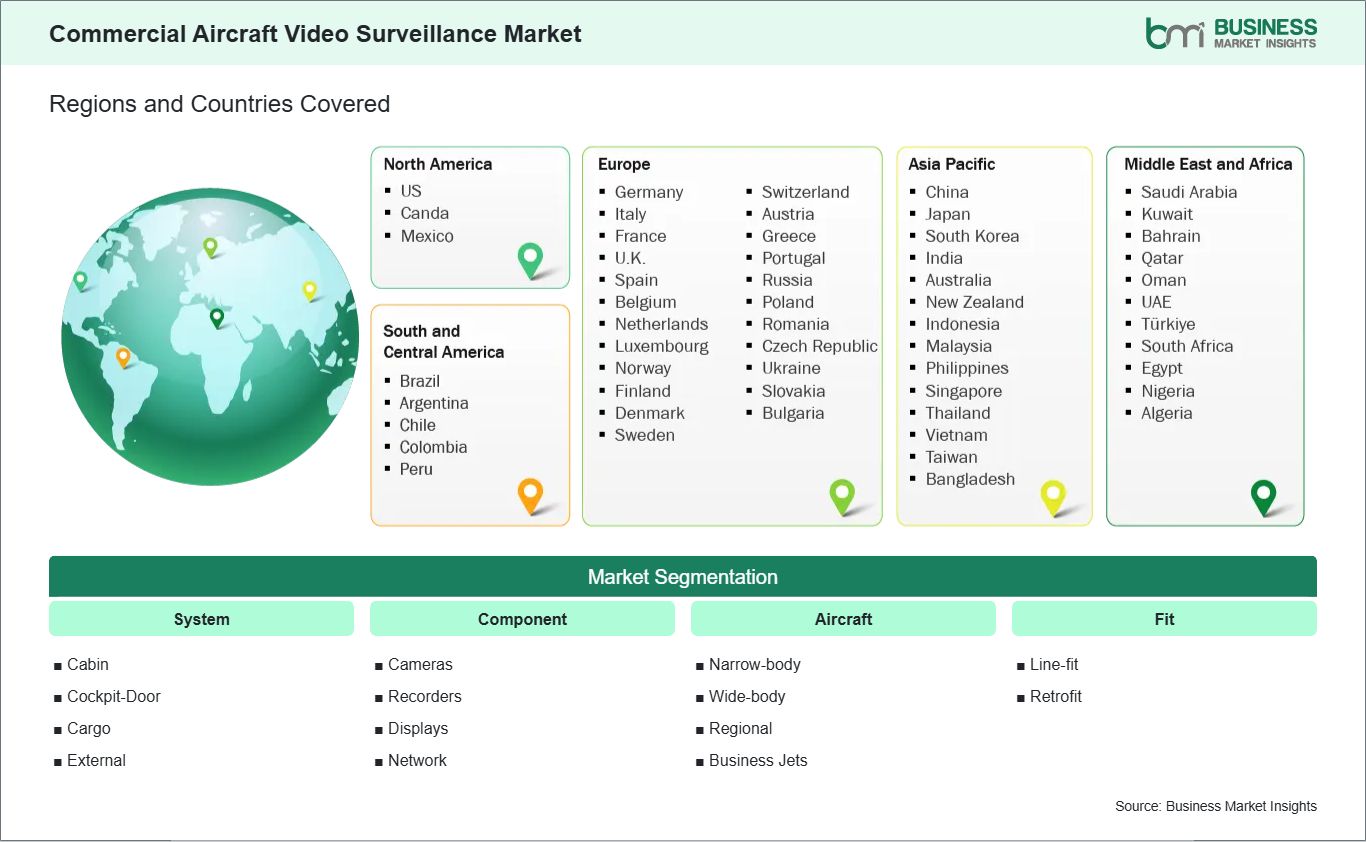
Commercial Aircraft Video Surveillance Market Segmentation
The commercial aircraft video surveillance market is segmented based on system, component, aircraft, and fit, reflecting aviation’s emphasis on integrated monitoring solutions and secure operational environments.
By System
- Cabin: Passenger monitoring enhances situational awareness and safety compliance.
- Cockpit-Door: Access control systems strengthen cockpit security protocols.
- Cargo: Surveillance ensures cargo integrity and operational transparency.
- External: External monitoring supports aircraft safety during ground and flight operations.
By Component
- Cameras: High-definition imaging improves visibility across aircraft zones.
- Recorders: Digital storage ensures reliable data retention and retrieval.
- Displays: Real-time visualization supports crew decision-making.
- Network: Connectivity enables seamless integration of surveillance subsystems.
By Aircraft
- Narrow-body: Standardized installations align with high-volume passenger operations.
- Wide-body: Multi-zone monitoring supports long-haul operational requirements.
- Regional: Compact systems address short-haul operational efficiency.
- Business: Customized solutions cater to corporate aviation needs.
By Fit
- Line-fit: Factory integration ensures standardized deployment across new aircraft.
- Retrofit: Upgrades modernize existing fleets with advanced surveillance capabilities.
Market Forces
Commercial Aircraft Video Surveillance Market Drivers and Opportunities
Passenger safety boosting surveillance demand
The aspect of passenger safety has been elevated to such an extent that it has prompted the installation of surveillance systems in most airline companies to ensure safety. The monitoring process and cockpit door access have been incorporated to guarantee safety through operational assurance, which is becoming more stringent due to new regulations. Through the surveillance system, the airline personnel will be able to take quick action in case anything unusual is detected.
There has been an increase in the regulations issued by the aviation authorities regarding safety and the need for the airline staff to adhere to them. The regulations have prompted the need for surveillance in the aviation industry. As a result, surveillance systems have been installed in most airlines as a measure to comply with the new regulations.
Retrofit demand boosting surveillance systems
Retrofit demand has become another important source of growth, allowing companies to retrofit their existing aircraft fleets with new surveillance technologies. There is always a demand among many air carriers to install new surveillance capabilities on the aircraft fleet before new aircraft is purchased. Through retrofits, aircraft will have more useful life left and will comply with current safety regulations.
Aftermarket demand will receive a boost as a result of ongoing modernization programs, due to the capability of retrofits to provide state-of-the-art surveillance equipment to old aircraft models. This contributes to long-term growth within the industry, since suppliers will be able to develop different surveillance technologies depending on specific customer needs. Through the addressing of retrofit demand, the market becomes an even more important part of fleet modernization.
Size and Share Analysis
Commercial Aircraft Video Surveillance Market Size and Share Analysis
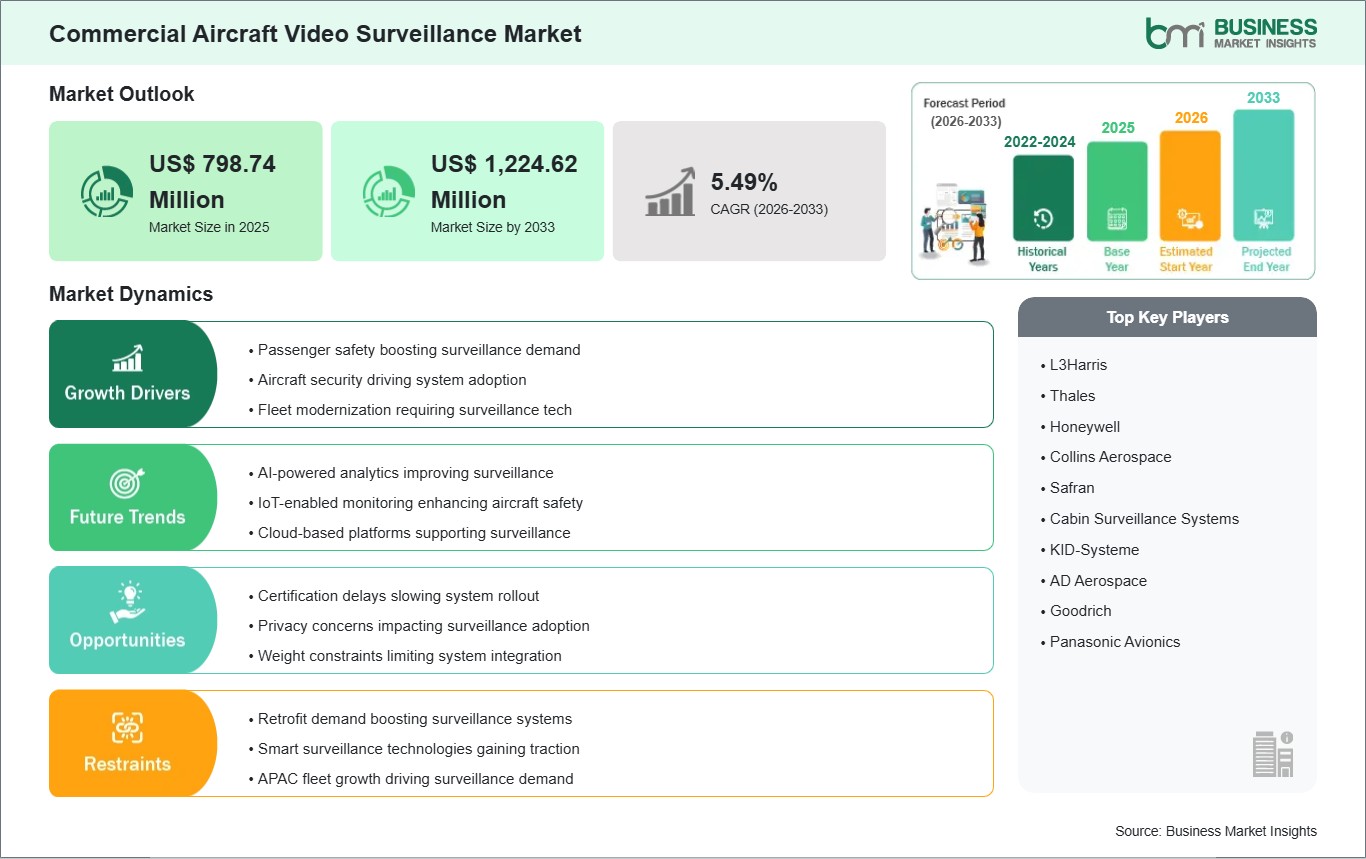
The Commercial Aircraft Video Surveillance Market is projected to grow from US$ 798.74 Million in 2025 to US$ 1,224.62 Million by 2033 , registering a CAGR of 5.49% from 2026 to 2033.
By system, cockpit-door surveillance systems maintain the leading position due to stringent global aviation security regulations mandating continuous monitoring of cockpit entry points. They play a critical role in preventing unauthorized access and enhancing pilot safety, especially after increased security concerns in commercial aviation, making them a mandatory and widely adopted system across airlines.
By component, cameras dominate as they are the core sensing element in all video surveillance systems across cabin, cockpit, cargo, and external applications. The rising adoption of high-definition, infrared, and wide-angle imaging technologies enhances situational awareness and recording capability, driving their widespread integration and replacement demand in modern aircraft fleets.
By aircraft, narrow-body leads the market owing to their large global fleet size and high utilization in short- and medium-haul operations, making them the most widely deployed aircraft type. Continuous production by major OEMs and extensive retrofit programs for safety upgrades significantly increase the installation of video surveillance systems in this segment.
By fit, line-fit holds a significant share because airlines prefer integrating surveillance systems during aircraft manufacturing for better system integration, lower installation costs, and reduced downtime. OEM-installed solutions ensure compliance with the latest safety and certification standards while offering higher reliability and seamless integration with modern avionics and aircraft monitoring architectures.
Report Coverage
Commercial Aircraft Video Surveillance Market Report Coverage and Deliverables
The "Commercial Aircraft Video Surveillance Market Size and Forecast (2022-2033)" report provides a detailed analysis of the market covering below areas:
- The market size and forecast at global, regional, and country levels for all market segments covered under the scope
- The market trends, as well as drivers, restraints, and opportunities
- The market analysis covering key trends, global and regional framework, major players, regulations, and recent developments
- Industry landscape and competition analysis covering market concentration, heat map analysis, prominent players, and recent developments for the market
- Detailed company profiles, including SWOT analysis
Geographic Insights
Commercial Aircraft Video Surveillance Market Geographic Insights
There are varying levels of adoption of video surveillance solutions for commercial aircraft worldwide due to factors such as the regulation of video surveillance technology, fleet management initiatives, and prioritization of safety measures. The global adoption is a combination of pre-integration in OEM aircraft and after-market installation, driven by the particular needs of each region.
North America is one of the regions that has embraced video surveillance because of effective regulations and extensive commercial airline fleets. U.S. and Canadian airlines focus on fulfilling aviation regulations that ensure the safety of their aircraft. The region has a robust aviation industry, and surveillance technologies are integrated into both aircraft delivery and retrofit programs.
The Asia-Pacific region shows tremendous growth through the increasing number of airline fleets in developing countries such as China, India, and Japan. Carriers in this region prefer investments aimed at modernizing the operation of airlines, where the demand for the installation of surveillance systems is driven by the need for retrofits within a wide array of aircraft categories. Aviation development in this region is driven by the increase in passenger traffic along with the growth in aircraft fleet size, providing ample opportunity for the providers to create customized solutions.
For the European region and the emerging markets, OEM installation combined with aftermarket retrofitting can be seen as a major trend within the market. In countries such as Germany, France, and the United Kingdom, the primary concern of carriers has been the need for compliance with safety standards. The integration of surveillance systems into the narrow-body and wide-body aircraft of such carriers is seen as an essential requirement. For emerging markets located within the Middle East and Latin American countries, the installation of surveillance systems becomes a necessary element for increased operational transparency among passengers.
Industry Activity
Recent Developments
The commercial aircraft video surveillance market is evaluated by gathering qualitative and quantitative data post primary and secondary research, which includes important corporate publications, association data, and databases. A few of the key developments in the commercial aircraft video surveillance market are:
- In April 2025, Thales Group announced a joint innovation concept with Diehl Aviation for an advanced digital cabin platform, integrating onboard data center technology to enable smart cabin functions, real-time monitoring, and scalable video-enabled cabin system architecture for next-generation connected aircraft.
- In May 2023, Collins Aerospace announced the launch of its IRT NX satellite communications system, integrating cabin connectivity with aircraft data systems that support real-time monitoring and enhance digital cockpit-to-cabin situational awareness within connected aircraft architectures, including video-enabled cabin ecosystems.
Trust & Transparency
Research Methodology
The market analysis combines proprietary research with secondary data from government agencies, company disclosures, regulatory filings, industry databases and expert interviews. Market estimates are validated through data triangulation, cross-market benchmarking and analyst
review.
View Full Research Methodology
Key Sources Referred:
Federal Aviation Administration (FAA) European Union Aviation Safety Agency (EASA) International Civil Aviation Organization (ICAO) UK Civil Aviation Authority (UK CAA) Civil Aviation Administration of China (CAAC) Transport Canada Civil Aviation (TCCA) International Air Transport Association (IATA) National Transportation Safety Board (NTSB) Company Websites Company Annual Reports Company Investor Presentations