Drone Surveillance Market Regional Highlights
North America Drone Surveillance Market
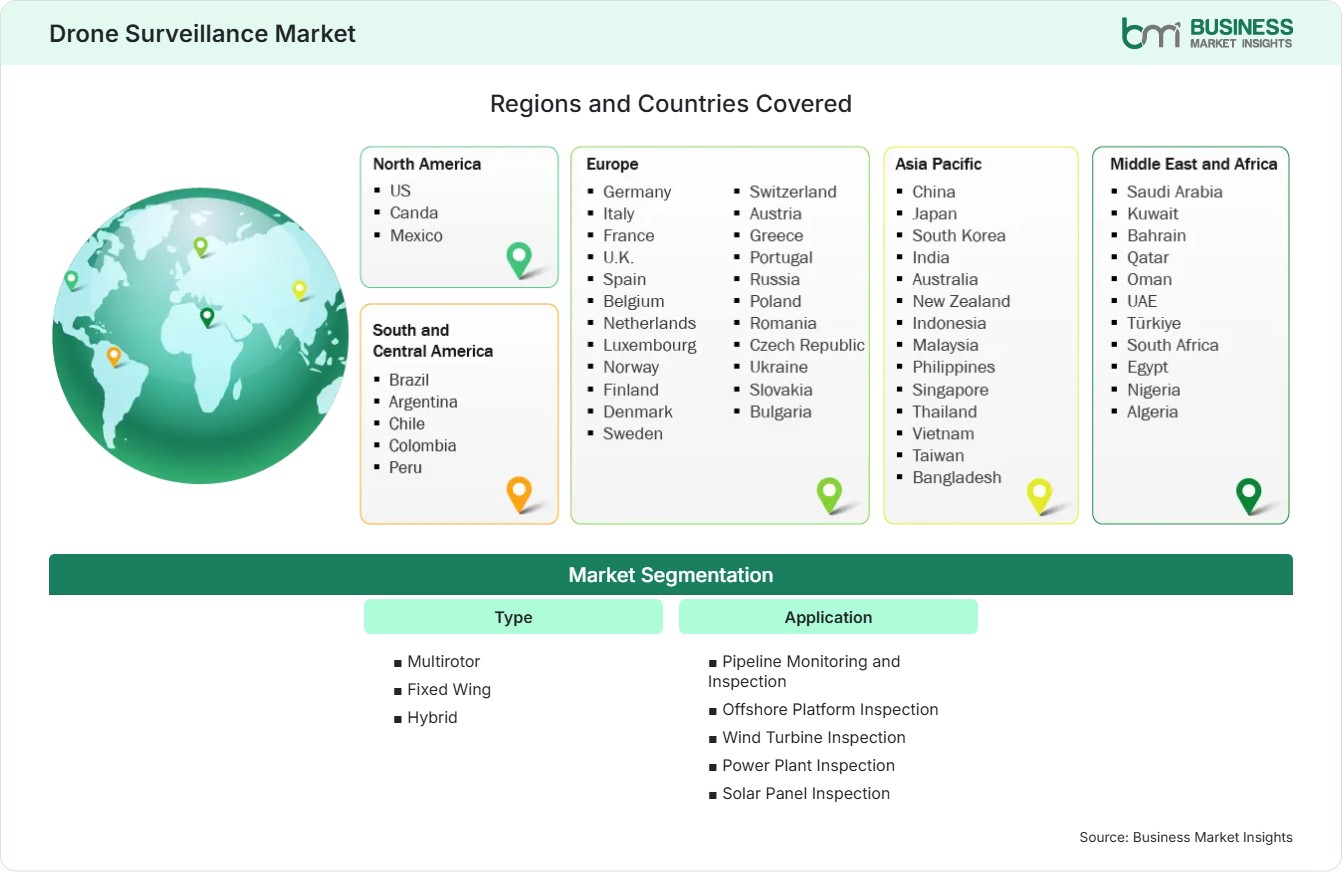
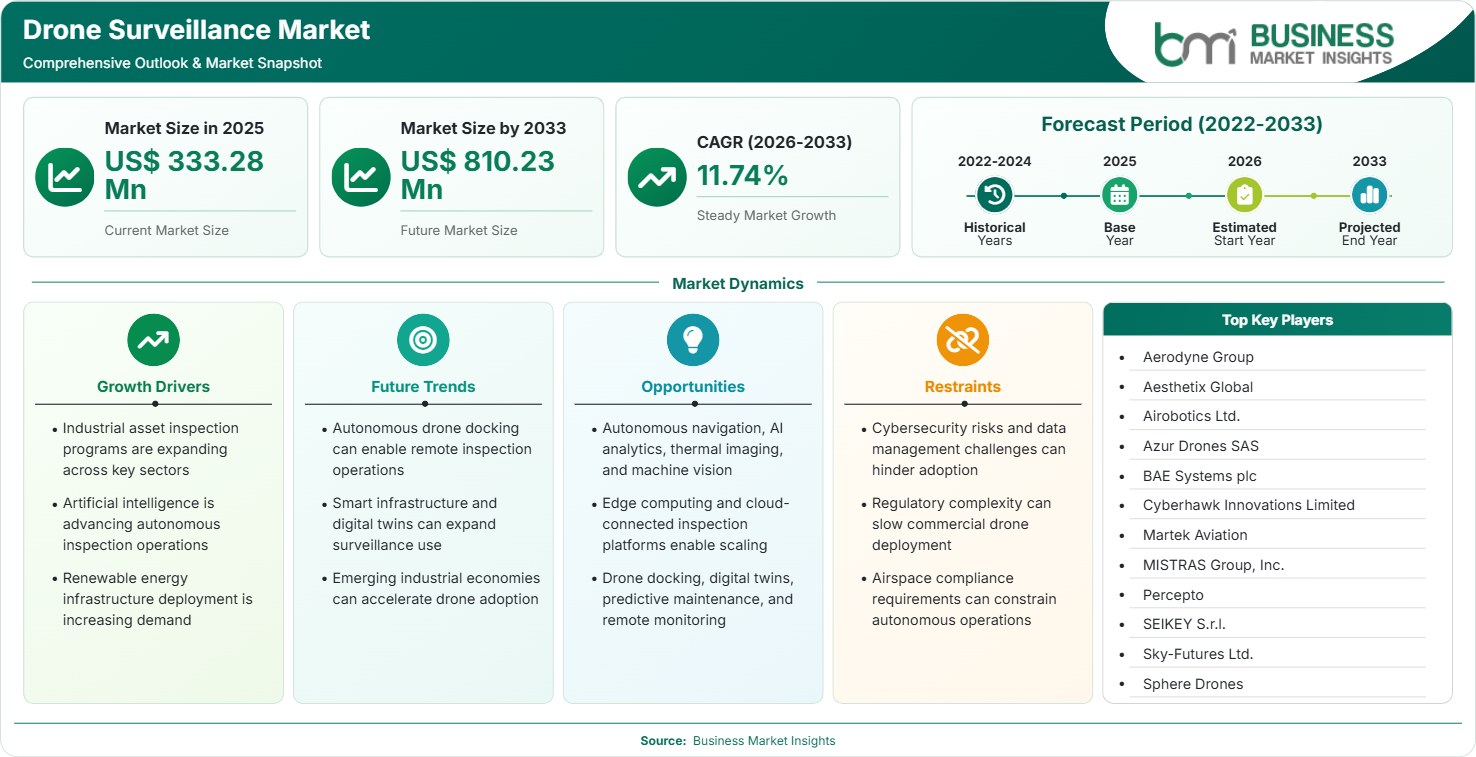
North America accounted for 34%–37% of global revenue in 2025 and is expected to register a CAGR of 10.8%–11.8% during 2026–2033. Strong demand from energy infrastructure, utilities, defense, transportation, and industrial inspection programs supports regional leadership. The Drone Surveillance Market share remains highest in North America because enterprises continue investing in autonomous inspection technologies, AI-enabled monitoring platforms, and advanced data analytics. Expanding regulatory support for commercial drone operations further strengthens adoption across critical infrastructure environments.
- Energy companies increasingly deploy autonomous surveillance platforms for pipeline integrity management, methane detection, and remote asset inspections across extensive operating environments.
- Utility operators are integrating drone-generated analytics into maintenance planning processes, improving reliability while reducing inspection costs and workforce exposure to hazardous conditions.
- Industrial organizations continue investing in AI-driven monitoring platforms capable of identifying structural defects, equipment anomalies, and operational risks in near real time.
- Autonomous drone stations and remote operations centers are gaining adoption across large industrial facilities seeking scalable inspection capabilities and continuous monitoring coverage.
- Expanding commercial approvals for advanced flight operations continue supporting long-term Drone Surveillance Market growth throughout the region.
US Drone Surveillance Market
The U.S. represents 78%–82% of North American revenue and is projected to expand at a CAGR of 11.0%–12.0% through 2033. Large-scale energy infrastructure, utility networks, transportation systems, and industrial assets create substantial demand for aerial monitoring solutions. Advanced analytics deployment, increasing industrial automation, and strong technology investment continue positioning the country as the leading national market for commercial surveillance operations.
- Oil and gas operators increasingly rely on autonomous surveillance systems for methane monitoring, environmental compliance, and operational efficiency improvement initiatives.
- Utility companies continue integrating thermal imaging and predictive analytics into inspection programs to improve asset performance and maintenance planning.
- Large industrial operators are deploying drone-based digital inspection platforms to improve safety metrics and reduce operational disruptions.
- AI-powered image analytics and remote operations centers are supporting scalable inspection programs across geographically dispersed infrastructure networks.
Europe Drone Surveillance Market
Europe held approximately 28%–31% of global revenue in 2025 and is forecast to achieve a CAGR of 11.3%–12.3% during 2026–2033. Regulatory harmonization, renewable energy expansion, and infrastructure modernization continue supporting adoption. France remains a leading market due to strong autonomous drone deployment activity, while the United Kingdom demonstrates robust growth supported by industrial inspection and offshore energy monitoring investments.
- Offshore wind inspections continue driving demand for autonomous aerial monitoring technologies capable of reducing operational costs and maintenance downtime.
- Industrial operators are increasing investments in digital inspection ecosystems integrating drones, analytics software, and predictive maintenance tools.
- Energy transition initiatives are supporting deployment across renewable energy infrastructure and utility modernization projects.
- France benefits from strong autonomous surveillance platform adoption across industrial facilities and critical infrastructure environments.
- The United Kingdom continues expanding drone-based offshore inspection programs across energy and infrastructure sectors.
Asia Pacific Drone Surveillance Market
Asia Pacific accounted for 27%–30% of global revenue in 2025 and is projected to register the fastest CAGR of 13.5%–14.8% through 2033. Industrial expansion, energy infrastructure investments, smart city programs, and utility modernization initiatives continue driving demand. Japan leads adoption across industrial inspection applications, while Australia demonstrates particularly strong growth through mining, utility, and renewable energy surveillance deployments.
- Utility modernization programs are creating opportunities for large-scale inspection and monitoring deployments across electricity transmission and distribution infrastructure.
- Renewable energy investments are increasing demand for solar and wind asset monitoring solutions capable of supporting predictive maintenance programs.
- Industrial enterprises increasingly deploy autonomous surveillance technologies to improve operational visibility and workforce safety.
- Japan benefits from advanced industrial automation ecosystems supporting adoption of intelligent inspection technologies.
- Australia continues expanding deployment across mining operations, utility infrastructure, and large-scale renewable energy projects.
Rest of World Drone Surveillance Market
Rest of World represented 6%–8% of global revenue in 2025 and is anticipated to achieve a CAGR of 12.0%–13.2% during 2026–2033. Adoption is expanding across energy, mining, and infrastructure sectors. The Middle East benefits from large-scale oil and gas monitoring requirements, while Brazil demonstrates growing demand associated with utility modernization and industrial asset inspection initiatives. Continued investments in infrastructure efficiency and digital transformation support long-term expansion.
- Oil-producing nations increasingly utilize autonomous drone operations to improve infrastructure visibility and reduce inspection costs across remote environments.
- Mining operators are adopting aerial monitoring systems to improve operational awareness, safety management, and asset performance optimization.
- Infrastructure modernization programs are encouraging deployment across transportation, utilities, and industrial facilities.
- Brazil is emerging as a significant market supported by energy infrastructure expansion and digital inspection initiatives.
- Gulf countries continue investing in smart infrastructure programs that support advanced surveillance and monitoring technologies.