
AI in Surveillance Market Outlook: Size, Share, Trends, Growth Analysis, Competitive Landscape & Forecast, 2026-2033

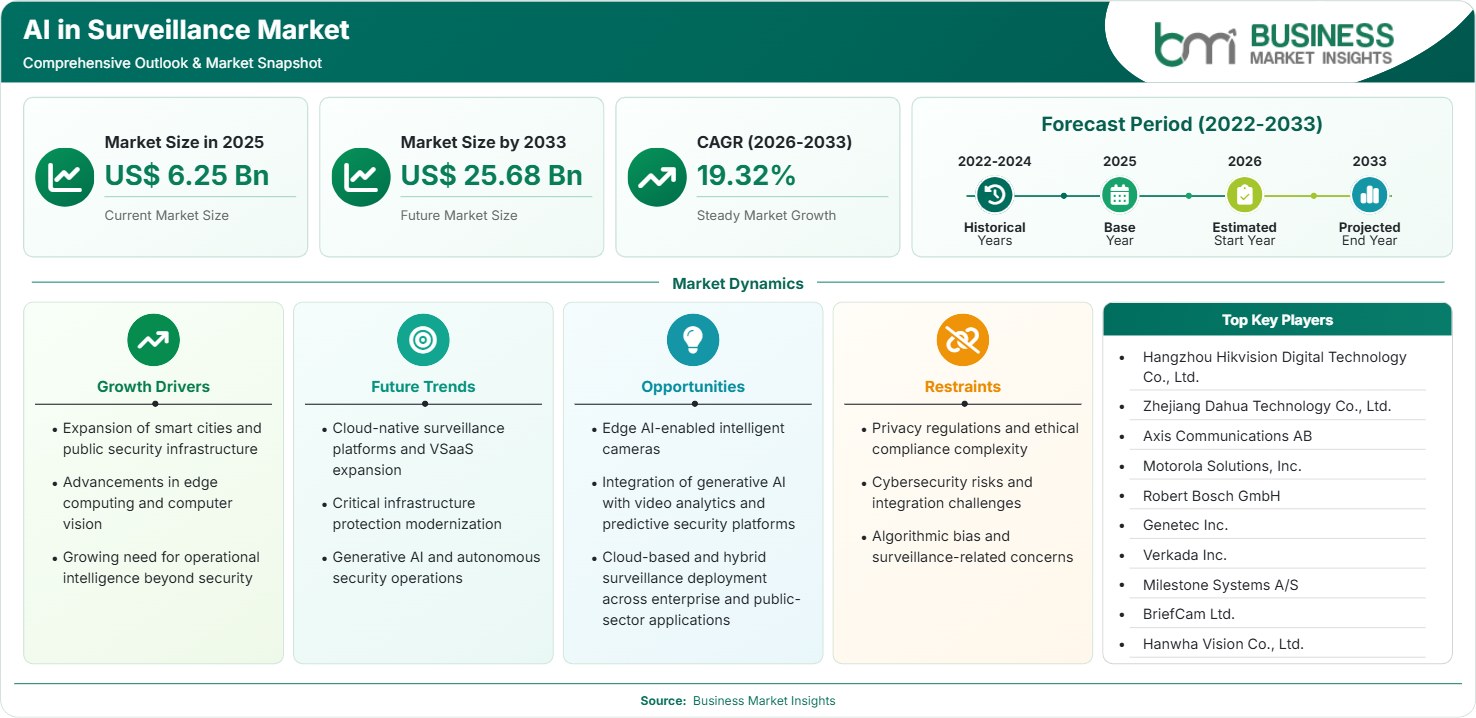
The AI in Surveillance Market size was valued at US$ 6.25 Billion in 2025 and is projected to reach US$ 25.68 Billion by 2033, growing at a CAGR of 19.32% during 2026–2033. Key drivers include smart city investments, expanding public safety programs, edge AI adoption, intelligent video analytics deployment, and rising demand for real-time threat detection. Opportunities are emerging across critical infrastructure, transportation, retail intelligence, and autonomous security operations.

Report Coverage
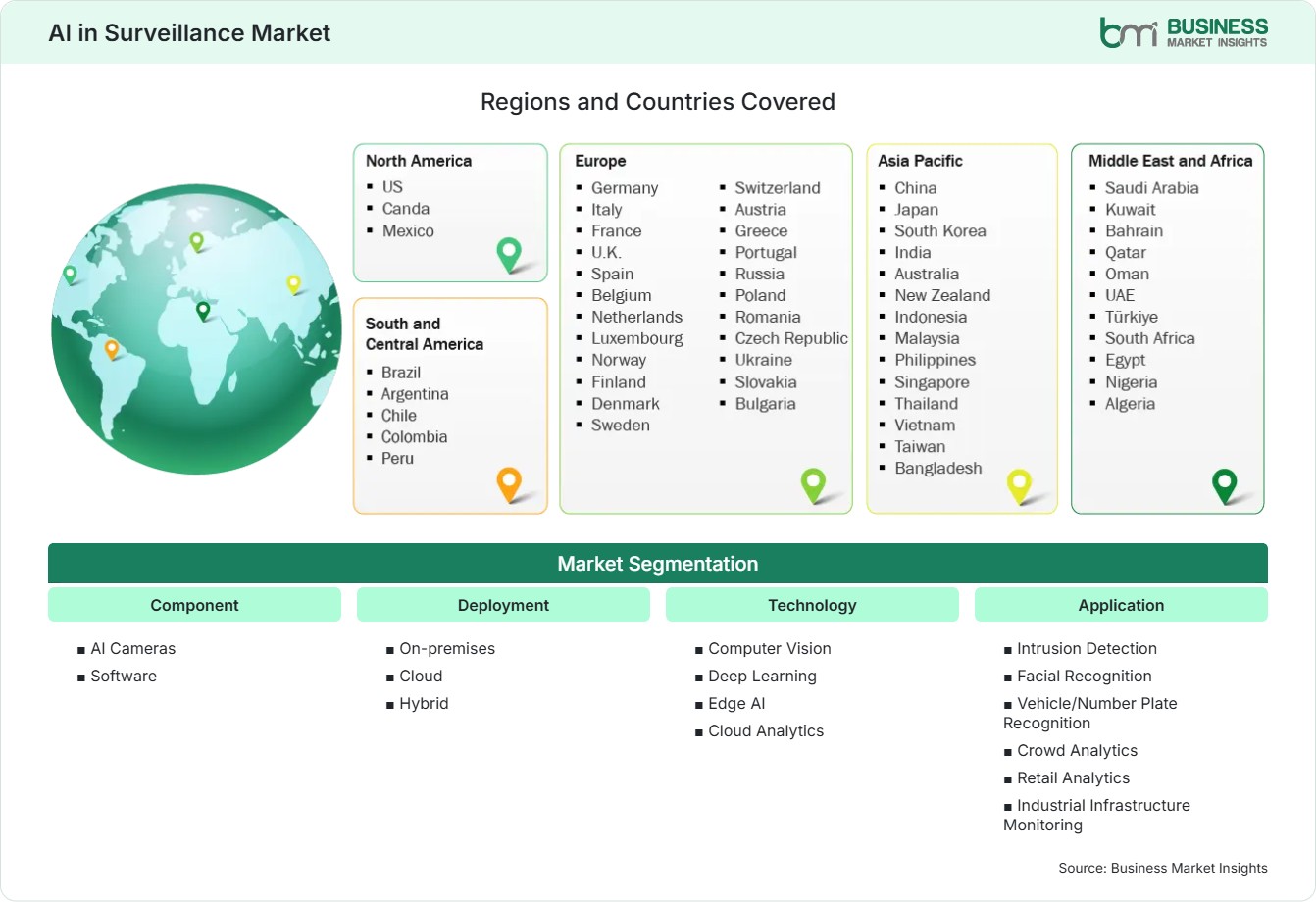
  • Component: AI Cameras, Software
  • Deployment: On-premises, Cloud, Hybrid
  • Technology: Computer Vision, Deep Learning, Edge AI, Cloud Analytics
  • Application: Intrusion Detection, Facial Recognition, Vehicle/Number Plate Recognition, Crowd Analytics, Retail Analytics, Industrial Infrastructure Monitoring
  • End-User: Government & Public Facilities, Commercial, Industrial, Military & Defense
US$ 6.25 Bn Market size in 2025
US$ 25.68 Bn Market Size by 2033
19.32% CAGR, 2026 - 2033
2026-2033 Forecast Period

AI Overview

AI in Surveillance Market Summary

  • North America Region: North America holds an AI in Surveillance Market share of 36%–39% in 2025, growing at a CAGR of 17.5%–19.0% during 2026–2033. Growth is supported by smart infrastructure modernization, public safety digitization, critical asset monitoring, cloud video analytics expansion, cybersecurity integration, and enterprise demand for scalable intelligent surveillance ecosystems. US market remains the regional anchor, supported by federal security programs and enterprise deployments, advancing at roughly 18.0%–19.5% CAGR.
  • Fastest Growing Region: Asia Pacific holds a market share of 27%–30% in 2025, growing at a CAGR of 21.0%–23.0% during 2026–2033. Rapid urbanization, smart city rollouts, transport digitization, AI investments, expanding camera networks, manufacturing automation, and government-backed public safety initiatives continue accelerating deployment across major economies.
  • Leading Segment: Government & Public Facilities accounts for a 30%–33% share of the AI in Surveillance Market in 2025, expanding at a CAGR of 18.0%–19.5%. Large-scale monitoring projects, border security requirements, urban surveillance modernization, emergency response optimization, and centralized command centers continue driving sustained procurement across agencies globally.
  • High Growth Segment: Cloud deployment represents a 26%–29% share in 2025 and advances at a CAGR of 23.0%–25.0%. Flexible scalability, lower infrastructure costs, remote monitoring capabilities, AI model updates, multi-site visibility, and video surveillance-as-a-service adoption strengthen demand.
  • Key Market Opportunity: Integration of generative AI, edge analytics, and predictive security platforms enables proactive risk identification, operational automation, reduced response times, stronger situational awareness, and higher-value intelligence extraction across industries.
  • Major Market Players: Hangzhou Hikvision Digital Technology Co., Ltd.; Zhejiang Dahua Technology Co., Ltd.; Axis Communications AB; Motorola Solutions, Inc.; Robert Bosch GmbH; Genetec Inc.; Verkada Inc.; Milestone Systems A/S; BriefCam Ltd.; Hanwha Vision Co., Ltd.
Strategic Insights

AI in Surveillance Market: Strategic Insights

AI in Surveillance Market Strategic Framework
FREE PDF
Request your free sample
Request free sample
Stakeholder View

Key Takeaways

  • The value chain is evolving from camera-centric systems toward software-driven ecosystems where analytics engines, AI models, cloud platforms, and cybersecurity layers generate increasing revenue share.
  • Vehicle recognition, crowd analytics, infrastructure monitoring, and industrial safety applications offer strong upside as organizations seek operational intelligence beyond conventional security functions.
  • Innovation is shifting toward multimodal AI combining computer vision, predictive analytics, edge inference, and generative intelligence to improve situational awareness and automate response workflows.
  • India, Southeast Asia, and Gulf countries present compelling investment cases due to expanding smart city programs, transportation infrastructure development, and public safety modernization budgets.
  • Strategic partnerships between camera manufacturers, software providers, and cloud vendors are increasing, creating integrated platforms capable of serving large-scale enterprise and government projects.
  • Regulatory focus on privacy, data residency, and algorithm transparency is encouraging vendors to develop explainable AI capabilities and localized deployment options.
Geographic Outlook

AI in Surveillance Market Regional Highlights

North America AI in Surveillance Market

North America represents approximately 36%–39% AI in Surveillance Market share in 2025 and is projected to expand at 17.5%–19.0% CAGR through 2033. Strong investment in public safety modernization, enterprise security digitization, critical infrastructure monitoring, and cloud-based analytics supports regional leadership. Federal agencies, transportation operators, utilities, and commercial organizations continue upgrading legacy surveillance networks with AI-enabled systems. Demand increasingly centers on real-time detection, predictive monitoring, and integrated command platforms, positioning the region as a major innovation hub for advanced surveillance technologies.

  • Strong adoption of edge-enabled cameras across airports, transportation networks, and public facilities improves decision speed while lowering bandwidth requirements and operational costs.
  • Enterprise organizations increasingly combine physical security and cybersecurity operations, creating demand for unified intelligence platforms capable of monitoring complex threat environments.
  • Smart city investments across metropolitan regions encourage deployment of AI-driven traffic analytics, crowd management solutions, and emergency response coordination systems.
  • Critical infrastructure operators utilize intelligent monitoring platforms to improve resilience, asset protection, and regulatory compliance across distributed facilities.

US AI in Surveillance Market

The United States accounts for roughly 78%–82% of regional revenue and advances at 18.0%–19.5% CAGR. Government modernization programs, enterprise digital transformation initiatives, and expanding cloud infrastructure adoption continue supporting demand. Transportation, defense, utilities, education, and retail are among the strongest implementation sectors. Procurement increasingly favors intelligent platforms offering automated alerts, analytics integration, cybersecurity controls, and flexible deployment architectures capable of supporting large distributed networks.

  • Airports and transportation agencies deploy analytics-driven surveillance to strengthen passenger safety and operational efficiency.
  • Retail chains increasingly adopt intelligent video systems for loss prevention, customer flow monitoring, and store optimization.
  • Defense and homeland security applications continue supporting investments in advanced perimeter monitoring technologies.
  • Cloud-enabled surveillance services reduce deployment complexity while strengthening accessibility across large multi-location enterprises.

Europe AI in Surveillance Market

Europe has a 24% to 27% share in 2025 and has a CAGR of 18.5% to 20.0% for the AI in Surveillance Market. The factors that drive growth include data governance needs, infrastructure upgrades, and industrial automation. The market is driven by Germany, but other Eastern European countries are experiencing rapid growth. Companies are focusing on privacy-compliant analytics architecture and deployment frameworks. Investments in rail infrastructure, logistics, manufacturing, and urban safety applications are driving the market.

  • Germany leads regional demand through industrial automation and critical infrastructure security projects.
  • The United Kingdom supports adoption through transportation modernization and smart urban services deployment.
  • Poland and Romania are among the faster-growing national markets with growth exceeding broader regional averages.
  • Privacy-focused surveillance deployments encourage adoption of advanced anonymization and data governance technologies.

Asia Pacific AI in Surveillance Market

Asia Pacific accounts for 27%–30% share during 2025 and represents the fastest-growing region with 21.0%–23.0% CAGR. Urbanization, industrialization, transportation modernization, and expanding public safety investments are driving extensive deployment activity. China remains the largest market, while India demonstrates exceptional momentum supported by digital infrastructure initiatives. Manufacturing facilities, smart cities, logistics networks, and transit systems are major end-use segments contributing to accelerating demand across the region.

  • China remains the largest national market through sustained investments in intelligent city infrastructure.
  • India records one of the strongest growth trajectories due to digital governance programs and transportation modernization projects.
  • Southeast Asian countries increasingly deploy AI-driven monitoring platforms in urban infrastructure and logistics sectors.
  • Manufacturing organizations utilize analytics-enabled surveillance to improve operational safety and productivity.

Rest of World AI in Surveillance Market

The rest of world holds a 9%-12% share in 2025 and grows at a CAGR of 19.0%-21.0% through 2033. The Middle East has the advantage of significant investments in smart cities and critical infrastructure projects, and South and Central America are increasingly using intelligent security systems in transport and commercial areas. Energy, public places, border security projects, and logistics sites remain significant deployment areas. Growing urban populations and modernization initiatives continue to strengthen long-term opportunities.

  • Saudi Arabia leads Middle East demand through large-scale smart infrastructure developments.
  • United Arab Emirates remains a notable adopter of advanced urban security technologies.
  • Brazil serves as the largest South American market driven by transportation and public safety investments.
  • Chile and Colombia display encouraging growth supported by modernization of public security networks.
Global Market Geography
FREE PDF
Request your free sample
Request free sample
Segment Analysis

AI in Surveillance Market Segmentation

Component

Component Segment exhibits high demand for intelligent devices and analytics solutions. This segment accounts for around 25%–28% of market share in AI cameras and is expected to grow at a CAGR of 19.0%–20.5%. The scope of AI in Surveillance Market continues to grow with the increasing adoption of capture devices and analytics solutions.

  • AI Cameras: Intelligent cameras perform edge analytics, object recognition, and instant event detection, reducing bandwidth demand while strengthening real-time security monitoring capabilities.
  • Software: Analytics software enables centralized management, threat identification, pattern analysis, compliance monitoring, and operational intelligence across distributed surveillance environments.

Deployment

Deployment preferences have been evolving toward scalable and secure architectures. The cloud deployment is experiencing a higher growth rate, with a 23.0%-25.0% CAGR, whereas the on-premises deployment is popular among regulated users. The hybrid model has emerged as the choice for large enterprises managing performance, compliance, and cost optimization requirements.

  • On-premises: Preferred by defense, government, and critical infrastructure users requiring direct control over data governance and security operations.
  • Cloud: Supports centralized intelligence, remote accessibility, software updates, multi-site visibility, and efficient resource utilization across enterprise networks.
  • Hybrid: Combines local processing and cloud analytics, delivering flexibility, performance optimization, and enhanced regulatory compliance capabilities.

Technology

The development of technology continues to play an important role in ensuring competitiveness across industries. Computer vision is the largest segment, accounting for 31%–34% of the AI in Surveillance Market, whereas Edge AI experiences one of the highest growth rates. Investments increasingly focus on improving detection accuracy, processing speed, and automation capabilities.

  • Computer Vision: Enables object detection, activity monitoring, behavioral analysis, and image interpretation across complex operating environments.
  • Deep Learning: Improves recognition accuracy through advanced neural networks trained across extensive data sources and surveillance scenarios.
  • Edge AI: Facilitates instantaneous decision-making by processing information locally, minimizing latency and network dependency.
  • Cloud Analytics: Supports large-scale data aggregation, advanced reporting, and centralized intelligence generation for distributed operations.

Application

Diversity in applications is set to increase as businesses adopt surveillance for intelligence gathering purposes. Intrusion detection remains an important revenue driver, while crowd and retail analytics have been adopted due to the need for automation and AI in Surveillance Market trends across commercial sectors.

  • Intrusion Detection: Enhances perimeter protection through real-time recognition of abnormal movements and unauthorized access attempts.
  • Facial Recognition: Supports identity verification, access control administration, and investigative workflows across security-sensitive environments.
  • Vehicle/Number Plate Recognition: Enables traffic management, parking automation, fleet monitoring, and law-enforcement intelligence functions.
  • Crowd Analytics: Assists public safety authorities and venue operators in monitoring movement density and risk conditions.
  • Retail Analytics: Provides customer behavior insights, space optimization intelligence, and improved loss prevention capabilities.
  • Industrial Infrastructure Monitoring: Strengthens operational oversight, safety compliance, and asset protection within critical facilities.

End-User

Government & Public Facilities remain the leading segment with a 30%–33% share and 18.0%–19.5% CAGR. Strategic investments in border management, urban security, public transportation, and emergency response systems support continued leadership.

  • Government & Public Facilities: Depend on centralized monitoring and large-scale intelligence platforms for public safety enhancement.
  • Commercial: Utilizes intelligent analytics for security optimization, customer insights, and operational efficiency improvements.
  • Industrial: Deploys AI-enabled monitoring to safeguard assets, workers, and production environments.
  • Military & Defense: Employs advanced surveillance systems for perimeter protection, situational awareness, and mission-critical security operations.
Market Forces

AI in Surveillance Market Dynamics

Key Market Drivers

Expansion of Smart Cities and Public Security Infrastructure

Governments around the world are making massive investments in smart mobility, city management, and public safety systems. The application of AI surveillance is important for providing real-time monitoring and incident detection in large cities. The increased use of connected camera systems, command centers, and traffic management systems fuels the demand. The AI in Surveillance Market growth will continue to be fueled by modernization projects in the public sector, where efficiency and citizen safety are key considerations. The integration of IoT with emergency management and transport systems makes value creation more pronounced and promotes the adoption of these technologies in developed and developing nations.

Advancements in Edge Computing and Computer Vision

Innovations related to AI processing, neural networks, and edge computing make it easier to conduct surveillance. The capacity to detect objects, observe behavior, identify faces, and recognize anomalies enables increased accuracy and faster reactions. It has become preferable for companies to use intelligent edge devices to process locally, thereby reducing bandwidth usage. AI in Surveillance Market trends indicate a clear move towards systems that utilize distributed architectures, which offer advantages in scalability, cybersecurity, and real-time awareness. Continued innovation in deep learning algorithms supports broader deployment across complex commercial, industrial, and government environments.

Growing Need for Operational Intelligence Beyond Security

Modern-day surveillance systems can be used for business intelligence, asset management, compliance management, and even employee safety. Businesses use analytics for customer insights, manufacturers use video analytics for operational effectiveness, and transportation providers use advanced surveillance to streamline processes and minimize disruption. With businesses seeking returns beyond that of basic security, there is much more justification for investment. The shift from basic recording to intelligence broadens the scope of possibilities and increases software spending across many industries.

Key Market Opportunities

Cloud-Native Surveillance Platforms and VSaaS Expansion

Cloud surveillance solutions are becoming more popular due to their flexibility, scalability, and centralized management. A subscription model for services lowers initial implementation and maintenance costs. Cloud Contribution to AI in Surveillance Market Forecasts is growing as companies move away from traditional systems. Multi-location businesses, educational organizations, logistics companies, and retail stores are potential customers. Suppliers that build a secure, compliant cloud ecosystem with strong analytics capabilities will benefit from growing demand, recurring income streams, and stronger customer retention rates.

Critical Infrastructure Protection Modernization

Advanced monitoring systems are needed by utilities, energy plants, transportation infrastructure, and telecommunications companies. Growing concerns about physical security and operational disruptions are driving the purchase of predictive surveillance technology. Predictive analytics can detect deviations, increase visibility into assets, and help address situations promptly. Funding in resilient infrastructure initiatives in developed countries and emerging markets ensures a positive demand environment for surveillance technology vendors, system integrators, and analytics software developers.

Generative AI and Autonomous Security Operations

AI opens the possibility of turning surveillance technology from detection-focused to an intelligence system. Automating reporting, explaining events, assigning risk scores, and using language-based investigation tools could enhance efficiency. Organizations nowadays need platforms that help lessen the analyst’s workload while providing better insights. Companies that integrate their generative models into well-known computer vision technologies might gain a unique market position and higher-value service offerings.

Market Restraints and Challenges

Privacy Regulations and Ethical Compliance Complexity

Factor: Increasing regulatory scrutiny for the use of facial recognition, biometric processing, and video data management. Impact: Businesses confront extended procurement processes, compliance expenditures, and limitations. Varied regional regulations complicate the planning and implementation of such technologies for multinational companies. Surveillance agencies need increasingly more ways to show audit trails and privacy-enhancing analytics. Inability to meet compliance can lead to project delays, legal risks, and the reduced use of technologies in regulated environments. This applies particularly in governmental, educational, healthcare, and venue settings where privacy concerns are heightened.

Cybersecurity Risks and Integration Challenges

Factor: The interconnectedness of camera systems, cloud, storage, and network infrastructure increases exposure. Impact: Security risks can lead to data breaches and loss of credibility for surveillance systems. Furthermore, integrating old infrastructure will create additional problems in terms of cost and complexity. An organization will be required to include features such as encryption, access control, software updates, and monitoring mechanisms. The requirements of cybersecurity architecture can pose limitations for financially constrained individuals and organizations.

Company Analysis

Competitive Landscape

The competitive environment reflects strong software innovation, integrated platform development, and expanding analytics capabilities. AI in Surveillance Market analysis indicates increasing competition among camera manufacturers, video management providers, and cloud-native surveillance specialists.

Company Name

Overview

Products and Services relevant to this market

Hangzhou Hikvision Digital Technology Co., Ltd.

Global surveillance technology provider with extensive camera and security platform portfolio.

AI cameras, video analytics, smart city surveillance solutions, command platforms.

Zhejiang Dahua Technology Co., Ltd.

Major provider of intelligent security and video surveillance technologies.

AI-enabled cameras, analytics software, perimeter protection, monitoring systems.

Axis Communications AB

Known for network video solutions and intelligent camera innovation.

Network cameras, edge analytics, access control, surveillance software.

Motorola Solutions, Inc.

Security technology leader through integrated video intelligence ecosystem.

Avigilon solutions, analytics, video management, public safety platforms.

Robert Bosch GmbH

Industrial and security technology company with advanced analytics capabilities.

Intelligent cameras, AI video analytics, monitoring and security solutions.

Genetec Inc.

Developer of unified security and surveillance management platforms.

Video management software, analytics integration, security operations platforms.

Verkada Inc.

Cloud-native enterprise physical security provider.

Cloud surveillance, analytics, access control, monitoring services.

Milestone Systems A/S

Specialist in open-platform video management technologies.

Video management software, analytics integration, monitoring infrastructure.

BriefCam Ltd.

Video analytics company specializing in rapid forensic review capabilities.

Video summarization, investigation tools, analytics and intelligence software.

Hanwha Vision Co., Ltd.

Global imaging and surveillance technology manufacturer.

AI cameras, imaging solutions, intelligent video analytics platforms.

Trust & Transparency

Research Methodology

The market analysis combines proprietary research with secondary data from government agencies, company disclosures, regulatory filings, industry databases and expert interviews. Market estimates are validated through data triangulation, cross-market benchmarking and analyst review.

View Full Research Methodology

Questions Answered

Frequently Asked Questions

What does an AI in Surveillance Market Report typically evaluate?

A Market Report generally examines market size, competitive positioning, technology trends, deployment models, regulatory influences, investment activity, growth outlook, and regional demand patterns.

How does edge AI improve surveillance performance?

Edge AI processes data directly on devices, reducing latency, lowering bandwidth consumption, enhancing system resilience, and enabling immediate response to security events.

Which end-user category currently generates the highest revenue?

Government and public facilities lead spending due to investments in public safety, transportation monitoring, border security, and large-scale urban surveillance modernization initiatives.

What deployment model is gaining the most momentum?

Cloud deployment is gaining momentum because it supports scalability, centralized management, rapid software updates, remote monitoring, and lower infrastructure requirements compared with fully on-premises environments.

What factors are accelerating adoption of AI-powered surveillance systems?

Real-time threat detection, automated analytics, smart city programs, falling edge-computing costs, and growing demand for operational intelligence are driving broader adoption across public and private sectors.

Access the Full AI in Surveillance Market Report

Get segment-level forecasts, regional estimates, competitive benchmarking, company profiles and downloadable Excel datasets.

Access the full AI in Surveillance Market Report
350 pages PDF & Excel | 2026-09-02