Market Summary
Executive Summary and Global Market Analysis
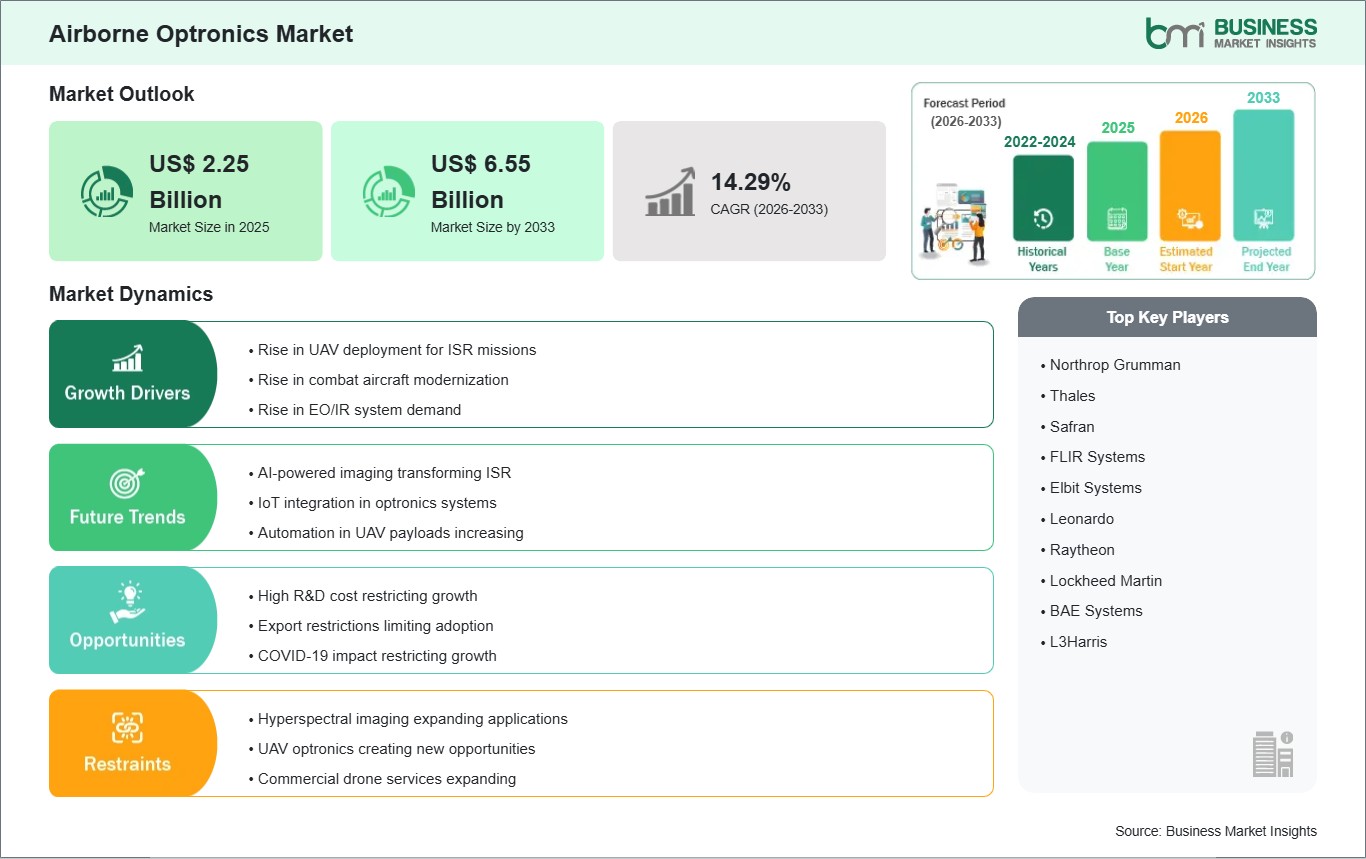
Airborne optronics systems combine optical and electronic technologies to support surveillance, targeting, navigation, reconnaissance, and imaging operations in airborne platforms. These systems include electro-optical and infrared sensors, multispectral and hyperspectral imaging technologies, and advanced visualization tools used across military, commercial, and space applications. The market is expanding due to increasing demand for real-time situational awareness, border surveillance, intelligence gathering, and precision targeting capabilities. Rising adoption of unmanned aerial vehicles and modernization of airborne defense platforms are also supporting market growth.
There are several challenges influencing market growth. High development and integration costs associated with advanced airborne imaging systems remain a major concern for budget-sensitive operators. Strict defense regulations and export control policies can slow technology deployment across international markets. The complexity of integrating multiple sensors and imaging systems into existing airborne platforms also increases operational and maintenance requirements. In harsh environmental and operational conditions, airborne optronics systems require continuous calibration and maintenance to maintain performance accuracy.
Despite these challenges, the market is expected to grow steadily due to increasing investments in next-generation airborne surveillance and intelligence systems. EO/IR technology continues to dominate the market because of its extensive use in military reconnaissance and targeting applications. Hyperspectral imaging is gaining attention for its ability to provide detailed environmental and terrain analysis. Military applications account for a significant market share, while commercial and space sectors are creating new opportunities through advancements in remote sensing and earth observation technologies.
Segment Analysis
Airborne Optronics Market Segmentation
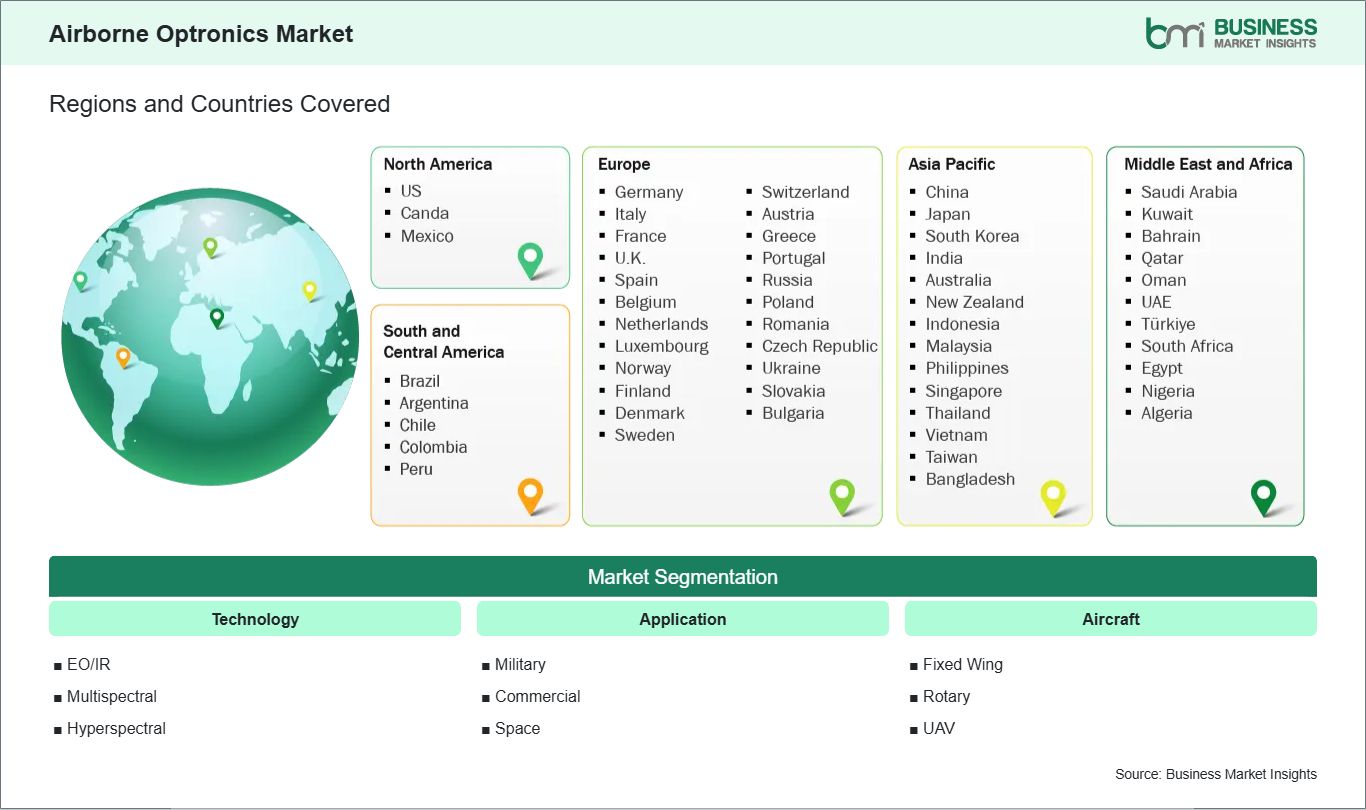
The Airborne Optronics market is segmented by technology, application, and aircraft type. Increasing investments in airborne surveillance, intelligence systems, and advanced imaging technologies are supporting market expansion across defense and commercial sectors.
By Technology
- EO/IR: Widely used for surveillance, targeting, navigation, and reconnaissance operations in airborne defense platforms.
- Multispectral: Supports environmental monitoring, terrain analysis, and agricultural observation through multi-band imaging capabilities.
- Hyperspectral: Increasingly adopted for detailed material detection, remote sensing, and advanced intelligence gathering applications.
By Application
- Military: Represents a major segment due to growing demand for airborne surveillance, intelligence, and precision targeting systems.
- Commercial: Used in aerial mapping, infrastructure monitoring, environmental assessment, and disaster management operations.
- Space: Supports satellite imaging, earth observation, and advanced remote sensing applications.
By Aircraft
- Fixed Wing: Commonly used for long-range surveillance, reconnaissance, and intelligence missions.
- Rotary: Supports tactical operations, rescue missions, and short-range aerial surveillance activities.
- UAV: Experiencing rapid adoption due to growing deployment of unmanned systems for intelligence and monitoring operations.
Market Forces
Airborne Optronics Market Drivers and Opportunities
Rising Demand for Advanced Airborne Surveillance Systems
The growing focus on border security, intelligence gathering, and modern battlefield awareness is driving demand for advanced airborne optronics systems. Governments and defense organizations are investing heavily in airborne surveillance platforms equipped with electro-optical and infrared imaging technologies to improve operational efficiency and mission accuracy. These systems help military forces monitor large geographic areas, detect threats in real time, and support precision targeting operations under different environmental conditions. Increasing geopolitical tensions and the modernization of airborne defense fleets are also supporting the adoption of advanced optronics technologies.
Commercial sectors are increasingly using airborne imaging systems for infrastructure monitoring, disaster management, and environmental observation. Technological advancements in imaging sensors, thermal cameras, and real-time data transmission systems are improving the performance and reliability of airborne optronics platforms. In addition, the growing use of unmanned aerial vehicles in surveillance and reconnaissance applications is creating further demand for lightweight and compact optronics systems. Regulatory support for advanced aerial monitoring and security systems is also contributing to the long-term expansion of the Airborne Optronics market.
Expansion of Hyperspectral Imaging and UAV Integration
Emerging opportunities in the Airborne Optronics market are linked to the rapid development of hyperspectral imaging technologies and increased integration of optronics systems into UAV platforms. Hyperspectral imaging provides highly detailed information across multiple spectral bands, enabling improved terrain analysis, environmental monitoring, and object detection capabilities. Industries such as defense, agriculture, mining, and environmental management are increasingly adopting these technologies for advanced data collection and analysis purposes.
The growing deployment of UAVs for surveillance, inspection, and mapping operations is also creating significant opportunities for compact airborne optronics solutions. Lightweight imaging systems with enhanced resolution and real-time processing capabilities are becoming essential for unmanned aerial operations. Artificial intelligence and machine learning technologies are further improving automated target recognition, image analysis, and operational decision-making processes. The increasing focus on smart surveillance systems and autonomous aerial operations is expected to support future market expansion. In addition, space-based observation programs and satellite imaging initiatives are generating additional demand for high-performance airborne optronics technologies across global markets.
Size and Share Analysis
Airborne Optronics Market Size and Share Analysis
The Airborne Optronics Market is projected to grow from US$ 2.25 Billion in 2025 to US$ 6.55 Billion by 2033 , registering a CAGR of 14.29% from 2026 to 2033.
By technology, EO/IR systems account for a significant share due to their extensive use in surveillance, reconnaissance, navigation, and targeting applications across airborne defense platforms. Multispectral imaging continues to gain adoption in environmental monitoring and commercial aerial mapping operations, while hyperspectral technologies are expanding steadily with increasing demand for advanced remote sensing and intelligence analysis capabilities.
By application, military applications dominate the market owing to rising investments in airborne surveillance systems, border security operations, and modern defense infrastructure. Commercial applications are witnessing strong growth due to increased use of airborne imaging systems in infrastructure inspection, disaster management, and environmental monitoring activities. Space applications are also expanding with growing interest in satellite imaging and earth observation programs.
Report Coverage
Airborne Optronics Market Report Coverage and Deliverables
The "Airborne Optronics Size and Forecast (2022-2033)" report provides a detailed analysis of the market covering below areas:
- Market size and forecast at global, regional, and country levels for all the key market segments covered under the scope
- Market trends, as well as market dynamics such as drivers, restraints, and key opportunities
- Market analysis covering key market trends, global and regional framework, major players, regulations, and recent market developments
- Industry landscape and competition analysis covering market concentration, heat map analysis, prominent players, and recent developments for the market
- Detailed company profiles, including SWOT analysis
Geographic Insights
Airborne Optronics Market Geographic Insights
The Airborne Optronics Market shows diverse regional adoption patterns influenced by defense modernization programs, surveillance requirements, aerospace infrastructure, and technological advancements in airborne imaging systems.
North America remains a leading region in the Airborne Optronics market due to significant investments in military surveillance, intelligence systems, and advanced aerospace technologies. The United States continues to deploy airborne optronics systems across fixed-wing aircraft, helicopters, and UAV platforms for reconnaissance and tactical operations. Canada is also increasing adoption of airborne imaging technologies for border monitoring, environmental observation, and disaster response activities. The region benefits from advanced aerospace manufacturing capabilities and strong integration of artificial intelligence into airborne surveillance operations. Continuous modernization of defense infrastructure is further supporting regional market expansion.
Asia Pacific is experiencing strong growth in the Airborne Optronics market due to rising defense budgets, increasing border surveillance activities, and expanding aerospace programs. China is investing heavily in advanced airborne intelligence and reconnaissance technologies to strengthen military capabilities and monitoring systems. India is increasing adoption of airborne optronics systems for border security, UAV operations, and defense modernization initiatives. Japan and South Korea are also focusing on advanced airborne imaging and surveillance systems to improve national security and disaster management preparedness. Growing investments in unmanned aerial technologies and aerospace innovation are contributing to long-term regional market development.
Industry Activity
Recent Developments
The Airborne Optronics Market is analyzed using a mix of primary and secondary research sources, including corporate publications, industry associations, and verified databases. This approach ensures accurate tracking of innovation trends and strategic developments influencing the market.
- In March 2024, RTX announced advancements in airborne electro-optical and infrared sensor technologies designed for intelligence, surveillance, and reconnaissance operations. The updated systems focused on improving imaging clarity, target tracking, and real-time situational awareness for airborne defense platforms. The development highlighted growing investment in advanced airborne surveillance capabilities.
- In October 2023, Leonardo introduced upgraded airborne optronics solutions for rotary and unmanned aerial platforms. The systems were developed to enhance mission visibility, threat detection, and operational efficiency in complex environments. The launch reflected increasing demand for compact and high-performance airborne imaging technologies across defense applications.
Trust & Transparency
Research Methodology
The market analysis combines proprietary research with secondary data from government agencies, company disclosures, regulatory filings, industry databases and expert interviews. Market estimates are validated through data triangulation, cross-market benchmarking and analyst
review.
View Full Research Methodology
Key Sources Referred:
World Bank - Global Trade Indicators World Trade Organization (WTO) International Monetary Fund (IMF) International Trade Administration (ITA) Company Websites Company Annual Reports Company Investor Presentations