Market Summary
Executive Summary and Global Market Analysis
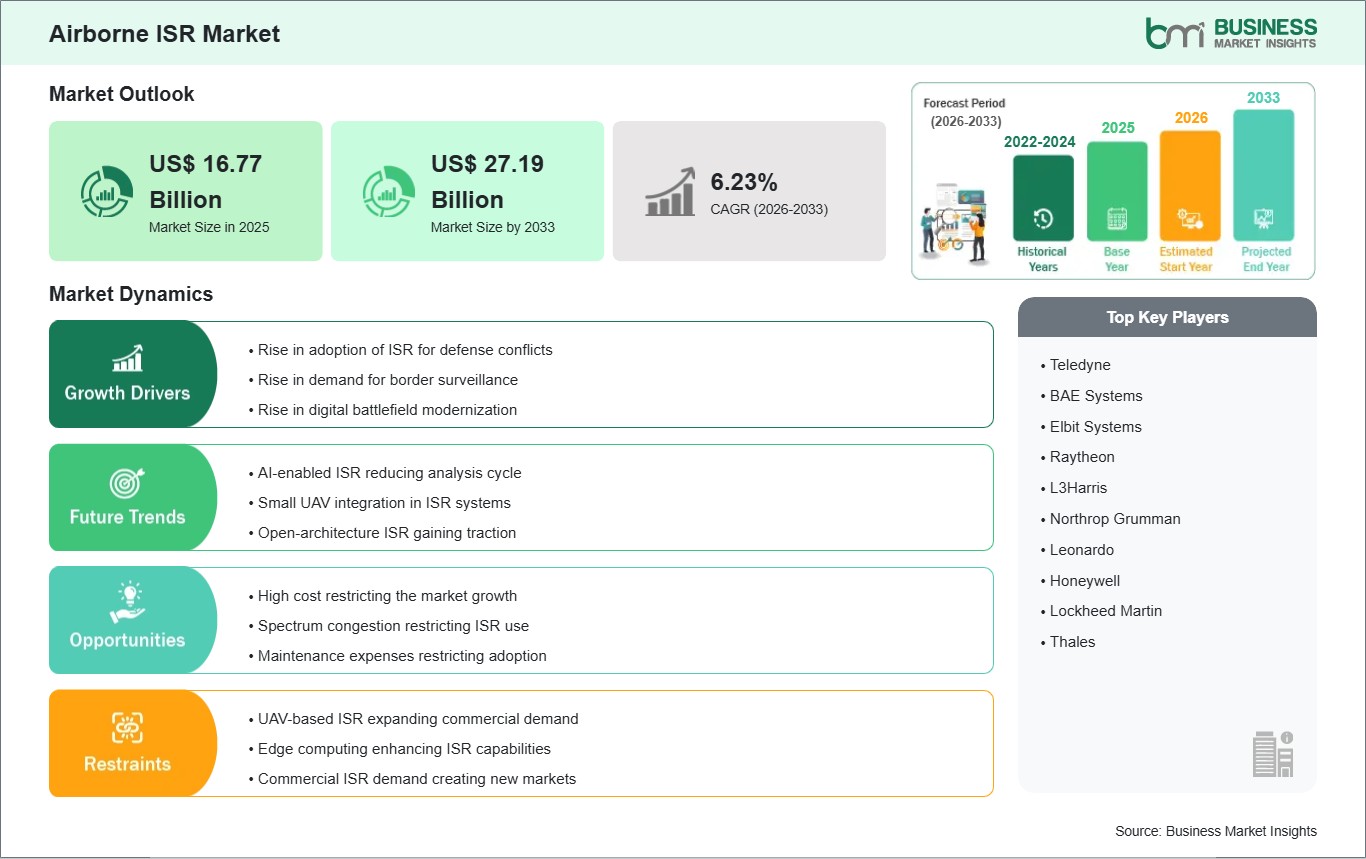
Airborne ISR systems are used for intelligence, surveillance, and reconnaissance operations through aircraft, unmanned aerial vehicles, and advanced sensing platforms. These systems help military and security agencies collect real-time information, monitor borders, track targets, and improve situational awareness during operations. Airborne ISR technologies include radar systems, electro-optical sensors, communication systems, and data processing platforms integrated into airborne assets. The market is expanding as governments focus on strengthening national security, border surveillance, maritime monitoring, and modern defense capabilities. Rising geopolitical tensions and the growing use of unmanned systems are increasing demand for advanced ISR solutions across military and homeland security operations.
Several challenges may limit market growth in some regions. High procurement and maintenance costs associated with advanced airborne ISR platforms can create budgetary pressure for defense agencies. Integration of complex communication and sensor systems also requires skilled personnel and significant infrastructure support. In addition, cybersecurity concerns and data management challenges continue to affect operational efficiency as ISR platforms generate large volumes of sensitive information. Delays in defense procurement programs and regulatory restrictions related to airspace operations can further impact deployment timelines and modernization projects.
Despite these challenges, the market is expected to benefit from rapid advancements in artificial intelligence, autonomous systems, and sensor fusion technologies. Opportunities are increasing through the adoption of next-generation unmanned aerial vehicles and cloud-based intelligence platforms that improve operational efficiency and real-time decision-making. Military organizations are also investing in lightweight and long-endurance ISR systems for persistent surveillance missions. The growing focus on border protection, maritime security, disaster response, and counterterrorism activities is expected to support long-term demand for Airborne ISR technologies across developed and emerging economies.
Segment Analysis
Airborne ISR Market Segmentation
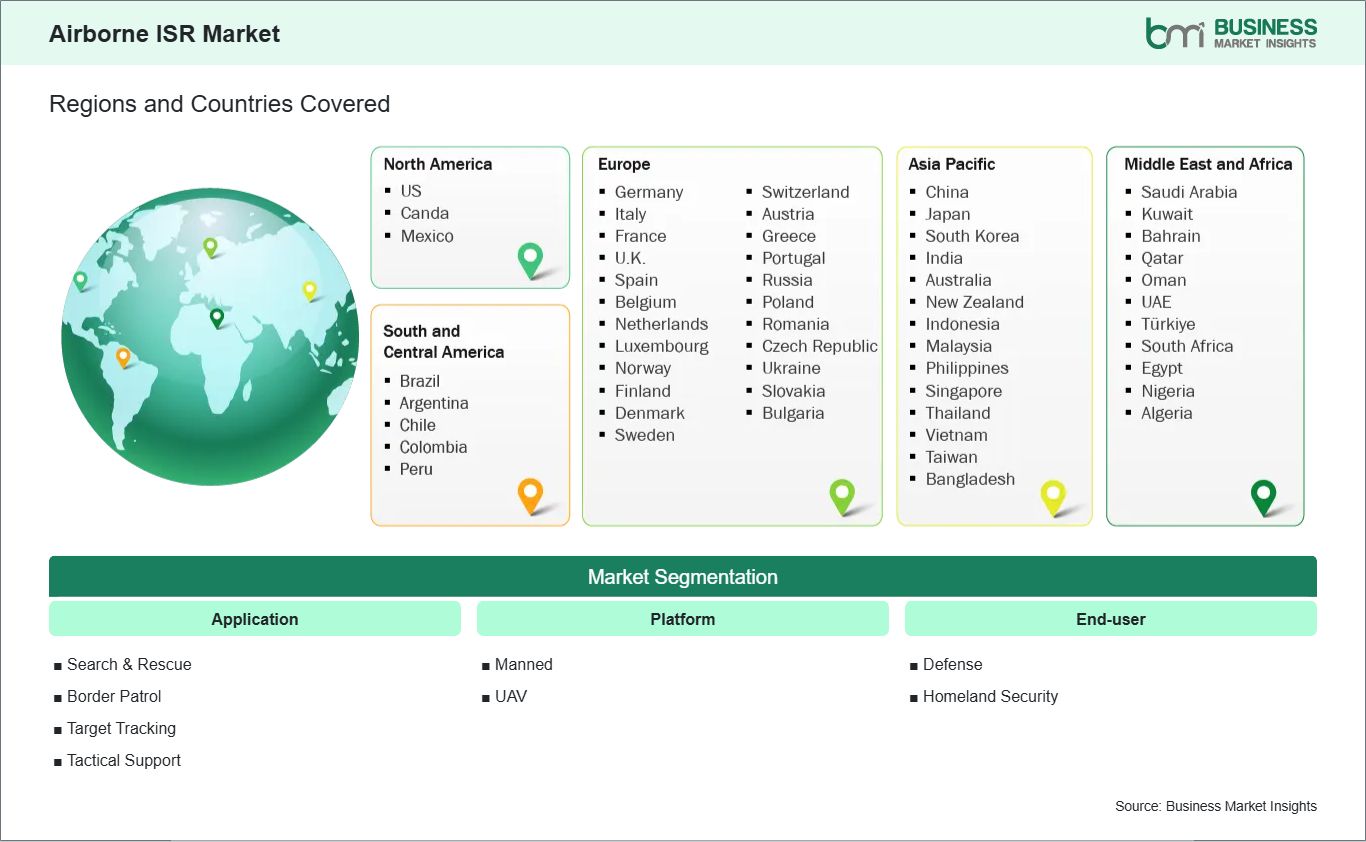
The Airborne ISR market is segmented based on type, application, and end-user categories. Different segments support varying operational requirements across surveillance, reconnaissance, and intelligence missions.
By Type
- Single-stage: Widely used in compact ISR platforms requiring simplified operational systems and lower maintenance requirements.
- Multi-stage: Preferred for advanced surveillance missions that require enhanced processing capability, long-duration monitoring, and integrated sensor systems.
- Submersible: Used in specialized surveillance and maritime intelligence applications where underwater and coastal monitoring capabilities are required.
By Application
- Water & Wastewater: Supports monitoring of critical infrastructure, environmental surveillance, and security operations near water facilities.
- Mining: Used for aerial mapping, operational monitoring, and site security across mining locations.
- Oil & Gas: Assists in pipeline surveillance, offshore monitoring, and infrastructure security management.
- Agriculture: Increasingly adopted for land monitoring, crop observation, and precision surveillance operations.
Market Forces
Airborne ISR Market Drivers and Opportunities
Rising Demand for Advanced Border and Surveillance Operations
The increasing focus on border protection and real-time intelligence gathering is driving demand for Airborne ISR systems globally. Governments are investing in airborne surveillance technologies to strengthen monitoring capabilities across land, maritime, and air borders. Growing geopolitical tensions and cross-border security concerns are encouraging defense organizations to modernize surveillance infrastructure with advanced airborne systems. ISR platforms equipped with radar, electro-optical sensors, and communication technologies help military agencies improve threat detection and operational coordination.
The adoption of unmanned aerial vehicles and long-endurance aircraft is also supporting market growth by enabling continuous monitoring across remote locations. In addition, defense modernization programs in several countries are increasing procurement of integrated ISR solutions capable of supporting surveillance, reconnaissance, and intelligence missions simultaneously. Regulatory support for advanced defense technologies and improvements in communication networks are further contributing to the expansion of the Airborne ISR market.
Integration of Artificial Intelligence in ISR Platforms
The integration of artificial intelligence and data analytics technologies is creating new opportunities in the Airborne ISR market. AI-enabled ISR systems can process large volumes of surveillance data more efficiently, helping defense agencies improve operational response and decision-making. Advanced analytics platforms are increasingly being used to identify patterns, detect threats, and automate target recognition processes during surveillance missions.
Emerging opportunities are also linked to the development of autonomous surveillance platforms capable of operating with limited human intervention. Lightweight sensors, cloud-based intelligence systems, and real-time communication technologies are improving the operational capabilities of airborne surveillance platforms. Growing demand for disaster response monitoring, maritime security, and critical infrastructure protection is further expanding the application scope of Airborne ISR systems. As defense agencies continue to focus on digital transformation and smart surveillance infrastructure, demand for next-generation ISR technologies is expected to increase steadily.
Size and Share Analysis
Airborne ISR Market Size and Share Analysis
The Airborne ISR Market is projected to grow from US$ 16.77 Billion in 2025 to US$ 27.19 Billion by 2033 , registering a CAGR of 6.23% from 2026 to 2033.
By type, multi-stage systems account for a significant share due to their ability to support advanced intelligence gathering, sensor integration, and long-duration surveillance missions. Single-stage systems continue to be widely adopted for tactical operations requiring compact and efficient monitoring solutions, while submersible systems are witnessing gradual adoption in maritime and coastal surveillance applications.
By application, oil and gas and mining sectors contribute notably to the market due to increasing use of airborne surveillance for infrastructure monitoring and operational security. Water and wastewater applications are expanding with rising demand for environmental monitoring and public infrastructure protection. Agricultural applications are also gaining attention as airborne monitoring technologies support precision farming and land observation activities across large operational areas.
Report Coverage
Airborne ISR Market Report Coverage and Deliverables
The "Airborne ISR Size and Forecast (2022-2033)" report provides a detailed analysis of the market covering below areas:
- Market size and forecast at global, regional, and country levels for all the key market segments covered under the scope
- Market trends, as well as market dynamics such as drivers, restraints, and key opportunities
- Market analysis covering key market trends, global and regional framework, major players, regulations, and recent market developments
- Industry landscape and competition analysis covering market concentration, heat map analysis, prominent players, and recent developments for the market
- Detailed company profiles, including SWOT analysis
Geographic Insights
Airborne ISR Market Geographic Insights
The Airborne ISR Market shows diverse regional adoption patterns influenced by defense modernization programs, surveillance infrastructure investments, and increasing security requirements across military and strategic operations.
North America remains a mature market due to strong investments in defense technologies and advanced surveillance systems. The United States continues to focus on improving airborne intelligence capabilities through modernization of military aircraft, unmanned systems, and integrated communication platforms. Canada is also enhancing border surveillance and maritime monitoring programs to strengthen national security operations. The region benefits from established defense infrastructure, advanced aerospace manufacturing capabilities, and continuous research activities related to ISR technologies. Increasing focus on autonomous surveillance platforms and artificial intelligence integration is further supporting regional market development.
Asia Pacific is witnessing growing adoption of Airborne ISR systems due to increasing regional security concerns and military modernization initiatives. Countries such as China, India, Japan, and South Korea are expanding investments in airborne surveillance platforms to strengthen border protection and maritime security capabilities. Rising defense expenditure and infrastructure upgrades are encouraging deployment of advanced radar, communication, and reconnaissance systems across the region. Emerging economies are also investing in unmanned aerial surveillance systems for disaster monitoring and strategic operations. Growing aerospace manufacturing activities and technological collaborations are contributing to long-term market expansion across Asia Pacific.
Industry Activity
Recent Developments
The Airborne ISR Market is analyzed using a mix of primary and secondary research sources, including corporate publications, industry associations, and verified databases. This approach ensures accurate tracking of innovation trends and strategic developments influencing the market.
- In March 2024, Northrop Grumman announced the expansion of its airborne intelligence and surveillance capabilities through upgrades to advanced ISR platforms supporting military reconnaissance operations. The upgrade focused on improving real-time data collection, sensor integration, and communication efficiency for defense missions. The development reflects increasing investments in modern airborne surveillance technologies.
- In July 2023, L3Harris Technologies introduced enhanced airborne ISR mission systems designed for multi-domain intelligence and surveillance operations. The updated systems were developed to improve operational flexibility, target tracking, and situational awareness across military environments. The development highlights growing demand for integrated ISR technologies in defense modernization programs.
Trust & Transparency
Research Methodology
The market analysis combines proprietary research with secondary data from government agencies, company disclosures, regulatory filings, industry databases and expert interviews. Market estimates are validated through data triangulation, cross-market benchmarking and analyst
review.
View Full Research Methodology
Key Sources Referred:
World Bank - Global Trade Indicators World Trade Organization (WTO) International Monetary Fund (IMF) International Trade Administration (ITA) Company Websites Company Annual Reports Company Investor Presentations