
ISR UUV Market Outlook: Size, Share, Trends, Growth Analysis, Competitive Landscape & Forecast, 2026-2033

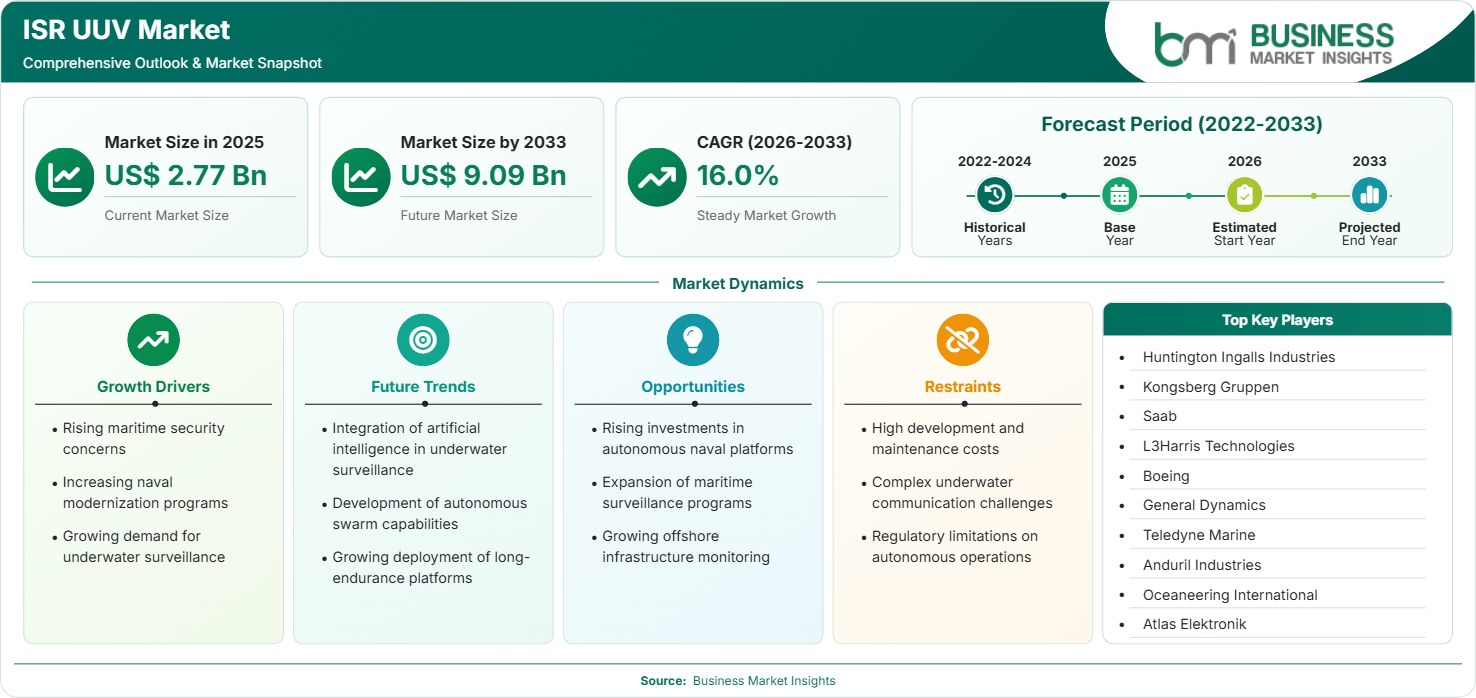
The ISR UUV Market size was valued at US$ 2.77 billion in 2025 and is projected to reach US$ 9.09 billion by 2033, growing at a CAGR of 16.0% during 2026–2033, driven by rising maritime security concerns, increasing naval modernization programs, and growing demand for underwater surveillance, creating new opportunities for autonomous underwater technologies and defense modernization.

Report Coverage
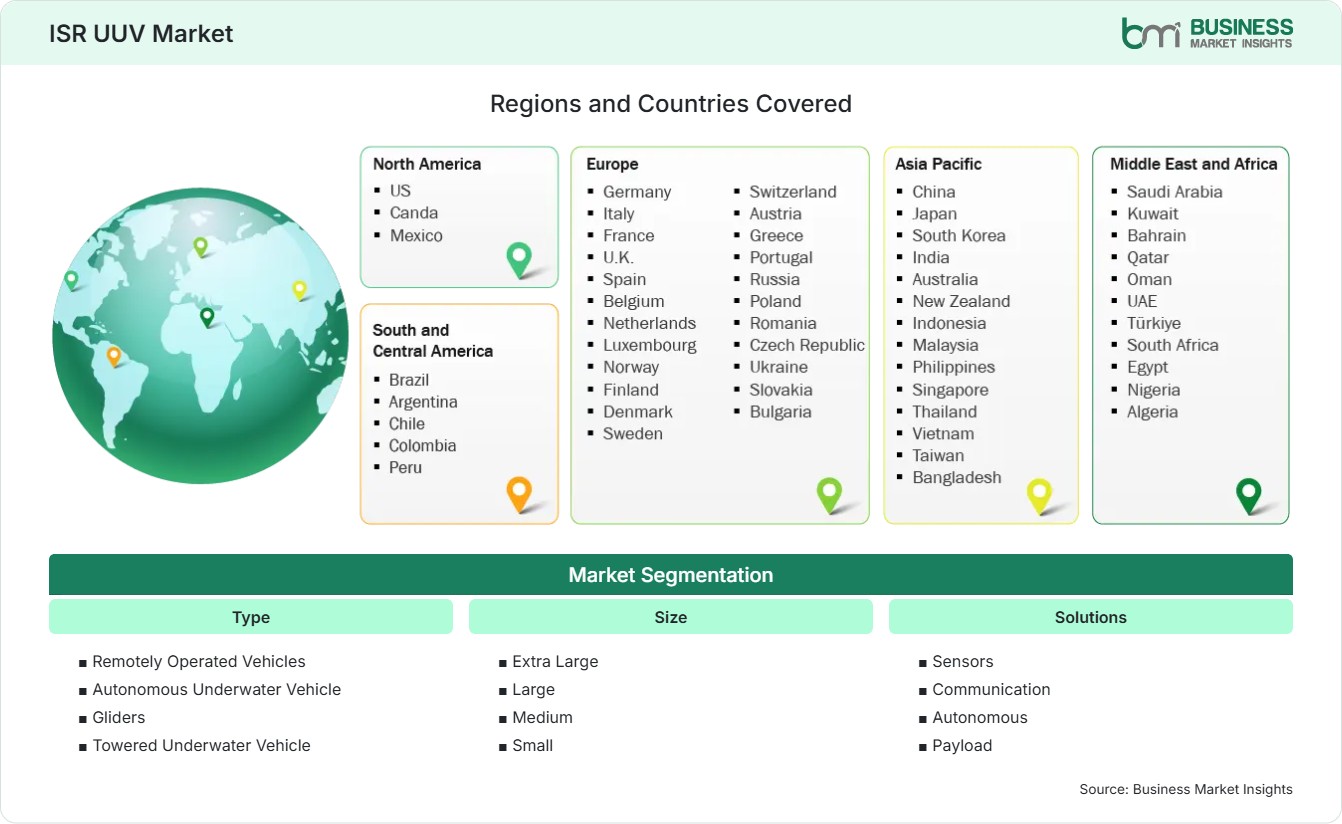
  • Type: Remotely Operated Vehicles, Autonomous Underwater Vehicle, Gliders, Towered Underwater Vehicle
  • Size: Extra Large, Large, Medium, Small
  • Solutions: Sensors, Communication, Autonomous, Payload
US$ 2.77 Bn Market size in 2025
US$ 9.09 Bn Market Size by 2033
16.0% CAGR, 2026 - 2033
2026-2033 Forecast Period

01 AI Overview

ISR UUV Market Summary

  • North America Region: North America holds a market share of 39%–42% in 2025, growing with a CAGR of 15.2%–15.8%, supported by naval modernization initiatives, defense technology investments, and increasing deployment of autonomous underwater systems. The US market continues expanding through advanced naval procurement programs and underwater surveillance capabilities, registering a CAGR of 15.5%–16.0% during 2026–2033.
  • Fastest Growing Region: Asia Pacific accounts for 26%–29% of the market in 2025 and is projected to expand at a CAGR of 17.1%–17.8%, driven by expanding naval capabilities, increasing maritime security investments, and growing underwater surveillance requirements.
  • Leading Segment: Autonomous Underwater Vehicle (AUV) holds a market share of 43%–46% in 2025 and is expected to grow at a CAGR of 16.5%–17.1% owing to increasing adoption for intelligence, surveillance, reconnaissance, and mine countermeasure missions.
  • High Growth Segment: Autonomous Solutions account for 35%–38% of the market in 2025 and are anticipated to register a CAGR of 17.4%–18.0%, supported by advancements in autonomous navigation, mission planning, and artificial intelligence-enabled underwater operations.
  • Key Market Opportunity: Rising investments in autonomous naval platforms, expansion of maritime surveillance programs, and growing offshore infrastructure monitoring are creating long-term opportunities for ISR UUV manufacturers and technology providers.
  • Major Market Players: Huntington Ingalls Industries, Kongsberg Gruppen ASA, Saab AB, L3Harris Technologies, Inc., The Boeing Company, General Dynamics Corporation, Teledyne Marine, Anduril Industries, Oceaneering International, Inc., and Atlas Elektronik GmbH.
02 Strategic Insights

ISR UUV Market: Strategic Insights

ISR UUV Market Strategic Framework
FREE PDF
Request your free sample
Request free sample
03 Stakeholder View

Key Takeaways

  • The market ecosystem is evolving through stronger collaboration among defense contractors, naval organizations, sensor manufacturers, software developers, and autonomous technology providers to deliver integrated underwater surveillance capabilities.
  • Autonomous Underwater Vehicles continue representing the largest revenue segment due to their operational flexibility, endurance, and ability to conduct intelligence and reconnaissance missions without direct operator intervention.
  • Technological innovation is increasingly focused on autonomous navigation, underwater sensing, payload integration, and intelligent mission planning to improve operational efficiency and mission success rates.
  • Asia Pacific presents significant long-term investment potential as regional governments expand naval modernization initiatives, maritime surveillance programs, and underwater defense capabilities.
  • Strategic defense partnerships, research collaborations, and government procurement programs continue driving technological advancement and strengthening competitive positioning among leading ISR UUV manufacturers.
  • Modular platform architectures and mission-specific payload integration are enabling operators to deploy ISR UUVs across a wider range of naval, offshore, and maritime security applications.
04 Geographic Outlook

ISR UUV Market Regional Highlights

North America ISR UUV Market

North America accounted for 39%–42% of the global market in 2025 and is projected to expand at a CAGR of 15.2%–15.8% during 2026–2033. The region benefits from substantial defense spending, advanced naval capabilities, and continuous investments in autonomous maritime technologies. The growing procurement of unmanned underwater systems for intelligence, surveillance, and reconnaissance missions continues to strengthen regional market leadership while spurring technological innovation.

  • Naval modernization initiatives continue increasing procurement of advanced unmanned underwater vehicles capable of supporting surveillance, mine countermeasure, and maritime security missions.
  • Defense agencies are investing in next-generation underwater sensors, autonomous navigation technologies, and mission management systems to improve operational capabilities.
  • Increased emphasis on maritime domain awareness continues to support the deployment of ISR UUV platforms across strategic coastal and deep-water environments.
  • Defense contractors continue expanding research and development activities to improve endurance, payload flexibility, and autonomous operational performance.

US ISR UUV Market

The United States accounted for 34%–37% of the global market in 2025 and is anticipated to register a CAGR of 15.5%–16.0% over the forecast period. Continued investment in naval modernization, autonomous maritime systems, and underwater intelligence capabilities supports strong market growth. Procurement programs focused on autonomous underwater platforms remain central to strengthening maritime defense readiness and operational effectiveness.

  • The U.S. Navy continues investing in autonomous underwater systems for intelligence gathering, mine countermeasures, and strategic surveillance operations.
  • Defense technology companies are accelerating the development of advanced underwater autonomous platforms with improved mission flexibility and sensor integration.
  • Government-funded research programs continue supporting innovation in underwater communication technologies and autonomous mission capabilities.

Europe ISR UUV Market

Europe accounted for 24%–27% of the global market in 2025 and is projected to expand at a CAGR of 15.0%–15.5% during the forecast period. Increasing investments in maritime defense, underwater surveillance, and naval modernization continue to strengthen regional demand. Norway, Germany, France, and the United Kingdom remain major contributors, while Sweden demonstrates increasing adoption through continued defense technology investments.

  • European navies continue expanding autonomous underwater capabilities to strengthen maritime surveillance and coastal security operations.
  • Norway remains a leading market through strong investments in underwater defense technologies and offshore maritime monitoring.
  • Germany continues advancing ISR UUV deployment through naval modernization initiatives and domestic defense technology development.
  • The United Kingdom is expanding autonomous underwater procurement to enhance underwater intelligence and surveillance capabilities.
  • France continues to strengthen its underwater surveillance infrastructure through investments in next-generation autonomous naval technologies.

Asia Pacific ISR UUV Market

Asia Pacific accounted for 26%–29% of the global market in 2025 and is projected to expand at a CAGR of 17.1%–17.8% from 2026–2033, making it the fastest-growing regional ISR UUV market. Increasing maritime territorial security concerns, expanding naval modernization initiatives, and rising investments in autonomous underwater technologies continue driving regional demand. China, India, Japan, South Korea, and Australia are strengthening underwater surveillance capabilities by procuring advanced ISR UUV platforms and integrated sensor technologies.

  • China continues expanding autonomous underwater vehicle deployments to strengthen maritime surveillance, naval intelligence, and offshore security operations.
  • India is increasing investments in underwater surveillance technologies and indigenous autonomous naval platforms to improve maritime domain awareness.
  • Japan and South Korea continue advancing ISR UUV procurement programs focused on coastal surveillance, mine countermeasure missions, and underwater reconnaissance.
  • Australia is strengthening naval modernization through investments in autonomous underwater systems supporting strategic maritime security operations.
  • Regional defense organizations continue collaborating with technology providers to develop advanced autonomous underwater capabilities and mission-specific payload systems.

Rest of World ISR UUV Market

The Rest of World region accounted for 7%–10% of the global ISR UUV market in 2025 and is expected to register a CAGR of 15.6%–16.2% during 2026–2033. The Middle East continues expanding maritime security investments to protect strategic offshore assets, while South America is gradually increasing adoption of underwater surveillance technologies for naval operations and offshore resource monitoring. Growing offshore energy infrastructure is further supporting regional demand.

  • Gulf countries continue strengthening underwater security capabilities to protect offshore oil and gas infrastructure from emerging maritime threats.
  • Brazil is increasing investments in underwater surveillance technologies supporting offshore energy exploration and naval security operations.
  • Regional governments continue modernizing naval capabilities through the procurement of autonomous underwater surveillance platforms.
  • Offshore infrastructure monitoring continues to create additional opportunities for ISR UUV deployment across energy and maritime industries.
  • Defense modernization programs continue supporting long-term investments in autonomous underwater technologies across emerging economies.
Global Market Geography
FREE PDF
Request your free sample
Request free sample
05 Segment Analysis

ISR UUV Market Segmentation

Type

The Type segment includes Remotely Operated Vehicles (ROV), Autonomous Underwater Vehicle (AUV), Gliders, and Towered Underwater Vehicle (TUV). Autonomous Underwater Vehicles accounted for the largest market share in 2025 due to their ability to perform extended intelligence, surveillance, and reconnaissance missions with minimal operator intervention. The segment is projected to expand at a CAGR of 16.5%–17.1% during 2026–2034.

  • Remotely Operated Vehicles (ROV): ROVs are widely deployed for inspection, underwater intervention, maintenance, and surveillance missions requiring continuous operator control.
  • Autonomous Underwater Vehicle (AUV): AUVs support long-endurance intelligence, reconnaissance, environmental monitoring, and mine countermeasure missions through fully autonomous operations.
  • Gliders: Gliders enable long-duration underwater surveillance and oceanographic data collection using energy-efficient buoyancy-driven propulsion systems.
  • Towered Underwater Vehicle (TUV): TUV platforms support specialized underwater surveillance and tactical missions requiring enhanced payload integration and operational flexibility.

Size

The Size segment comprises Extra Large, Large, Medium, and Small ISR UUV platforms. Medium-sized vehicles continue to account for the largest deployment due to their operational flexibility, payload capacity, and cost efficiency across naval surveillance missions. The segment is expected to register a CAGR of 16.2%–16.8% during the forecast period.

  • Extra Large: Extra-large platforms support extended endurance missions requiring substantial payload capacity for strategic underwater operations.
  • Large: Large ISR UUVs balance operational range, payload integration, and mission flexibility across naval intelligence and surveillance applications.
  • Medium: Medium platforms remain widely deployed due to their versatility, transportability, and suitability for diverse underwater mission profiles.
  • Small: Small ISR UUVs provide rapid deployment, maneuverability, and efficient coastal surveillance capabilities across tactical operations.

Solutions

The Solutions segment includes Sensors, Communication, Autonomous, and Payload technologies. Autonomous solutions continue leading technological investments owing to rapid advancements in artificial intelligence, navigation systems, and autonomous mission execution in the ISR UUV market. The segment is projected to register a CAGR of 17.4%–18.0% throughout the forecast period.

  • Sensors: Advanced sonar, imaging, acoustic, and environmental sensors improve underwater target detection, mapping, and intelligence collection capabilities.
  • Communication: Underwater communication technologies enable secure data transmission, mission coordination, and operational control across challenging underwater environments.
  • Autonomous: Autonomous software enables intelligent navigation, adaptive mission planning, obstacle avoidance, and independent underwater decision-making capabilities.
  • Payload: Modular payload systems support multiple mission requirements, including surveillance, reconnaissance, mine detection, environmental monitoring, and scientific exploration.
06 Market Forces

ISR UUV Market Dynamics

Key Market Drivers

Rising Maritime Security Concerns

Increasing security issues in water have caused increased investment in market technologies. Countries are improving their capability in monitoring underwater through technology to deal with illegal maritime issues, territorial issues, protecting critical infrastructure, monitoring underwater assets, and naval threats. The use of unmanned underwater systems ensures that intelligence gathering, reconnaissance, and surveillance are conducted without risk. Moreover, the rise in military spending, developments in autonomous navigation and sensors, and the increasing attention to maritime domain awareness will continue to drive the adoption of modern ISR UUV technology by defense organizations. These developments are expected to strengthen long-term growth opportunities for the ISR UUV Market.

Increasing Naval Modernization Programs

The continuous increase in navalization projects is important for growth, given the rising defense budget allocated to modernizing the naval industry. The navalization projects involve the use of unmanned ships in the navy for surveillance and reconnaissance operations. The government is also investing in the production of sophisticated technologies for underwater operations. Ongoing improvements in autonomous navigation, artificial intelligence, underwater communication, and sensor integration will continue to shape ISR UUV market trends, enabling more efficient and effective mission performance. The increasing focus on maritime security, continuous surveillance, and multiple missions is expected to accelerate the adoption of advanced ISR UUV systems by defense organizations.

Growing Demand for Underwater Surveillance

Growing needs for underwater surveillance are driving the increasing use of ISR UUVs in the military, security, and offshore sectors. Growing needs for continuous surveillance of the coastal waters, strategic shipping lanes, offshore resources, and underwater infrastructure are leading to increased investments in autonomous underwater technologies. Sensor technology improvements, artificial intelligence, better navigation capabilities, and mission automation are making the process of surveillance more effective and allowing its deployment in varied operational environments. Technical development is paving the way for ISR UUVs with improved endurance, efficiency, data-gathering, and situational-awareness capabilities.

Key Market Opportunities

Rising Investments in Autonomous Naval Platforms

The growing investments in autonomous naval systems provide considerable growth prospects for ISR UUV makers and technology providers. The defense community is now emphasizing the development of autonomous maritime systems that will extend mission duration, reduce operational costs, increase operational flexibility, and boost underwater intelligence capabilities. Growing investments in naval modernization, artificial intelligence, autonomous navigation, advanced sensors, secure underwater communications, and mission management software speed up technological developments. Makers of next-generation ISR UUVs are improving batteries, increasing range, boosting payload capacity, and enabling real-time data processing.

Expansion of Maritime Surveillance Programs

The continued expansion of maritime surveillance initiatives is creating more procurement opportunities for advanced ISR UUVs. Enhanced coastal, underwater, maritime border, and critical infrastructure surveillance has been made possible by the deployment of more autonomous underwater vehicles. Continuous investments in integrated surveillance systems, underwater sensor technology, artificial intelligence, autonomous navigation, and data transfer have made operations more effective. Rising defense modernization initiatives and growing emphasis on persistent maritime domain awareness are expected to support sustained ISR UUV Market growth throughout the forecast period.

Growing Offshore Infrastructure Monitoring

Increasing infrastructure monitoring offshore offers great opportunities for governments and energy companies interested in enhanced security of offshore oil facilities, pipelines, communication cables, offshore wind power plants, and other renewable energy sources. Using unmanned autonomous underwater vessels is very effective for conducting inspections, monitoring, and securing these facilities, decreasing operational risks, as well as providing round-the-clock surveillance of the facilities. Higher investments in offshore energy infrastructure, undersea communications networks, and maritime security are increasing the demand for ISR UUVs. These developments are expected to generate significant opportunities for the ISR UUV Market forecast over the coming years.

Market Restraints and Challenges

High Development and Maintenance Costs

Factor: High development and maintenance costs remain a significant challenge due to sophisticated underwater technologies, advanced sensors, autonomous software, and specialized engineering requirements.

Impact: Elevated acquisition and lifecycle costs may limit procurement by smaller naval organizations, extend development timelines, and increase financial risks for manufacturers developing next-generation ISR UUV platforms. High costs of advanced sensors, autonomous navigation systems, battery technologies, software integration, testing, and maintenance can also slow adoption, delay procurement decisions, and increase budgetary pressure on defense agencies, particularly in cost-sensitive markets and emerging economies.

Complex Underwater Communication Challenges

Factor: Complex underwater communication challenges continue affecting operational effectiveness because underwater environments restrict reliable high-speed data transmission and real-time communication.

Impact: Communication limitations may reduce mission coordination, delay information exchange, and require advanced acoustic communication technologies, increasing system complexity and overall operational costs. Limited underwater bandwidth, signal attenuation, and challenging ocean environments can also affect real-time data transmission, navigation accuracy, and remote operational control. As a result, manufacturers must invest in more reliable communication systems, advanced networking technologies, and robust data processing capabilities, increasing development costs and extending deployment timelines for next-generation ISR UUV platforms.

07 Company Analysis

Competitive Landscape

The ISR UUV Market analysis indicates that technological innovation, naval modernization programs, and expanding demand for autonomous maritime surveillance solutions increasingly drive competition. Companies are strengthening their portfolios through strategic defense contracts, research collaborations, and investments in artificial intelligence-enabled underwater systems.

Company Name

Overview

Products and Services Relevant to this Market

Huntington Ingalls Industries

Leading U.S. defense shipbuilder developing advanced autonomous maritime and unmanned underwater systems for naval applications.

Autonomous underwater vehicles, naval platforms, mission systems, defense integration, and maritime surveillance solutions.

Kongsberg Gruppen ASA

Norwegian defense technology company specializing in autonomous underwater systems and advanced maritime technologies.

Autonomous underwater vehicles, sonar systems, underwater sensors, navigation technologies, and maritime surveillance solutions.

Saab AB

Global defense company offering advanced underwater warfare and autonomous naval technologies.

Underwater vehicles, mine countermeasure systems, naval surveillance solutions, sonar technologies, and mission management systems.

L3Harris Technologies, Inc.

Defense technology company delivering autonomous maritime systems and advanced ISR capabilities.

Autonomous underwater technologies, ISR systems, communication solutions, mission electronics, and defense integration services.

The Boeing Company

Aerospace and defense company developing autonomous underwater platforms for naval intelligence and reconnaissance missions.

Autonomous underwater vehicles, advanced mission systems, defense technologies, and underwater surveillance platforms.

General Dynamics Corporation

Global defense contractor providing integrated naval systems and autonomous underwater technologies.

Underwater mission systems, naval electronics, ISR technologies, autonomous platforms, and defense integration services.

Teledyne Marine

Leading provider of marine technologies supporting commercial and defense underwater operations.

Underwater sensors, sonar systems, autonomous vehicles, imaging technologies, and oceanographic monitoring solutions.

Anduril Industries

Defense technology company focused on autonomous systems and artificial intelligence-enabled maritime surveillance platforms.

Autonomous underwater systems, AI-enabled mission software, maritime surveillance technologies, and defense autonomy solutions.

Oceaneering International, Inc.

Engineering company delivering advanced remotely operated and autonomous underwater systems for offshore and defense sectors.

ROVs, autonomous underwater vehicles, subsea technologies, offshore inspection, and underwater engineering services.

Atlas Elektronik GmbH

German defense electronics company specializing in underwater defense systems and naval technologies.

Autonomous underwater vehicles, sonar systems, underwater sensors, mine countermeasure technologies, and naval combat solutions.

08 Industry Activity

Recent Developments

June 2026

KONGSBERG entered a strategic partnership with DRASS to develop next-generation unmanned underwater vehicles (UUVs), maritime intelligence, surveillance, and reconnaissance (ISR) systems, and manned-unmanned teaming (MUM-T) solutions to address evolving global defense requirements.

June 2026

HII delivered the first REMUS 130 unmanned underwater vehicle (UUV) to a U.S. ally, expanding its next-generation autonomous underwater systems portfolio for ISR, mine countermeasures, and maritime security missions.

April 2026

HII secured a contract from the U.S. Defense Innovation Unit (DIU) to develop a Torpedo Tube Launch and Recovery (TTLR) system, enabling autonomous deployment and recovery of REMUS UUVs from submarines and advancing undersea ISR and manned-unmanned teaming capabilities.

March 2025

HII announced that it had sold more than 700 REMUS unmanned underwater vehicles (UUVs) worldwide, reinforcing its leadership in autonomous underwater systems supporting intelligence, surveillance, reconnaissance (ISR), mine countermeasures, and anti-submarine warfare missions.

10 Trust & Transparency

Research Methodology

The market analysis combines proprietary research with secondary data from government agencies, company disclosures, regulatory filings, industry databases and expert interviews. Market estimates are validated through data triangulation, cross-market benchmarking and analyst review.

View Full Research Methodology

11 Questions Answered

Frequently Asked Questions

What are the primary challenges affecting the market?

Major challenges include high development and maintenance costs, which increase lifecycle expenses, and complex underwater communication challenges, which can affect mission coordination, data transmission, and real-time operational effectiveness.

What opportunities are expected to shape future market growth?

Key opportunities include rising investments in autonomous naval platforms, expansion of maritime surveillance programs, and growing offshore infrastructure monitoring, supporting wider adoption across defense and maritime security applications.

Which type segment accounts for the largest ISR UUV market share?

Autonomous Underwater Vehicles (AUVs) represent the leading segment because they provide extended operational endurance, autonomous mission execution, advanced intelligence gathering, and multi-mission flexibility for modern naval operations.

Which region dominates the ISR UUV Market report?

North America leads the market owing to substantial defense expenditures, advanced naval modernization initiatives, strong autonomous technology development, and continuous procurement of unmanned underwater surveillance platforms.

What is driving growth in the Market?

The market is primarily driven by rising maritime security concerns, expanding naval modernization programs, and growing demand for underwater surveillance, which is encouraging defense organizations to invest in advanced autonomous underwater systems.

Access the Full ISR UUV Market Report

Get segment-level forecasts, regional estimates, competitive benchmarking, company profiles and downloadable Excel datasets.

Access the full ISR UUV Market Report
350 pages PDF & Excel | 2026-07-31