
Electro Optical Infrared Systems Market Outlook: Size, Share, Trends, Growth Analysis, Competitive Landscape & Forecast, 2026-2033

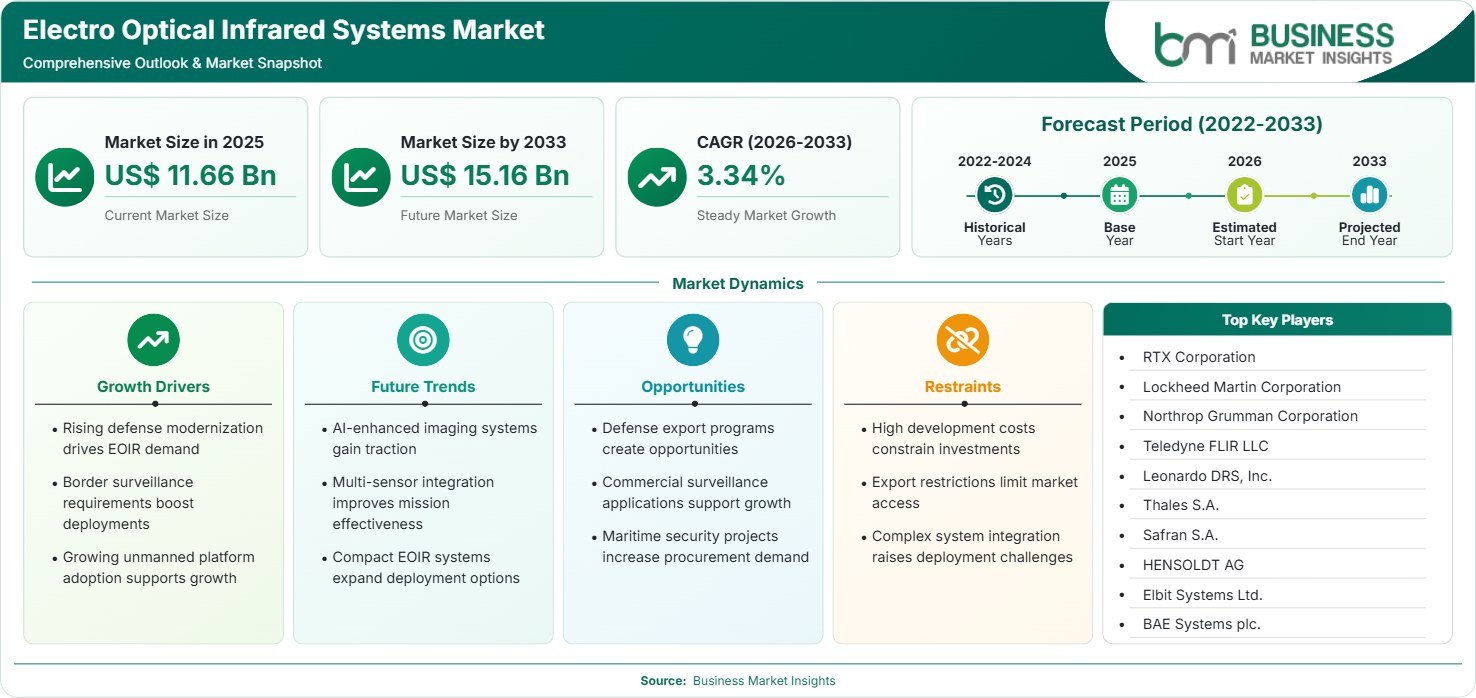
The Electro Optical Infrared Systems Market size was valued at US$ 11.66 Billion in 2025 and is projected to reach US$ 15.16 Billion by 2033, growing at a CAGR of 3.34% during 2026–2033. Rising defense modernization programs, increasing ISR requirements, multi-domain operations, AI-enabled sensing technologies, and expanding homeland security investments are creating significant opportunities across airborne, land, and naval platforms.

Report Coverage
  • System: Imaging EO/IR System, Non-Imaging EO/IR System
  • Sensor Technology: Staring Sensor, Scanning Sensor
  • Technology: Cooled, Uncooled
  • Imaging Technology: Multispectral, Hyperspectral
  • Component: Sensors, Optics, Detectors, Electronics, Others
US$ 11.66 Bn Market size in 2025
US$ 15.16 Bn Market Size by 2033
3.34% CAGR, 2026 - 2033
2026-2033 Forecast Period

AI Overview

Electro Optical Infrared Systems Market Summary

  • North America Region: North America holds a market share of 36%–39% in 2025, growing at a CAGR of 2.9%–3.3% influenced by defense procurement, border monitoring, advanced surveillance integration, and sensor modernization programs. Opportunities arise from AI-enabled targeting, autonomous platforms, and persistent situational awareness investments across military and homeland security agencies. The U.S. remains the dominant contributor, supported by sustained defense budgets and expanding EO/IR deployment programs, advancing at approximately 3.0%–3.4% CAGR.
  • Fastest Growing Region: Asia Pacific holds an Electro Optical Infrared Systems Market share of 25%–28% in 2025, growing at a CAGR of 4.4%–4.8% driven by military modernization, maritime security requirements, indigenous defense manufacturing, and increasing procurement of advanced reconnaissance systems across major economies.
  • Leading Segment: Airborne platforms hold a market share of 42%–45% in 2025, growing at a CAGR of 3.1%–3.5% supported by demand for ISR aircraft, UAV payloads, targeting systems, border surveillance missions, and long-range threat detection capabilities.
  • High Growth Segment: Hyperspectral imaging holds a market share of 15%–18% in 2025, growing at a CAGR of 5.2%–5.8% due to enhanced target discrimination, environmental intelligence applications, advanced battlefield awareness requirements, and AI-assisted analytics integration.
  • Key Market Opportunity: Integration of artificial intelligence, sensor fusion, and autonomous mission systems enables enhanced target identification, reduced operator workload, improved battlefield awareness, and broader deployment across defense and security environments.
  • Major Market Players: RTX Corporation, Lockheed Martin Corporation, Northrop Grumman Corporation, Teledyne FLIR LLC, Leonardo DRS, Inc., Thales S.A., Safran S.A., HENSOLDT AG, Elbit Systems Ltd., and BAE Systems plc.
Strategic Insights

Electro Optical Infrared Systems Market: Strategic Insights

Electro Optical Infrared Systems Market Strategic Framework
FREE PDF
Request your free sample
Request free sample
Stakeholder View

Key Takeaways

  • The industry value chain is increasingly integrated, with optics suppliers, detector manufacturers, electronics specialists, software providers, and defense integrators collaborating to deliver high-performance mission systems.
  • The strongest commercial upside resides in unmanned airborne surveillance platforms, maritime ISR systems, and advanced border security deployments requiring persistent observation capabilities.
  • Innovation is shifting toward sensor fusion, AI-enabled object recognition, hyperspectral imaging, and open-architecture designs supporting rapid technology insertion and software-driven performance enhancements.
  • Asia Pacific presents the most compelling investment case due to accelerating defense expenditure, indigenous procurement programs, and large-scale modernization initiatives across China, India, Japan, and South Korea.
  • Strategic partnerships, technology alliances, and defense-sector acquisitions continue strengthening supply chain resilience while expanding access to advanced sensing technologies and international procurement programs.
  • Demand for uncooled thermal technologies is increasing because they offer lower operational costs, simplified maintenance requirements, and broader deployment flexibility across mobile and fixed installations.
Geographic Outlook

Electro Optical Infrared Systems Market Regional Highlights

North America Electro Optical Infrared Systems Market

North America accounts for 36% to 39% of global demand and is growing at a CAGR of 2.9% to 3.3% through 2033. North America is favored by continued defense spending, sophisticated aerospace capability, and robust procurement of ISR modernization. The North American market share in the Electro Optical Infrared Systems Market is the largest due to widespread installation on airborne, naval, and land vehicles. Ongoing development in autonomous systems, sensor fusion, and future target recognition technology is bolstering procurement by military and homeland security agencies.

  • AI-enabled surveillance payloads are increasingly integrated into UAV fleets to enhance mission endurance, object recognition accuracy, and operational awareness.
  • Border protection programs continue driving demand for persistent observation systems across coastal and terrestrial security networks.
  • Defense contractors are emphasizing modular architectures that simplify upgrades and extend operational lifecycles.
  • Naval modernization initiatives support procurement of advanced thermal imaging and long-range electro-optical targeting systems.

US Electro Optical Infrared Systems Market

The United States holds 78% - 82% market share in the North American Electro Optical Infrared Systems market and registers a CAGR of 3.0% - 3.4%. Some of the main contributors driving market growth include heavy investment from defense budgets, a significant presence in the aerospace sector, and research & development investments. The demand for products is primarily being driven by ISR payloads, targeting pods, and the autonomous systems segment. The technology providers are constantly improving AI-enabled sensor processing and distributed sensing technologies.

  • Department of Defense modernization programs prioritize persistent ISR and advanced situational awareness solutions.
  • Increased deployment of unmanned systems is accelerating procurement of lightweight and power-efficient imaging technologies.
  • Research organizations are supporting next-generation hyperspectral and multi-sensor fusion developments.
  • Homeland security agencies continue investing in critical infrastructure monitoring and border surveillance platforms.

Europe Electro Optical Infrared Systems Market

Europe represents 26%-29 % of the Electro Optical Infrared Systems Market and a CAGR of 3.2%-3.7%. The rise in security issues in the region and increased defense cooperation have facilitated adoption. Germany leads in revenue generation, whereas Poland shows the highest growth rate, at 4.3%-4.8% CAGR, owing to the need for modernization. Procurement is now more inclined toward interoperability and sustainability in view of NATO operations.

  • Defense industrial cooperation programs encourage indigenous sensing technology development.
  • Military readiness initiatives stimulate deployment of advanced reconnaissance and targeting systems.
  • Increased border monitoring requirements support investments in thermal imaging infrastructure.
  • Modernization projects emphasize interoperability and lifecycle cost optimization.
  • European manufacturers strengthen export competitiveness through advanced sensor innovation.

Asia Pacific Electro Optical Infrared Systems Market

The Asia Pacific region holds a market share of 25%-28% and has the highest CAGR of 4.4%-4.8%. Growth is driven by growing defense budgets, maritime security programs, and domestic manufacturing capability in the region. China is the biggest market, and India is the fastest-growing country with a growth rate of around 4.8%-5.3% CAGR. The Electro Optical Infrared Systems Market growth dynamics are driven by increasing investments in multi-domain surveillance and border security.

  • Indigenous defense production initiatives are accelerating sensor development activities.
  • Maritime surveillance and territorial security priorities boost procurement of advanced imaging systems.
  • Expanding UAV deployment creates demand for lightweight EO/IR payload integration.
  • Governments increasingly support AI-enabled surveillance capability development.
  • Cross-border security concerns encourage continued modernization spending.

Rest of World Electro Optical Infrared Systems Market

Rest of World holds a 10%–13% share in 2025 and grows at a 3.5%–4.0% CAGR. Middle Eastern countries remain interested in border security, critical infrastructure protection, and aerial surveillance programs. South and Central America concentrate on their maritime surveillance capabilities and counter-smuggling efforts. Saudi Arabia remains the largest spender in the region, while the UAE shows good progress in implementing technology. Regional procurement increasingly emphasizes operational flexibility and mission-specific configuration capability.

  • Gulf countries are investing heavily in ISR infrastructure and defense modernization.
  • Energy infrastructure protection drives thermal surveillance requirements.
  • Maritime domain awareness remains a strategic priority for coastal economies.
  • Local industrial participation programs support long-term procurement partnerships.
  • Governments seek advanced capabilities while maintaining manageable lifecycle costs.
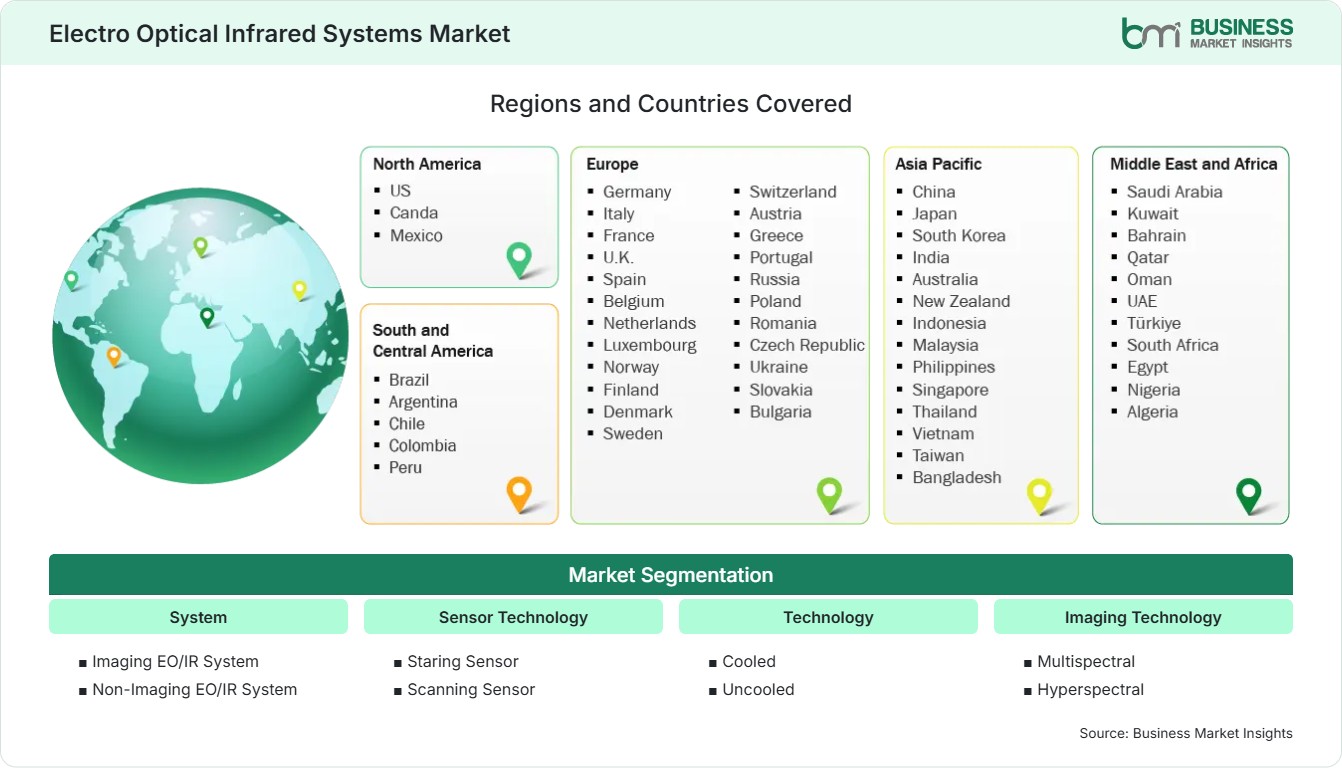
Global Market Geography
FREE PDF
Request your free sample
Request free sample
Segment Analysis

Electro Optical Infrared Systems Market Segmentation

System

Imaging systems account for 68%–72% share during 2025, and the segment grows at a CAGR of 3.4%–3.8%. The Electro Optical Infrared Systems Market scope continues expanding through enhanced image quality, AI-enabled analytics, and integration across airborne, land, and naval applications. Demand is supported by situational awareness, surveillance, and reconnaissance requirements.

  • Imaging EO/IR System: Widely deployed across defense operations for real-time intelligence collection, target tracking, and surveillance missions requiring high-resolution imagery and improved operator decision-making capabilities.
  • Non-Imaging EO/IR System: Supports detection, warning, ranging, and tracking applications where precise measurement, threat alerting, and environmental monitoring functions outweigh image-generation requirements.

Sensor Technology

Staring sensors will dominate the market, with a share of 58%–62% in 2025 and a CAGR of 3.5%–3.9%. This is due to improved image sensitivity and faster capture, along with support for current surveillance systems.

  • Staring Sensor: Delivers superior detection performance with continuous observation capability, supporting advanced tracking and targeting operations across military surveillance environments.
  • Scanning Sensor: Remains relevant in wide-area monitoring applications requiring broad coverage and reliable performance across varied operating conditions.

Technology

Uncooled solutions account for 54%-58% of the market by 2025 and grow at CAGRs of 3.8%-4.2% due to low maintenance needs and cost savings. They are used across portable, vehicular, and infrastructure applications.

  • Cooled: Preferred in long-range detection and high-performance military applications where elevated sensitivity and imaging quality are mission-critical.
  • Uncooled: Gains traction through affordability, compact design characteristics, and operational simplicity supporting large-scale deployment programs.

Imaging Technology

The multispectral sector retains a market share of 64%-68%, while hyperspectral is the fastest-growing segment. The Electro Optical Infrared Systems Market trends involve the usage of advanced spectral processing for better discrimination capabilities.

  • Multispectral: Supports broad military and security applications through balanced performance, efficient data processing, and proven deployment across diverse operational environments.
  • Hyperspectral: Enables detailed material identification, camouflage detection, and advanced intelligence gathering capabilities through extensive spectral information capture.

Component

Sensors contribute a 29%–33% share in 2025 and grow at 3.6%–4.0% CAGR. Component innovation focuses on improved sensitivity, durability, and integration flexibility.

  • Sensors: Form the foundational element responsible for signal acquisition, detection accuracy, and operational effectiveness.
  • Optics: Enhance image clarity, range performance, and precision across surveillance missions.
  • Detectors: Support reliable thermal and optical signal conversion for advanced sensing applications.
  • Electronics: Enable data processing, communication, and system control functionalities essential to mission performance.

Wavelength

Medium wavelength infrared remains the leading category with a 30%–34% share during 2025 and a CAGR of 3.4%–3.8%. Demand reflects performance advantages across defense surveillance missions.

  • Ultraviolet: Supports specialized detection and environmental monitoring requirements.
  • Near Infrared: Commonly utilized in imaging, night vision, and observation applications.
  • Short Wavelength Infrared: Enables improved visibility through haze and challenging atmospheric conditions.
  • Medium Wavelength Infrared: Provides strong target contrast and effective long-range detection capability.
  • Long Wavelength Infrared: Supports thermal imaging operations under diverse environmental conditions.

Platform

Airborne systems account for 42%–45% share in 2025 and expand at 3.1%–3.5% CAGR driven by UAV and ISR demand.

  • Airborne: Supports intelligence gathering, targeting, reconnaissance, and persistent surveillance requirements across fixed-wing and rotary platforms.
  • Land: Benefits from vehicle modernization, border security, and force protection initiatives.
  • Naval: Enables maritime monitoring, navigation support, and threat detection across coastal and blue-water operations.
Market Forces

Electro Optical Infrared Systems Market Dynamics

Key Market Drivers

Escalating Defense Modernization Programs Worldwide

The continued growth in defense spending by the world’s largest economies has encouraged the use of high-end sensors. NATO allies have made more capabilities-related investments, whereas countries from the Indo-Pacific region have intensified their efforts towards military modernization. Advanced intelligence, surveillance, and reconnaissance needs have prompted the acquisition of thermal imaging, targeting, and multispectral sensors. The need for surveillance in contested areas is enhancing the adoption of high-performance sensor systems. Growth in the Electro Optical Infrared Systems Market is being driven by digitization on battlefields and autonomous mission needs. There is a requirement for solutions that can function in low-visibility conditions and deliver actionable intelligence.

Expansion of Unmanned and Autonomous Platforms

The global deployment of unmanned air, ground, and maritime systems is growing rapidly. EO/IR payload systems are required for missions like navigation, target tracking, reconnaissance, and threat detection. The development of lightweight, energy-efficient payload systems is contributing to the increased adoption of EO/IR systems. Nations are showing interest in ISR capabilities that do not put their personnel at risk during operations. Defense agencies are looking for modular EO/IR payload systems that enable mission customization and easy upgrades. Improving autonomy requires enhanced perception capabilities, and EO/IR systems have become important enablers in this regard. Adoption goes beyond military environments to applications in border security, infrastructure monitoring, and maritime surveillance, where continuous situational awareness is required across vast geographic areas.

Growing Demand for Multi-Sensor Fusion and AI Analytics

Modern military personnel need integrated sensors that integrate thermal imaging, optics, radar, and analysis. Sensor fusion ensures reliable target recognition, fewer false alarms, and higher mission efficiency. With the use of artificial intelligence, automatic recognition of objects and targets becomes possible, and decision-making can be supported. These technologies become necessary in the face of information overload and constant changes in threats. The implementation of AI technologies is one of the key Electro Optical Infrared Systems Market trends affecting procurement choices. Software-defined solutions allow developers to implement algorithm upgrades without changing the hardware.

Key Market Opportunities

AI-Enabled Persistent Surveillance Architectures

Intelligent surveillance ecosystems are revolutionizing how military and security agencies monitor their operational environments. With the help of powerful algorithms, they are able to track and detect anomalies, prioritize threats, and reduce the load on operators. Procurement programs are now seeking solutions that integrate sensing and analytics. It offers great potential for vendors that can provide advanced software capabilities rather than simple hardware solutions. Electro Optical Infrared Systems Market Forecasts suggest growing needs for systems that are able to support autonomous operations and decision-making in real time. Suppliers that deliver open architectures, scalable analytics, and multi-platform interoperability are well positioned to capture growing investments in next-generation ISR modernization initiatives and distributed sensing networks.

Expansion of Border and Maritime Security Investments

Globally, governments are improving their capacity for border and maritime security in response to evolving security needs. The need for sophisticated technology is evident in applications such as coastal surveillance, anti-smuggling measures, combating illegal fishing, and protecting infrastructure. The use of EO/IR technology is becoming common in stationary facilities, autonomous systems, and mobile surveillance. There is an increasing need not only from defense establishments but also from coast guard and customs units, and critical infrastructure operators. The strengths that long-distance imaging and enhanced performance in dark and harsh conditions provide suppliers make it easier for them to tap into growing procurement drives that generate sustained demand driven by security needs rather than temporary market trends.

Emergence of Hyperspectral Intelligence Applications

Hyperspectral technologies enable the identification of materials, the detection of concealment, and the support of advanced intelligence collection missions. Growing computational capability is making these solutions more operationally practical across defense and homeland security applications. Integration with AI technology further improves analytical capabilities and mission success. Organizations are beginning to realize the potential offered by spectral intelligence for applications in environmental surveillance, camouflage detection, and target description. There are new investment opportunities arising from the deployment of aircraft and satellite systems, which offer considerable operational benefits through comprehensive data acquisition. Companies offering compact hyperspectral sensors can benefit from this trend.

Market Restraints and Challenges

High Development and Lifecycle Ownership Costs

Factor: Advanced EO/IR solutions require sophisticated optics, precision detectors, specialized manufacturing processes, and extensive qualification testing. Impact: Elevated acquisition and sustainment costs can restrict adoption, particularly among budget-constrained customers. Many next-generation deployments involve integration with broader command-and-control environments, increasing implementation complexity and overall program expenditures. Maintenance, calibration, and software support requirements further contribute to lifecycle costs. Procurement decisions frequently involve extended evaluation cycles and funding approvals, slowing deployment timelines. Suppliers must balance capability enhancement with affordability objectives. Competitive differentiation increasingly depends on demonstrating measurable operational value and lower total ownership costs alongside technological performance improvements.

Supply Chain Complexity and Critical Component Dependencies

Factor: EO/IR systems rely on specialized semiconductor materials, detector technologies, optics manufacturing expertise, and restricted defense supply chains. Impact: Production schedules can be affected by component shortages, export controls, and geopolitical disruptions. Extended lead times may delay program execution and increase procurement risk. Manufacturers are responding through supplier diversification and regional production strategies, yet challenges remain across high-performance detector and optical component categories. As defense customers increasingly prioritize supply chain resilience, vendors face pressure to maintain production continuity while meeting stringent quality and security requirements. These operational constraints can influence profitability and competitive positioning.

Company Analysis

Competitive Landscape

Electro Optical Infrared Systems Market analysis indicates competition is driven by defense relationships, sensor innovation, AI integration capabilities, and platform-level expertise.

Company Name

Overview

Products and Services relevant to this market

RTX Corporation

Major defense technology provider with strong EO/IR capabilities across airborne, naval, and intelligence applications.

Targeting systems, advanced EO/IR sensors, ISR payloads, multi-spectral surveillance, AI-enabled sensing architectures.

Lockheed Martin Corporation

Global defense contractor serving military and government customers through advanced mission systems.

Targeting pods, surveillance systems, integrated sensing technologies, command-and-control-enabled EO/IR solutions.

Northrop Grumman Corporation

Leading aerospace and defense company focused on ISR, autonomous systems, and sensing platforms.

EO/IR payloads, airborne reconnaissance systems, multi-sensor fusion technologies, surveillance architectures.

Teledyne FLIR LLC

Specialized thermal imaging and sensing technology provider with broad defense and security presence.

Thermal cameras, infrared sensors, ISR payloads, targeting systems, border surveillance solutions.

Leonardo DRS, Inc.

Advanced defense electronics company with significant electro-optical and infrared manufacturing expertise.

Thermal weapon sights, infrared detectors, imaging modules, military surveillance technologies.

Thales S.A.

European defense and aerospace leader with strong optronics and intelligence capabilities.

Electro-optical systems, naval sensors, targeting solutions, reconnaissance and surveillance technologies.

Safran S.A.

Major aerospace and defense supplier serving global military modernization programs.

Optronic systems, targeting devices, thermal imaging products, airborne surveillance solutions.

HENSOLDT AG

Sensor specialist focused on defense electronics and advanced observation technologies.

Optronics, reconnaissance sensors, vehicle-mounted surveillance systems, electro-optical solutions.

Elbit Systems Ltd.

Defense technology provider known for integrated sensing and situational awareness products.

Thermal imaging systems, targeting solutions, airborne payloads, intelligence collection technologies.

BAE Systems plc

Global defense manufacturer supporting land, sea, air, and intelligence applications.

Sensor systems, surveillance technologies, targeting equipment, integrated defense sensing platforms.

Trust & Transparency

Research Methodology

The market analysis combines proprietary research with secondary data from government agencies, company disclosures, regulatory filings, industry databases and expert interviews. Market estimates are validated through data triangulation, cross-market benchmarking and analyst review.

View Full Research Methodology

Questions Answered

Frequently Asked Questions

What does the Electro Optical Infrared Systems Market Report typically evaluate?

The Market Report evaluates technology trends, competitive positioning, procurement patterns, regional demand dynamics, segmentation performance, and strategic opportunities across defense and security applications.

Which platform segment generates the highest revenue?

Airborne platforms generate the largest revenue contribution because of extensive deployment across UAVs, ISR aircraft, fighter aircraft, and maritime patrol operations.

What role does artificial intelligence play in these systems?

AI improves object recognition, target classification, anomaly detection, and sensor fusion performance while reducing operator workload and improving mission effectiveness.

Which region offers the strongest future growth potential?

Asia Pacific presents the strongest growth outlook due to expanding defense budgets, indigenous military manufacturing initiatives, and increasing investments in surveillance and reconnaissance capabilities.

What is driving demand for advanced EO/IR systems?

Growing military modernization, autonomous platform deployment, border security needs, and demand for real-time situational awareness are accelerating adoption across airborne, land, and naval applications.

Access the Full Electro Optical Infrared Systems Market Report

Get segment-level forecasts, regional estimates, competitive benchmarking, company profiles and downloadable Excel datasets.

Access the full Electro Optical Infrared Systems Market Report
350 pages PDF & Excel | 2026-08-31