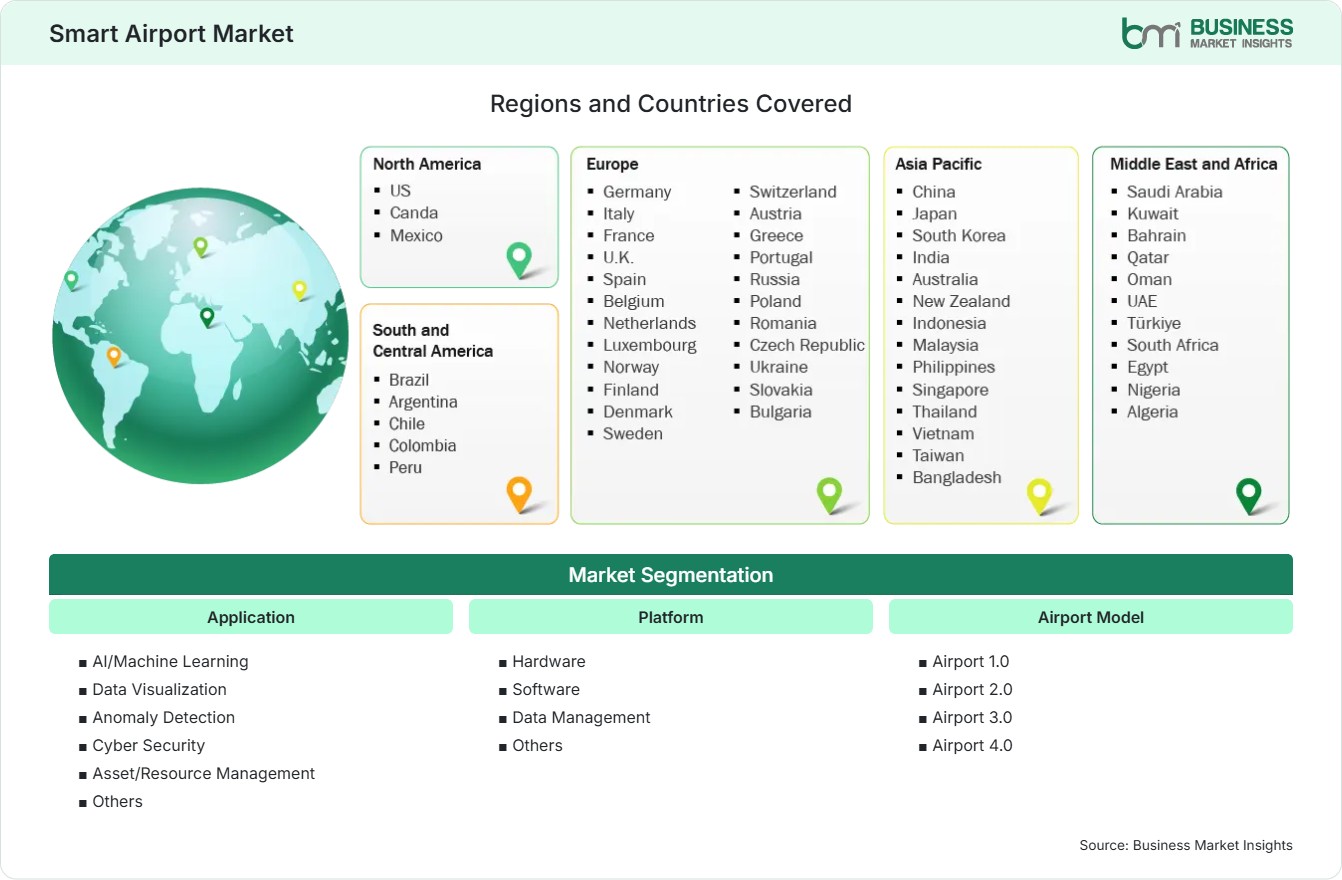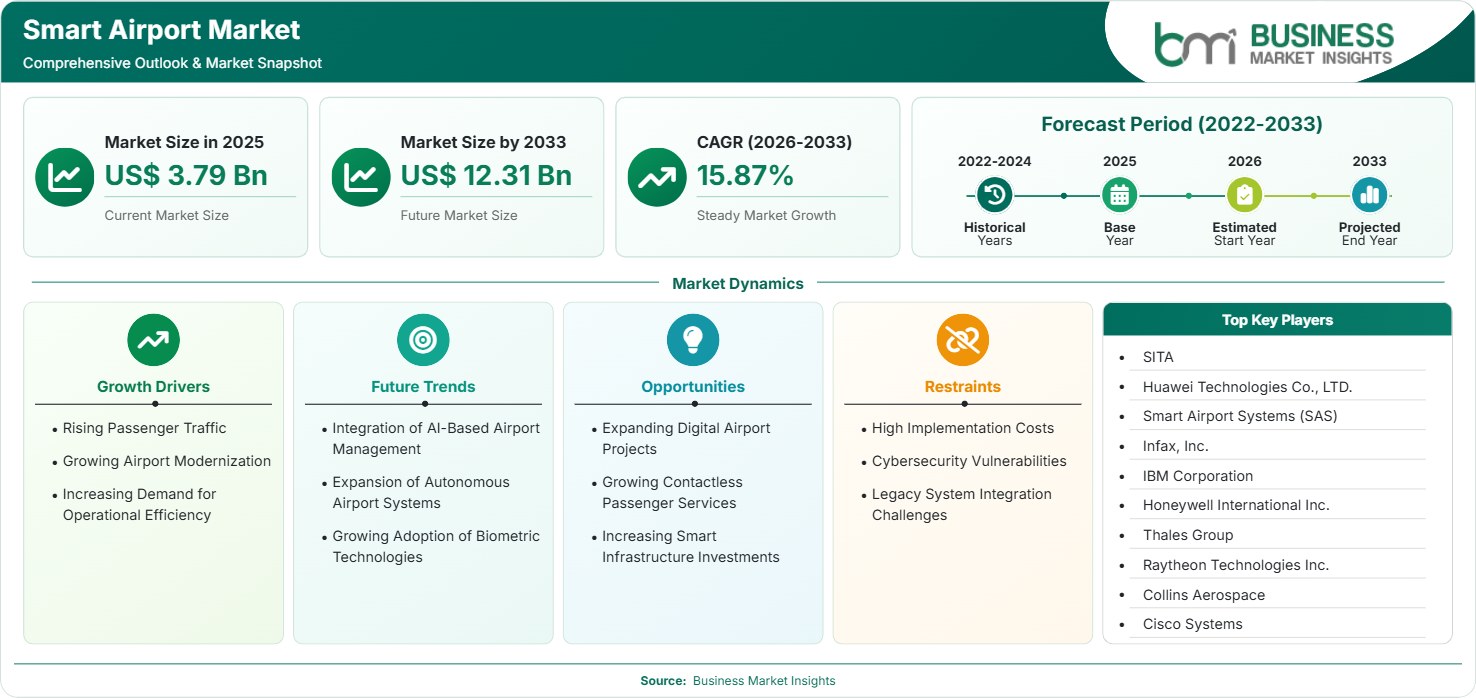
Smart Airport Market Regional Highlights
North America Smart Airport Market
North America represents a modeled 27%–31% share in 2025, with a CAGR of 14.8%–16.2% during 2026–2033. The region benefits from established technology suppliers, mature airport infrastructure, and demand for operational modernization. The US remains the principal regional market, while Canada contributes through digital infrastructure and passenger-service upgrades.
- Established airport infrastructure supports recurring demand for modernization solutions that can integrate with existing systems while improving operational visibility and reducing dependence on disconnected technology environments.
- Cybersecurity remains strategically important as airports connect more operational assets, passenger systems, communication networks, and data platforms, increasing demand for secure architectures and continuous technology monitoring.
- AI-enabled operational tools are gaining commercial relevance because airport operators require faster identification of congestion, equipment issues, resource constraints, and process deviations across complex environments.
- North American suppliers benefit from established relationships with airport operators and systems integrators, strengthening opportunities for long-term technology deployment, maintenance, software upgrades, and lifecycle services.
US Smart Airport Market
The US represents a modeled 21%–24% share of the global Smart Airport Market in 2025 and is positioned to grow at a CAGR of 14.9%–16.3% during 2026–2033. Technology procurement is increasingly centered on scalable architectures that can support phased modernization without disrupting daily airport operations.
- Large airport environments create demand for centralized operational platforms capable of coordinating facilities, passenger processing, security, asset management, and resource allocation through shared data structures.
- Software-led modernization offers operators a practical pathway for improving existing infrastructure, particularly where complete physical replacement would create excessive operational disruption or capital requirements.
- Demand for connected security and operational technologies supports opportunities for providers offering integrated communications, analytics, cybersecurity, and automated monitoring capabilities.
Europe Smart Airport Market
Europe Smart Airport Market accounts for a modeled 23%–27% share in 2025, with a CAGR of 14.5%–16.0% during 2026–2033. The UK, Germany, and France represent leading markets, while Spain and Italy provide additional modernization opportunities. Regional demand is increasingly oriented toward connected passenger services, automation, cybersecurity, resource optimization, and energy-aware infrastructure management.
- The UK provides opportunities for digital passenger processing, operational analytics, and integrated airport-management technologies as operators prioritize smoother passenger journeys and more coordinated infrastructure utilization.
- Germany represents a strong technology market where automation, asset intelligence, cybersecurity, and operational data management can support modernization across complex airport environments.
- France offers opportunities for integrated airport technologies covering passenger services, infrastructure management, security, and data-driven operational coordination.
- Spain and Italy provide high-growth opportunities as airport modernization and passenger-service digitization create demand for scalable technology platforms and connected operational systems.
Asia Pacific Smart Airport Market
Asia Pacific holds a modeled 24%–28% of the Smart Airport Market share in 2025 and is expected to record the fastest regional expansion at a CAGR of 17.0%–18.8% during 2026–2033. China, Japan, India, South Korea, and Australia represent important markets, while India and Southeast Asian economies provide substantial future deployment opportunities. New infrastructure development allows smart technologies to be embedded into airport designs, while existing facilities increasingly require modernization.
- China represents a major technology opportunity because large-scale airport environments require integrated platforms capable of coordinating passenger services, infrastructure, communications, security, and operational data.
- India offers strong potential for smart airport deployment as airport expansion and modernization create opportunities to incorporate digital passenger processing, automation, analytics, and connected infrastructure.
- Japan and South Korea provide mature technology environments where automation, operational intelligence, robotics, connectivity, and advanced passenger services support continued smart airport adoption.
- Southeast Asia presents emerging opportunities for modular platforms that can support airport modernization while allowing operators to scale technology investment according to traffic growth and infrastructure requirements.
Rest of World Smart Airport Market
Rest of World represents a modeled 18%–22% share in 2025, with a CAGR of 15.3%–17.1% during 2026–2033. South and Central America offer opportunities through airport modernization, passenger-service improvements, and digital infrastructure development. Brazil and Mexico provide leading commercial opportunities, while Chile and Colombia offer additional growth potential. In the Middle East and Africa, airport expansion and technology-led infrastructure planning support demand for connected operations, cybersecurity, automation, and advanced passenger services.
- Brazil and Mexico offer opportunities for airport technology suppliers through modernization initiatives focused on operational efficiency, passenger processing, security, asset management, and integrated communications.
- Chile and Colombia provide developing markets for modular smart airport platforms that can improve operational visibility while limiting the complexity associated with large-scale infrastructure transformation.
- Middle Eastern airport projects create opportunities for integrated digital environments because technology can be incorporated alongside new facilities, passenger systems, security infrastructure, and operational platforms.
- Gulf markets favor high-performance passenger services, automation, analytics, and connected infrastructure, creating opportunities for technology providers with comprehensive integration and lifecycle capabilities.