
Airport Infrastructure Market Outlook: Size, Share, Trends, Growth Analysis, Competitive Landscape & Forecast, 2026-2033

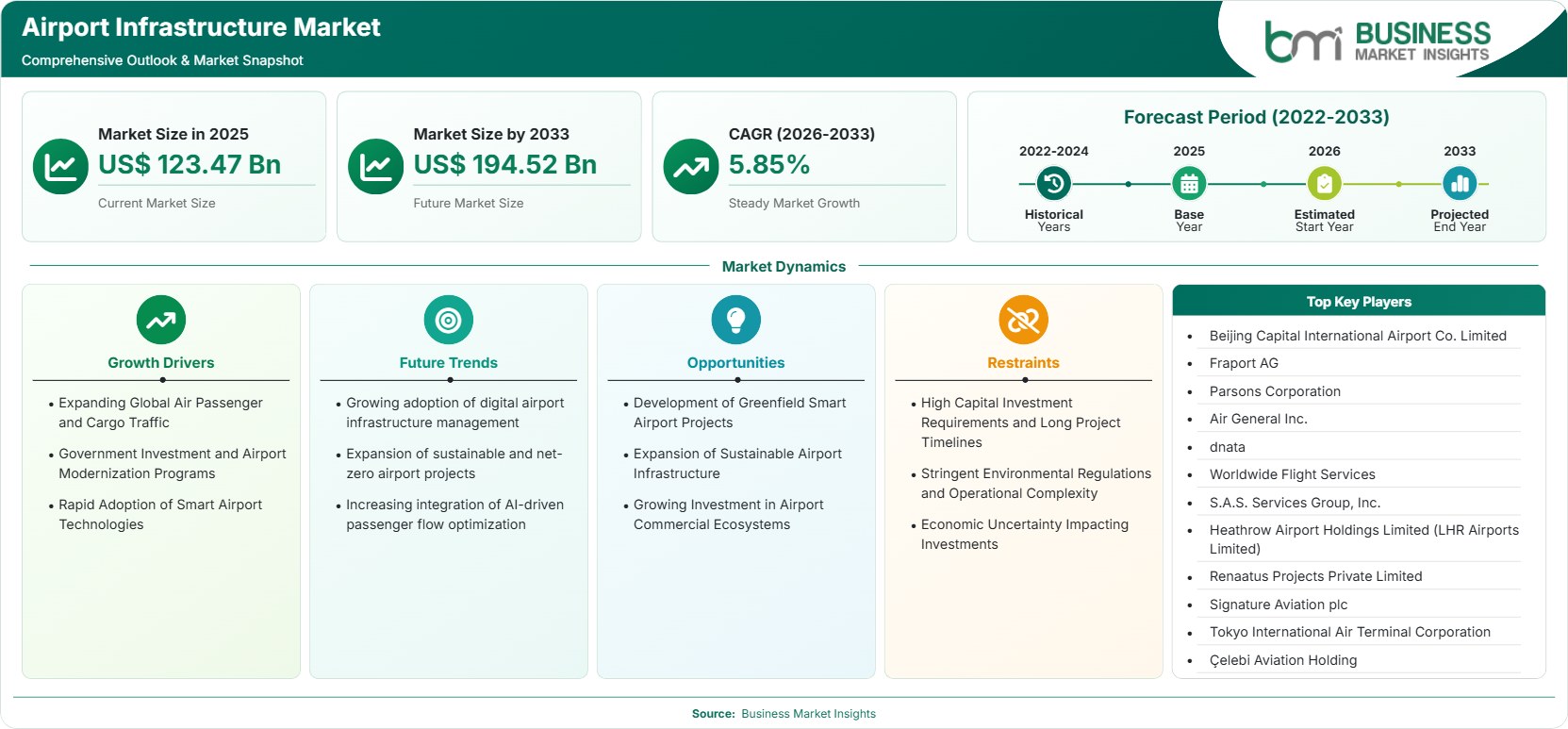
The Airport Infrastructure Market size was valued at US$ 123.47 Billion in 2025 and is projected to reach US$ 194.52 Billion by 2033, growing at a CAGR of 5.85% during 2026–2033. Rising passenger traffic, airport modernization, digital transformation, sustainability initiatives, and public-private investments continue creating strong opportunities across terminal expansion, smart airside operations, and integrated airport management infrastructure.

Report Coverage
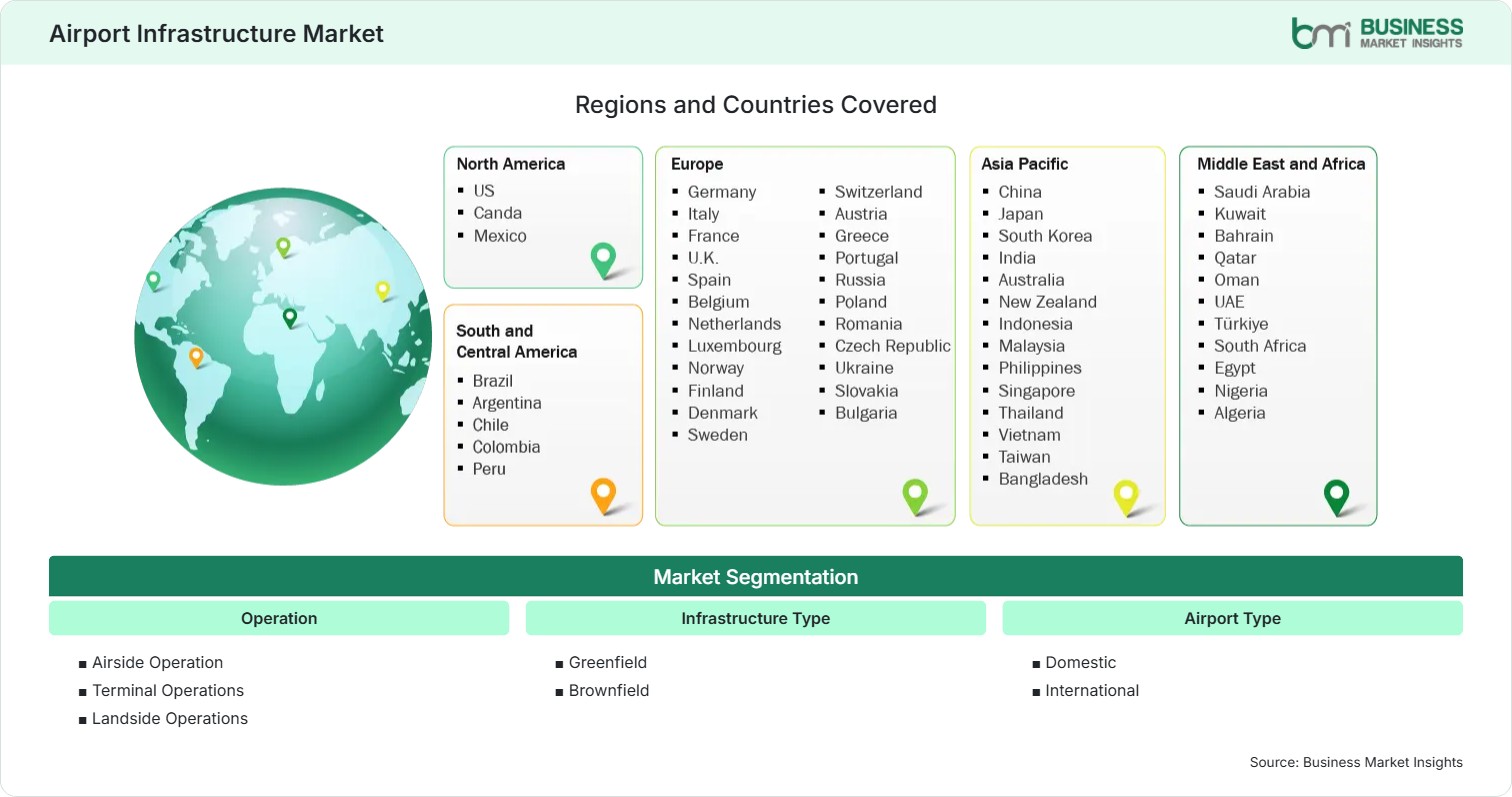
  • Operation: Airside Operation, Terminal Operations , Landside Operations
  • Infrastructure Type: Greenfield, Brownfield
  • Airport Type: Domestic, International
US$ 123.47 Bn Market size in 2025
US$ 194.52 Bn Market Size by 2033
5.85% CAGR, 2026 - 2033
2026-2033 Forecast Period

01 AI Overview

Airport Infrastructure Market Summary

  • North America Region: North America held 34%–37% market share in 2025 and is projected to grow at a 5.0%–5.4% CAGR through 2033. Growth is driven by terminal modernization, runway upgrades, digital security, sustainable infrastructure, smart airport technologies, cargo expansion, and public-private partnerships. The U.S. leads the region with extensive airport modernization and automation investments, growing at a 5.1%–5.5% CAGR.
  • Fastest Growing Region: Asia Pacific held 28%–31% market share in 2025 and is expected to grow at a 6.8%–7.3% CAGR through 2033. Growth is driven by urbanization, rising air travel demand, airport investments, smart terminals, digital services, cargo expansion, and tourism recovery.
  • Leading Segment: Airside Operations held 39%–42% market share in 2025 and is expected to grow at a 5.7%–6.1% CAGR through 2033. Growth is supported by runway upgrades, navigation systems, airfield lighting, safety improvements, predictive maintenance, and digital monitoring investments.
  • High Growth Segment: High Growth Segment: Greenfield infrastructure accounted for 42%–45% market share in 2025 and is projected to grow at a 6.6%–7.0% CAGR through 2033. Growth is driven by new airport projects, smart terminals, sustainable construction, renewable energy, digital operations, and expanding aviation capacity.
  • Key Market Opportunity: Expanding smart airport ecosystems integrating artificial intelligence, digital twins, predictive maintenance, renewable energy infrastructure, automated baggage systems, biometric passenger processing, and connected mobility solutions create sustainable long-term investment opportunities across developed and emerging aviation markets.
  • Major Market Players: Beijing Capital International Airport Co. Limited, Fraport AG, Parsons Corporation, Air General Inc., dnata, Worldwide Flight Services, S.A.S. Services Group, Inc., Heathrow Airport Holdings Limited (LHR Airports Limited), Renaatus Projects Private Limited, Signature Aviation plc, Tokyo International Air Terminal Corporation, Çelebi Aviation Holding, and Aéroports de Paris SA.
02 Strategic Insights

Airport Infrastructure Market: Strategic Insights

Airport Infrastructure Market Strategic Framework
FREE PDF
Request your free sample
Request free sample
03 Stakeholder View

Key Takeaways

  • The industry value chain is evolving toward integrated digital ecosystems where infrastructure developers, engineering firms, airport operators, technology providers, and facility management companies collaborate to deliver resilient, data-driven airport environments with higher operational efficiency.
  • Greenfield airport developments across emerging economies present the strongest expansion opportunities as governments prioritize aviation connectivity, tourism growth, cargo logistics, and regional economic development through long-term infrastructure investment programs.
  • Artificial intelligence, digital twins, predictive maintenance, biometric passenger processing, autonomous ground support equipment, and cloud-based airport management platforms are redefining operational efficiency while improving safety, sustainability, and passenger experience.
  • Asia Pacific offers one of the most compelling investment destinations due to expanding air passenger demand, supportive government policies, increasing private participation, and extensive airport capacity enhancement projects across developing economies.
  • Strategic partnerships, concession agreements, infrastructure financing models, and mergers among airport operators, engineering companies, and aviation service providers continue reshaping competitive positioning while supporting modernization and long-term revenue diversification.
  • Sustainability is becoming a core investment criterion as airport operators increasingly integrate renewable energy systems, low-carbon construction materials, electric ground support infrastructure, and advanced environmental monitoring technologies into future expansion projects.
04 Geographic Outlook

Airport Infrastructure Market Regional Highlights

North America Airport Infrastructure Market

North America accounted for 34%–37% Airport Infrastructure Market share in 2025 and is anticipated to expand at a 5.0%–5.4% CAGR during 2026–2033. The region benefits from continuous investments in airport modernization, digital air traffic management, runway rehabilitation, terminal expansion, and sustainable aviation infrastructure.

  • Airports are modernizing runways, taxiways, and lighting systems to improve operational safety, reduce maintenance costs, increase aircraft movement efficiency, and support rising passenger traffic.
  • Smart airport technologies, including AI, biometrics, digital twins, and predictive maintenance, are improving terminal operations, reducing disruptions, and enhancing the passenger experience.
  • Sustainability initiatives are driving investments in renewable energy, electric ground support equipment, energy-efficient buildings, and water management systems to reduce emissions and operating costs.
  • Growing e-commerce and pharmaceutical cargo demand is accelerating investments in cargo terminals, automated handling systems, warehouse modernization, and multimodal logistics infrastructure.

US Airport Infrastructure Market

The United States represents nearly 73%–76% of North America's regional market and is projected to register a 5.1%–5.5% CAGR through 2033. Strong federal funding programs, airport improvement grants, private investments, and continuous passenger demand support modernization across commercial airports in Airport Infrastructure Market trends.

  • Large terminal redevelopment projects are integrating automated check-in, biometric boarding, advanced baggage handling, and digital passenger information systems to improve efficiency and reduce congestion.
  • Airport operators are investing in runway resurfacing, modern airfield lighting, and next-generation navigation systems to enhance safety, support larger aircraft, and improve operational reliability.
  • Sustainability initiatives include solar power, electric airport vehicles, green buildings, and intelligent energy management to lower emissions and reduce operating costs.
  • Rising cargo volumes are driving expansion of logistics facilities, aircraft parking, automated cargo handling, and distribution infrastructure to support trade and manufacturing.

Europe Airport Infrastructure Market

Europe held 26%–29% market share in 2025 and is projected to grow at a 5.3%–5.7% CAGR through 2033. Growth is driven by airport modernization, sustainability initiatives, digitalization, and cross-border mobility. Germany, France, and the UK lead the Airport Infrastructure market, while Poland and Türkiye show faster infrastructure expansion.

  • European airports are investing in carbon-neutral terminals, renewable energy, and smart building systems to support sustainability goals.
  • Digital border control, biometric verification, and automated security screening are improving passenger processing and travel efficiency.
  • Expansion of rail links and multimodal transport is enhancing airport accessibility and integrated mobility.
  • Cargo infrastructure upgrades support pharmaceutical logistics, manufacturing exports, and temperature-controlled supply chains.
  • AI- and IoT-based predictive asset management is improving maintenance efficiency, infrastructure utilization, and operational reliability.

Asia Pacific Airport Infrastructure Market

Asia Pacific accounted for 28%–31% market share in 2025 and is anticipated to register the highest regional CAGR of 6.8%–7.3% through 2033. Rapid urbanization, increasing disposable incomes, expanding airline fleets, and supportive government infrastructure policies continue driving airport investments. China remains the largest regional contributor in Airport Infrastructure Market, while India and Southeast Asian economies demonstrate the fastest infrastructure expansion through greenfield developments, terminal upgrades, and integrated transportation connectivity.

  • Governments are developing new international airports and regional hubs to support economic growth, tourism, and rising air travel demand.
  • Smart airport investments include digital passenger services, automated immigration, AI, robotics, and cloud-based management systems to improve efficiency.
  • Growing flight traffic is driving expansion of runways, taxiways, apron capacity, fuel infrastructure, and air traffic management systems.
  • Public-private partnerships and concession models are accelerating funding for airport construction, modernization, and technology deployment.
  • Sustainable airport planning integrates green buildings, renewable energy, rainwater harvesting, and energy-efficient infrastructure to support long-term growth.

Rest of World Airport Infrastructure Market

The Rest of World region accounted for 9%–12% of the market in 2025 and is projected to grow at a 5.9%–6.4% CAGR through 2033. Growth is driven by airport modernization, tourism recovery, cargo expansion, and aviation infrastructure investments, with Brazil, Saudi Arabia, and the UAE leading regional demand in Airport Infrastructure Market while Colombia and South Africa record strong infrastructure development.

  • Gulf countries are investing in mega airports, digital passenger services, luxury terminals, and multimodal transport to strengthen tourism and global transit.
  • Airport privatization across Latin America is attracting private investment for infrastructure upgrades, operational efficiency, and expanded passenger and cargo capacity.
  • African countries are modernizing runways and regional airports to improve connectivity, trade, tourism, and humanitarian logistics.
  • Airports are adopting intelligent surveillance, advanced security systems, and digital management platforms to enhance safety, resilience, and regulatory compliance.
  • Sustainable airport projects focus on renewable energy, climate-resilient designs, efficient water use, and environmentally responsible construction.
Global Market Geography
FREE PDF
Request your free sample
Request free sample
05 Segment Analysis

Airport Infrastructure Market Segmentation

Operation

Operation accounted for approximately 58%–61% of the market in 2025 and is projected to grow at a 5.8%–6.2% CAGR during 2026–2033. The Airport Infrastructure Market scope continues expanding as airport operators prioritize operational efficiency, passenger experience, digital transformation, and sustainable asset management.

  • Airside Operation: Airside infrastructure remains fundamental for safe aircraft movement through continuous investments in runway modernization, navigation technologies, lighting systems, drainage networks, and digital monitoring platforms that improve operational efficiency and regulatory compliance.
  • Terminal Operations: Terminal modernization emphasizes automation, passenger convenience, digital services, and operational resilience, encouraging investments across baggage systems, security technologies, airport management platforms, retail infrastructure, and food service facilities.
  • Landside Operations: Growing passenger mobility encourages investments in parking infrastructure, integrated transport systems, and smart mobility solutions connecting airports with surrounding urban transportation networks.

Infrastructure Type

Infrastructure Type represented nearly 39%–42% market share during 2025 and is projected to expand at a 6.0%–6.4% CAGR through 2033. Governments increasingly balance modernization of existing airports with development of entirely new facilities to accommodate rising passenger traffic, cargo growth, sustainability objectives, and regional economic development strategies in Airport Infrastructure Market.

  • Greenfield: New airport developments integrate smart infrastructure, renewable energy systems, digital passenger technologies, scalable terminal designs, and multimodal connectivity supporting long-term aviation expansion across emerging economies.
  • Brownfield: Existing airport modernization projects prioritize terminal upgrades, runway rehabilitation, operational automation, sustainability improvements, and infrastructure optimization while minimizing disruptions to ongoing airport operations.

Airport Type

Airport Type contributed approximately 33%–36% market share in 2025 and is expected to register a 5.6%–6.0% CAGR through 2033. Infrastructure investments increasingly align with passenger traffic patterns, tourism expansion, cargo logistics requirements, and national aviation development strategies supporting balanced growth across domestic and international airport networks in Airport Infrastructure Market.

  • Domestic: Domestic airports increasingly modernize passenger terminals, digital check-in systems, security infrastructure, and regional connectivity to accommodate growing short-haul travel demand and economic development initiatives.
  • International: International airports prioritize advanced customs infrastructure, large-capacity terminals, automated passenger processing technologies, premium commercial facilities, and integrated cargo operations supporting expanding global aviation networks.
06 Market Forces

Airport Infrastructure Market Dynamics

Key Market Drivers

Expanding Global Air Passenger and Cargo Traffic

Passenger mobility improvements and continued cargo requirements for air transport also result in further investments in airport infrastructure across the globe. As per Airports Council International (ACI), global passengers have started to grow again close to their pre-pandemic trends, which stimulates further development of terminals, runway upgrades and baggage handling systems to meet these requirements. Increased international tourism and business travels as well as logistic services of e-commerce demand from airports to serve larger fleets of aircraft and flights frequencies. The infrastructure development now focuses on more flexible terminal construction, air traffic control, and efficient passenger processing systems.

Government Investment and Airport Modernization Programs

Airport modernization is currently being addressed by the national aviation authorities through infrastructure investment programs that involve establishing public-private partnership structures and concession agreements. The investments are aimed at the rehabilitation of old terminals, enhancement of apron capacity, rehabilitation of runways and construction of modern and efficient security infrastructure. Some countries have also adopted the concept of integrating airports into their broader transport and economic development strategies to ensure multimodal connectivity among air, rail, and road transport. This has been facilitated through regulatory support of sustainable airport and digital infrastructure development.

Rapid Adoption of Smart Airport Technologies

Transforming airports into smart environments through the integration of artificial intelligence, Internet of Things (IoT), biometrics, cloud-based airport management systems, autonomous machinery, and predictive maintenance is the future of airport operations in light of digitalization. Intelligent infrastructure enables faster airplane turnaround, shorter passenger wait times, more accurate passenger screening, and more efficient resource allocation within airports. The use of digital twins and operational analytics allows infrastructure managers to monitor the operation of assets and reduce the maintenance costs and operational disruption risks. Investments in intelligent infrastructure will grow as airports compete on experience and efficiency.

Key Market Opportunities

Development of Greenfield Smart Airport Projects

Emerging economies continue investing in greenfield airport developments to support urbanization, tourism, manufacturing growth, and regional connectivity. These projects provide opportunities to integrate smart infrastructure from the planning stage, including renewable energy systems, automated passenger processing, intelligent baggage handling, digital air traffic management, and sustainable construction materials. The Airport Infrastructure Market Forecasts indicate continued investment in next-generation airport ecosystems that combine operational efficiency with environmental sustainability. Private investors, engineering firms, and technology providers are increasingly participating through public-private partnerships, accelerating project delivery while supporting long-term revenue generation across rapidly expanding aviation markets.

Expansion of Sustainable Airport Infrastructure

There has been an increase in environmentally friendly airport infrastructure investments by airport owners to achieve their carbon emissions reduction goals and conform to emerging environmental regulations. The investment areas include the installation of solar power generation facilities, energy-efficient terminal buildings, electrically powered ground handling equipment, infrastructure for sustainable aviation fuels, rainwater harvesting facilities, and green building certification. Such investments not only reduce operating costs but also improve environmental performance and secure sustainable finance. With the emergence of stringent government climate policies and aviation sector decarbonization strategies, the market for environmentally sound airport infrastructure will continue to grow.

Growing Investment in Airport Commercial Ecosystems

Contemporary airports are transforming into commercial enterprises that have the potential to earn significant amounts of non-aeronautical income. Growing retail, hospitality, premium passenger facilities, logistics, business parks, and multimodal transport facilities make good investment propositions. Digital retailing facilities, customer-focused passenger services, and intelligent transport systems further add value by increasing commerce while enhancing the customer experience. Airport authorities are now exploring ways to make money outside the realm of airlines’ activities and are making infrastructural investments that facilitate mixed-use developments.

Market Restraints and Challenges

High Capital Investment Requirements and Long Project Timelines

Factor: Projects involving airport infrastructure require significant financial investment, approvals from various regulatory authorities, land acquisition, environmental impact assessments, and other considerations before construction begins. Impact: This means such projects will be significantly delayed due to the challenges and risks, as well as higher construction costs. Budget overruns, difficulties obtaining permits, supply chain disruptions, and other factors will delay airport expansion projects and diminish the profits expected to be generated by the process. Regional airports face budget constraints and cannot modernize despite rising flight demand.

Stringent Environmental Regulations and Operational Complexity

Factor: Airport expansion projects face increasingly rigorous environmental regulations covering emissions, noise pollution, biodiversity conservation, land utilization, and climate resilience, alongside complex operational coordination during construction. Impact: Compliance with these regulatory requirements increases project complexity, engineering costs, and approval durations while requiring significant investments in sustainable technologies and environmental mitigation measures. Construction activities must often be completed without disrupting ongoing airport operations, creating additional logistical challenges. Delays associated with environmental reviews and community consultations can postpone capacity expansion projects, affecting airport competitiveness and limiting the pace of infrastructure development despite growing demand for aviation services.

07 Company Analysis

Competitive Landscape

The competitive environment reflects a combination of airport operators, engineering and infrastructure specialists, ground handling providers, and integrated aviation service companies. The Airport Infrastructure Market analysis indicates that companies are investing in smart airport technologies, terminal modernization, digital passenger processing, sustainability initiatives, automated ground operations, and strategic partnerships to strengthen long-term competitiveness. Infrastructure expansion, operational efficiency, and carbon reduction remain the principal differentiators across global airport development projects.

Company Name

Overview

Products and Services Relevant to this Market

Beijing Capital International Airport Co. Limited

Operates a major Chinese international airport with expertise in terminal management, expansion, and operational efficiency.

Passenger terminals, runway operations, commercial facilities, aviation services, digital management, and infrastructure modernization.

Fraport AG

Global airport operator and infrastructure developer managing airports across multiple regions with operational and consulting expertise.

Airport development, terminal management, planning, airside operations, digital systems, and asset management.

Parsons Corporation

Engineering and technology company focused on aviation, transportation, and critical infrastructure development worldwide

Airport planning, engineering design, runway upgrades, intelligent transport systems, and project management.

Air General Inc.

U.S.-based aviation services provider supporting airlines with cargo, passenger, and ground handling operations across major airports.

Cargo terminal operations, passenger handling, ground support services, aircraft servicing, and airport logistics solutions.

dnata

Global aviation services company providing integrated airport operations across numerous international airports with extensive handling capabilities.

Ground handling, cargo logistics, airport hospitality, passenger services, baggage operations, and airport support infrastructure.

Worldwide Flight Services

International cargo and ground handling specialist serving airlines through integrated airport operational services across multiple continents.

Air cargo handling, passenger services, ramp operations, warehouse logistics, and airport operational support.

S.A.S. Services Group, Inc.

Aviation facility services provider delivering operational support and infrastructure maintenance across airport environments in North America.

Facility management, airport maintenance, cleaning services, operational support, and infrastructure management.

LHR Airports Limited

Operator of Heathrow Airport with expertise in large-scale airport expansion, passenger services, sustainability, and infrastructure modernization.

Terminal operations, airport development, passenger infrastructure, sustainability programs, and operational management.

Renaatus Projects Private Limited

Indian infrastructure company engaged in airport construction, engineering, and integrated project execution across transportation infrastructure projects.

Airport construction, civil engineering, terminal development, infrastructure contracting, and project execution services.

Signature Aviation plc

Leading provider of premium airport support infrastructure focused on business and private aviation operations globally.

Fixed-base operations, aircraft parking, hangar infrastructure, fueling facilities, maintenance support, and passenger services.

Tokyo International Air Terminal Corporation

Operator responsible for international passenger terminal management and continuous airport infrastructure enhancement in Japan.

International terminals, passenger processing, commercial facilities, airport management, and infrastructure development.

Çelebi Aviation

International aviation services provider delivering airport ground handling and cargo services across Europe, Asia, and the Middle East.

Ground handling, cargo services, warehousing, passenger handling, ramp operations, and aviation logistics.

Airports de Paris SA

One of Europe's leading airport operators managing Paris airport infrastructure while expanding sustainable and digital airport capabilities.

Airport operations, terminal development, engineering, sustainability, and smart airport technologies.

10 Trust & Transparency

Research Methodology

The market analysis combines proprietary research with secondary data from government agencies, company disclosures, regulatory filings, industry databases and expert interviews. Market estimates are validated through data triangulation, cross-market benchmarking and analyst review.

View Full Research Methodology

11 Questions Answered

Frequently Asked Questions

Why is sustainability becoming a strategic priority for airport operators?

Airports increasingly invest in renewable energy, energy-efficient terminals, electric ground support equipment, sustainable construction materials, and carbon reduction initiatives to meet regulatory requirements, lower operating costs, and achieve long-term environmental objectives.

Which organizations influence standards within the Airport Infrastructure Market Report?

International organizations including Airports Council International (ACI), the International Air Transport Association (IATA), the International Civil Aviation Organization (ICAO), and national aviation regulators significantly influence infrastructure planning, operational standards, sustainability initiatives, and safety requirements.

How are digital technologies transforming airport infrastructure?

Artificial intelligence, biometrics, digital twins, predictive maintenance, cloud-based airport management, and IoT-enabled monitoring improve operational efficiency, passenger experience, security, asset utilization, and infrastructure maintenance while reducing operating costs.

Which infrastructure type offers the highest future investment potential?

Greenfield airport developments offer the strongest long-term investment potential because they enable integrated deployment of smart technologies, renewable energy systems, digital passenger services, and scalable infrastructure designed for future aviation demand.

What are the primary factors driving investments in Airport Infrastructure Market?

Growing passenger traffic, airport modernization programs, digital transformation, sustainability initiatives, cargo expansion, and government infrastructure funding are the primary drivers encouraging long-term investments in airport terminals, runways, airside systems, and smart airport technologies.

Access the Full Airport Infrastructure Market Report

Get segment-level forecasts, regional estimates, competitive benchmarking, company profiles and downloadable Excel datasets.

Access the full Airport Infrastructure Market Report
350 pages PDF & Excel | 2026-08-12