
Space Infrastructure Market Outlook: Size, Share, Trends, Growth Analysis, Competitive Landscape & Forecast, 2026-2033

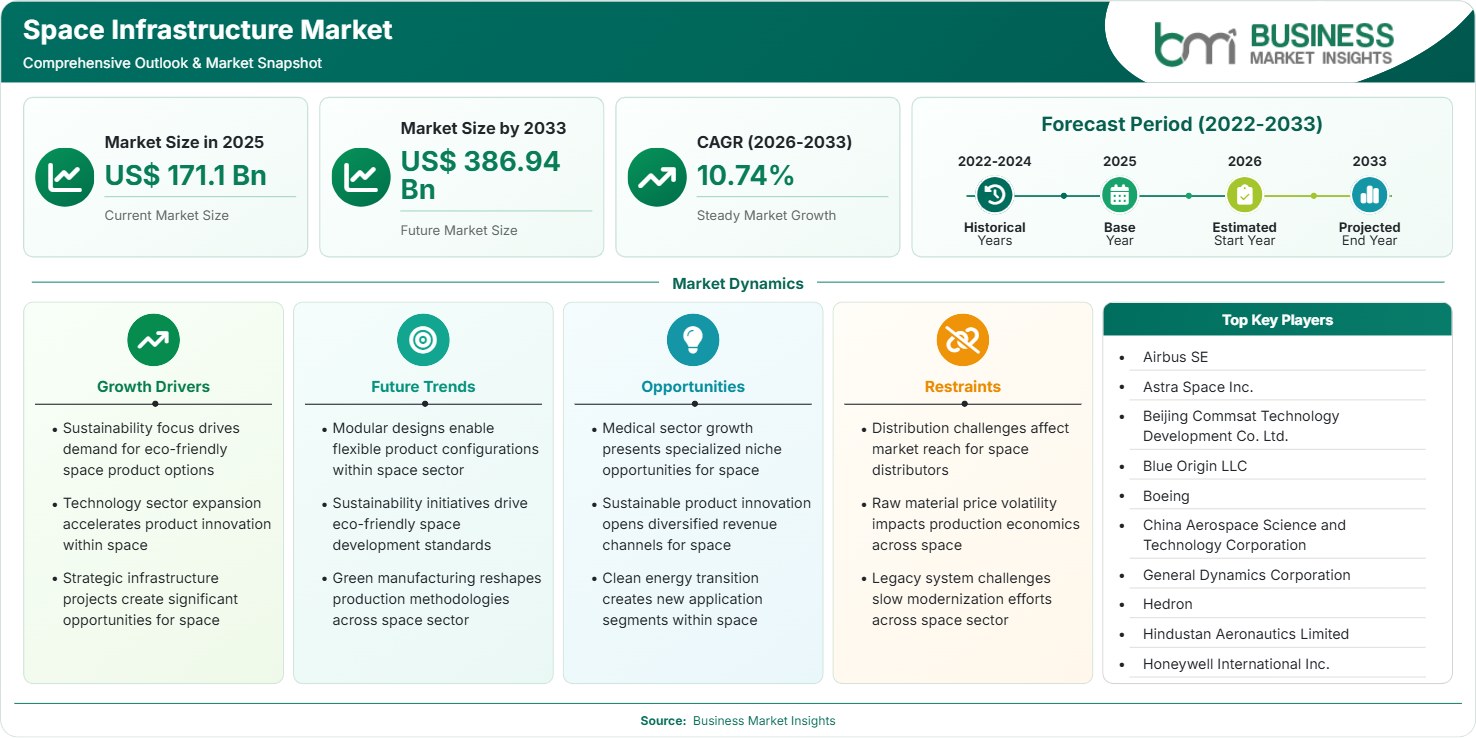
The Space Infrastructure Market size was valued at US$ 171.1 Billion in 2025 and is projected to reach US$ 386.94 Billion by 2033, growing at a CAGR of 10.74% during 2026–2033, driven by satellite deployment, commercial space investments, launch service expansion, and increasing demand for Earth observation and communication capabilities.

Report Coverage
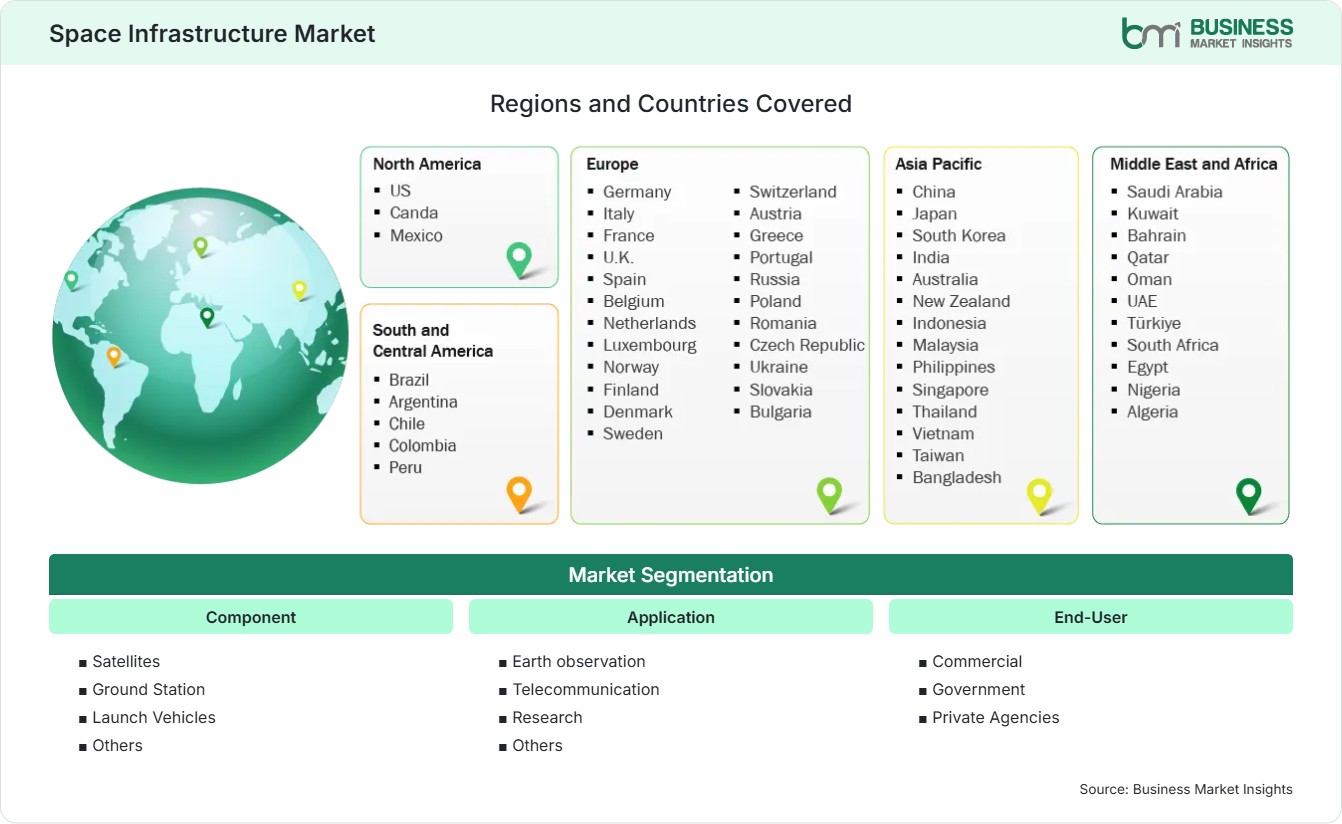
  • Component: Satellites, Ground Station, Launch Vehicles, Others
  • Application: Earth observation, Telecommunication, Research, Others
  • End-User: Commercial, Government, Private Agencies
US$ 171.1 Bn Market size in 2025
US$ 386.94 Bn Market Size by 2033
10.74% CAGR, 2026 - 2033
2026-2033 Forecast Period

AI Overview

Space Infrastructure Market Summary

  • North America Region: North America , 35%–38% share (2025) , 10.2%–11.1% CAGR (2026–2033) , Commercial satellite operators, government space programs, defense modernization, private launch investments, and advanced ground infrastructure development create sustained opportunities across the regional ecosystem. The US market shows strong momentum with a CAGR of 10.5%–11.2% during 2026–2033, supported by NASA initiatives, Défense contracts, and private space companies.
  • Fastest Growing Region: Asia Pacific , 28%–32% share (2025) , 11.5%–12.5% CAGR (2026–2033) , Expanding satellite communication networks, national space missions, manufacturing capabilities, private sector participation, and increasing investments from China, India, Japan, and South Korea accelerate regional infrastructure development opportunities.
  • Leading Segment: Satellites , 42%–46% share (2025) , 10.8%–11.6% CAGR (2026–2033) , Rising demand for broadband connectivity, remote sensing applications, navigation systems, defense surveillance, and constellation-based services strengthens satellite infrastructure adoption across commercial and institutional users.
  • High Growth Segment: Launch Vehicles , 18%–22% share (2025) , 12.0%–13.0% CAGR (2026–2033) , Reusable launch technologies, lower deployment costs, increasing small satellite launches, private space companies, and commercial launch service expansion support rapid growth opportunities globally.
  • Key Market Opportunity: Commercial space expansion, satellite constellation deployment, in-orbit services, and emerging applications such as climate monitoring and secure connectivity provide substantial investment opportunities across the space infrastructure value chain.
  • Major Market Players: Airbus SE, Astra Space Inc., Beijing Commsat Technology Development Co. Ltd., Blue Origin LLC, Boeing, China Aerospace Science and Technology Corporation, General Dynamics Corporation, Hedron, Hindustan Aeronautics Limited, and Honeywell International Inc.
Strategic Insights

Space Infrastructure Market: Strategic Insights

Space Infrastructure Market Strategic Framework
FREE PDF
Request your free sample
Request free sample
Stakeholder View

Key Takeaways

  • The market ecosystem is evolving from traditional government-led programs toward integrated commercial value chains involving satellite manufacturers, launch providers, ground infrastructure operators, and specialized technology suppliers.
  • The highest upside opportunities are emerging in satellite communication networks, Earth observation platforms, and commercial launch services as demand increases for connectivity, monitoring, and data-driven applications.
  • Innovation priorities are shifting toward reusable launch vehicles, advanced satellite architectures, autonomous spacecraft management, and efficient propulsion technologies that reduce operational costs.
  • Asia Pacific presents a compelling regional opportunity due to expanding domestic space programs, increasing private investments, and growing demand for communication and Earth observation capabilities.
  • Investment activity is increasingly focused on space technology companies, launch service providers, and infrastructure specialists as strategic partnerships and consolidation reshape competitive positioning.
  • Cross-industry adoption from telecommunications, defense, agriculture, and climate monitoring sectors is broadening the addressable customer base and accelerating infrastructure commercialization.
Geographic Outlook

Space Infrastructure Market Regional Highlights

North America Space Infrastructure Market

North America accounted for a 35%–38% share of the market in 2025 and is projected to expand at a 10.2%–11.1% CAGR during 2026–2033. The region maintains leadership through advanced aerospace capabilities, government funding, private launch programs, and commercial satellite deployment. The Space Infrastructure Market share reflects strong US dominance supported by defense applications, broadband constellations, and space exploration investments. The market growth is influenced by established manufacturing networks, innovation ecosystems, and increasing private sector participation.

  • Commercial satellite operators are increasing investments in low Earth orbit constellations, creating demand for spacecraft production, launch services, and advanced ground communication infrastructure across North American markets.
  • Government space initiatives and defense modernization programs are supporting satellite procurement, secure communication networks, and next-generation surveillance capabilities through increased collaboration with private aerospace companies.
  • Private launch providers are improving regional competitiveness by developing reusable technologies, reducing deployment costs, and enabling frequent access to orbit for commercial and institutional customers.
  • Advanced research capabilities, skilled engineering workforce, and established aerospace supply chains continue strengthening North America’s position in spacecraft manufacturing and space infrastructure innovation.

US Space Infrastructure Market

The US represented 28%–31% of the North American Space Infrastructure Market share in 2025 and is expected to grow at a 10.5%–11.2% CAGR between 2026–2033. The country remains the largest regional contributor due to government contracts, commercial space companies, and advanced launch capabilities. The US market benefits from strong investments in satellite communication, defense applications, and space exploration programs. Private enterprises continue expanding infrastructure capabilities through innovative spacecraft platforms and launch solutions.

  • Federal space budgets and defense requirements continue supporting satellite development, mission systems, and secure communication infrastructure for strategic applications.
  • Commercial operators are deploying large satellite networks to improve broadband availability, navigation services, and data analytics capabilities across multiple industries.
  • Venture capital investments in aerospace technology are accelerating innovation in propulsion systems, spacecraft components, and launch service models.

Europe Space Infrastructure Market

Europe held a 22%–25% share of the Space Infrastructure Market in 2025 and is anticipated to achieve a 9.8%–10.8% CAGR during 2026–2033. The region benefits from collaborative space programs, satellite manufacturing expertise, and growing commercial participation. France, Germany, Italy, and the United Kingdom are leading contributors, while emerging investments in Poland and other European nations support expansion. The market in Europe is influenced by Earth observation requirements, secure communication demand, and sustainable space operations.

  • France continues supporting aerospace innovation through satellite programs, launch capabilities, and institutional partnerships focused on strategic space independence.
  • Germany is expanding spacecraft manufacturing and research capabilities through industrial expertise, advanced engineering, and commercial satellite technology development.
  • The United Kingdom is strengthening its space ecosystem through private investments, satellite applications, and emerging launch service initiatives.
  • European sustainability initiatives are increasing demand for debris monitoring, orbital management solutions, and environmentally responsible spacecraft operations.

Asia Pacific Space Infrastructure Market

Asia Pacific captured a 28%–32% share of the market in 2025 and is expected to register an 11.5%–12.5% CAGR during 2026–2033. The region represents the fastest-growing market due to expanding national programs, private sector participation, and increasing satellite demand. China, India, Japan, and South Korea are major contributors. The Space Infrastructure Market trends across Asia Pacific are shaped by communication needs, Earth observation applications, and indigenous manufacturing capabilities.

  • China is expanding satellite constellations, launch capacity, and domestic aerospace production through large-scale government-backed space programs.
  • India is increasing commercial space participation through private launch companies, satellite manufacturers, and growing demand for communication and observation services.
  • Japan and South Korea are investing in advanced satellite systems, research missions, and commercial applications requiring reliable orbital infrastructure.
  • Regional telecommunications expansion is creating demand for satellite-based connectivity solutions across remote and underserved areas.

Rest of World Space Infrastructure Market

South and Central America, along with the Middle East and Africa, represented a 8%–11% share of the Space Infrastructure Market in 2025 and are projected to grow at a 9.5%–10.5% CAGR during 2026–2033. Brazil, Mexico, the UAE, Saudi Arabia, and South Africa are emerging contributors through satellite programs, communication initiatives, and research investments. The region is developing capabilities through international partnerships and commercial space applications.

  • Brazil is strengthening Earth observation capabilities through environmental monitoring requirements and regional satellite development initiatives.
  • Middle Eastern countries are investing in satellite communication, scientific missions, and national space strategies to diversify technology ecosystems.
  • African nations are adopting satellite-based services for agriculture, connectivity, disaster monitoring, and resource management applications.
  • International collaborations are improving access to launch services, spacecraft technologies, and space infrastructure expertise across developing markets.
Global Market Geography
FREE PDF
Request your free sample
Request free sample
Segment Analysis

Space Infrastructure Market Segmentation

Component

The component segment represented a major portion of the market in 2025, with satellites leading adoption at 42%–46% share and a 10.8%–11.6% CAGR during 2026–2033. Increasing demand for communication networks, Earth observation, navigation systems, and defense applications drives component-level investments. The Space Infrastructure Market scope continues expanding through integrated satellite, launch, and ground infrastructure development.

  • Satellites: Satellites support communication, observation, navigation, and research missions, with increasing adoption of small satellites, constellations, and advanced payload technologies.
  • Ground Station: Ground stations enable spacecraft communication, tracking, and data processing, supported by automation, network expansion, and increasing satellite deployment volumes.
  • Launch Vehicles: Launch vehicles are advancing through reusable technologies, improved propulsion systems, and commercial services that reduce costs and increase orbital access.

Application

The application segment demonstrates diversified adoption across communication, observation, and research activities. Telecommunication applications represent a significant demand area due to increasing broadband requirements and satellite connectivity needs. Earth observation continues gaining importance through climate monitoring, agriculture analysis, and disaster management. Research applications support scientific missions and technology demonstrations. The Space Infrastructure Market trends indicate increasing integration of satellite data across commercial and government operations.

  • Earth observation: Earth observation applications enable environmental monitoring, mapping, agriculture management, and climate analysis through advanced satellite imaging capabilities.
  • Telecommunication: Telecommunication applications drive satellite demand through broadband connectivity, mobile communications, and secure data transmission requirements globally.
  • Research: Research applications support scientific exploration, technology validation, and experimental missions conducted by governments and institutions.

End-User

The end-user segment reflects increasing participation from commercial organizations, government bodies, and private agencies. Commercial users are expanding investments in satellite services, communication platforms, and data applications. Government agencies remain important contributors through defense, exploration, and scientific missions. Private agencies are gaining momentum through entrepreneurial space initiatives. The Space Infrastructure Market share distribution continues shifting toward broader commercial participation.

  • Commercial: Commercial users adopt space infrastructure for communication services, Earth data solutions, logistics optimization, and digital connectivity applications.
  • Government: Government organizations utilize space infrastructure for defense, navigation, scientific research, and national security requirements.
  • Private Agencies: Private agencies are increasing involvement through startups, investment-backed ventures, and specialized space technology solutions.
Market Forces

Space Infrastructure Market Dynamics

Key Market Drivers

Rising Satellite Deployment and Commercial Space Expansion

One of the key factors responsible for the growth of the market is the rising number of communication, Earth observation, and navigation satellites. As per market reports from firms like the Satellite Industry Association, satellite operations are continuing to grow globally due to investments made in broadband constellations and data services. The Space Infrastructure Market trends are influenced by reduced satellite manufacturing costs, miniaturization, and improved launch availability. Growing demand from telecommunications, defense, agriculture, and climate monitoring sectors is encouraging companies to develop scalable satellite platforms. Private investment in space technology is also increasing competition, enabling new business models around satellite services, data analytics, and orbital infrastructure operations.

Government Space Programs and Strategic Infrastructure Investments

Government-backed space programs remain a significant driver as nations prioritize satellite capabilities, defense applications, and scientific missions. Public investments in launch facilities, spacecraft development, and research programs are strengthening domestic aerospace ecosystems. Organizations such as NASA, the European Space Agency, and national space agencies are backing long-term infrastructure development through procurement programs and technology partnerships. The emphasis on security of communication, independent navigation systems, and Earth observation is paving the way for infrastructure advancements, thus offering business prospects for manufacturers, component providers, and service providers alike. Public-private partnerships are allowing private organizations to join forces with governments in their endeavors as well.

Advancements in Reusable Launch and Space Technologies

Technological advancements in reusable launch systems, propulsion efficiency, autonomous spacecraft operations, and artificial intelligence integration are transforming space infrastructure economics. Reusable launch vehicles are reducing deployment costs and increasing mission frequency, enabling more commercial satellite launches. Advanced methods of manufacture, like additive manufacturing and modular spacecraft, have been making production more efficient. Use of advanced technologies makes the process reliable and expands its application to different types of activities like communications, research, and observations. Increased collaboration between aerospace industries and technology companies is increasing the rate of innovation. This development intensifies competition among infrastructure companies and makes the orbital environment more accessible.

Key Market Opportunities

Expansion of Satellite Broadband and Connectivity Networks

Satellite broadband expansion represents a major opportunity as underserved regions seek reliable digital connectivity solutions. Growing demands for fast internet connectivity, connectivity at sea, aviation communications, and remote industrial activity are driving investments in satellite constellations. Network architectures are being designed and built that combine sophisticated satellites, ground stations, and data handling capabilities. New markets are being created in regions like the Asia Pacific, Africa, and Latin America owing to deficiencies in connectivity and the growing need for digital infrastructures. Investors are paying increasing attention to businesses that offer affordable satellite services.

Growth of Space-Based Earth Observation Applications

There are a variety of increasing opportunities in earth observation as various industries take advantage of the data from satellites for environmental monitoring, agriculture improvement, urban planning, and disaster response. There are analytics-based solutions that are currently used by both governments and private companies for resource management and decision-making. As such technologies become more available, there will be greater opportunities to utilize satellite data services. The need for climate monitoring and sustainability efforts is also providing more opportunities in this sector. The companies that are focusing on specialized payloads, data services, and integrated solutions stand to gain from increased commercial utilization of space data.

Increasing Private Sector Participation and Space Services

Involvement of private organizations has opened new possibilities via unique business models, unique missions, and commercial space operations. Startups as well as large aerospace corporations are focusing on launch operations, satellite fabrication, in-space services, and mission management tools. Increased customer demand from communications, defense, logistics, and scientific communities widens the target audience from governmental customers only. Funding of space technology startups assists in developing new technologies such as on-orbit servicing and advanced spacecraft. The Space Infrastructure Market Forecasts indicate continued opportunities as private companies improve accessibility, reduce costs, and introduce specialized solutions across the global space ecosystem.

Market Restraints and Challenges

High Capital Requirements and Complex Development Processes

Factor: High capital requirements for spacecraft manufacturing, launch infrastructure, testing facilities, and mission operations increase financial barriers for new market participants.

Impact: Small companies could have problems scaling up their operations, raising capital, and competing with established aerospace companies. It takes extensive research, government approval, and testing to launch space projects to market, making the development process time-consuming. Although private investment is expanding, the need for specialized engineering expertise and significant upfront expenditure remains a major challenge for companies seeking to establish competitive positions within the space infrastructure ecosystem.

Orbital Congestion and Regulatory Complexity

Factor: Increasing satellite deployments are creating concerns related to orbital congestion, spectrum management, and space debris mitigation requirements.

Impact: Operators face additional compliance obligations, higher operational complexity, and potential limitations on future mission planning. The regulatory system differs from one nation to another, posing difficulties for international activities. Increasingly, there is a need to adopt a sense of responsibility in the use of space. This demands increased expenditure for the establishment of monitoring systems, debris removal technology, and safe operation procedures. Good coordination among nations and standardization of regulations will be crucial for sustainable access and growth of industries.

Company Analysis

Competitive Landscape

The Space Infrastructure Market analysis highlights a competitive ecosystem comprising aerospace manufacturers, launch providers, satellite specialists, and technology companies developing integrated solutions across the space value chain. Leading participants focus on spacecraft production, launch capabilities, communication systems, and advanced infrastructure services to strengthen market positioning.

Company Name

Overview

Products and Services relevant to this market

Airbus SE

Airbus SE is a global aerospace company providing advanced space systems, satellite platforms, and integrated mission solutions for commercial and institutional customers.

Satellite manufacturing, Earth observation systems, telecommunications satellites, navigation platforms, and space mission solutions.

Astra Space Inc.

Astra Space Inc. develops commercial launch solutions focused on flexible and responsive access to orbit for small satellite customers.

Small launch vehicles, satellite delivery services, propulsion technologies, and orbital transportation solutions.

Beijing Commsat Technology Development Co. Ltd.

Beijing Commsat Technology Development Co. Ltd. specializes in commercial satellite development and space technology applications in China.

Small satellites, satellite platforms, communication systems, and commercial space technology services.

Blue Origin LLC

Blue Origin LLC develops space transportation technologies with emphasis on reusable launch systems and commercial space access.

Reusable launch vehicles, orbital launch services, propulsion systems, and space transportation infrastructure.

Boeing

Boeing is a major aerospace company involved in spacecraft systems, defense space programs, and satellite technologies.

Satellite systems, spacecraft components, launch support services, and government space infrastructure programs.

China Aerospace Science and Technology Corporation

China Aerospace Science and Technology Corporation is a leading Chinese aerospace organization supporting national and commercial space missions.

Launch vehicles, satellites, spacecraft systems, and space technology development programs.

General Dynamics Corporation

General Dynamics Corporation provides aerospace and defense technologies supporting communication, surveillance, and mission infrastructure requirements.

Satellite communication systems, defense space solutions, mission technologies, and aerospace engineering services.

Hedron

Hedron develops advanced space technology solutions supporting satellite operations and emerging space infrastructure requirements.

Space technology platforms, mission support solutions, and specialized infrastructure services.

Hindustan Aeronautics Limited

Hindustan Aeronautics Limited is an Indian aerospace organization supporting aircraft and space-related manufacturing capabilities.

Aerospace manufacturing, satellite-related components, engineering services, and space program support.

Honeywell International Inc.

Honeywell International Inc. provides advanced aerospace technologies, electronics, and systems supporting space missions.

Space-grade electronics, navigation systems, sensors, aerospace components, and mission technologies.

Trust & Transparency

Research Methodology

The market analysis combines proprietary research with secondary data from government agencies, company disclosures, regulatory filings, industry databases and expert interviews. Market estimates are validated through data triangulation, cross-market benchmarking and analyst review.

View Full Research Methodology

Questions Answered

Frequently Asked Questions

Why is sustainability becoming important for space infrastructure?

The Space Infrastructure Market Report highlights that sustainability is gaining importance due to increasing satellite deployments and concerns related to orbital congestion and space debris. Operators are investing in tracking systems, responsible mission planning, and technologies that support long-term utilization of orbital resources.

What role do governments play in market development?

Governments support market development through funding programs, regulatory frameworks, defense requirements, scientific missions, and national space strategies. These initiatives create opportunities for aerospace companies while strengthening domestic capabilities in satellite production and launch infrastructure.

How are emerging companies changing the competitive environment?

Emerging companies are introducing specialized solutions in satellite manufacturing, launch services, and space data applications. Their participation is improving cost efficiency, accelerating innovation, and expanding access to orbital infrastructure for commercial and institutional customers.

Which application area is creating new demand opportunities?

Telecommunication applications are creating significant demand due to increasing requirements for broadband connectivity, remote communication, and secure data transmission. Earth observation applications are also expanding through climate monitoring, agriculture management, and disaster response use cases.

What factors are influencing investment in the Space Infrastructure Market?

Investment is being influenced by commercial satellite deployment, reusable launch technology development, government space programs, and increasing demand for communication and Earth observation services. Private funding and public-private partnerships are also encouraging innovation across manufacturing, launch, and operational segments.

Access the Full Space Infrastructure Market Report

Get segment-level forecasts, regional estimates, competitive benchmarking, company profiles and downloadable Excel datasets.

Access the full Space Infrastructure Market Report
350 pages PDF & Excel | 2026-08-17
Similar Research

Related Market Reports