
Space Cybersecurity Market Outlook: Size, Share, Trends, Growth Analysis, Competitive Landscape & Forecast, 2026-2033

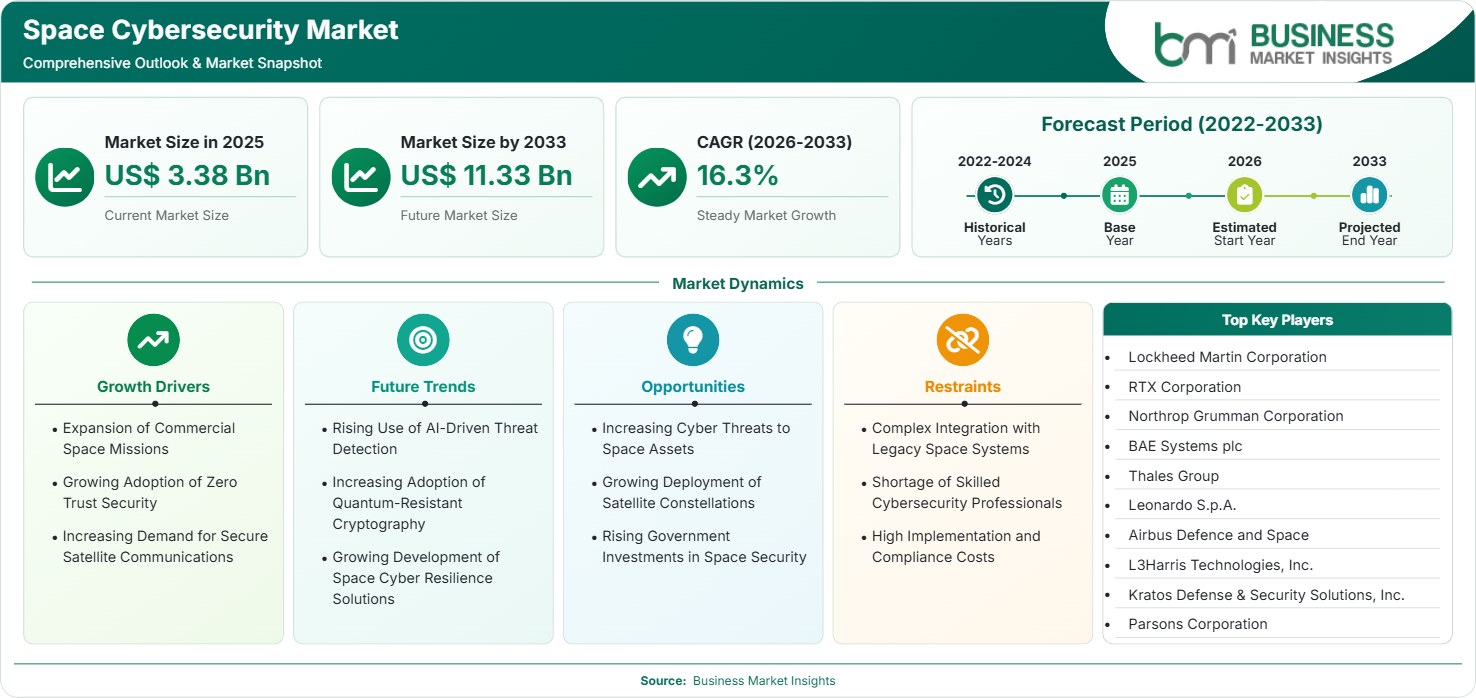
The Space Cybersecurity Market size was valued at USD 3.38 Billion in 2025 and is projected to reach USD 11.33 Billion by 2033, growing at a CAGR of 16.3% during 2026–2033. Rising deployment of commercial satellite constellations, increasing cyber risks targeting critical space infrastructure, defense modernization initiatives, and stronger regulatory focus on secure-by-design satellite architectures continue to accelerate market expansion while creating opportunities for AI-driven threat detection, zero-trust security, and post-quantum encryption solutions.

Report Coverage
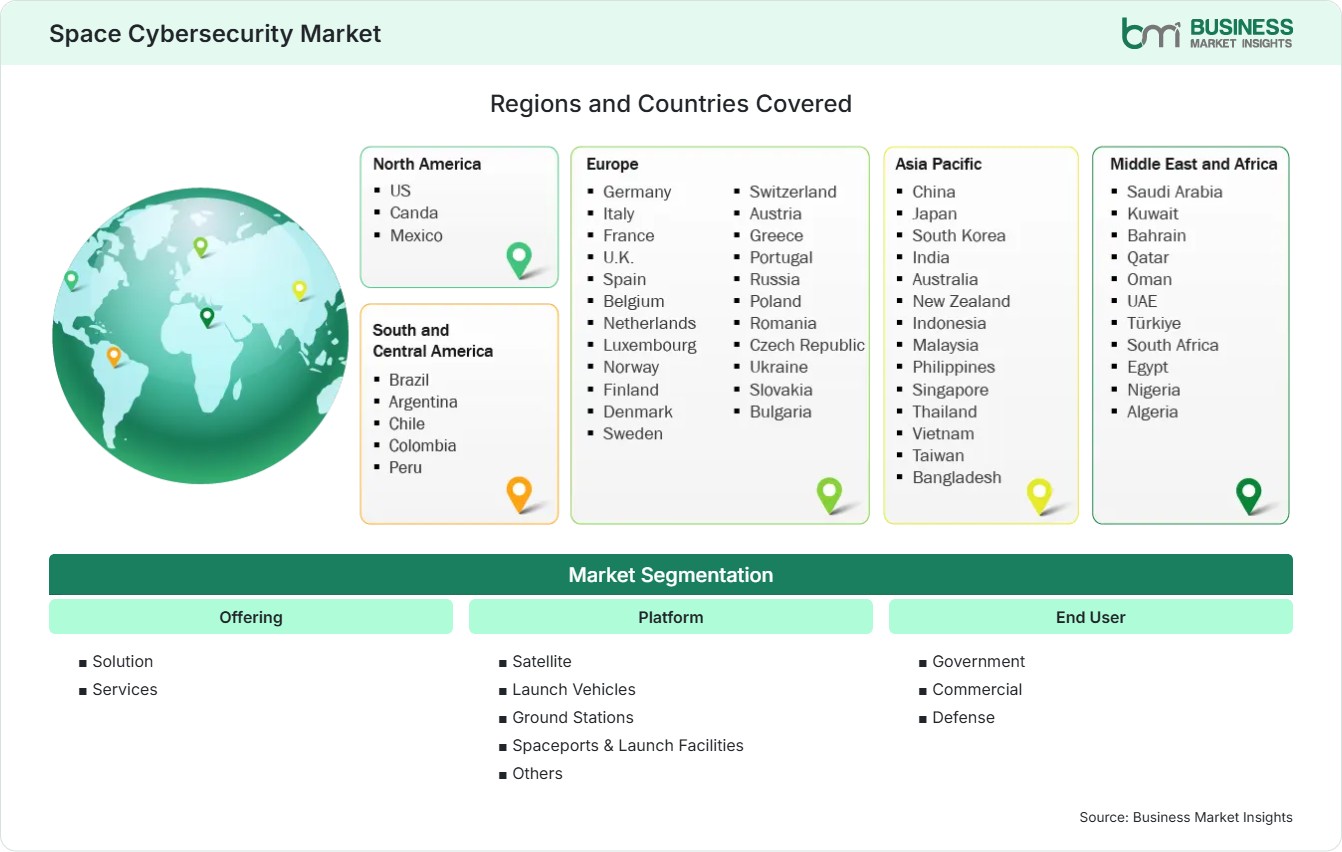
  • Offering: Solution, Services
  • Platform: Satellite, Launch Vehicles, Ground Stations, Spaceports & Launch Facilities, Others
  • End User: Government, Commercial, Defense
US$ 3.38 Bn Market size in 2025
US$ 11.33 Bn Market Size by 2033
16.3% CAGR, 2026 - 2033
2026-2033 Forecast Period

AI Overview

Space Cybersecurity Market Summary

  • North America Region: North America holds a market share of 36%–39% in 2025, expanding at a CAGR of 15.5%–16.2% during 2026–2033, supported by defense modernization, commercial satellite launches, and cybersecurity investments protecting national space assets. The United States continues strengthening cyber resilience across civil, commercial, and military space programs with an estimated 15.8%–16.4% CAGR.
  • Fastest Growing Region: Asia Pacific accounts for 23%–26% market share in 2025 and is forecast to expand at a CAGR of 17.8%–18.6% through 2033, driven by expanding satellite manufacturing, sovereign space programs, digital infrastructure investments, and increasing cybersecurity mandates for emerging commercial operators.
  • Leading Segment: Government represents 46%–49% market share in 2025 while growing at a CAGR of 15.4%–16.1%, supported by national security priorities, secure satellite communication requirements, classified missions, and continuous investment in resilient command-and-control infrastructure.
  • High Growth Segment: Services account for 34%–37% market share in 2025 and are projected to grow at a CAGR of 17.5%–18.3%, reflecting rising demand for managed security operations, vulnerability assessments, incident response, cyber monitoring, and mission assurance throughout satellite lifecycles.
  • Key Market Opportunity: Expansion of low Earth orbit satellite constellations, secure ground infrastructure, quantum-resistant encryption, AI-enabled cyber monitoring, and international cybersecurity standards presents significant opportunities for technology vendors and defense contractors over the forecast period.
  • Major Market Players: Lockheed Martin Corporation, RTX Corporation, Northrop Grumman Corporation, BAE Systems plc, Thales Group, Leonardo S.p.A., Airbus Defence and Space, L3Harris Technologies, Inc., Kratos Defense & Security Solutions, Inc., and Parsons Corporation.
Strategic Insights

Space Cybersecurity Market: Strategic Insights

Space Cybersecurity Market Strategic Framework
FREE PDF
Request your free sample
Request free sample
Stakeholder View

Key Takeaways

  • The market ecosystem is becoming increasingly integrated as satellite manufacturers, launch providers, cybersecurity vendors, cloud service providers, and government agencies collaborate to embed cybersecurity throughout mission design, deployment, and operational lifecycles rather than treating it as a post-launch capability.
  • The strongest commercial opportunities are emerging across managed cybersecurity services, satellite constellation protection, secure ground station operations, and cloud-based mission control platforms, where continuous monitoring and threat intelligence are becoming operational necessities.
  • Innovation is shifting toward AI-assisted threat detection, zero-trust architectures, quantum-resistant cryptography, digital twin-based cyber testing, secure software-defined satellites, and automated incident response capabilities that improve resilience against increasingly sophisticated attacks.
  • Asia Pacific presents one of the most attractive long-term investment destinations as China, India, Japan, South Korea, and Australia continue expanding satellite programs, commercial launch capabilities, and national cybersecurity frameworks supporting resilient space infrastructure.
  • Strategic partnerships, defense modernization contracts, and acquisitions are reshaping the competitive landscape as aerospace primes strengthen cybersecurity capabilities through specialist technology providers, cloud partnerships, and secure communication platform investments.
  • Regulatory compliance is becoming a competitive differentiator as organizations increasingly align cybersecurity practices with NIST guidance, ESA cybersecurity initiatives, Zero Trust principles, and national critical infrastructure protection requirements, enabling stronger participation in government and defense programs.
Geographic Outlook

Space Cybersecurity Market Regional Highlights

North America Space Cybersecurity Market

North America accounted for approximately 36%–39% of global revenue in 2025 and is expected to register a 15.5%–16.2% CAGR through 2033. The Space Cybersecurity Market share remains the largest globally because of sustained defense expenditure, mature satellite manufacturing capabilities, commercial space expansion, and comprehensive cybersecurity regulations. Government agencies continue investing in resilient satellite communications, secure mission operations, and advanced cyber defense technologies across civil and military programs.

  • Continuous investments by the U.S. Department of Defense and NASA strengthen cyber resilience across satellite constellations, mission control centers, and launch infrastructure, supporting long-term commercial and government adoption of advanced cybersecurity platforms.
  • Rapid commercialization of low Earth orbit satellite constellations increases demand for secure communications, identity management, endpoint protection, and real-time threat monitoring solutions throughout operational satellite networks.
  • Mature cybersecurity vendors collaborate with aerospace manufacturers to integrate zero-trust architectures, secure firmware validation, encryption technologies, and AI-powered anomaly detection into next-generation orbital systems.
  • Increasing regulatory emphasis on supply-chain security, software assurance, and cyber risk management encourages adoption of comprehensive lifecycle security frameworks across government and private sector space programs.
  • Expansion of cloud-enabled mission operations and secure ground infrastructure further reinforces regional leadership by improving operational efficiency while minimizing cyber vulnerabilities across interconnected space ecosystems.

US Space Cybersecurity Market

The United States represented nearly 29%–32% of global Space Cybersecurity Market revenue in 2025 while advancing at a 15.8%–16.4% CAGR through the forecast period. Federal investments, expanding commercial launch activity, and defense modernization continue accelerating deployment of secure satellite systems, resilient communications, and AI-enabled cyber defense capabilities supporting national strategic priorities.

  • The U.S. Space Force increasingly prioritizes cyber resilience for military satellite constellations through secure communications, advanced encryption, and continuous monitoring capabilities integrated into mission operations.
  • Commercial operators continue expanding satellite broadband networks, increasing demand for managed cybersecurity services protecting payloads, ground stations, and cloud-connected operational infrastructure.
  • Collaboration between leading aerospace contractors, cybersecurity firms, and government agencies accelerates innovation in quantum-resistant encryption, zero-trust implementation, and secure software development practices.
  • Strong venture capital activity and federal research funding encourage cybersecurity innovation supporting autonomous satellite operations and next-generation secure mission architectures.

Europe Space Cybersecurity Market

Europe held approximately 26%–29% of the global Space Cybersecurity Market during 2025 and is projected to expand at a 15.8%–16.6% CAGR through 2033. Regional growth is supported by ESA cybersecurity initiatives, increasing defense collaboration, expanding satellite manufacturing, and stronger regulatory focus on protecting critical space infrastructure. Germany leads regional revenue generation, while Poland demonstrates the fastest growth with an estimated CAGR of 17.2%–18.0%.

  • European governments continue strengthening cybersecurity requirements across civil and defense satellite missions through harmonized security standards and collaborative technology development programs.
  • Growing investments in Earth observation, secure communications, and navigation satellites encourage wider deployment of integrated cyber protection throughout mission lifecycles.
  • Cross-border industrial partnerships enable aerospace manufacturers and cybersecurity specialists to develop standardized security frameworks improving interoperability and resilience.
  • Increasing investment in sovereign launch capabilities and secure digital infrastructure strengthens long-term market competitiveness while reducing dependence on external technology ecosystems.
  • Public funding supporting research into AI-enabled cyber monitoring and post-quantum cryptography creates new opportunities for regional technology providers.

Asia Pacific Space Cybersecurity Market

Asia Pacific represented 23%–26% of worldwide revenue during 2025 and is forecast to achieve the fastest expansion at a 17.8%–18.6% CAGR through 2033. Rising satellite launches, expanding commercial space companies, government-backed digital security initiatives, and increasing defense modernization collectively support strong Space Cybersecurity Market growth across the region. China leads market revenue, while India records the fastest CAGR of 18.8%–19.5%.

  • National investments supporting satellite communications, remote sensing, navigation systems, and launch capabilities continue accelerating demand for integrated cybersecurity technologies.
  • Rapid expansion of commercial satellite operators increases adoption of managed detection, endpoint protection, secure command systems, and cyber risk assessment services.
  • Governments strengthen cybersecurity regulations protecting critical national infrastructure while encouraging domestic innovation in secure aerospace technologies.
  • Growing collaboration among universities, research organizations, defense agencies, and private companies accelerates commercialization of advanced cybersecurity solutions.
  • Increasing adoption of AI, machine learning, and automation enhances real-time threat detection capabilities for increasingly complex satellite constellations.

Rest of World Space Cybersecurity Market

Rest of World accounted for 10%–12% of global revenue in 2025 and is expected to register a 16.4%–17.2% CAGR through 2033.

South and Central America continue expanding satellite communication programs supporting disaster management, environmental monitoring, and digital connectivity, increasing demand for resilient cybersecurity infrastructure. Brazil remains the regional leader with an estimated 16.5%–17.2% CAGR.

Middle East and Africa are witnessing increasing investments in sovereign satellite capabilities, secure government communications, and national cybersecurity programs. Saudi Arabia demonstrates the strongest regional momentum with an estimated 17.4%–18.1% CAGR.

  • National digital transformation initiatives continue driving investments in secure satellite communications supporting government services, defense modernization, and critical infrastructure protection.
  • Increasing partnerships with global aerospace companies improve technology transfer while strengthening regional cybersecurity capabilities across emerging space programs.
  • Growth in satellite-based broadband connectivity encourages deployment of secure network architectures and managed cyber protection services.
  • Government-backed smart city initiatives increase reliance on satellite-enabled connectivity, reinforcing demand for resilient cybersecurity platforms across public infrastructure.
  • Expanding international cooperation creates opportunities for advanced cybersecurity vendors supporting new satellite deployments and mission assurance initiatives.
Global Market Geography
FREE PDF
Request your free sample
Request free sample
Segment Analysis

Space Cybersecurity Market Segmentation

Offering

The Offering segment accounted for the largest revenue contribution within the market ecosystem, supported by increasing demand for integrated cybersecurity platforms and lifecycle security services. This segment represented approximately 58%–61% market share in 2025 and is projected to grow at a CAGR of 16.1%–16.8% through 2033. Expanding government programs, commercial satellite deployments, and rising demand for managed cyber operations continue strengthening the Space Cybersecurity Market scope across solution providers and specialized security service vendors.

  • Solution: Organizations increasingly deploy endpoint protection, identity and access management, encryption, threat intelligence, network security, and zero-trust platforms to secure satellites, payloads, launch systems, and mission control infrastructure against sophisticated cyber threats.
  • Services: Managed detection and response, cyber consulting, penetration testing, security monitoring, vulnerability assessments, incident response, and compliance services continue gaining momentum as operators seek continuous protection throughout mission lifecycles.

Platform

Platform-based deployment remains a critical component of cybersecurity investment as every stage of a space mission requires dedicated protection against evolving cyber threats. This segment accounted for nearly 41%–44% market share in 2025 and is anticipated to expand at a 16.5%–17.2% CAGR through the forecast period. Increasing satellite launches, digital launch infrastructure, and connected mission operations continue driving cybersecurity integration across operational platforms.

  • Satellite: Satellite operators increasingly integrate encryption, secure boot technologies, onboard intrusion detection, firmware validation, and AI-powered anomaly detection to protect communications, navigation, Earth observation, and scientific missions.
  • Launch Vehicles: Secure telemetry, navigation integrity, encrypted command systems, and software assurance are becoming essential to minimize cyber risks during vehicle preparation, launch operations, and mission execution.
  • Ground Stations: Ground infrastructure requires comprehensive cybersecurity through network segmentation, zero-trust architecture, privileged access management, continuous monitoring, and secure cloud connectivity to protect mission-critical communications.
  • Spaceports & Launch Facilities: Digital launch infrastructure increasingly incorporates cyber risk management, operational technology security, secure industrial control systems, and resilient communication networks supporting launch preparation and mission coordination.

End User

The End User segment continues evolving as governments, commercial operators, and defense organizations expand investments in resilient space infrastructure. Government remained the leading category with approximately 46%–49% market share in 2025, while the segment is expected to register a 15.4%–16.1% CAGR through 2033 due to sustained national security investments and regulatory requirements supporting secure satellite operations.

  • Government: National space agencies prioritize cyber resilience across Earth observation, navigation, communications, scientific research, and civil infrastructure, creating sustained demand for integrated cybersecurity technologies and specialized operational services.
  • Commercial: Private satellite operators increasingly invest in advanced cybersecurity to safeguard broadband constellations, remote sensing services, in-orbit data platforms, and cloud-connected mission operations against sophisticated cyberattacks.
  • Defense: Defense organizations continue strengthening cyber protection for secure communications, intelligence gathering, missile warning systems, electronic warfare support, and resilient command-and-control networks operating in contested environments.
Market Forces

Space Cybersecurity Market Dynamics

Key Market Drivers

Expansion of Commercial Space Missions

The rising number of satellite launches by commercial entities will drive a continuous need for high-end security products and services in the space industry. Based on data from launch statistics in the industry, there are already thousands of satellites that have been launched into space, and most of them are commercially operated. Since these satellites enable broadband communications, earth observations, navigation, and industrial IoT operations, cyber threat exposure has become widespread among their payloads, control system, and ground facilities. Space Cybersecurity Market growth becomes more associated with secure-by-design architecture, vulnerability assessments, encryption, and cyber risk management throughout the entire lifecycle.

Growing Adoption of Zero Trust Security

Zero Trust network architecture is increasingly emerging as the ideal cybersecurity model for use by government entities, defense departments, and commercial satellite providers owing to the inability of the current perimeters-based cybersecurity system to offer sufficient protection to the orbiting systems. Through identity validation, least privilege, continuous authentication, and encryption, the chances of any compromise to the assets are greatly minimized. Zero Trust architecture is being adopted in the production, launch preparations, and operations control for satellites alongside enhancing the security of the supply chain and software development.

Increasing Demand for Secure Satellite Communications

Secure satellite communications have become crucial as both the government and enterprises rely on space-based assets for their military operations, disaster management activities, financial transactions, air travel, maritime communications, and critical infrastructure monitoring purposes. Cyber-attacks aimed at communications lines, command-and-control channels, and ground stations could potentially interrupt critical services and affect national security. Hence, there is an ongoing effort from satellite owners to implement enhanced encryption, secure key management, quantum-resistant cryptography, AI-enabled anomaly detection, and resilient communication protocols. The same investments also support Space Cybersecurity Market trends by promoting innovation in cybersecurity software, managed services, and satellite-specific communication systems.

Key Market Opportunities

Increasing Cyber Threats to Space Assets

Cyber-attacks on satellite-based technology, launch capabilities, and mission control operations are becoming more complex and sophisticated in nature, thereby providing immense business prospects for cybersecurity solution providers. Hackers are using software weaknesses, supply chain vulnerabilities, and communications interfaces as attack vectors, leading to the adoption of advanced threat monitoring tools, automation of incident responses, and proactive threat intelligence solutions. The long lifespan of satellites is another contributing factor that drives the requirement of scalable cybersecurity solutions to safeguard already deployed satellites. Such factors will help in the space cybersecurity market forecast rise.

Growing Deployment of Satellite Constellation

The large-scale deployment of Low Earth Orbit (LEO) satellite constellations needs complete cybersecurity in manufacturing, launch, communication, and management of operations. With each new satellite added, the attack surface gets larger, which means that centralized security monitoring, secure software updates, digital identity management, and anomaly detection become highly necessary. Companies providing cloud-native cybersecurity solutions, secure mission management, and threat intelligence using AI are in a great position to capitalize on the growth in LEO constellations used for broadband communications, earth observation, and industry application.

Rising Government Investments in Space Security

Governments across the globe are still increasing their investments in sovereign satellites, space-based military activities, and cybersecurity infrastructures. The new funding initiatives aim at developing robust satellite communication systems, reliable navigation systems, classified mission protection systems, and secure ground infrastructure with an emphasis on fostering technology growth in the domestic market. This opens up doors for aerospace manufacturing firms, cybersecurity experts, software developers, and managed security providers who can help build highly regulated government-funded projects.

Market Restraints and Challenges

Complex Integration with Legacy Space Systems

Factor: Most of the existing satellites and ground-based systems have been designed before the advent of security considerations into the mission design process. The limited computational capabilities on board, use of proprietary software, and lengthy lifespans pose technical and financial challenges for introducing additional security measures. Impact: Organizations usually experience higher costs and delays in the deployment process when implementing cutting-edge security measures into legacy systems. Compatibility issues may cause delays in the upgrade processes and higher expenses for managing the system lifecycle.

Shortage of Skilled Cybersecurity Professionals

Factor: The security of space infrastructure needs multi-disciplinary skills that cut across aerospace engineering, satellite communications, encryption, artificial intelligence, operational technology, and cybersecurity. There are only a limited people worldwide who possess such combination of skills, even as the demand in the industry grows. Impact: Such workforce challenges make projects costly, lengthy and make it difficult for firms to adapt to new threats posed by cybersecurity. The small operators in the industry find it more difficult due to the stiff competition for specialists.

Company Analysis

Competitive Landscape

Space Cybersecurity Market analysis indicates that companies are prioritizing Zero Trust architectures, AI-enabled threat detection, secure satellite communications, and lifecycle cybersecurity services to strengthen their positions across government, defense, and commercial space programs.

Company Name

Overview

Products and Services Relevant to this Market

Lockheed Martin Corporation

Global aerospace and defense contractor with extensive satellite, missile defense, and secure space mission capabilities.

Secure satellite systems, cyber mission assurance, AI-enabled cyber defense, satellite command security, resilient space architectures.

RTX Corporation

Diversified aerospace and defense technology company supporting secure communications and mission-critical defense infrastructure.

Secure communications, cyber protection, intelligence systems, encrypted networking, space mission cybersecurity solutions.

Northrop Grumman Corporation

Leading provider of national security, satellite, and advanced space technologies supporting resilient missions.

Satellite cybersecurity, secure mission operations, protected communications, space command systems, cyber resilience services.

BAE Systems plc

International defense company delivering cybersecurity, electronic warfare, and secure digital defense solutions.

Cybersecurity platforms, secure communications, digital mission assurance, intelligence solutions, cyber engineering services.

Thales Group

Global technology company specializing in aerospace, defense, digital identity, and cybersecurity solutions.

Satellite security, encryption, identity management, cyber consulting, secure communication infrastructure.

Leonardo S.p.A.

European aerospace and defense company focusing on secure digital transformation and space technologies.

Space cybersecurity consulting, secure satellite operations, cyber monitoring, defense communication systems.

Airbus Defence and Space

Major European space manufacturer supporting commercial, civil, and defense satellite programs.

Secure satellite platforms, mission assurance, encrypted communications, cyber engineering services.

L3Harris Technologies, Inc.

Defense technology provider delivering resilient communications and advanced intelligence capabilities.

Secure communications, satellite networking, cyber protection, mission-critical networking solutions.

Kratos Defense & Security Solutions, Inc.

Technology company specializing in satellite communications, ground systems, and defense cybersecurity.

Ground station security, satellite command systems, network protection, mission cybersecurity services.

Parsons Corporation

Digital infrastructure and defense engineering company with advanced cyber and critical infrastructure expertise.

Cyber risk assessment, Zero Trust implementation, secure mission infrastructure, managed cybersecurity services.

Industry Activity

Recent Developments

July 2026

Airbus Defence and Space signed a Memorandum of Understanding (MoU) with Brave1, Ukraine’s central government-led defence technology coordinator. This will function as a joint innovation platform for the country's ministries, military, and private tech sector.

June 2026

Airbus Defence and Space partnered with SkyFall to advance European and Ukrainian defence innovation. The partnership reinforces the protection of Ukraine's airspace against drone and missile strikes and strengthens Ukraine as a leading European centre for defence innovation

April 2026

Parsons Corporation expanding suite of artificial intelligence (AI) capabilities that driving growth across its Federal Solutions and Critical Infrastructure segments. This will help to grow global national security, cyber, space, and infrastructure markets.

July 2024

Lockheed Martin Corporation leveraged AI and Machine Learning to revolutionize defense and space technology. Lockheed Martin has offered a solution concentrated on the development of advanced M&S capabilities using AI-driven models to deliver faster and more accurate results enabling rapid training of AI agents.

Trust & Transparency

Research Methodology

The market analysis combines proprietary research with secondary data from government agencies, company disclosures, regulatory filings, industry databases and expert interviews. Market estimates are validated through data triangulation, cross-market benchmarking and analyst review.

View Full Research Methodology

Questions Answered

Frequently Asked Questions

What does the market report typically cover?

A comprehensive Space Cybersecurity Market Report includes market sizing, forecasts, segmentation, regional analysis, competitive benchmarking, technology trends, regulatory developments, and strategic opportunities for stakeholders.

Which technologies will shape future competition?

Artificial intelligence, machine learning, post-quantum cryptography, Zero Trust security, secure software-defined satellites, digital twins, and autonomous cyber monitoring are expected to define future competitive differentiation.

Which end-user segment dominates demand?

Government organizations remain the largest end users because national security missions, civil space programs, intelligence operations, and regulatory compliance require continuous investment in secure space systems.

Which region leads the market?

North America leads due to its mature defense ecosystem, commercial satellite industry, significant government investment, and early adoption of advanced cybersecurity technologies protecting critical space infrastructure.

What factors are driving the Space Cybersecurity Market?

Growing satellite deployments, increasing cyber threats against orbital assets, defense modernization, Zero Trust adoption, AI-driven security, and government investment in resilient space infrastructure are the primary growth drivers.

Access the Full Space Cybersecurity Market Report

Get segment-level forecasts, regional estimates, competitive benchmarking, company profiles and downloadable Excel datasets.

Access the full Space Cybersecurity Market Report
350 pages PDF & Excel | 2026-07-29