
Space Based Defense Platforms Market Outlook: Size, Share, Trends, Growth Analysis, Competitive Landscape & Forecast, 2026-2033

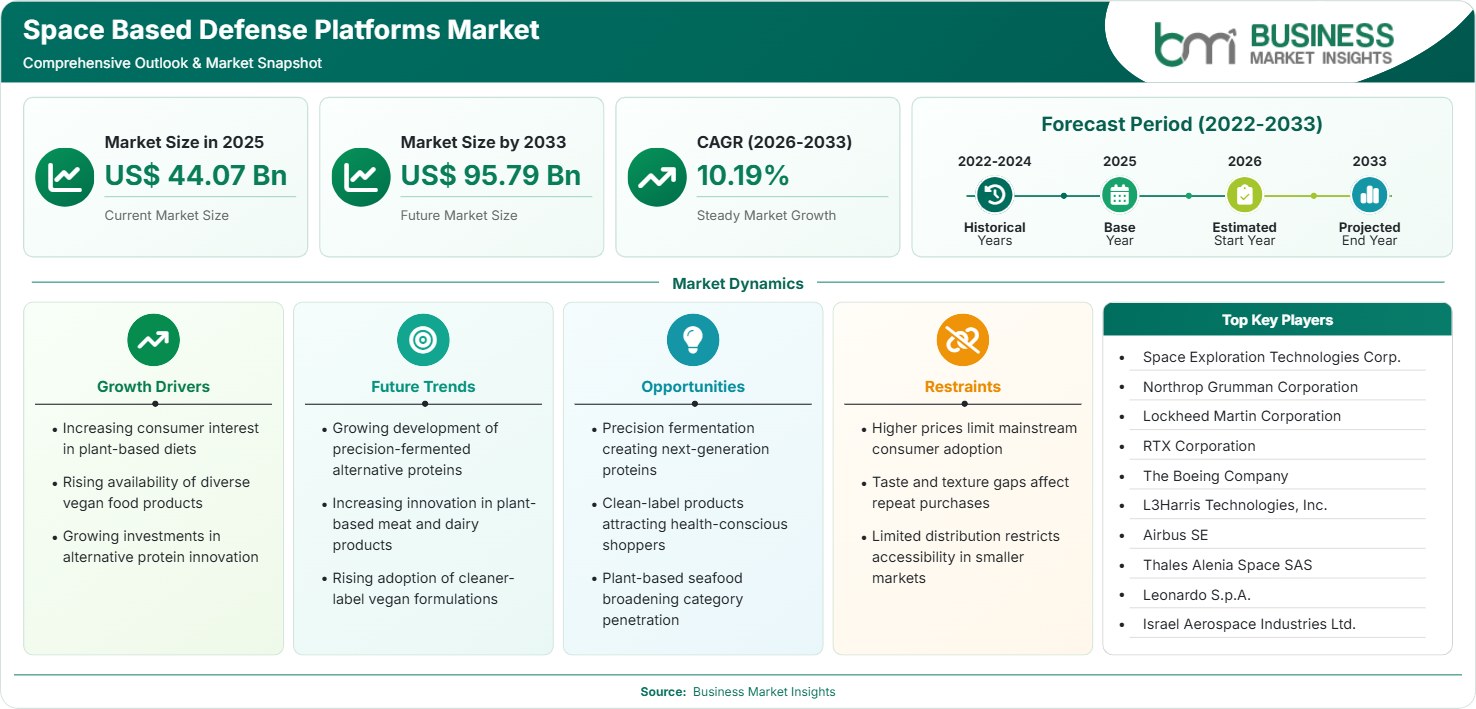
The Space Based Defense Platforms Market size was valued at US$ 44.07 Billion in 2025 and is projected to reach US$ 95.79 Billion by 2033, growing at a CAGR of 10.19% during 2026–2033, driven by resilient satellite architectures, missile tracking, secure communications, ISR modernization, and sovereign space capabilities.

Report Coverage
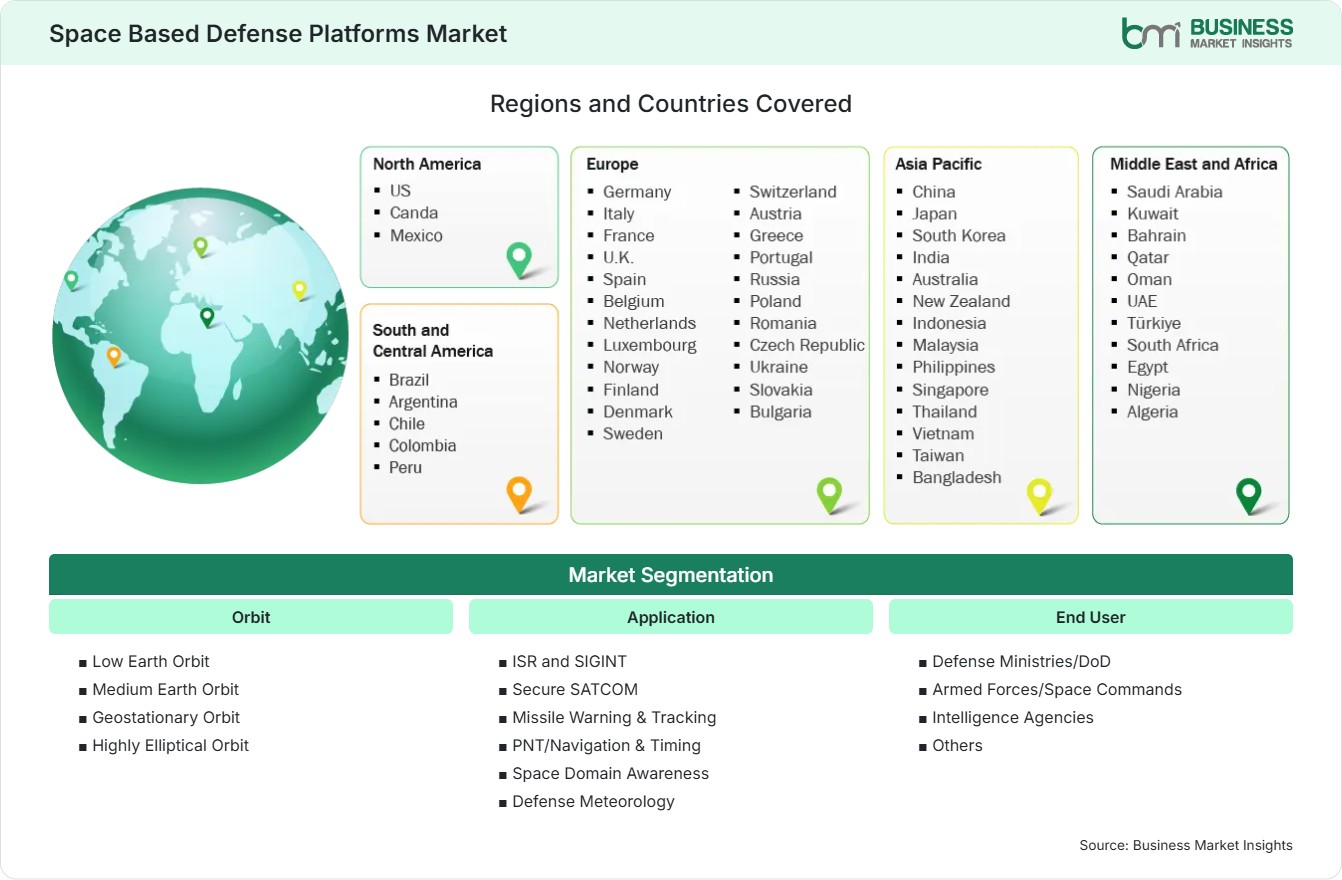
  • Orbit: Low Earth Orbit, Medium Earth Orbit, Geostationary Orbit, Highly Elliptical Orbit
  • Application: ISR and SIGINT, Secure SATCOM, Missile Warning & Tracking, PNT/Navigation & Timing, Space Domain Awareness, Defense Meteorology
  • End User: Defense Ministries/DoD, Armed Forces/Space Commands, Intelligence Agencies, Others
US$ 44.07 Bn Market size in 2025
US$ 95.79 Bn Market Size by 2033
10.19% CAGR, 2026 - 2033
2026-2033 Forecast Period

AI Overview

Space Based Defense Platforms Market Summary

  • North America: holds a 50%–53% share in 2025, growing at a CAGR of 8.7%–9.1%, supported by defense-space modernization, proliferated LEO constellations, missile tracking, secure SATCOM, resilient PNT, and strong government-industry investment. The US market benefits from Space Force procurement, SDA architectures, missile warning modernization, and sustained demand for protected communications and surveillance capabilities.
  • Fastest Growing Region: Asia Pacific holds a 21%–24% share in 2025, expanding at a CAGR of 10.2%–10.6%, driven by Indo-Pacific security competition, reconnaissance satellites, maritime surveillance, missile warning, sovereign communications, and national space-domain awareness programs.
  • Leading Segment: Dedicated military satellites hold a 48%–52% share in 2025, growing at a CAGR of 9.0%–9.5%, supported by sovereign control, encrypted communications, persistent ISR, missile warning, PNT resilience, and mission-specific payload integration for defense agencies.
  • High Growth Segment: Hosted payload platforms account for an 8%–11% Space Based Defense Platforms Market share in 2025, advancing at a CAGR of 12.2%–12.8%, as governments reduce deployment costs, share orbital infrastructure, accelerate mission insertion, and expand dual-use defense capabilities.
  • Key Market Opportunity: Multi-orbit architectures can combine GEO persistence with LEO responsiveness, enabling governments to diversify communications, sensing, missile tracking, and data-routing infrastructure while reducing dependence on single-orbit systems.
  • Major Market Players: Space Exploration Technologies Corp., Northrop Grumman Corporation, Lockheed Martin Corporation, RTX Corporation, The Boeing Company, L3Harris Technologies, Inc., Airbus SE, Thales Alenia Space SAS, Leonardo S.p.A., and Israel Aerospace Industries Ltd.
Strategic Insights

Space Based Defense Platforms Market: Strategic Insights

Space Based Defense Platforms Market Strategic Framework
FREE PDF
Request your free sample
Request free sample
Stakeholder View

Key Takeaways

  • The value chain is becoming more vertically integrated, with satellite primes increasingly combining spacecraft buses, payloads, software, ground systems, mission operations, and data-processing capabilities. This structure favors suppliers that can deliver complete mission architectures rather than standalone hardware.
  • The strongest application upside is emerging from missile warning and tracking, ISR, secure SATCOM, and space-domain awareness. Proliferated LEO and MEO architectures are creating additional demand for high-revisit sensing, distributed tracking, and resilient tactical communications.
  • Innovation is moving toward digital payloads, AI-assisted mission processing, electronically steered antennas, infrared sensing, autonomous collision avoidance, and software-defined spacecraft. These technologies enable operators to modify mission priorities without replacing entire spacecraft.
  • Asia Pacific presents a compelling investment case because governments are strengthening reconnaissance, secure communications, maritime surveillance, and space-domain awareness amid heightened strategic competition. India, Japan, South Korea, and Australia offer particularly diverse procurement opportunities.
  • Investment is increasingly directed toward scalable satellite manufacturing and defense-space infrastructure. Recent awards involving L3Harris, Airbus, Thales Alenia Space, and other primes show that governments are funding both sovereign satellites and resilient constellation architectures.
  • Competitive differentiation is shifting from spacecraft size toward mission availability, resilience, launch flexibility, cybersecurity, data latency, and constellation-level performance. Providers able to integrate commercial technologies with classified defense requirements can capture a broader procurement base.
Geographic Outlook

Space Based Defense Platforms Market Regional Highlights

North America Space Based Defense Platforms Market

North America commands a 50%–53% share in 2025 and is projected to expand at a CAGR of 8.7%–9.1% through 2033. The US remains the regional anchor because defense agencies prioritize resilient satellite communications, missile warning, ISR, PNT, and space-domain awareness. Space Development Agency programs are accelerating proliferated LEO deployment, while Space Systems Command continues integrating missile-warning and tracking architectures.

  • US procurement remains the primary regional demand engine, with Space Force, SDA, and defense agencies funding multi-orbit architectures and resilient mission networks.
  • Canada contributes through dual-use satellite communications, Arctic surveillance, sovereign situational awareness, and interoperability requirements with US-led defense architectures.
  • Space Based Defense Platforms Market share remains supported by extensive defense manufacturing capacity, mature launch infrastructure, advanced payload development, and strong government-backed research programs.
  • Market growth is reinforced by missile-warning modernization, proliferated constellations, and demand for lower-latency tactical data connectivity.

US Space Based Defense Platforms Market

The United States accounts for 95%-97% of the total North American Space Based Defense Platforms Market in 2025 and is projected to grow at a CAGR of 8.5%-8.9% during 2023-2033. Procurement drivers include resilient satellite communication, missile detection, advanced OPIR, ISR, and space domain awareness. The Space Force has stated that satellites provide secure communications, weather updates, navigation support, threat warnings, and continuous operational availability.

  • The SDA Proliferated Warfighter Space Architecture is accelerating demand for distributed LEO communications and tracking capabilities.
  • Next-generation missile warning programs are creating sustained requirements for infrared payloads, relay stations, command-and-control systems, and ground integration.
  • Commercial launch and satellite manufacturing ecosystems increasingly support defense acquisition through faster production cycles, standardized platforms, and responsive deployment.

Europe Space Based Defense Platforms Market

Europe holds a 17%-20% market share and is projected to have a CAGR of 9.2%-9.7% between 2023 and 2025. France, the UK, Germany, and Italy remain major centers for procurement, while Poland and the Nordic region are fast-growing segments. The current trend in Europe's defense-space strategy is towards sovereign communications and ISR, resilience, and less reliance on external infrastructure. In 2025, Airbus bagged an order from the UK MOD for two Oberon SAR satellites.

  • France leads advanced sovereign military-space programs, supported by secure communications, optical reconnaissance, and independent launch and satellite capabilities.
  • Germany is strengthening secure satellite infrastructure and industrial participation, while Poland is developing dedicated defense telecommunications capacity.
  • The UK is increasing sovereign ISR capabilities through high-resolution SAR satellites and defense-space procurement.
  • Italy and Spain benefit from radar observation and secure SATCOM programs supporting national and allied defense requirements.
  • European Space Based Defense Platforms Market trends increasingly favor collaborative procurement, sovereign payloads, multi-orbit communications, and interoperable NATO capabilities.

Asia Pacific Space Based Defense Platforms Market

The Asia Pacific region accounts for 21%-24% market share in 2025 and is anticipated to exhibit a CAGR of 10.2%-10.6%. China, India, Japan, and South Korea are the key countries in this market, whereas the growth in Australia is driven by robust communication and surveillance efforts. Demand in the region is fueled by maritime security, border surveillance, reconnaissance, missile warnings, navigation assurance, and strategic competition.

  • China maintains extensive military-space capabilities spanning reconnaissance, communications, navigation, electronic intelligence, and space-domain monitoring.
  • India is expanding sovereign defense satellite capabilities for secure communications, surveillance, navigation, and integrated command networks.
  • Japan prioritizes X-band defense communications, intelligence-gathering satellites, and resilient space infrastructure to strengthen regional deterrence.
  • South Korea is increasing reconnaissance and secure communications capacity, supporting faster adoption of advanced defense satellite technologies.
  • Space Based Defense Platforms Market growth is strengthened by rising defense budgets and increasingly space-dependent military operations across the Indo-Pacific.

Rest of World Space Based Defense Platforms Market

The Rest of World is expected to capture 7%-9% market share in 2025 and experience a CAGR of 6.1%-6.6%. The key Middle Eastern requirements involve security for SATCOM, ISR, missile awareness, and border surveillance, whereas dual-use of Earth observation, maritime, and strategic communications is important to Latin American buyers. Important Middle Eastern customers are Israel, Saudi Arabia, and the United Arab Emirates, while Brazil is an important Latin American buyer.

Latin American procurement is guided by budget constraints and dual-use requirements, while Middle Eastern projects are driven by sovereign security needs and surveillance performance. This makes regional adoption more conducive to partnerships, hosted payloads, commercial satellites, and ground segment capabilities.

  • Middle Eastern buyers increasingly prioritize space-enabled intelligence, surveillance, secure communications, and missile threat awareness.
  • Israel contributes advanced satellite reconnaissance, navigation warfare, and defense-space technologies with strong export potential.
  • Brazil remains an important Latin American market for Earth observation, communications, environmental monitoring, and strategic surveillance.
  • Rest of World Space Based Defense Platforms Market share is constrained by procurement scale but supported by modernization programs and security requirements.
  • Market growth opportunities are strongest where governments combine commercial satellite services with sovereign defense applications.
Global Market Geography
FREE PDF
Request your free sample
Request free sample
Segment Analysis

Space Based Defense Platforms Market Segmentation

Platform Type

Platform Type continues to be dominated by military satellites, which hold a 48%-52% market share in 2025 and are forecasted to record a 9.0%-9.5% CAGR till 2033. Sovereignty, encryption, availability, and payload for specific missions drive the demand. The scope of the Space Based Defense Platforms Market is expanding due to dual-use and hosted platforms being adopted by governments.

  • Dedicated Military Satellites: Provide sovereign control, protected communications, ISR, missile warning, and specialized payloads, supporting high-priority defense missions requiring assured availability and controlled data access.
  • Dual-use Defense-tasked Platforms: Combine civilian and military missions, reducing infrastructure duplication while supporting Earth observation, communications, navigation, disaster response, and intelligence requirements across government agencies.
  • Hosted Payload Platforms: Enable defense sensors and communications payloads to share commercial spacecraft infrastructure, lowering deployment barriers and accelerating access to orbital capabilities.

Orbit

The Geostationary Orbit continues to play a significant role in generating value, while Low Earth Orbit is picking up steam due to the benefits of distributed satellite networks in revisits, latency, and tactical capabilities. Orbit choice is now becoming more mission-driven than preference for one orbit over another. Space Based Defense Platforms Market trends, therefore, favor hybrid architectures that combine persistent GEO coverage with responsive LEO and MEO capabilities.

  • Low Earth Orbit: Supports low-latency communications, frequent observation, missile tracking, and proliferated constellations, with lower altitude enabling responsive tactical data services.
  • Medium Earth Orbit: Offers advantageous coverage and persistence for navigation, missile tracking, and resilient communications while complementing LEO and GEO architectures.
  • Geostationary Orbit: Remains valuable for wide-area secure SATCOM, persistent coverage, strategic communications, and long-duration defense missions requiring stable regional visibility.
  • Highly Elliptical Orbit: Supports high-latitude coverage where GEO geometry is less effective, benefiting Arctic surveillance, strategic communications, and specialized defense observation missions.

Application

ISR and SIGINT remain the primary applications, with sustained demand for surveillance, intelligence, maritime awareness, and battlefield awareness. The Space Based Defense Platforms Market growth is also more reliant on missile warning and space domain awareness due to the need for rapid identification of hypersonic and ballistic threats.

  • ISR and SIGINT: Supplies persistent intelligence through optical, radar, and electromagnetic sensing, improving target identification, activity monitoring, electronic intelligence, and operational decision-making.
  • Secure SATCOM: Provides protected connectivity for deployed forces, command networks, intelligence agencies, and government users requiring resilient communications under contested conditions.
  • Missile Warning & Tracking: Uses infrared sensing and distributed architectures to identify launches, track trajectories, and provide data supporting missile defense and early-warning decisions.
  • PNT/Navigation & Timing: Supports precision operations, synchronization, targeting, communications, and logistics while increasing demand for resilient alternatives against interference and disruption.
  • Space Domain Awareness: Tracks satellites, debris, and potentially hostile activities, improving orbital safety, threat assessment, and protection of critical national space infrastructure.
  • Defense Meteorology: Provides weather intelligence for mission planning, communications, launch operations, navigation, aviation, maritime activity, and battlefield decision-making.

End User

Defense Ministries/DoD will continue to be the major financiers and procurers, accounting for 45%-49% of market value by 2025, with a CAGR of 9.2%-9.7%. Armed forces and space commands will have increasing importance as end users of their systems. There is high demand from intelligence organizations for ISR, SIGINT, and other secure information services.

  • Defense Ministries/DoD: Control major procurement budgets and coordinate long-term satellite, launch, ground infrastructure, communications, and missile-warning modernization programs.
  • Armed Forces/Space Commands: Operate space-enabled capabilities and increasingly influence architecture design, tactical connectivity requirements, resilience standards, and mission integration.
  • Intelligence Agencies: Require high-resolution ISR, SIGINT, secure data processing, and persistent surveillance to support strategic intelligence and threat assessment.
Market Forces

Space Based Defense Platforms Market Dynamics

Key Market Drivers

Proliferated Constellations Strengthen Defense Resilience

Proliferated constellations are changing the dynamics of the Space Based Defense Platforms Market growth by spreading out mission roles across many satellites rather than depending on a few key satellites. The above-mentioned method is exemplified by the United States Space Development Agency's system design, in which Tranche 1 satellites were launched in September 2025 to ensure secure communications and future missile-tracking capabilities. Distributed architecture systems help prevent the loss of individual satellites and provide greater geographic persistence and faster technology integration. Moreover, low Earth orbit platforms can guarantee lower latency and higher communication frequency. While designing their future space programs, the defense agencies are increasingly considering diversity in constellations, payload performance, cybersecurity, launch services, and ground systems integration.

Escalating Missile Threats Increase Space-Based Tracking Demand

Space-based infrared sensing and distributed tracking networks are being pursued in response to advancing ballistic and hypersonic missile capabilities. In March 2026, the US Space Force concluded a preliminary design review for a ten-satellite missile detection and tracking network in MEO orbit. Such technologies include specialized IR sensors, fast processing, secure communications links, and command-and-control system integration. An ecosystem that emerges from this includes not only spacecraft but also payload electronics, software, ground stations, data fusion, and operations management. As a result, the Space Based Defense Platforms Market trends shift towards persistent threat monitoring and fast data distribution. Another requirement is the ability to operate under disturbance conditions on any part of the architecture.

Secure Communications Become Core Defense Infrastructure

Secure SATCOM is moving away from being a supporting tool and becoming an essential element of the defense infrastructure. Military troops require secure connectivity for command and control, information distribution, deployments, logistics, and coordination of air, land, sea, cyber, and space elements. European projects show the direction of that development through secure communications programs such as Poland's geostationary defense satellite project and Spain's SpainSat NG III program. Multi-orbit systems enable the government to integrate its persistent GEO coverage with flexible LEO capabilities and commercial possibilities. Consequently, encryption, jam-proofing, electronically steered antennas, and software-defined payloads become crucial procurement factors.

Key Market Opportunities

Hosted Payloads Lower Barriers to Defense-Space Deployment

Hosted payloads give governments an alternative to paying for dedicated satellites for all their operations. Military sensors, communications payloads, and new sensor technologies can leverage commercial platforms or existing satellite infrastructure in orbit to deploy sooner and at lower cost. It becomes a viable option for nations that have just started developing their space-based defense or require a test period for new sensors before investing in their own constellations. Space Based Defense Platforms Market Forecasts show more inclination towards platforms that comprise dedicated platforms along with hosted or commercial platforms. Companies can take advantage of additional market opportunities through designing standard interfaces, modular power, and secure data linkages.

Multi-orbit Architectures Create Integrated Mission Networks

The combination of LEO, MEO, GEO, and highly elliptical systems enables the formation of mission networks rather than individual satellite programs. The GEO platforms may offer continuous communications, whereas the LEO satellites will provide low latency and fast sensing. The MEO platforms may be used for missile tracking and navigation applications, while the highly elliptical orbit systems may address the needs of high-latitude regions. This design enables defense planners to use the characteristics of various orbits in conjunction with mission priorities and have alternative communication routes in case of disruptions. Suppliers who can integrate satellites, payloads, ground infrastructure, and network management software can take full advantage of the program's value.

AI-enabled Space Operations Improve Mission Responsiveness

AI represents an exciting opportunity in satellite tasking, anomaly detection, image analysis, signal classification, collision avoidance, and mission scheduling. Defense organizations need to analyze vast amounts of sensor data without transmitting every observation to humans on the ground. By integrating AI, it becomes possible to identify key events and minimize data transfer needs. In terms of ISR, automated classification allows faster detection of changes in target areas, whereas machine learning applications help analyze electronic intelligence. At the same time, AI enables autonomous spacecraft operations, with systems capable of detecting anomalies and advising on corrective actions.

Market Restraints and Challenges

High Development and Lifecycle Costs and Budget Pressure

Factor: The development of space-based defensive systems is a costly process, involving not only satellite construction but also payloads, launch costs, cyber protection of ground stations, cybersecurity, tests, and mission operations. Impact: Higher lifecycle costs will lead to delays, especially for countries with small defense budgets or no space industry. Dedicated military satellites will need to undergo lengthy qualification procedures and other security measures, making the process more difficult. In such cases, the procurement department may prefer hosted payloads, commercial systems, or constellation sharing. Yet, reducing costs should not undermine the system's encryption, radiation resistance, and mission assurance capabilities. The issue here is to promote standardization and modularity while minimizing the risk of compromising the system’s security.

Orbital Congestion and Cyber Risk and Mission Vulnerability

Factor: A higher concentration of satellites increases vulnerability to conjunctions, space debris, electronic disturbances, cyberattacks, and hostile actions in space. Impact: It becomes necessary for defense agencies to allocate resources for surveillance, maneuverability, cybersecurity, redundant communication, and hardening. This increases operational and lifecycle costs, which is why awareness of the space domain has become one of the key functions of defense organizations, as they require timely information on orbits and risks. According to the US Space Force, space surveillance and security of space assets are strategic capabilities. Cybersecurity issues cover spacecraft software, ground control facilities, communications channels, logistics, and data networks.

Company Analysis

Competitive Landscape

The Space Based Defense Platforms Market analysis indicates competition is centered on integrated mission architectures, resilient constellations, secure payloads, missile-warning systems, ISR, and multi-orbit communications. Leading companies are expanding capabilities through internal R&D, strategic partnerships, production investments, and government contracts. The competitive environment increasingly rewards companies that combine spacecraft manufacturing with payload integration, software, ground systems, and mission operations.

Company Name

Overview

Products and Services relevant to this market

Space Exploration Technologies Corp.

US aerospace company providing launch and satellite-network capabilities with increasing relevance to national-security space missions and proliferated architectures.

Falcon launch services, Starlink-based communications infrastructure, satellite deployment, national-security launch support, and resilient LEO connectivity.

Northrop Grumman Corporation

Major US defense and aerospace contractor with extensive expertise in missile warning, protected communications, spacecraft, payloads, and mission systems.

Next-generation OPIR spacecraft, missile-warning systems, satellite buses, ISR platforms, payload integration, and space mission operations.

Lockheed Martin Corporation

Global defense company with major space programs supporting missile warning, communications, navigation, surveillance, and national-security missions.

Next-generation OPIR satellites, GPS systems, missile-warning payload integration, secure communications, satellite systems, and space-domain capabilities.

RTX Corporation

Defense technology provider with specialized infrared sensing, missile-warning, tracking, and advanced sensor technologies for orbital defense applications.

Raytheon missile-warning sensors, infrared payloads, advanced algorithms, space sensing, missile defense electronics, and mission-support technologies.

The Boeing Company

Aerospace and defense company with long-standing satellite manufacturing and military communications capabilities supporting US and allied requirements.

Wideband Global SATCOM satellites, military communications platforms, satellite integration, mission systems, and defense-space engineering.

L3Harris Technologies, Inc.

Defense technology company expanding rapidly in missile tracking, space-domain awareness, infrared sensing, and resilient satellite architectures.

Tracking Layer satellites, missile-warning payloads, SDA systems, space surveillance ground systems, and advanced infrared sensing.

Airbus SE

European aerospace leader supporting sovereign ISR, secure communications, Earth observation, and defense satellite programs across multiple countries.

Oberon SAR satellites, secure communications spacecraft, ISR payloads, satellite buses, Earth observation systems, and defense-space integration.

Thales Alenia Space SAS

European satellite specialist focused on secure telecommunications, Earth observation, navigation, and defense-space infrastructure.

Defense telecommunications satellites, SAR platforms, secure payloads, observation satellites, GovSat systems, and multi-orbit communications solutions.

Leonardo S.p.A.

Italian aerospace and defense group participating in satellite systems, sensors, secure communications, and European space-security initiatives.

Satellite payloads, defense electronics, space sensors, secure communications technologies, radar systems, and space-domain solutions.

Israel Aerospace Industries Ltd.

Israeli aerospace and defense company offering satellites, space systems, reconnaissance technologies, and advanced defense solutions for national-security customers.

Reconnaissance satellites, satellite buses, space payloads, communications systems, ISR technologies, and integrated defense-space solutions.

Trust & Transparency

Research Methodology

The market analysis combines proprietary research with secondary data from government agencies, company disclosures, regulatory filings, industry databases and expert interviews. Market estimates are validated through data triangulation, cross-market benchmarking and analyst review.

View Full Research Methodology

Questions Answered

Frequently Asked Questions

What should investors assess when evaluating a Space Based Defense Platforms Market Report?

Investors should assess government procurement visibility, constellation scalability, payload differentiation, manufacturing capacity, cybersecurity, launch access, recurring service revenue, international partnerships, and exposure to long-duration defense modernization programs.

What makes hosted payloads attractive to defense organizations?

Hosted payloads can reduce the cost and schedule associated with dedicated spacecraft while enabling governments to deploy specialized sensors or communications payloads on existing commercial platforms.

Why are governments adopting multi-orbit defense architectures?

Multi-orbit architectures diversify mission dependencies. GEO provides persistent coverage, LEO offers low latency and high revisit, MEO supports selected tracking and navigation missions, and highly elliptical orbits address specialized high-latitude requirements.

What technologies will have the strongest influence on defense satellite procurement?

Proliferated LEO architectures, infrared missile tracking, software-defined payloads, AI-enabled processing, electronically steered antennas, secure networking, autonomous operations, and cyber-resilient ground systems are likely to influence procurement decisions.

How does the Space Based Defense Platforms Market differ from the broader military satellite market?

It focuses on defense-oriented orbital platforms and associated mission capabilities, including dedicated military satellites, dual-use platforms, hosted payloads, missile tracking, secure SATCOM, ISR, PNT, space-domain awareness, and defense meteorology.

Access the Full Space Based Defense Platforms Market Report

Get segment-level forecasts, regional estimates, competitive benchmarking, company profiles and downloadable Excel datasets.

Access the full Space Based Defense Platforms Market Report
350 pages PDF & Excel | 2026-09-10
Similar Research

Related Market Reports