
Space-Based C4ISR Market Outlook: Size, Share, Trends, Growth Analysis, Competitive Landscape & Forecast, 2026-2033

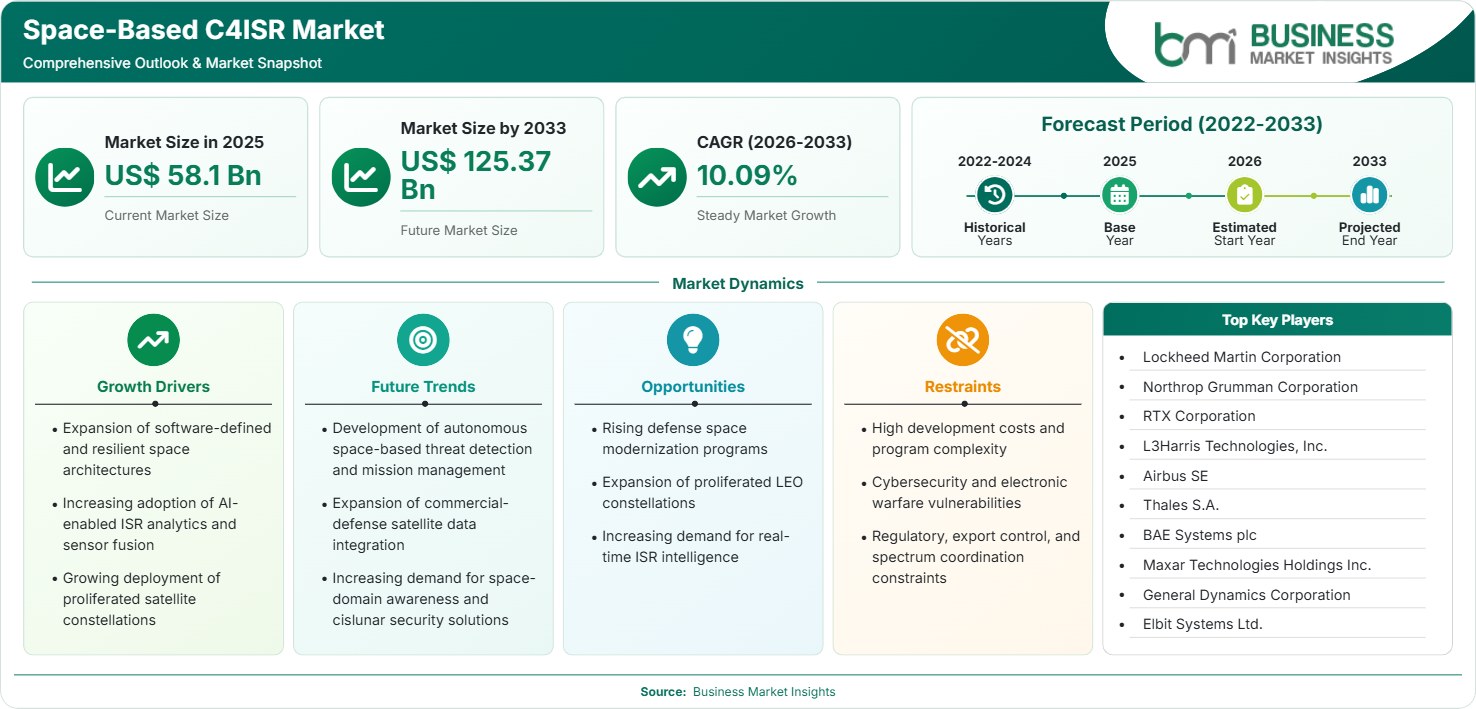
The Space-Based C4ISR Market size was valued at US$ 58.1 Billion in 2025 and is projected to reach US$ 125.37 Billion by 2033, growing at a CAGR of 10.09% during 2026–2033, driven by defense modernization, proliferated satellite constellations, AI-enabled intelligence systems, resilient communications architectures, and expanding space-domain awareness investments worldwide.

Report Coverage
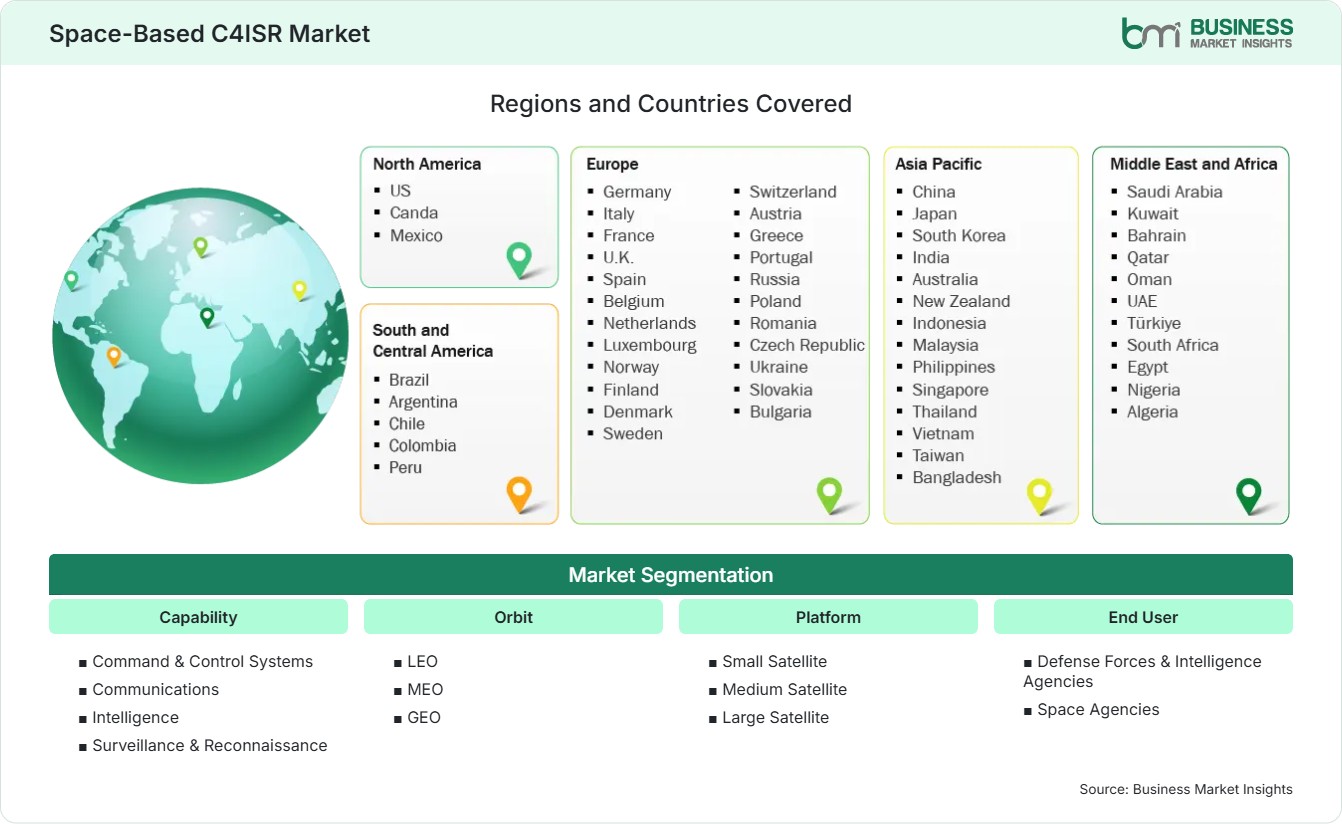
  • Capability: Command & Control Systems, Communications, Intelligence, Surveillance & Reconnaissance
  • Orbit: LEO, MEO, GEO
  • Platform: Small Satellite, Medium Satellite, Large Satellite
  • End User: Defense Forces & Intelligence Agencies, Space Agencies
US$ 58.1 Bn Market size in 2025
US$ 125.37 Bn Market Size by 2033
10.09% CAGR, 2026 - 2033
2026-2033 Forecast Period

AI Overview

Space-Based C4ISR Market Summary

  • North America Region: North America holds a market share of 42%–45% in 2025, growing with a CAGR of 8.8%–9.5% during 2026–2033. Key drivers include missile warning modernization, SDA constellation deployment, military communications resilience, and integrated multi-domain operations. Opportunities arise from sensor fusion, AI analytics, and sovereign space security programs. U.S. market benefits from large defense allocations and advanced satellite procurement programs, expanding at 8.9%–9.6% CAGR.
  • Fastest Growing Region: Asia Pacific holds a market share of 24%–27% in 2025 and expands at a CAGR of 11.5%–12.4% through 2026–2033. Growth is supported by indigenous satellite development, regional security priorities, military digitalization, and increasing ISR investments across emerging space powers.
  • Leading Segment: Communications (SATCOM) accounts for 37%–40% share in 2025 and grows at 9.6%–10.3% CAGR. Demand stems from secure battlefield connectivity, network-centric warfare requirements, protected communications infrastructure, and growing deployment of multi-orbit military communications systems.
  • High Growth Segment: Small Satellite represents 30%–33% share in 2025 and records 12.0%–13.0% CAGR. Rapid launches, lower deployment costs, constellation scalability, persistent coverage requirements, and responsive space capabilities continue strengthening adoption across defense missions.
  • Key Market Opportunity: Expansion of proliferated low-earth-orbit defense constellations enables persistent surveillance, resilient communications, rapid intelligence dissemination, enhanced missile tracking, reduced latency, and cost-efficient coverage across contested operational environments globally.
  • Major Market Players: Lockheed Martin Corporation, Northrop Grumman Corporation, RTX Corporation, L3Harris Technologies, Inc., Airbus SE, Thales S.A., BAE Systems plc, Maxar Technologies Holdings Inc., General Dynamics Corporation, Elbit Systems Ltd.
Strategic Insights

Space-Based C4ISR Market: Strategic Insights

Space-Based C4ISR Market Strategic Framework
FREE PDF
Request your free sample
Request free sample
Stakeholder View

Key Takeaways

  • The industry value chain is shifting from standalone satellite systems toward integrated ecosystems combining launch providers, payload manufacturers, software developers, analytics vendors, and secure communications operators.
  • Proliferated LEO architectures and advanced ISR missions offer the strongest commercial upside due to growing demand for real-time data collection and rapid threat detection.
  • Artificial intelligence, onboard processing, autonomous tasking, and digital engineering are becoming core technology priorities, reducing response times and enhancing mission effectiveness.
  • India, Japan, Australia, and Gulf countries present compelling investment cases as governments increase budgets for military space assets and strategic surveillance programs.
  • Strategic acquisitions increasingly focus on satellite communications, geospatial intelligence, cybersecurity, and space-domain awareness technologies that complement defense modernization strategies.
  • Multi-orbit interoperability is emerging as a decisive competitive differentiator, enabling operators to improve resilience against jamming, cyberattacks, and infrastructure disruptions.
Geographic Outlook

Space-Based C4ISR Market Regional Highlights

North America Space-Based C4ISR Market

North America accounted for 42%–45% of global revenue in 2025 and is projected to expand at a CAGR of 8.8%–9.5% through 2033. The region benefits from substantial defense spending, established satellite manufacturing capabilities, advanced launch infrastructure, and strong government support for space security. The Space-Based C4ISR Market share remains highest in North America due to large procurement programs focused on missile warning, resilient communications, and space-domain awareness. Continuous upgrades of orbital defense architectures reinforce regional leadership.

  • The United States drives regional demand through Space Force modernization programs and proliferated constellations supporting missile tracking and tactical communications.
  • Growing investments in AI-enabled ISR analytics improve operational effectiveness and accelerate data interpretation across complex military environments.
  • Public-private collaboration supports rapid deployment of secure communications architectures and advanced sensing technologies across multiple orbital layers.
  • Rising attention to cislunar monitoring and strategic deterrence applications is creating new procurement opportunities for technology suppliers.

US Space-Based C4ISR Market

The United States represented 75%–79% of North American Space-Based C4ISR Market revenue during 2025 and continues expanding at a CAGR of 8.9%–9.6%. Strong funding from defense agencies, leadership in satellite manufacturing, and advanced command-and-control modernization initiatives sustain demand. National security priorities emphasize persistent surveillance, missile defense tracking, and secure battlefield communications. Long-term procurement programs are supporting continual technology refresh cycles, enabling adoption of sophisticated intelligence and communications capabilities spanning multiple orbital regimes.

  • Space Development Agency initiatives are accelerating deployment of resilient architectures supporting real-time threat detection and command integration.
  • National defense modernization plans prioritize protected SATCOM technologies designed to operate under congested and contested conditions.
  • Growing industry participation supports innovation across onboard computing, autonomous operations, and integrated mission management systems.

Europe Space-Based C4ISR Market

Europe held 21%–24% market share in 2025 and is expected to achieve a CAGR of 9.5%–10.2% through 2033. Strategic autonomy initiatives, defense cooperation programs, and investment in sovereign satellite capabilities are strengthening regional competitiveness. France remains the leading market, while Germany represents one of the fastest-growing countries with CAGR exceeding regional averages. Enhanced focus on secure communications and intelligence-sharing frameworks supports sustained demand across defense institutions and national space agencies.

  • European governments are increasing investment in protected satellite networks to reduce external technological dependence.
  • Defense collaboration programs strengthen interoperability and improve collective intelligence-sharing capabilities across member states.
  • Expansion of Earth observation assets enhances environmental monitoring, border security, and military surveillance applications.
  • AI-enabled mission planning tools are supporting greater operational efficiency throughout orbital defense architectures.

Asia Pacific Space-Based C4ISR Market

Asia Pacific captured 24%–27% of revenue in 2025 and records the fastest CAGR of 11.5%–12.4% through 2033. Regional governments are strengthening sovereign capabilities through expanded satellite deployment, defense digitalization, and greater investment in intelligence infrastructure. China remains the largest market, while India demonstrates some of the strongest growth prospects. Increasing geopolitical competition and maritime security priorities continue supporting technology adoption and long-term procurement across multiple end users.

  • National space programs continue expanding constellation deployments supporting surveillance, navigation, and communications requirements.
  • Domestic manufacturing initiatives reduce import dependence and accelerate capability development among regional stakeholders.
  • Growing defense budgets facilitate procurement of advanced ISR payloads and secure military communications systems.
  • Maritime monitoring requirements create sustained demand for persistent coverage and rapid intelligence dissemination.

Rest of World Space-Based C4ISR Market

Rest of World accounted for 10%–13% of global revenue in 2025 and is projected to grow at a CAGR of 10.1%–11.0% through 2033. The Middle East is emerging as a major investor in sovereign satellite capabilities, while Brazil maintains leadership across South America. Expanding security requirements, border monitoring initiatives, and modernization programs support technology adoption.

Governments are increasingly partnering with private aerospace firms to develop resilient communications and ISR assets. Space-Based C4ISR Market share continues improving across developing regions supported by strategic defense priorities.

  • Gulf countries are investing in secure communications infrastructure and advanced intelligence collection capabilities.
  • Brazil leads regional adoption through expanding Earth observation and defense modernization initiatives.
  • Cross-border security concerns increase demand for reliable surveillance and communications assets.
  • International collaboration programs facilitate technology transfer and capability development across emerging markets.
Global Market Geography
FREE PDF
Request your free sample
Request free sample
Segment Analysis

Space-Based C4ISR Market Segmentation

Capability

Capability represented the most commercially significant category, led by SATCOM deployments. This segment accounted for approximately 37%–40% share in 2025 and is projected to grow at 9.6%–10.3% CAGR. Expanding multi-domain military operations, secure data exchange requirements, and resilient networking architectures continue driving adoption. The Space-Based C4ISR Market scope increasingly encompasses integrated communications, command, and intelligence capabilities operating across distributed orbital infrastructures.

  • Command & Control (C2) Systems: Supports operational coordination, mission planning, and decision superiority through integrated command architectures connecting distributed military assets across highly dynamic operational environments.
  • Communications (SATCOM): Enables resilient, protected, and long-range connectivity supporting tactical communications, data transfer, and network-centric operations across geographically dispersed defense missions.
  • Intelligence, Surveillance & Reconnaissance (ISR): Provides persistent monitoring, threat detection, and actionable intelligence through advanced sensors, analytics platforms, and real-time geospatial information gathering capabilities.

Orbit

Orbit selection shapes performance requirements, latency profiles, mission persistence, and coverage characteristics. The segment holds significant strategic relevance with LEO deployments experiencing the strongest adoption trajectory. Investments in distributed architectures support operational flexibility, scalability, and enhanced resilience against emerging threats while enabling broader intelligence collection and communications coverage.

  • LEO: Favored for low latency, constellation scalability, rapid revisit rates, and missile tracking applications requiring continuous surveillance and communications coverage.
  • MEO: Supports navigation-linked services, balanced coverage characteristics, and secure connectivity requirements across extensive operational areas.
  • GEO: Remains critical for persistent communications, strategic monitoring missions, and large-area coverage supporting military and governmental users.

Platform

Platform choices increasingly favor agile deployment models and cost-efficient constellation expansion. The Small Satellite category maintains 30%–33% share and delivers the highest CAGR of 12.0%–13.0%. Space-Based C4ISR Market trends indicate increased emphasis on distributed architectures, rapid replenishment capability, and resilient mission continuity across contested operational environments.

  • Small Satellite: Supports responsive deployment, lower launch costs, constellation redundancy, and scalable mission architectures suitable for intelligence and communications missions.
  • Medium Satellite: Balances payload capacity, operational endurance, and deployment economics while serving diverse command, communications, and surveillance objectives.
  • Large Satellite: Provides extensive payload capabilities, strategic communications capacity, and long-duration mission support for national security applications.

End User

Defense-focused organizations remain the primary demand center due to security priorities and sustained budget allocations. The segment benefits from expanding surveillance requirements and increasing reliance on real-time situational awareness capabilities. National space agencies also contribute demand through dual-use infrastructure investments and collaborative technology development initiatives.

  • Defense Forces & Intelligence Agencies: Drive procurement through requirements for secure communications, persistent surveillance, missile warning, and operational decision-support systems.
  • Space Agencies: Support technology development, national capability enhancement, and civil-security missions through advanced satellite programs and research initiatives.
Market Forces

Space-Based C4ISR Market Dynamics

Key Market Drivers

Rising Defense Space Modernization Programs

Governments are increasingly allocating resources toward resilient orbital infrastructure capable of supporting communications, surveillance, missile defense, and command activities. The defense spending levels by the members of NATO will continue to increase, with the US progressing on its space architecture initiatives. The need for intelligence gathering and the threat of hypersonic weapons makes this necessary. Space-Based C4ISR Market growth will be fueled by consistent government spending and increased focus on multi-domain integration. Military organizations will make more efforts to have better awareness and decision advantage, and their spending on secure satellite technologies will keep growing. There is long-term visibility for manufacturers, system integrators, analytic providers, and communications companies.

Expansion of Proliferated LEO Constellations

The use of distributed LEO constellations is gaining popularity among defense organizations because of their robustness, lower latency, and better survivability. With hundreds of satellites, it becomes easier for defense agencies to ensure mission continuity while performing intelligence and secure communications. Through sophisticated networking techniques, there is instant sharing of information between sensors, command stations, and operating units. Space-Based C4ISR Market growth is therefore linked closely to procurement programs emphasizing proliferated networks. Demand continues rising for small satellites, onboard processors, optical inter-satellite links, and mission management software that support scalable constellation operations.

Increasing Demand for Real-Time ISR Intelligence

Effective functioning of the military today requires timely information based on multiple sources of data. ISR uses geospatial imaging, signals intelligence, and artificial intelligence for better situational awareness. Military units are more dependent on persistent surveillance technologies for the maritime, land, and space areas. Data overload is creating the need for advanced technologies to process the data. Machine learning technologies play a significant role in achieving accurate detection and swift response. This trend will continue to drive further acquisitions of ISR payloads, analytics software, and secure dissemination solutions.

Key Market Opportunities

AI-Enabled Autonomous Mission Operations

AI holds considerable promise in such areas as mission planning, in-flight processing, anomaly detection, and tasking activities. Space operators require software tools that would minimize human effort and boost speed and intelligence. With the help of AI tools, it is possible to achieve efficient use of orbital assets and quick processing of big data. Vendors that can incorporate analytics into their command architectures will have a competitive edge. Space-Based C4ISR Market Forecasts increasingly reflect growing demand for intelligent mission automation technologies. As operational complexity rises, autonomous systems can improve resilience, enhance decision support, and generate measurable efficiency gains across defense-oriented space missions.

Growth of Sovereign Space Security Programs

Many nations are pursuing indigenous communications and surveillance capabilities to strengthen strategic autonomy. The emergence of such a trend will present business prospects for satellite manufacturing firms, system vendors, software providers, and launch service providers serving local defense efforts. The newly emerging markets are opting more for technology transfer arrangements and manufacturing partnerships. The national programs that are involved with securing critical infrastructure and border surveillance ensure a steady pipeline for purchases. Firms that can provide flexible, scalable, and configurable solutions are in the best position to satisfy their changing needs.

Integration of Multi-Orbit Architectures

Defense users increasingly require seamless connectivity across LEO, MEO, and GEO assets. The multi-orbit architecture allows for improved redundancy, flexibility in coverage, and resilience in mission, at the same time minimizing vulnerability to operational interruptions. This presents an opportunity for vendors providing interoperable communication platforms, network management software, and command solutions. With the focus on maintaining access to intelligence and communication capabilities, the investments in orbital integration technologies will keep growing. Integration of information collected by various satellite systems improves operational awareness and allows for making decisions based on better analysis.

Market Restraints and Challenges

High Development Costs and Program Complexity

Factor: Development of advanced satellites requires substantial investment in research, manufacturing, testing, launch services, and cybersecurity compliance. Impact: Increased costs lead to postponement of purchase decision-making and reduced participation from small organizations. A longer development period leads to increased sensitivity to budget changes and mission needs changes. Complexity in integration across hardware, software, and communications levels results in execution risk, which may affect the scheduling of deployment. Security needs, in turn, lead to increased certification efforts. Such obstacles can hinder access to the market for those without financial capacity, technical knowledge, or government connections.

Cybersecurity and Electronic Warfare Vulnerabilities

Factor: Growing dependence on interconnected orbital networks increases exposure to cyber intrusions, signal interference, and electronic warfare activities. Impact: Risks related to security can impact mission continuity, data integrity, and stakeholder trust. Organizations in the field of defense need to make significant investments in encryption, authentication, and communication systems to address these risks. The capability of the adversaries is continually developing; therefore, continuous upgrading and testing are necessary. Providers of the solutions face a burden due to compliance requirements.

Company Analysis

Competitive Landscape

Space-Based C4ISR Market analysis indicates competition is centered on satellite integration capabilities, secure communications technologies, ISR payload innovation, software-defined architectures, and long-term government contracting expertise.

Company Name

Overview

Products and Services relevant to this market

Lockheed Martin Corporation

Major aerospace and defense contractor with extensive government space and missile defense experience.

Missile warning satellites, command systems, secure communications, tracking architectures, space integration services.

Northrop Grumman Corporation

Global defense leader focused on advanced space systems and strategic national security programs.

ISR payloads, satellite buses, command systems, space-domain awareness solutions.

RTX Corporation

Aerospace and defense company emphasizing sensing, communications, and integrated defense technologies.

Secure communications, sensors, mission systems, intelligence-support solutions.

L3Harris Technologies, Inc.

Specialist in mission-critical communications and advanced space-based tracking technologies.

Missile-tracking satellites, SATCOM solutions, ISR technologies, mission software.

Airbus SE

European aerospace leader with strong satellite design and defense communications capabilities.

Military communications satellites, Earth observation systems, intelligence platforms.

Thales S.A.

Technology group supporting defense communications, surveillance, and secure networking requirements.

Secure SATCOM, ISR systems, command-and-control technologies.

BAE Systems plc

Defense contractor investing in digital battlespace and intelligence capabilities.

Electronic systems, communications infrastructure, intelligence technologies.

Maxar Technologies Holdings Inc.

Space infrastructure and geospatial intelligence specialist serving government customers.

Satellite platforms, geospatial intelligence, imagery analytics, mission support.

General Dynamics Corporation

Defense company delivering communications and mission-critical information systems.

Secure communications networks, mission command solutions, ISR support systems.

Elbit Systems Ltd.

Defense technology provider focused on intelligence, surveillance, and networking solutions.

ISR systems, data links, command systems, sensor integration services.

Trust & Transparency

Research Methodology

The market analysis combines proprietary research with secondary data from government agencies, company disclosures, regulatory filings, industry databases and expert interviews. Market estimates are validated through data triangulation, cross-market benchmarking and analyst review.

View Full Research Methodology

Questions Answered

Frequently Asked Questions

What does the Space-Based C4ISR Market Report typically evaluate?

It assesses market size, technology developments, regional demand patterns, competitive positioning, investment trends, segment performance, and long-term growth opportunities across the value chain.

How does AI influence future capability development?

AI enhances onboard processing, mission automation, anomaly detection, sensor fusion, and intelligence interpretation, improving operational efficiency and reducing decision-making timelines.

Which end users generate the largest demand?

Defense forces and intelligence agencies account for the largest spending due to requirements for secure communications, operational awareness, strategic monitoring, and threat detection.

What role do small satellites play in industry expansion?

Small satellites support distributed architectures with lower deployment costs, faster launch cycles, improved redundancy, and expanded global coverage for communications and ISR missions.

What is driving adoption of space-based defense intelligence systems?

Increasing demand for resilient communications, missile tracking, persistent surveillance, and AI-enabled intelligence processing is accelerating deployment across defense and national security organizations.

Access the Full Space-Based C4ISR Market Report

Get segment-level forecasts, regional estimates, competitive benchmarking, company profiles and downloadable Excel datasets.

Access the full Space-Based C4ISR Market Report
350 pages PDF & Excel | 2026-09-02
Similar Research

Related Market Reports