Market Summary
Executive Summary and Global Market Analysis
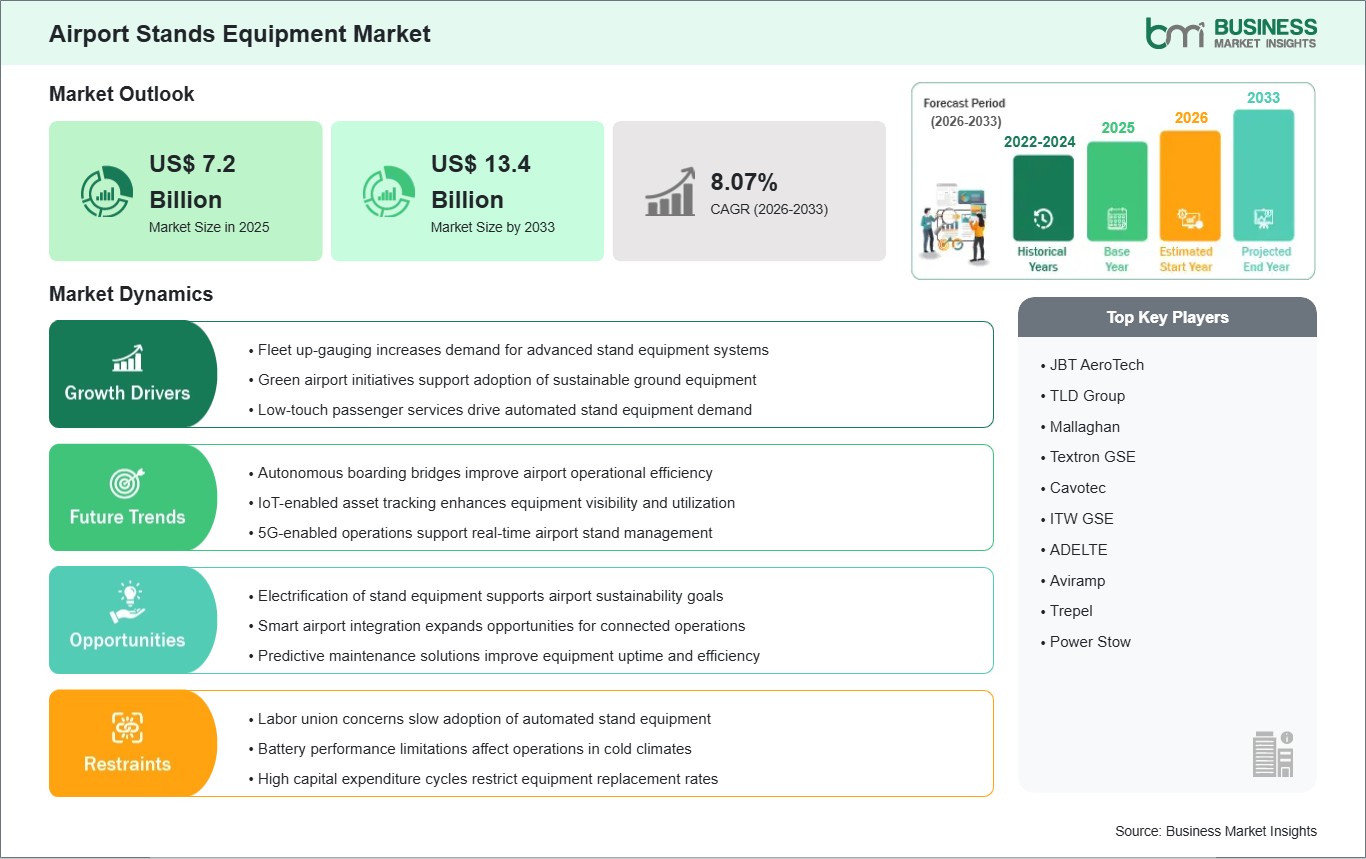
Airport stands equipment comprises the infrastructure and support systems used at aircraft parking positions to facilitate safe, efficient, and comfortable ground operations. These systems include passenger boarding bridges, ground power units, and preconditioned air units that support aircraft servicing while minimizing the need for onboard auxiliary systems. There is continuous growth in the Airport Stands Equipment market since airports are continuously upgrading their facilities to increase operational efficiencies and provide a better customer experience. The growth in airport expansions, more flights, and increased focus on the sustainable operation of airports is helping market growth. There is a growing trend towards advanced airport stands equipment solutions that help meet environmental goals and reduce operating costs.
Despite favorable growth conditions, the market faces several operational and financial challenges. Airport stand equipment requires significant capital investment and must comply with stringent aviation safety and operational standards. Installation and maintenance activities often require coordination with airport operations to minimize disruptions. Aging airport infrastructure in several regions may also create integration challenges when upgrading existing equipment. Furthermore, airport authorities continue to balance infrastructure modernization goals with budget constraints, requiring careful planning and long-term investment strategies.
The market continues to present opportunities through the adoption of automated, energy-efficient, and digitally connected stand equipment systems. Airports are increasingly focusing on reducing aircraft emissions during ground operations by using ground power and preconditioned air systems instead of onboard auxiliary power units. Due to increased investment in airport construction and expansions, there is an anticipated steady demand. The competition in the Airport Stands Equipment market revolves around reliability, technology, and efficiency in terms of cost throughout its life cycle.
Segment Analysis
Airport Stands Equipment Market Segmentation
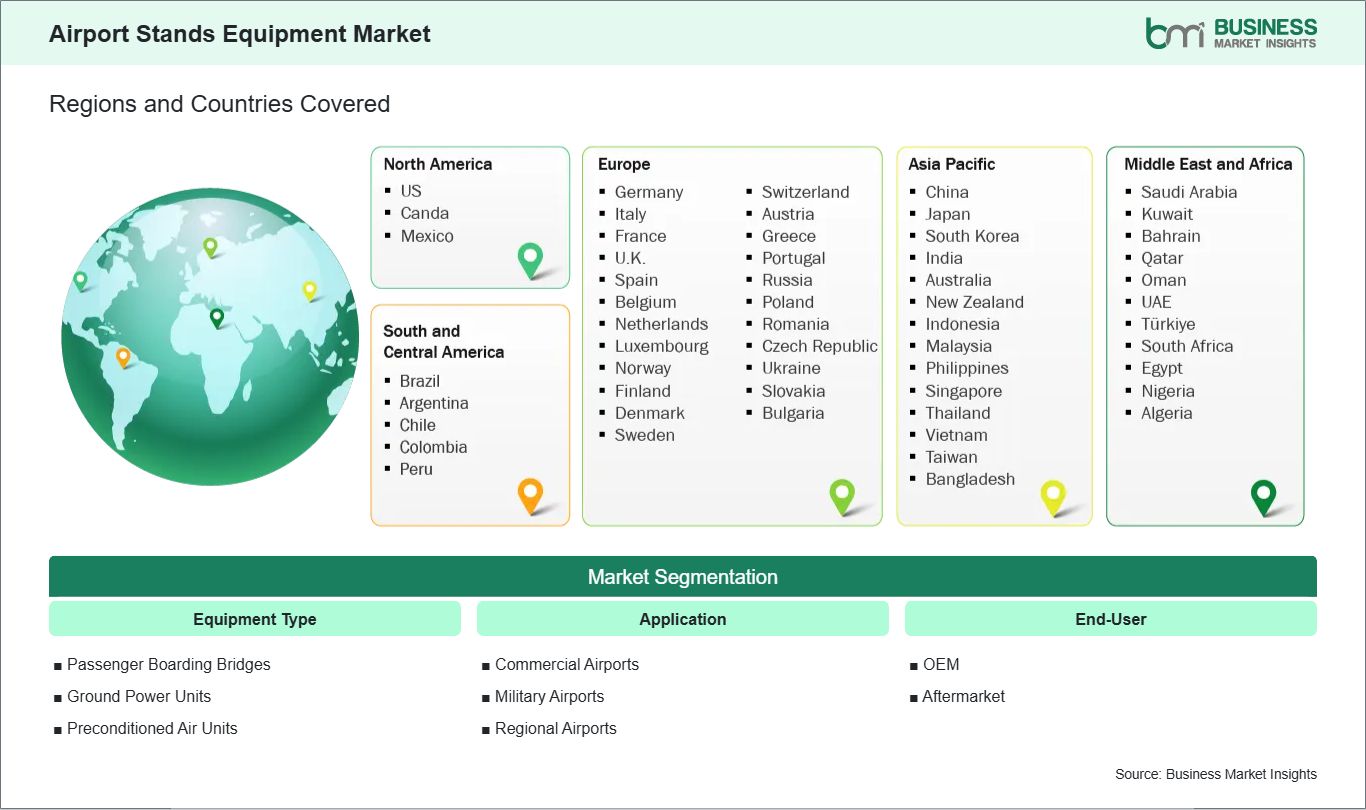
The Airport Stands Equipment market is segmented based on equipment type, application, and end-user, reflecting the diverse requirements of airport ground operations and infrastructure development.
By Equipment Type
- Passenger Boarding Bridges: Provide safe and convenient passenger access between terminal buildings and aircraft.
- Ground Power Units: Supply electrical power to parked aircraft during ground operations.
- Preconditioned Air Units: Deliver climate-controlled air to aircraft cabins while parked at airport stands.
By Application
- Commercial Airports: Represents the largest demand segment due to high passenger volumes and aircraft traffic.
- Military Airports: Utilizes stand equipment to support defense aviation operations and aircraft servicing.
- Regional Airports: Supports aircraft handling and passenger services at smaller airport facilities.
By End-User
- OEM: Driven by new airport infrastructure development and equipment installation projects.
- Aftermarket: Includes maintenance, upgrades, refurbishment, and replacement of airport stand equipment.
Market Forces
Airport Stands Equipment Market Drivers and Opportunities
Expanding Airport Infrastructure and Operational Efficiency Goals
The demand for airport stands equipment is increasing as airports continue to expand infrastructure and improve operational efficiency. Growing air passenger traffic and rising aircraft movements are encouraging airport authorities to invest in advanced ground support systems that streamline aircraft servicing activities. Passenger boarding bridges, ground power units, and preconditioned air units play an important role in reducing aircraft turnaround times and improving passenger convenience. These systems help airports manage increasing traffic volumes while maintaining safe and efficient operations.
There is an ongoing push towards sustainability and cost savings at most airports, thus there is growing interest in adopting stand equipment that cuts fuel usage by airplanes. There is a growing focus on environmental performance and efficiency in the regulation of airports. In addition, terminal expansion projects and airport modernization programs are creating demand for new stand installations across commercial, military, and regional airport facilities. These factors continue to strengthen the role of airport stands equipment within airport infrastructure development strategies worldwide.
Smart Airport Technologies and Sustainable Ground Operations
The Airport Stands Equipment market is creating new opportunities through the adoption of smart airport technologies and environmentally sustainable operational practices. Airports are increasingly implementing digitally connected equipment systems that enable remote monitoring, predictive maintenance, and improved asset utilization. These technologies help airport operators reduce downtime, improve service reliability, and optimize maintenance planning.
Growing environmental concerns are also driving the adoption of advanced ground power units and preconditioned air systems that reduce the need for aircraft auxiliary power units while parked at gates. This is beneficial to airport sustainability goals as these innovations decrease emissions, conserve fuel, and improve air quality in terminal areas. As more airports invest in the construction and modernization of their facilities, there will be further openings for the adoption of advanced stand equipment technologies. With the increased focus on automation and efficiency within airport operations, there will likely be a rise in the demand for advanced stand equipment technologies.
Size and Share Analysis
Airport Stands Equipment Market Size and Share Analysis
The Airport Stands Equipment Market size is expected to reach US$ 13.4 billion by 2033 from US$ 7.2 billion in 2025. The market is estimated to record a CAGR of 8.07% from 2026 to 2033.
By equipment type, passenger boarding bridges account for a significant share of the market due to their widespread deployment across commercial airport terminals. Ground power units and preconditioned air units are also experiencing growing adoption as airports seek to reduce aircraft emissions and improve operational efficiency during ground handling activities.
By application, commercial airports represent the largest demand segment because of increasing passenger traffic and infrastructure development activities. Demand from military and regional airports is also growing as these facilities invest in modernization projects and improved aircraft servicing capabilities.
Report Coverage
Airport Stands Equipment Market Report Coverage and Deliverables
The "Airport Stands Equipment Market Size and Forecast (2022-2033)" report provides a detailed analysis of the market covering below areas:
- Market size and forecast at global, regional, and country levels for all the key market segments covered under the scope
- Market trends, as well as market dynamics such as drivers, restraints, and key opportunities
- Market analysis covering key market trends, global and regional framework, major players, regulations, and recent market developments
- Industry landscape and competition analysis covering market concentration, heat map analysis, prominent players, and recent developments for the market
- Detailed company profiles, including SWOT analysis
Geographic Insights
Airport Stands Equipment Market Geographic Insights
The Airport Stands Equipment Market shows diverse regional adoption patterns influenced by airport modernization programs, aviation infrastructure investments, sustainability initiatives, and operational efficiency requirements.
North America represents a mature airport infrastructure market supported by extensive commercial aviation networks and ongoing airport modernization programs. The region comprises the United States and Canada, where airports continue to invest in advanced stand equipment to improve passenger handling and aircraft servicing operations. Airport operators are increasingly adopting energy-efficient ground power and preconditioned air systems to support sustainability goals and reduce operational costs. Strong regulatory frameworks and continued investment in smart airport technologies contribute to the widespread deployment of modern stand equipment across major aviation hubs.
Asia Pacific is experiencing strong demand for airport stands equipment due to rapid aviation growth, airport expansion projects, and increasing passenger traffic. The region comprises countries such as China, India, Japan, and Singapore, where governments and airport authorities are investing heavily in new terminals and airport infrastructure. Growing commercial aviation activity and the development of regional airports are creating demand for passenger boarding bridges and advanced ground support systems. Airports across the region are also implementing modern technologies to improve efficiency, enhance passenger experience, and support long-term operational sustainability. Continued infrastructure development is expected to strengthen market opportunities throughout the region.
Industry Activity
Recent Developments
The Airport Stands Equipment Market is analyzed using a mix of primary and secondary research sources, including corporate publications, industry associations, and verified databases. This approach ensures accurate tracking of innovation trends and strategic developments influencing the market.
- In July 2025, London Gatwick Airport commissioned the services of engineering specialist M Group to launch its comprehensive Passenger Boarding Bridges Replacement Programme spanning 2025 to 2026. The infrastructure initiative introduces high-specification, enclosed elevated walkways to systematically replace aged bridges across the hub's active gates. The development significantly strengthens airside operational safety, protects commuters from localized airfield hazards, and forms a key component of the airport's wider £1.9 billion Capital Investment Programme to maximize terminal efficiency.
- In March 2026, Oshkosh AeroTech introduced new intelligent management capabilities for its iOPS unified digital ecosystem at the Passenger Terminal Expo World in London. The digital advancement connects aircraft, gates, ground support equipment, and personnel into a single operational view to deliver real-time predictive insights and mobile-enabled intelligence. The development significantly improves airside asset utilization, assists operators in managing localized flight delays, and highlights the continued integration of cloud-based telematics into modern terminal gate infrastructure.
Trust & Transparency
Research Methodology
The market analysis combines proprietary research with secondary data from government agencies, company disclosures, regulatory filings, industry databases and expert interviews. Market estimates are validated through data triangulation, cross-market benchmarking and analyst
review.
View Full Research Methodology
Key Sources Referred:
World Bank - Global Trade IndicatorsWorld Trade Organization (WTO)International Monetary Fund (IMF)International Trade Administration (ITA)Company WebsitesCompany Annual ReportsCompany Investor Presentations