Market Summary
Executive Summary and Global Market Analysis
Airport lighting systems are essential infrastructure components that support safe aircraft movement, navigation, and airport operations during day and night conditions. They consist of runway lights, taxiway lights, and apron lights, and play a key role in assisting pilots in navigating airport environments and improving their efficiency and safety. With the upgrading and expansion of airport facilities and capacity, along with the use of better lighting technologies, the Airport Lighting market is expanding at a steady pace. Growth in air traffic and airport expansion projects has fueled the growth of this market.
Despite positive market conditions, several challenges continue to influence industry growth. Airport lighting systems must comply with strict aviation regulations and performance standards, requiring extensive testing and certification processes. Installation and maintenance activities often require runway closures or operational adjustments, creating implementation challenges for airport authorities. Aging airport infrastructure in several regions also increases upgrade costs and project complexity.
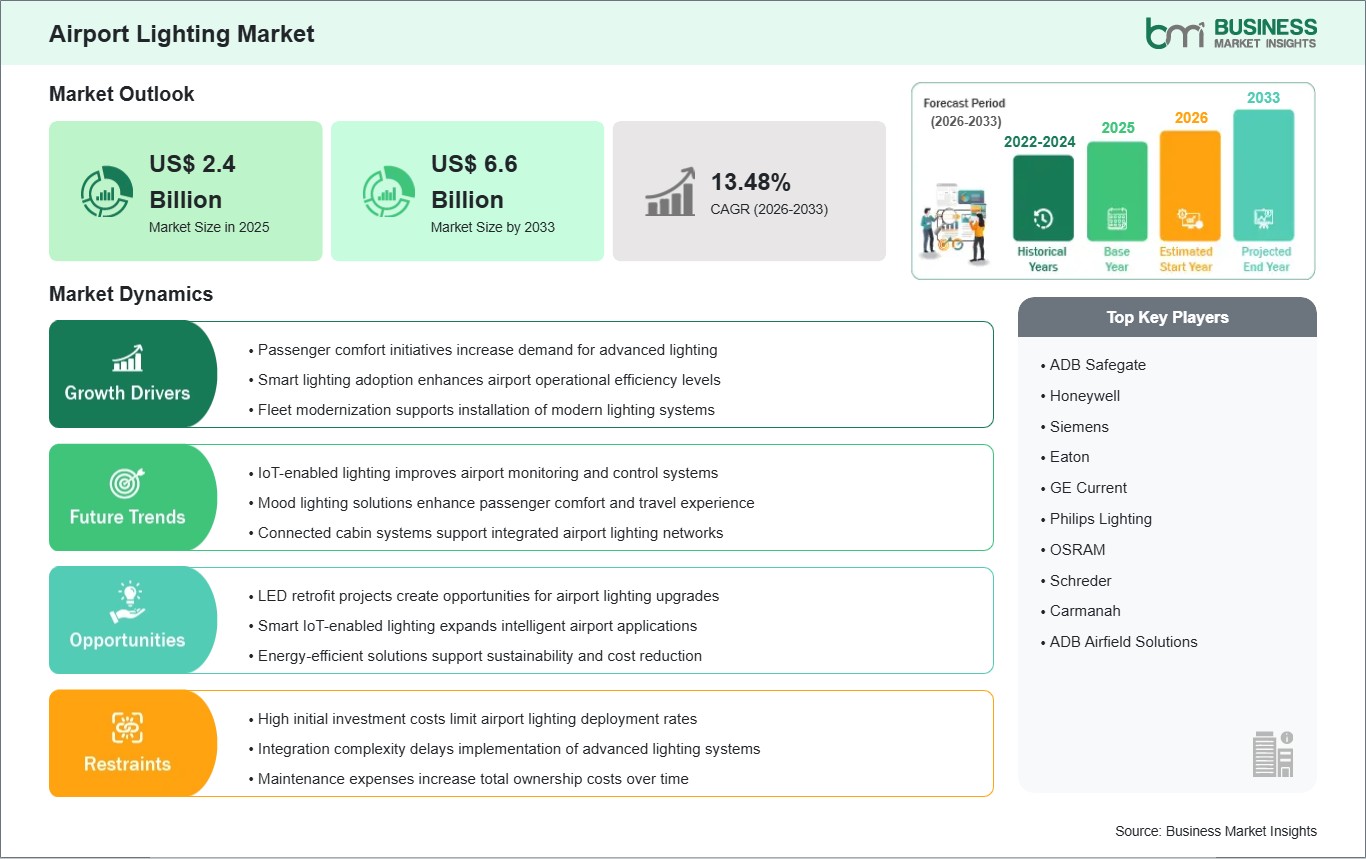
The market continues to present opportunities through the implementation of intelligent lighting systems, digital monitoring methods, and energy-efficient lighting methods. Airports have started to focus on intelligent lighting systems that allow for monitoring and optimization. Further development in LEDs, automation, and sustainable airport structures is expected to generate further growth opportunities. Competition within the Airport Lighting market is focused on technological innovation, regulatory compliance, product reliability, and long-term operational efficiency.
Segment Analysis
Airport Lighting Market Segmentation
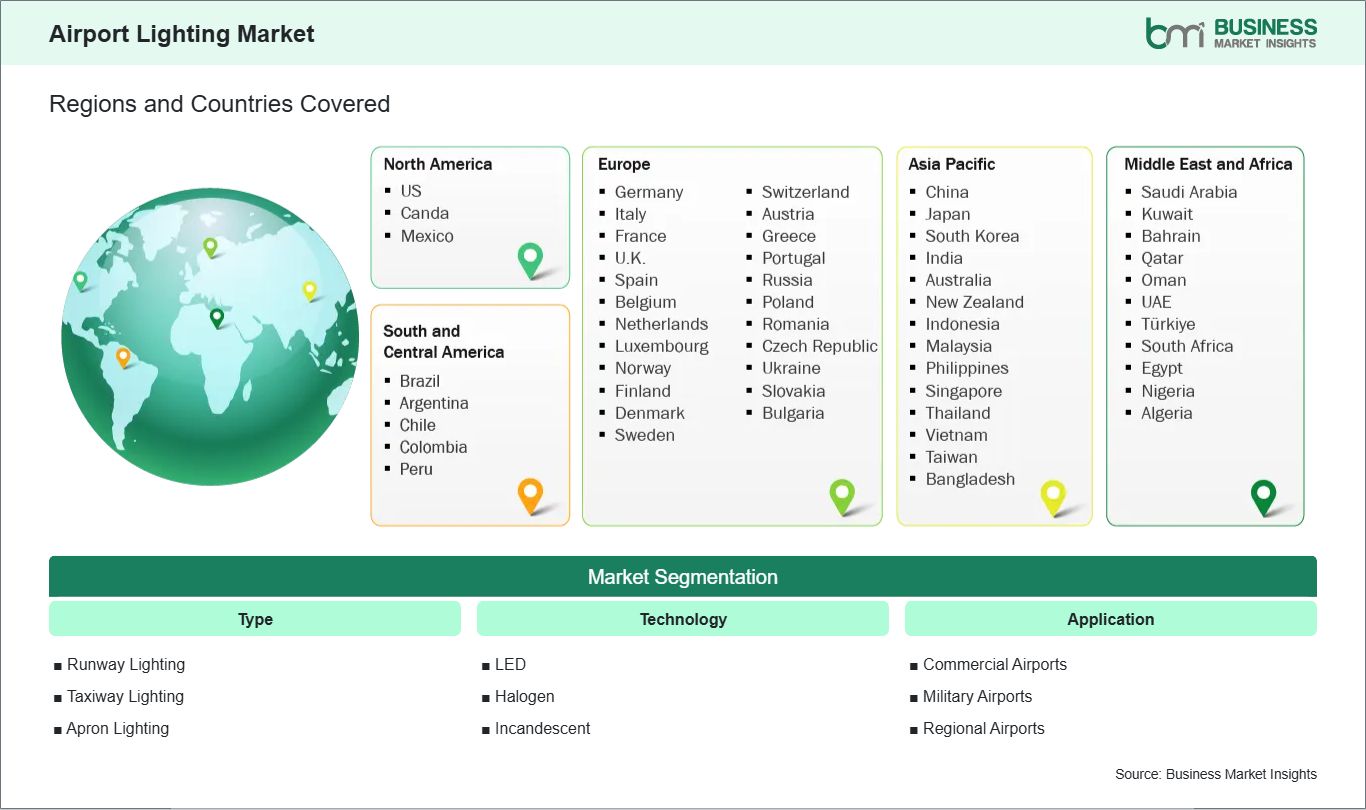
The Airport Lighting market is segmented based on type, technology, and application, reflecting the diverse operational requirements of airport environments.
By Type
- Runway Lighting: Provides visual guidance for aircraft during takeoff, landing, and low-visibility operations.
- Taxiway Lighting: Assists aircraft movement between runways, terminals, and maintenance areas.
- Apron Lighting: Supports aircraft parking, servicing, loading, and ground handling activities.
By Technology
- LED: Widely adopted due to energy efficiency, longer lifespan, and reduced maintenance requirements.
- Halogen: Used in various airport applications requiring reliable illumination performance.
- Incandescent: Primarily utilized in legacy airport lighting systems and existing infrastructure.
By Application
- Commercial Airports: Represents the largest demand segment due to high passenger traffic and operational activity.
- Military Airports: Utilizes specialized lighting systems to support defense aviation operations.
- Regional Airports: Supports safe aircraft operations in smaller and developing airport facilities.
Market Forces
Airport Lighting Market Drivers and Opportunities
Rising Airport Modernization and Aviation Safety Requirements
The demand for airport lighting systems is increasing as airports around the world continue to modernize infrastructure and improve operational safety. The increased amount of air traffic has made airport operators consider modernizing old infrastructure as well as making new investments in advanced airfield infrastructure to facilitate aircraft guidance and visibility. Lighting for runways, taxiways, and aprons is a vital component that helps maintain safe air traffic control in adverse weather and at night. With aviation regulatory agencies becoming more stringent, airports have begun giving importance to lighting systems.
The development of airports and the construction of new terminals and airfields are also driving the market growth. Increasing use of lighting systems that offer greater visibility with less maintenance is becoming common practice. Advanced lighting solutions help provide enhanced situational awareness to pilots as well as ground staff, thus helping airlines to operate efficiently. Such trends will further bolster the importance of airport lighting systems in aviation infrastructure and drive market growth in the long run.
Adoption of Smart and Energy-Efficient Lighting Technologies
The Airport Lighting market is creating new opportunities through the growing adoption of smart lighting technologies and energy-efficient infrastructure solutions. Airports are increasingly transitioning to LED lighting systems that offer lower energy consumption, longer operational life, and improved illumination quality. This shift is helping airport operators reduce operating costs while meeting sustainability objectives and environmental requirements.
The integration of intelligent lighting management systems is also transforming airport operations. Advanced solutions equipped with remote monitoring, automated controls, and predictive maintenance capabilities allow operators to improve system performance and reduce downtime. With smart airport innovations, there is a push towards adopting more connected systems, which will improve the visibility and utilization of assets within the airport environment. At the same time, the introduction of new regional airports and airport expansion will create a need for efficient lighting. With increasing emphasis on sustainable development and automation within airport operations, lighting will become more significant in the future.
Size and Share Analysis
Airport Lighting Market Size and Share Analysis
The Airport Lighting Market size is expected to reach US$ 6.6 billion by 2033 from US$ 2.4 billion in 2025. The market is estimated to record a CAGR of 13.48% from 2026 to 2033.
By type, runway lighting accounts for a significant share of the market due to its critical role in supporting aircraft takeoff and landing operations. Taxiway and apron lighting systems continue to experience demand as airports seek to improve aircraft movement and ground operations across increasingly busy airport environments.
By application, commercial airports represent the largest demand segment due to ongoing airport expansion projects and rising passenger traffic. Military and regional airports are also contributing to market growth through modernization initiatives and investments in improved airfield infrastructure.
Report Coverage
Airport Lighting Market Report Coverage and Deliverables
The "Airport Lighting Market Size and Forecast (2022-2033)" report provides a detailed analysis of the market covering below areas:
- Market size and forecast at global, regional, and country levels for all the key market segments covered under the scope
- Market trends, as well as market dynamics such as drivers, restraints, and key opportunities
- Market analysis covering key market trends, global and regional framework, major players, regulations, and recent market developments
- Industry landscape and competition analysis covering market concentration, heat map analysis, prominent players, and recent developments for the market
- Detailed company profiles, including SWOT analysis
Geographic Insights
Airport Lighting Market Geographic Insights
The Airport Lighting Market shows diverse regional adoption patterns influenced by aviation infrastructure development, airport modernization initiatives, regulatory requirements, and operational safety standards.
North America represents a mature airport lighting market supported by well-established aviation infrastructure and continuous investment in airport modernization. The region comprises the United States and Canada, where airports are upgrading lighting systems to improve operational efficiency and comply with evolving aviation regulations. Airports across the region are increasingly adopting LED-based airfield lighting solutions and intelligent monitoring systems to reduce maintenance requirements and improve visibility. Strong investment in runway rehabilitation, airport expansion projects, and advanced air traffic management infrastructure continues to support demand for modern airport lighting technologies.
Asia Pacific is experiencing significant growth driven by rapid airport expansion, increasing passenger traffic, and large-scale aviation infrastructure investments. The region comprises countries such as China, India, Japan, and Australia, where governments and airport authorities are investing in new airports and modernization projects. The growing number of regional airports and expansion of commercial aviation networks are increasing demand for runway, taxiway, and apron lighting systems. Airports across the region are also adopting energy-efficient lighting technologies to improve operational performance and support sustainability objectives. Continued aviation development and infrastructure investment are strengthening the role of airport lighting systems across the region.
Industry Activity
Recent Developments
The Airport Lighting Market is analyzed using a mix of primary and secondary research sources, including corporate publications, industry associations, and verified databases. This approach ensures accurate tracking of innovation trends and strategic developments influencing the market.
- In June 2026, Honeywell Automation India emerged as the lowest bidder for a ₹121.66 crore project to upgrade the airfield ground lighting system at Lal Bahadur Shastri International Airport in Varanasi. The comprehensive modernizations feature intelligent, high-visibility LED runway and taxiway systems designed to drastically lower flight disruptions during heavy North Indian winter fog. The development strengthens regional airside infrastructure and highlights growing domestic investment in automated visual aids to improve operational efficiency across India's Tier-2 hubs.
- In April 2026, Cardiff Airport finalized a comprehensive airfield infrastructure improvement programme in partnership with aviation specialist atg airports. The extensive modernizations featured the full installation of high-performance FX range LED fixtures alongside completely overhauled primary and secondary electrical cabling circuits. The development significantly strengthens the hub's operational resilience and regulatory compliance while supporting a long-term strategy for increased air traffic and sustainable airport growth.
Trust & Transparency
Research Methodology
The market analysis combines proprietary research with secondary data from government agencies, company disclosures, regulatory filings, industry databases and expert interviews. Market estimates are validated through data triangulation, cross-market benchmarking and analyst
review.
View Full Research Methodology
Key Sources Referred:
World Bank - Global Trade IndicatorsWorld Trade Organization (WTO)International Monetary Fund (IMF)International Trade Administration (ITA)Company WebsitesCompany Annual ReportsCompany Investor Presentations