
Airport Information Systems Market Outlook: Size, Share, Trends, Growth Analysis, Competitive Landscape & Forecast, 2026-2033

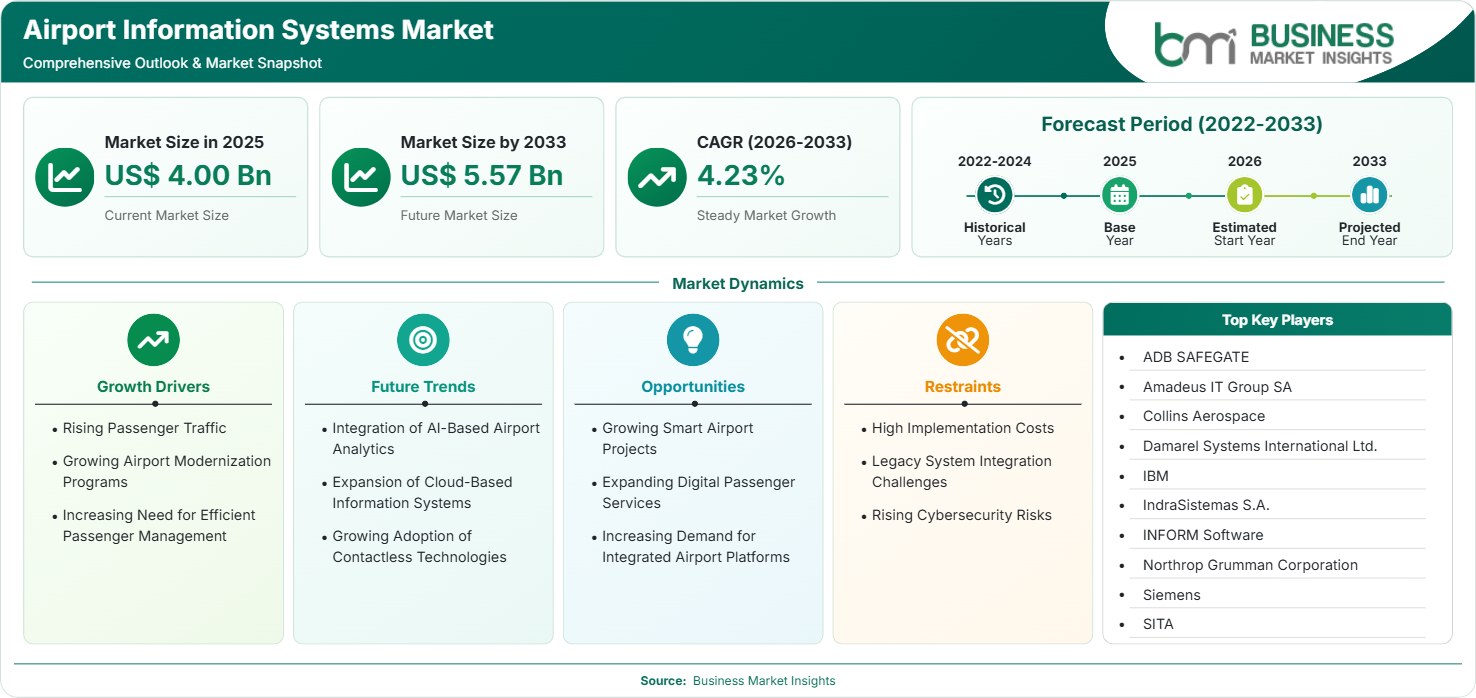
The Airport Information Systems Market size was valued at US$ 4.00 Billion in 2025 and is projected to reach US$ 5.57 Billion by 2033, growing at a CAGR of 4.23% during 2026–2033, driven by passenger traffic, airport modernization, digital passenger services, integrated operations, automation, and real-time data management.

Report Coverage
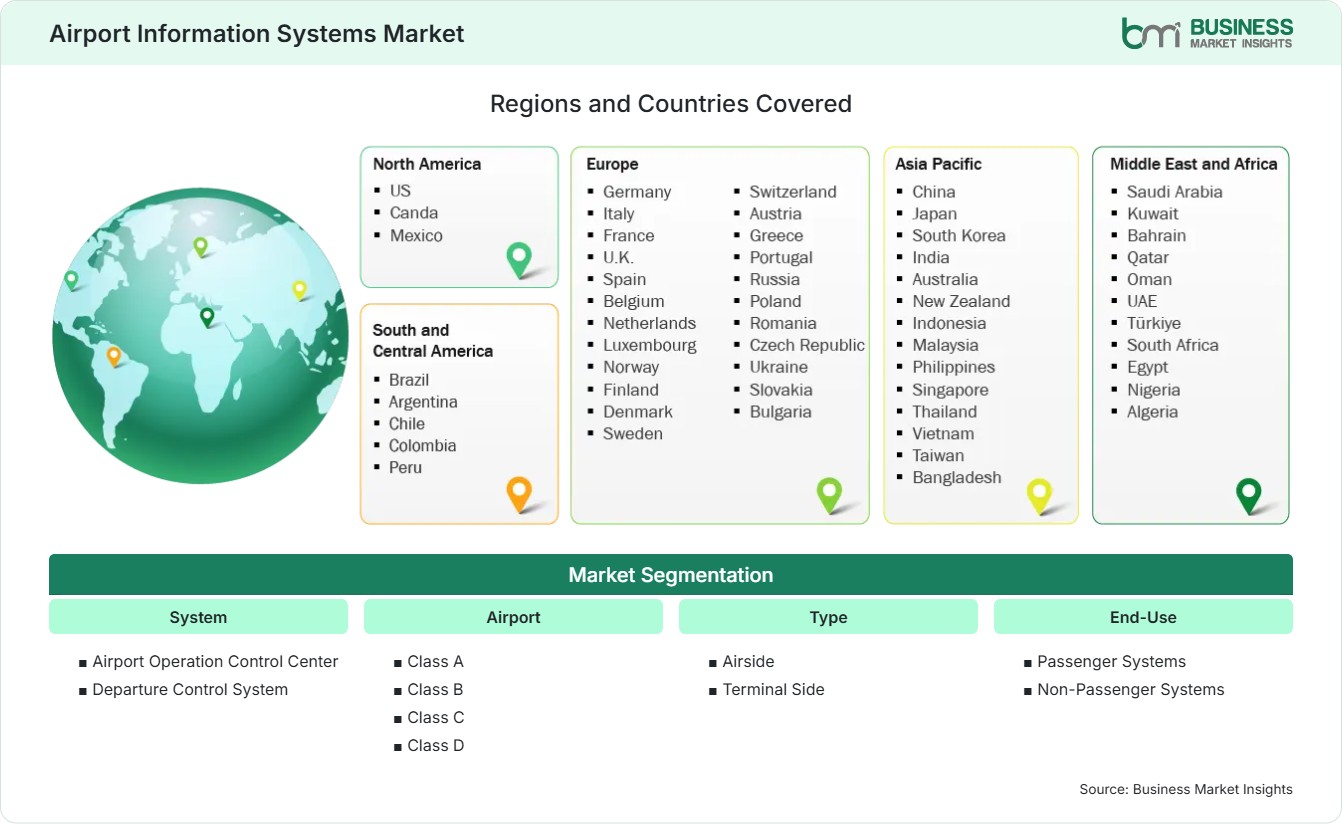
  • System: Airport Operation Control Center, Departure Control System
  • Airport: Class A, Class B, Class C, Class D
  • Type: Airside, Terminal Side
  • End-Use: Passenger Systems, Non-Passenger Systems
  • Investment: Brownfield, Greenfield
US$ 4.00 Bn Market size in 2025
US$ 5.57 Bn Market Size by 2033
4.23% CAGR, 2026 - 2033
2026-2033 Forecast Period

AI Overview

Airport Information Systems Market Summary

  • North America Region: North America holds a 25%–28% share in 2025, growing with a CAGR of 4.0%–4.7% during 2026–2033, influenced by airport modernization, cloud migration, cybersecurity, passenger automation, operational analytics, and replacement of legacy platforms. The U.S. represents most regional demand, expanding at a 4.1%–4.8% CAGR as major airports invest in integrated operations, passenger processing, and resilient digital infrastructure.
  • Fastest Growing Region: Asia Pacific holds a 31%–35% share in 2025, expanding with a CAGR of 5.0%–5.8% during 2026–2033, supported by airport construction, passenger growth, smart-terminal investment, digital identity, automation, cloud platforms, and rapidly expanding aviation infrastructure across emerging economies.
  • Leading Segment: Airport Operation Control Center systems hold a 42%–46% share in 2025, growing with a CAGR of 4.4%–5.0% during 2026–2033, supported by centralized decision-making, real-time coordination, predictive analytics, resource optimization, disruption management, and increasing integration across airport stakeholders.
  • High Growth Segment: Passenger Systems account for a 55%–59% share in 2025, with a CAGR of 4.8%–5.5% during 2026–2033, supported by self-service processing, biometric identification, digital boarding, mobile services, automated baggage handling, and demand for seamless passenger journeys.
  • Key Market Opportunity: Airport operators can capture value through cloud-native platforms, artificial intelligence, biometric identity, predictive operations, interoperable data environments, cybersecurity, and integrated passenger-management systems across increasingly connected airport ecosystems.
  • Major Market Players: ADB SAFEGATE; Amadeus IT Group S.A.; Collins Aerospace; Damarel Systems International Ltd.; International Business Machines Corporation; Indra Sistemas, S.A.; INFORM GmbH; Northrop Grumman Corporation; Siemens AG; SITA.
Strategic Insights

Airport Information Systems Market: Strategic Insights

Airport Information Systems Market Strategic Framework
FREE PDF
Request your free sample
Request free sample
Stakeholder View

Key Takeaways

  • Ecosystem is shifting towards an integrated platform involving the airport operator, airlines, ground handlers, security organizations, border authorities, and technology vendors.
  • The passenger experience space provides great upside potential as airports roll out more self-check, biometrics, mobile credentials, automated boarding, and bag management.
  • Artificial intelligence is becoming a practical layer for operational forecasting, disruption management, resource allocation, predictive maintenance, and passenger-flow optimization. Vendors are increasingly embedding analytics directly into operational interfaces instead of selling analytics as separate tools.
  • Asia Pacific presents an attractive investment environment because airport capacity expansion is occurring alongside digital modernization. India, China, Southeast Asia, and selected Gulf markets offer opportunities for suppliers providing scalable systems suited to rapidly expanding passenger volumes.
  • Airport technology vendors are increasingly expanding their scope through strategic partnerships, acquisitions, cloud computing alliances, and portfolio of integrated solutions.
Geographic Outlook

Airport Information Systems Market Regional Highlights

North America Airport Information Systems Market

North America holds a 25%–28% share in 2025 and is projected to expand at a CAGR of 4.0%–4.7% during 2026–2033. The market share reflects mature airport infrastructure, replacement demand, cybersecurity requirements, and strong digital investment. U.S. airports remain the primary demand center, while Canada supports adoption through terminal modernization and passenger automation. Regional Airport Information Systems Market growth increasingly emphasizes cloud migration, operational resilience, biometric processing, integrated resource management, and modernization of aging technology environments.

  • U.S. airports are prioritizing integrated operational platforms that connect flight, gate, stand, baggage, and passenger information while improving coordination between airport stakeholders.
  • Cybersecurity investment is strengthening demand for resilient architectures, secure connectivity, identity controls, and continuous monitoring across mission-critical airport applications.
  • Major hubs are adopting predictive analytics to improve capacity utilization, disruption management, aircraft turnaround coordination, and passenger-flow planning.
  • Replacement of fragmented legacy applications creates opportunities for modular cloud platforms capable of supporting phased modernization without extensive operational downtime.

US Airport Information Systems Market

The U.S. accounts for approximately 78%–82% of North American demand in 2025 and is projected to grow at a CAGR of 4.1%–4.8% through 2033. Large international hubs remain key buyers, while secondary airports increasingly adopt scalable platforms. Federal security requirements, infrastructure investment, passenger growth, and operational resilience support technology spending. Procurement increasingly favors interoperable platforms that integrate airport operations, passenger services, analytics, and cybersecurity rather than isolated applications.

  • Major U.S. airports are increasing investments in biometric processing, automated passenger flows, digital identity, and self-service technologies.
  • Cloud migration allows airports to modernize applications while reducing dependence on locally maintained infrastructure and improving scalability during traffic peaks.
  • Data interoperability remains a major procurement consideration because airport operators must coordinate airlines, security agencies, ground handlers, and terminal service providers.

Europe Airport Information Systems Market

Europe holds a 22%–26% share in 2025 and is projected to expand at a CAGR of 3.6%–4.3% through 2033. The region combines mature airport infrastructure with strong digital transformation requirements. The United Kingdom, Germany, France, and Spain represent leading demand centers, while Poland, Italy, and selected Eastern European markets provide higher-growth opportunities at approximately 4.2%–5.0% CAGR. The Airport Information Systems Market share is supported by automation, sustainability objectives, cybersecurity, passenger identity initiatives, and replacement of aging systems.

  • Germany and the United Kingdom remain important technology markets because major airports require sophisticated operational coordination and passenger-processing capabilities.
  • Southern European airports are investing in passenger-flow systems to manage seasonal traffic peaks without proportionate expansion of physical infrastructure.
  • Digital identity and biometric processing are gaining relevance as airports seek faster border, security, and boarding workflows.
  • European operators increasingly evaluate energy efficiency, resilience, and lifecycle costs when selecting digital airport infrastructure.

Asia Pacific Airport Information Systems Market

Asia Pacific holds a 31%–35% share in 2025 and records the fastest growth at a CAGR of 5.0%–5.8% during 2026–2033. China, India, Japan, South Korea, and Southeast Asia form the principal demand centers. India and Southeast Asia offer particularly strong growth opportunities at approximately 5.5%–6.3% CAGR because new terminals and airport expansions increasingly incorporate digital systems from initial design stages. Rapid passenger growth, smart-city programs, and airport construction reinforce regional technology investment.

  • China continues developing large aviation infrastructure networks where integrated operational systems support high passenger volumes and complex airport coordination.
  • India is expanding airport capacity while introducing automated processing, digital passenger services, and centralized operational platforms across newer facilities.
  • Southeast Asian markets provide opportunities for cloud-based solutions that can scale alongside expanding international and regional passenger traffic.
  • Japan and South Korea emphasize automation, operational reliability, biometric processing, and highly integrated passenger services.

Rest of World Airport Information Systems Market

South and Central America account for a smaller but increasingly digitalizing portion of demand, supported by airport modernization, passenger processing upgrades, and replacement of fragmented systems. Brazil and Mexico remain important markets, while Colombia and Chile provide growth opportunities. The Airport Information Systems Market share across these economies benefits from modernization projects and international passenger growth.

The Middle East and Africa are increasingly attractive because Gulf airports combine large-scale capacity expansion with digitally enabled infrastructure. Saudi Arabia, the United Arab Emirates, and Qatar lead regional investment, while selected African aviation hubs pursue scalable modernization programs. Regional growth is estimated at a CAGR of 4.3%–5.2% through 2033.

  • Gulf airports are integrating digital passenger processing and centralized operational platforms into large-scale terminal development programs.
  • Saudi Arabia's aviation modernization agenda is encouraging investment in smart airport infrastructure and technology-enabled passenger services.
  • Brazil and Mexico offer replacement opportunities as airports modernize operational systems to manage increasing passenger volumes.
  • African airports increasingly favor modular systems that can expand incrementally as passenger traffic, routes, and terminal capacity increase.
Global Market Geography
FREE PDF
Request your free sample
Request free sample
Segment Analysis

Airport Information Systems Market Segmentation

System

The System segment accounts for a 64%–68% share in 2025 and is projected to expand at a CAGR of 4.1%–4.8% during 2026–2033. Airport operations require centralized coordination, while departure systems manage passenger processing and flight readiness. The Airport Information Systems Market scope increasingly favors integrated system architectures supporting shared data, automated workflows, and real-time operational decisions.

  • Airport Operation Control Center: Centralized platforms coordinate flights, gates, stands, baggage, staffing, and disruptions, supporting real-time airport decision-making and improving operational visibility across departments.
  • Departure Control System: Departure systems manage check-in, boarding, passenger records, load-related processes, and airline interfaces, supporting faster processing and stronger coordination with airport operations.

Airport

The Airport segment represents facilities classified according to operational scale and complexity, with Class A and Class B facilities generally requiring broader system capabilities. The segment holds a 4.0%–4.7% CAGR outlook through 2033 as airports modernize information architecture. Different traffic levels influence deployment scale, redundancy, integration requirements, and technology procurement priorities.

  • Class A: Large airports require highly integrated platforms supporting complex flight schedules, multiple terminals, extensive passenger flows, and numerous operational stakeholders.
  • Class B: Medium-to-large airports increasingly deploy modular operational systems that balance functionality, scalability, cybersecurity, and implementation costs.
  • Class C: Regional facilities favor scalable information systems supporting essential passenger processing, flight coordination, resource allocation, and operational communication.
  • Class D: Smaller airports generally prioritize cost-efficient platforms covering core operational and passenger requirements while allowing future functional expansion.

Type

Airside systems coordinate aircraft movements, stands, runways, and ground operations, while terminal-side systems focus on passenger processing and facility management. The Type segment is projected to expand at a CAGR of 4.2%–4.9% during 2026–2033 as airports increasingly connect operational and passenger data environments.

  • Airside: Airside applications support aircraft movement, stand allocation, turnaround coordination, surface operations, and operational safety through increasingly connected real-time data.
  • Terminal Side: Terminal-side systems coordinate check-in, gates, passenger information, baggage, and facility resources, supporting smoother passenger flows and better utilization of terminal capacity.

End-Use

Passenger Systems represent the leading end-use category with a 55%–59% share in 2025 and a CAGR of 4.8%–5.5% during 2026–2033. The Airport Information Systems Market trends favor passenger-facing automation because travelers increasingly expect mobile, biometric, self-service, and contactless experiences throughout airport journeys.

  • Passenger Systems: Passenger applications support check-in, boarding, digital identity, passenger information, baggage interfaces, and self-service processing, reducing queues and improving journey visibility.
  • Non-Passenger Systems: Non-passenger applications support airport staff, operational coordination, resource management, security, maintenance, and administrative workflows that underpin efficient airport performance.

Investment

Greenfield projects offer opportunities to deploy integrated architectures without legacy constraints, while brownfield programs represent a large replacement opportunity across mature airports. The segment is projected to grow at a CAGR of 3.9%–4.7% through 2033, with procurement increasingly emphasizing interoperability and phased implementation.

  • Brownfield: Brownfield modernization replaces or integrates aging applications while preserving operational continuity, creating demand for migration tools, interfaces, cybersecurity, and modular deployment strategies.
  • Greenfield: Greenfield airports can incorporate cloud platforms, digital identity, integrated operations, and advanced analytics during initial design, enabling stronger system interoperability from commissioning.
Market Forces

Airport Information Systems Market Dynamics

Key Market Drivers

Rising Passenger Traffic

Rising passenger volumes are increasing pressure on airports to process travelers efficiently while maintaining service quality, operational visibility, and security. Increased traffic creates the need for information coordination, gate assignment, passenger processing, baggage handling, and use of terminal resources. Modern airports need systems that can manage the varying demand without a corresponding increase in the involvement of manpower or infrastructure. Information exchange in real time will help coordinate activities at the airport and respond to congestion or other problems quickly. Passenger numbers will continue to affect infrastructure planning in future, hence the Airport Information Systems Market growth due to increased demand for flexible platforms and workflow automation.

Growing Airport Modernization Programs

Airport modernization programs are driving replacement of fragmented applications with integrated digital platforms that improve operational coordination and information accessibility. The modernization process is increasingly adopting cloud-based architectures, centralizing the information management process, real-time monitoring, and standardizing interfaces within all aspects of the airport operations. The brownfield airports need solutions that allow for integration of the already installed infrastructure without any interruption to the ongoing processes at the airport, whereas the greenfield airports can adopt integrated systems during the planning phase itself. The Airport Information Systems Market trends therefore increasingly favor modular platforms that can evolve with changing capacity, technology requirements, and stakeholder expectations.

Increasing Need for Efficient Passenger Management

The growing emphasis on efficient passenger management is strengthening demand for technologies that reduce processing delays and improve movement throughout airport facilities. Rapid growth in the use of technologies such as self-service check-in, automated boarding processes, passenger ID authentication, passenger information displays, and real-time alerts is causing changes in the way in which the interaction between travelers and airports takes place. Interconnected information platforms enable passenger information to be transferred through different processing stages, allowing passengers to smoothly go through check-in, security checks, boarding, and baggage reclaim processes.

Key Market Opportunities

Growing Smart Airport Projects

Smart airport development is creating opportunities for technology providers to combine operational information systems with cloud computing, artificial intelligence, Internet of Things connectivity, predictive analytics, and automated decision support. Connected infrastructure will be able to provide constant information from flights, terminals, passengers, luggage handling, and airport assets. Smart airports may also create the possibility of scalable software architecture which can include other applications with growing digital maturity. The Airport Information Systems Market Forecasts report indicates rising opportunities for integrated digital ecosystems in airport management.

Expanding Digital Passenger Services

Digital passenger services present opportunities to extend information systems across more stages of the traveler journey. Mobile apps, digital credentials, biometric verification, automation, flight updates in real time, and airport-specific information can decrease reliance on manual communication. The airport can utilize integrated systems to share passenger information among check-in, security, boarding, baggage handling, and navigating the terminals. Growing use of digital technologies presents the possibility for systems to exchange information between airlines, airports, immigration authorities, and service providers.

Increasing Demand for Integrated Airport Platforms

Demand for integrated airport platforms is increasing as operators seek to eliminate duplicated information, disconnected applications, and inconsistent operational workflows. Unified technology environments will be able to connect airport control, departures, passenger experience, baggage handling, resource allocation, and facility systems through common data models. Open interfaces and communications platforms are more and more critical as airports run rather complicated ecosystems that include many independent players.

Market Restraints and Challenges

High Implementation Costs

Factor: Airport information systems can require substantial investment in software, hardware, connectivity, cybersecurity, integration, testing, employee training, and operational transition. Impact: High initial expenditure can delay modernization decisions, particularly among smaller airports and facilities operating under constrained capital budgets. Procurement teams may prioritize essential functionality over advanced capabilities when return on investment is difficult to demonstrate. Flexible licensing, modular architectures, cloud deployment, and phased implementation can reduce financial barriers, but cost remains an important constraint on adoption.

Legacy System Integration Challenges

Factor: Established airports frequently operate multiple technology platforms developed across different periods, vendors, architectures, databases, and communication standards. Impact: Integration complexity can extend deployment schedules, increase project costs, and create operational risks during system transitions. Technology providers with strong interoperability, application programming interfaces, migration tools, and technical support can reduce implementation barriers, but heterogeneous legacy environments remain a persistent modernization challenge.

Company Analysis

Competitive Landscape

The Airport Information Systems Market analysis indicates competition is increasingly based on platform breadth, interoperability, cloud capabilities, operational intelligence, passenger technology, cybersecurity, and implementation expertise. Leading suppliers are combining specialized airport applications with broader digital infrastructure to address complex modernization programs.

Company Name

Overview

Products and Services relevant to this market

ADB SAFEGATE

Global airport technology provider focused on integrated airside operations, airport safety, automation, and digital transformation.

Airside digital platforms, airport operations solutions, tower systems, lighting controls, apron management, and operational intelligence.

Amadeus IT Group S.A.

Major travel technology provider serving airports, airlines, and travel stakeholders through connected software platforms.

Airport management, passenger processing, departure control, baggage, operations, digital identity, and traveler-facing technologies.

Collins Aerospace

Aerospace and aviation technology supplier with capabilities spanning airport, airline, and connected aviation infrastructure.

Airport operations technologies, passenger processing, baggage solutions, communications, navigation, and integrated aviation systems.

Damarel Systems International Ltd.

Specialist airport software provider focused on operational and passenger management applications for airports and airlines.

Airport operational databases, flight information, resource management, passenger processing, and integrated airport applications.

International Business Machines Corporation

Global technology company providing cloud, artificial intelligence, analytics, cybersecurity, and enterprise integration capabilities.

AI analytics, cloud infrastructure, data platforms, cybersecurity, enterprise integration, and airport operational intelligence solutions.

Indra Sistemas, S.A.

Technology and engineering company supplying advanced transportation, airport, air traffic, and digital infrastructure solutions.

Airport operations, air traffic management, passenger systems, security, automation, and integrated transportation platforms.

INFORM GmbH

Software specialist focused on optimization and decision-support solutions for transportation and aviation operations.

Airport resource management, turnaround optimization, ground operations, scheduling, disruption management, and decision-support software.

Northrop Grumman Corporation

Aerospace and defense technology company with expertise in mission systems, communications, cybersecurity, and advanced information technologies.

Secure communications, data integration, command systems, cybersecurity, surveillance, and mission-critical digital infrastructure.

Siemens AG

Global technology company providing automation, digitalization, infrastructure, and intelligent building technologies.

Airport automation, building systems, digital infrastructure, energy management, security, and integrated operational technologies.

SITA

Air transport technology specialist providing airport, airline, passenger, connectivity, and operational technology solutions globally.

Airport operations, passenger processing, connectivity, baggage, digital identity, communications, and airport management platforms.

Trust & Transparency

Research Methodology

The market analysis combines proprietary research with secondary data from government agencies, company disclosures, regulatory filings, industry databases and expert interviews. Market estimates are validated through data triangulation, cross-market benchmarking and analyst review.

View Full Research Methodology

Questions Answered

Frequently Asked Questions

What does Airport Information Systems Market Report analysis typically evaluate?

The report evaluates system architecture, airport classification, operational applications, passenger technologies, investment models, regional demand, competitive positioning, technology trends, opportunities, restraints, and supplier capabilities.

How can smaller airports adopt advanced information systems?

Smaller airports can prioritize modular and cloud-based platforms that address core operational requirements before expanding into advanced analytics, passenger automation, and predictive capabilities.

What role does cybersecurity play in airport information technology?

Cybersecurity protects operational continuity across passenger systems, flight information, communications, identity services, and airport infrastructure. Increasing interconnection expands the potential impact of technology failures or malicious activity.

Why are biometric systems becoming important for airport technology providers?

Biometric systems can connect identity verification with check-in, security, border processing, and boarding. Their value increases when a common identity framework eliminates repeated document checks across multiple airport touchpoints.

How does cloud computing affect Airport Information Systems Market procurement?

Cloud computing allows airports to scale applications, centralize data, simplify infrastructure management, and introduce software updates more efficiently. It can also support multi-site deployments and remote operational monitoring.

Access the Full Airport Information Systems Market Report

Get segment-level forecasts, regional estimates, competitive benchmarking, company profiles and downloadable Excel datasets.

Access the full Airport Information Systems Market Report
350 pages PDF & Excel | 2026-08-21
Similar Research

Related Market Reports