
Airport Security Market Outlook: Size, Share, Trends, Growth Analysis, Competitive Landscape & Forecast, 2026-2033

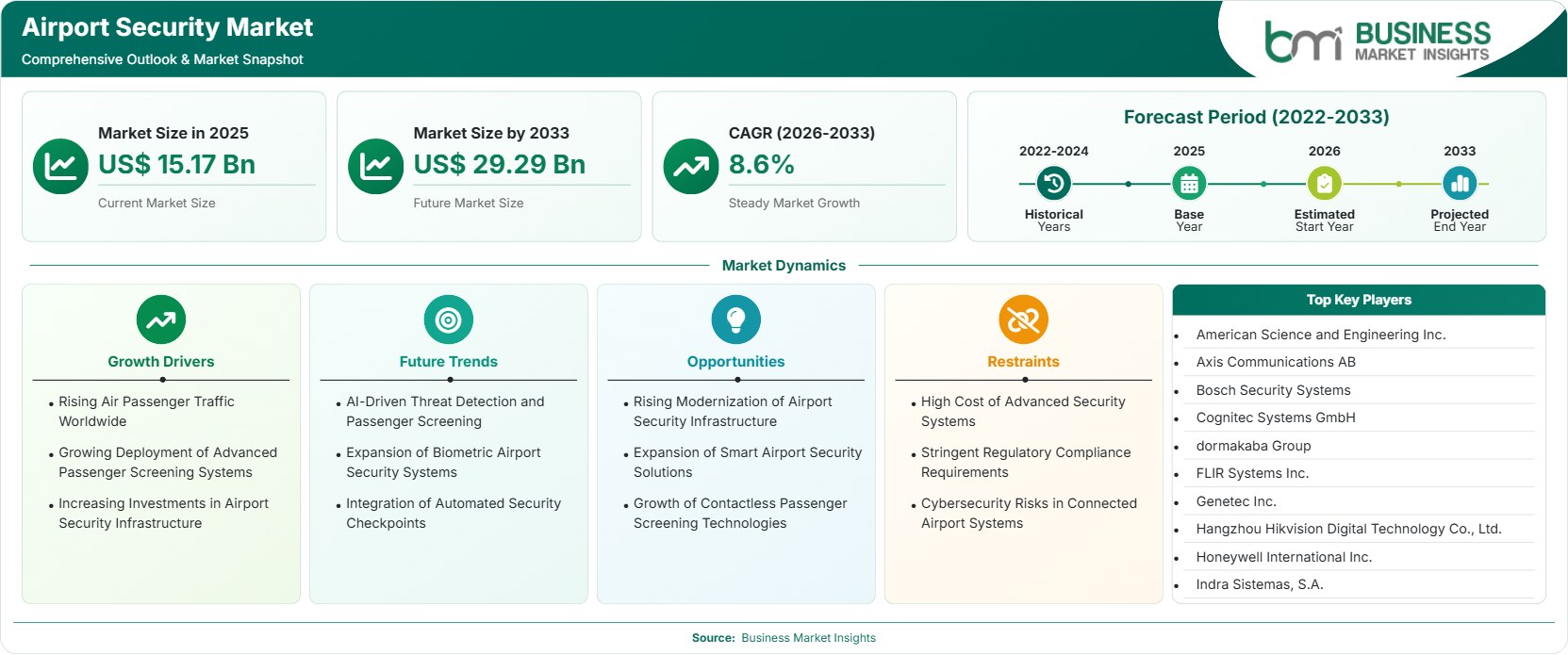
The Airport Security Market size was valued at USD 15.17 Billion in 2025 and is projected to reach USD 29.29 Billion by 2033, growing at a CAGR of 8.6% during 2026–2033. Growth is driven by increasing air passenger traffic, rising investments in airport modernization, growing concerns regarding aviation security, expanding adoption of advanced surveillance technologies, and increasing deployment of integrated security management systems across airports worldwide.

Report Coverage
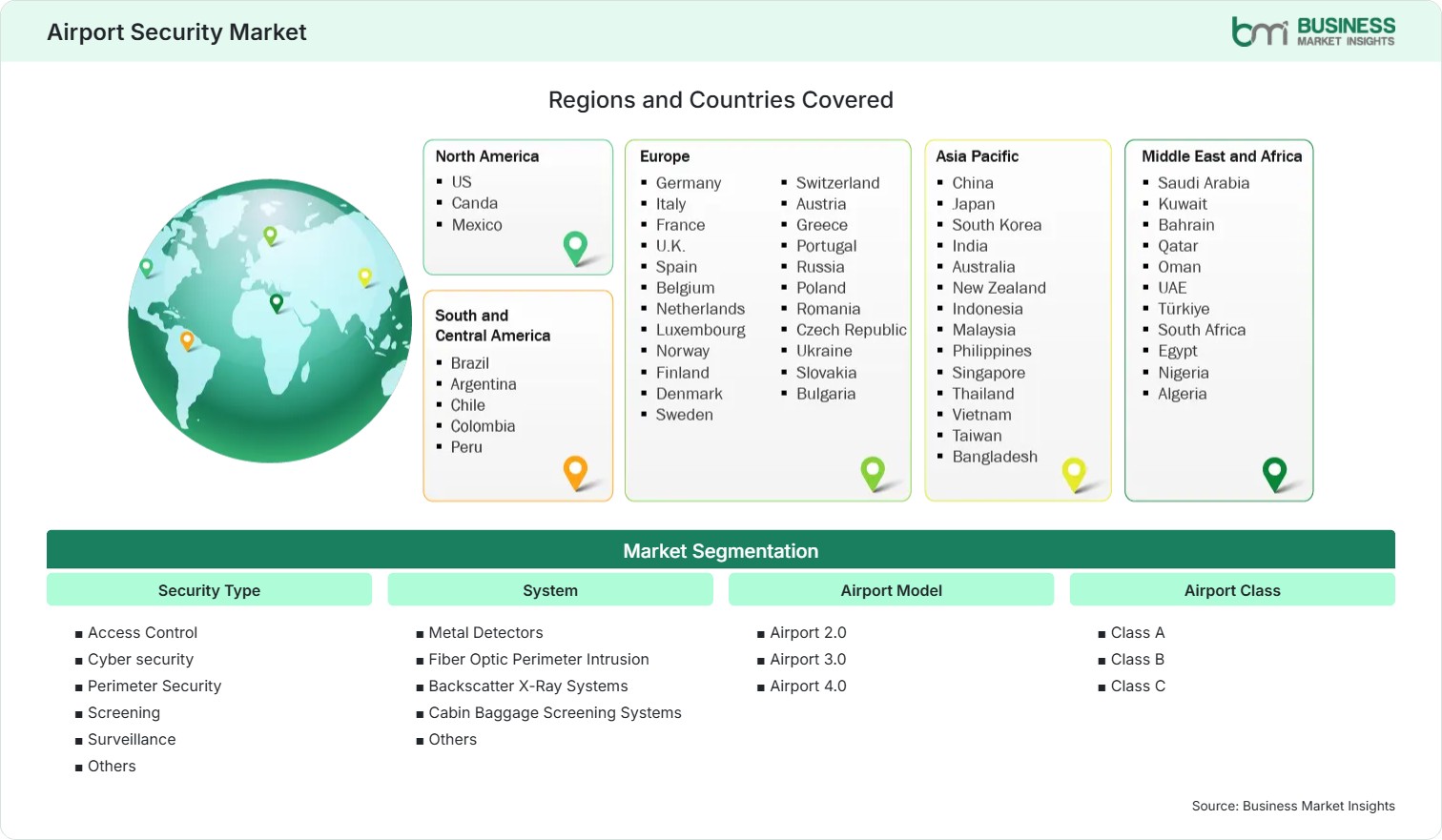
  • Security Type: Access Control, Cyber security, Perimeter Security, Screening, Surveillance, Others
  • System: Metal Detectors, Fiber Optic Perimeter Intrusion, Backscatter X-Ray Systems, Cabin Baggage Screening Systems, Others
  • Airport Model: Airport 2.0, Airport 3.0, Airport 4.0
  • Airport Class: Class A, Class B, Class C
US$ 15.17 Bn Market size in 2025
US$ 29.29 Bn Market Size by 2033
8.6% CAGR, 2026 - 2033
2026-2033 Forecast Period

01 AI Overview

Airport Security Market Summary

  • North America Region: North America holds an airport security market share of 32%–35% in 2025, growing at a CAGR of 8.0%–8.6% during 2026–2033. Demand is supported by extensive airport infrastructure, high security spending, and increasing adoption of advanced screening technologies. The U.S. remains the dominant market, advancing at a CAGR of 8.2%–8.8%.
  • Fastest Growing Region: Asia Pacific accounts for 30%–33% of revenue in 2025 and is projected to register a CAGR of 9.3%–10.0% through 2033. Expanding airport construction projects, growing passenger volumes, and increasing aviation security investments continue supporting market development.
  • Leading Segment: Screening Security holds a market share of 26%–30% in 2025 and is expected to grow at a CAGR of 8.8%–9.4%. Demand is driven by stringent aviation safety regulations and increasing passenger screening requirements.
  • High Growth Segment: Cyber Security accounts for 14%–18% of market revenue in 2025 and is projected to register a CAGR of 10.0%–10.7% during the forecast period. Growing digitization of airport operations and rising cyber threats continue supporting expansion.
  • Key Market Opportunity: Increasing implementation of smart airport technologies, integrated command centers, and AI-enabled security platforms is creating significant opportunities for market participants.
  • Major Market Players: American Science and Engineering Inc., Axis Communications AB, Bosch Security Systems, Cognitec Systems GmbH, dormakaba Group, FLIR Systems Inc., Genetec Inc., Hangzhou Hikvision Digital Technology Co., Ltd., Honeywell International Inc., and Indra Sistemas, S.A.
02 Strategic Insights

Airport Security Market: Strategic Insights

airport-security-market-market-strategic-framework
FREE PDF
Request your free sample
Request free sample
03 Stakeholder View

Key Takeaways

  • The airport security market analysis includes airport operators, aviation authorities, security technology providers, surveillance equipment manufacturers, government agencies, and system integrators.
  • Screening systems remain a major revenue contributor due to increasing passenger traffic, regulatory compliance requirements, and evolving threat detection needs.
  • Product innovation increasingly focuses on biometric authentication, intelligent video analytics, AI-driven threat detection, and integrated security management platforms.
  • Asia Pacific offers significant growth opportunities because of large-scale airport expansion projects, increasing air travel demand, and rising investments in aviation infrastructure.
  • Airport modernization initiatives are encouraging deployment of advanced access control, surveillance, perimeter protection, and cybersecurity solutions.
  • Cyber security is emerging as a critical priority as airports become increasingly dependent on connected systems, digital platforms, and automated operational technologies.
  • Government regulations and international aviation safety standards continue influencing technology adoption across airport security operations.
  • Smart airport development programs are accelerating the integration of security technologies into unified operational management systems.
  • Security providers are increasingly combining physical security and digital security capabilities to address evolving threat environments.
  • Continuous investment in passenger safety, operational resilience, and critical infrastructure protection is a major global airport security market trends.
04 Geographic Outlook

Airport Security Market Regional Highlights

North America Airport Security Market

North America accounted for 32%–35% of global revenue in 2025 and is projected to expand at a CAGR of 8.0%–8.6% through 2033. Growth is supported by extensive airport infrastructure, increasing passenger traffic, rising investments in aviation security modernization, and growing deployment of advanced screening technologies. The Airport Security Market share in the region continues benefiting from stringent regulatory requirements and strong investments in digital airport operations.

  • Major airports are increasingly deploying biometric identification systems to improve passenger verification and operational efficiency.
  • Investments in next-generation baggage screening, threat detection, and intelligent surveillance technologies continue supporting airport security market expansion.
  • Airport authorities are integrating cybersecurity solutions to protect critical operational systems and passenger data.
  • Growing focus on reducing passenger wait times is encouraging adoption of automated security screening technologies.
  • Strong government support for aviation safety initiatives continues accelerating technology upgrades across airport facilities.

US Airport Security Market

The United States represented 27%–30% of global revenue in 2025 and is anticipated to register a CAGR of 8.2%–8.8% during the forecast period. Demand is driven by increasing domestic and international air travel, ongoing airport modernization programs, and rising investments in advanced security systems. Continued implementation of technology-driven security solutions supports Airport Security Market growth.

  • Airports continue adopting AI-enabled surveillance systems to enhance situational awareness and threat detection.
  • Increasing passenger volumes are driving investments in automated and high-capacity screening systems.
  • Airport operators are expanding cybersecurity capabilities to address growing digital security concerns.
  • Smart airport initiatives continue encouraging deployment of integrated security management platforms.

Europe Airport Security Market

Europe held 25%–28% of global revenue in 2025 and is projected to grow at a CAGR of 8.3%–8.9% through 2033. Rising passenger traffic, increasing airport modernization projects, and growing demand for advanced threat detection technologies continue supporting market expansion. Germany remains the leading airport security market with a CAGR of 8.4%–9.0%, while Poland is the fastest-growing country, expanding at a CAGR of 9.0%–9.6%.

  • Airport operators are increasingly adopting integrated surveillance and access control solutions.
  • Expansion of smart airport technologies continues driving demand for advanced security infrastructure.
  • Germany maintains leadership through strong aviation activity and substantial investment in airport modernization.
  • Biometric passenger processing technologies are witnessing growing adoption across European airports.
  • Enhanced regulatory focus on aviation safety continues supporting long-term technology deployment.

Asia Pacific Airport Security Market

Asia Pacific accounted for 30%–33% of global revenue in 2025 and is expected to remain the fastest-growing region, registering a CAGR of 9.3%–10.0% through 2033. Expanding airport construction, rising passenger traffic, increasing government investments, and growing aviation infrastructure development continue driving market growth. China remains the largest regional market with a CAGR of 9.1%–9.8%, while India records the highest growth at 9.8%–10.5%.

  • Large-scale airport expansion projects are creating significant demand for advanced security systems and monitoring technologies.
  • China benefits from rapid aviation infrastructure growth and increasing adoption of integrated airport security platforms.
  • India is witnessing growing investments in airport modernization, digital security infrastructure, and passenger screening technologies.
  • Rising international travel activity is increasing demand for efficient passenger processing and threat detection solutions.
  • Smart airport development programs continue driving adoption of AI-powered surveillance, biometrics, and automated screening systems.

Rest of World Airport Security Market

The Rest of World region accounted for 7%–10% of global revenue in 2025 and is expected to register a CAGR of 8.1%–8.7% through 2033. Airport security market growth is supported by increasing airport development projects, rising tourism activity, and growing investments in aviation security infrastructure. Demand remains particularly strong across passenger screening, perimeter security, and surveillance applications.

Brazil is the leading market in South & Central America and is forecast to grow at a CAGR of 8.3%–8.9%. In the Middle East & Africa, Saudi Arabia is expected to be the fastest-growing country with a CAGR of 8.7%–9.3%.

  • Brazil continues benefiting from airport modernization programs and increasing passenger traffic.
  • Saudi Arabia is witnessing substantial investments in aviation infrastructure and airport security technologies.
  • Perimeter security systems are increasingly deployed to protect critical airport assets and operations.
  • Airport authorities are strengthening cyber security capabilities alongside physical security infrastructure.
  • Rising international connectivity and tourism growth continue creating long-term market opportunities.
global-market-geography
FREE PDF
Request your free sample
Request free sample
05 Segment Analysis

Airport Security Market Segmentation

Security Type

Security systems continue evolving as airports increasingly prioritize passenger safety, operational continuity, and protection of critical infrastructure. Screening Security leads the segment with 26%–30% share in 2025 and is projected to grow at a CAGR of 8.8%–9.4% through 2033. The Airport Security Market scope continues expanding as airport authorities strengthen threat detection capabilities and modernize security frameworks to accommodate growing passenger volumes.

  • Access Control: Supports identity verification, restricted area management, employee authentication, and secure facility access.
  • Cyber Security: Represents the fastest-growing segment due to increasing digitization of airport systems and the need to protect critical digital infrastructure.
  • Perimeter Security: Remains essential for safeguarding airport boundaries, runways, restricted zones, and operational facilities.
  • Screening: Dominates market demand due to strict passenger, baggage, and cargo inspection requirements.
  • Surveillance: Continues witnessing strong adoption through deployment of intelligent cameras, analytics platforms, and real-time monitoring systems.
  • Others: Include command-and-control systems, emergency response technologies, and integrated security platforms.

System

System adoption continues increasing as airports invest in technologies designed to improve detection accuracy, operational efficiency, and passenger throughput.

  • Metal Detectors: Widely deployed for passenger screening and threat identification.
  • Fiber Optic Perimeter Intrusion Systems: Support real-time perimeter monitoring and unauthorized access detection.
  • Backscatter X-Ray Systems: Improve identification of concealed threats and prohibited items.
  • Cabin Baggage Screening Systems: Remain critical to ensuring passenger safety and regulatory compliance.
  • Others: Include biometric scanners, explosive detection systems, facial recognition technologies, and integrated security monitoring platforms.

Airport Model

Airport modernization initiatives continue driving adoption of advanced security technologies across evolving airport operational models.

  • Airport 2.0: Focuses on traditional security measures and centralized operational oversight.
  • Airport 3.0: Integrates digital technologies, automation, and enhanced passenger management systems.
  • Airport 4.0: Represents the fastest-growing segment through adoption of AI, IoT, biometrics, predictive analytics, and smart security infrastructure.

Airport Class

Demand varies according to passenger traffic, operational complexity, and infrastructure requirements.

  • Class A: Represents the largest segment due to high passenger throughput, international operations, and advanced security requirements.
  • Class B: Utilizes a combination of screening, surveillance, and access control solutions to support medium-sized airport operations.
  • Class C: Increasingly adopts scalable and cost-effective security technologies to address evolving regulatory requirements.
06 Market Forces

Airport Security Market Dynamics

Key Market Drivers

Rising Air Passenger Traffic Worldwide

The continuous increase in global air passenger traffic is creating significant demand for advanced airport security solutions. Airports are handling larger passenger volumes than ever before, requiring efficient systems capable of maintaining safety while minimizing delays. Growing international tourism, business travel, and regional air connectivity are placing additional pressure on airport infrastructure and security operations. Airport operators are increasingly investing in technologies that improve passenger throughput without compromising security standards. As air travel demand continues rising globally, the need for scalable and sophisticated airport security systems is expected to strengthen considerably.

Growing Deployment of Advanced Passenger Screening Systems

Airport operators are increasingly implementing advanced passenger screening technologies to improve threat detection accuracy and operational efficiency. Modern screening systems utilize artificial intelligence, imaging technologies, automated detection capabilities, and data analytics to identify potential security risks more effectively. These systems help enhance passenger safety while reducing manual inspection requirements and processing times. Regulatory authorities continue encouraging adoption of advanced screening technologies to address evolving aviation threats. This trend remains a major contributor to market growth.

Increasing Investments in Airport Security Infrastructure

Governments, airport authorities, and aviation stakeholders are directing substantial investments toward upgrading airport security infrastructure. Modernization programs often include surveillance systems, perimeter protection technologies, biometric authentication platforms, security command centers, and cybersecurity capabilities. These investments are designed to improve operational resilience, support regulatory compliance, and strengthen overall airport safety. As airport expansion projects continue globally, security infrastructure spending is expected to rise steadily throughout the forecast period.

Key Market Opportunities

Rising Modernization of Airport Security Infrastructure

Airport modernization projects are creating substantial opportunities for security technology providers and system integrators. Aging airport facilities are increasingly being upgraded with advanced screening equipment, digital surveillance systems, access control technologies, and intelligent monitoring platforms. Airport authorities are prioritizing investments that improve security effectiveness while enhancing passenger experience. Large-scale infrastructure development programs across emerging and developed markets continue supporting technology adoption. This modernization trend is expected to generate significant long-term opportunities throughout the airport security ecosystem.

Expansion of Smart Airport Security Solutions

The growing adoption of smart airport concepts is accelerating demand for integrated security solutions that combine physical security, data analytics, automation, and real-time monitoring. Smart airports increasingly rely on AI-powered surveillance, biometric passenger processing, predictive threat detection, and centralized command centers. These technologies improve operational efficiency while enabling more proactive security management. As airports continue pursuing digital transformation strategies, providers of intelligent security solutions are expected to benefit from expanding market opportunities.

Growth of Contactless Passenger Screening Technologies

Contactless passenger screening solutions are gaining popularity due to their ability to improve efficiency, convenience, and safety. Airports are increasingly adopting biometric authentication, facial recognition systems, touchless identity verification platforms, and automated screening technologies. These solutions help streamline passenger movement while maintaining robust security standards. Growing emphasis on passenger experience and operational efficiency continues encouraging investment in contactless technologies. This trend is expected to create attractive opportunities for airport security technology providers during the forecast period.

Market Restraints and Challenges

High Cost of Advanced Security Systems

Factor: Advanced airport security technologies often require significant capital investment in hardware, software, installation, infrastructure upgrades, and ongoing maintenance activities.

Impact: High implementation costs can limit adoption among smaller airports and delay modernization initiatives in budget-constrained regions. Airport operators may face challenges balancing security improvements with financial considerations. These pressures can influence technology deployment timelines and procurement strategies.

Stringent Regulatory Compliance Requirements

Factor: Airport security systems must comply with rigorous aviation safety regulations, certification standards, testing procedures, and operational requirements established by national and international authorities.

Impact: Regulatory compliance obligations can increase deployment complexity, extend implementation timelines, and raise overall project costs. Security vendors and airport operators must continuously adapt to evolving standards while maintaining operational efficiency. These factors can create additional administrative and technical challenges across the industry.

07 Company Analysis

Competitive Landscape

The market remains highly competitive with the presence of surveillance technology providers, access control specialists, airport screening equipment manufacturers, biometric solution providers, and integrated security system developers. Companies are focusing on AI-powered threat detection, biometric passenger processing, intelligent video surveillance, perimeter intrusion detection, and integrated airport security platforms. Growing investments in smart airports and aviation safety continue shaping Airport Security Market analysis and competitive strategies across the global aviation security industry.

Company Name

Overview

Products and Services Relevant to this Market

American Science and Engineering Inc.

Security technology company specializing in advanced inspection and screening solutions.

X-ray screening systems, cargo inspection solutions, airport security technologies.

Axis Communications AB

Provider of network security and surveillance solutions.

IP cameras, video surveillance systems, security analytics platforms.

Bosch Security Systems

Security technology company serving transportation and infrastructure sectors.

Surveillance systems, access control solutions, intrusion detection technologies.

Cognitec Systems GmbH

Biometric technology company focused on identity verification solutions.

Facial recognition systems, biometric identification platforms, airport security solutions.

dormakaba Group

Access control and security solutions provider.

Access management systems, identity verification, airport entry control solutions.

FLIR Systems Inc.

Developer of thermal imaging and security technologies.

Thermal cameras, perimeter security systems, surveillance solutions.

Genetec Inc.

Security software and unified security management provider.

Video management systems, access control platforms, security analytics software.

Hangzhou Hikvision Digital Technology Co., Ltd.

Provider of intelligent surveillance and monitoring solutions.

Video surveillance, AI-enabled security systems, airport monitoring technologies.

Honeywell International Inc.

Industrial technology company offering airport and critical infrastructure security solutions.

Airport security systems, surveillance platforms, integrated safety technologies.

Indra Sistemas, S.A.

Technology company serving aviation and transportation markets.

Airport security management systems, surveillance solutions, operational control platforms.

08 Industry Activity

Recent Developments

July 2026

Tata Consultancy Services (TCS) was announced as the strategic technology and innovation partner for New York’s New Terminal One at JFK Airport to deploy AI-driven solutions spanning passenger processing, baggage handling, and cybersecurity platforms.

July 2026

TSA installed advanced computed tomography (CT) screening systems at Juneau International Airport, enhancing threat-detection capabilities with 3D imaging while allowing passengers to keep laptops and approved liquids inside their carry-on bags.

March 2026

RX Global announced that the 25th edition of the Airport Show will be hosted at the Dubai World Trade Centre from May 12 to 14, 2026, showcasing next-generation 3D Computed Tomography (CT) scanners and advanced airport security systems.

10 Trust & Transparency

Research Methodology

The market analysis combines proprietary research with secondary data from government agencies, company disclosures, regulatory filings, industry databases and expert interviews. Market estimates are validated through data triangulation, cross-market benchmarking and analyst review.

View Full Research Methodology

11 Questions Answered

Frequently Asked Questions

What challenge has the greatest long-term impact on the industry?

High costs associated with advanced security technologies remain a significant challenge because airports must balance security enhancement requirements with infrastructure investment and operational budget constraints.

How are smart airport initiatives influencing market growth?

Smart airport initiatives are accelerating adoption of AI-enabled surveillance, biometrics, integrated command centers, automated screening systems, and intelligent security management platforms.

Why is Asia Pacific the fastest-growing region?

The region benefits from extensive airport construction projects, increasing air travel demand, rising government investment in aviation infrastructure, and growing adoption of advanced security technologies.

Which security type segment leads the market?

Screening Security leads the airport security market forecast due to stringent aviation regulations, increasing passenger volumes, and the growing need for effective threat detection systems.

What is driving growth in the Airport Security Market report?

Rising air passenger traffic worldwide, growing deployment of advanced passenger screening systems, increasing investments in airport security infrastructure, and modernization of airport facilities are the primary growth drivers.

Access the Full Airport Security Market Report

Get segment-level forecasts, regional estimates, competitive benchmarking, company profiles and downloadable Excel datasets.

Access the full Airport Security Market Report
350 pages PDF & Excel | 2026-07-29