
Maritime Security Market Outlook: Size, Share, Trends, Growth Analysis, Competitive Landscape & Forecast, 2026-2033

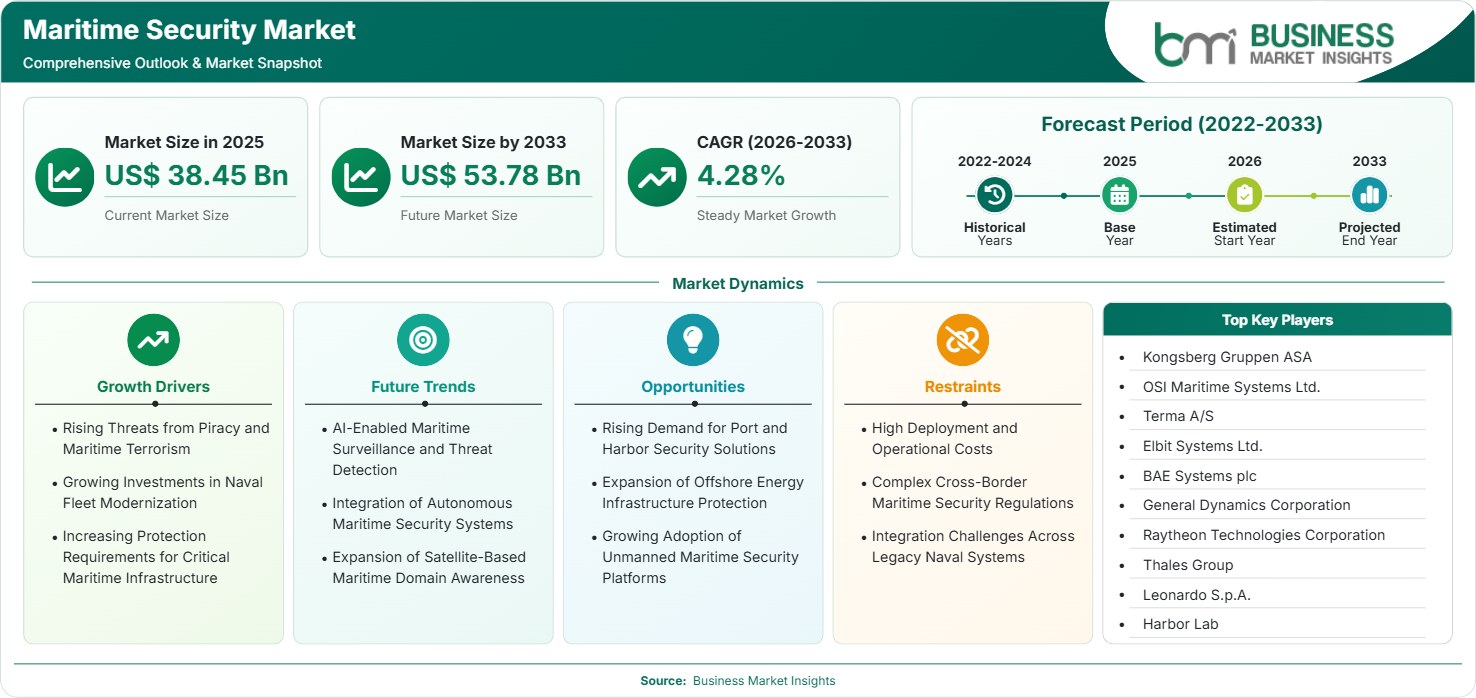
The Maritime Security Market size was valued at US$ 38.45 Billion in 2025 and is projected to reach US$ 53.78 Billion by 2033, growing at a CAGR of 4.28% during 2026–2033. Increasing maritime trade activities, rising concerns regarding piracy and illegal trafficking, growing investments in coastal surveillance infrastructure, and expanding adoption of advanced maritime monitoring technologies are supporting market growth globally.

Report Coverage
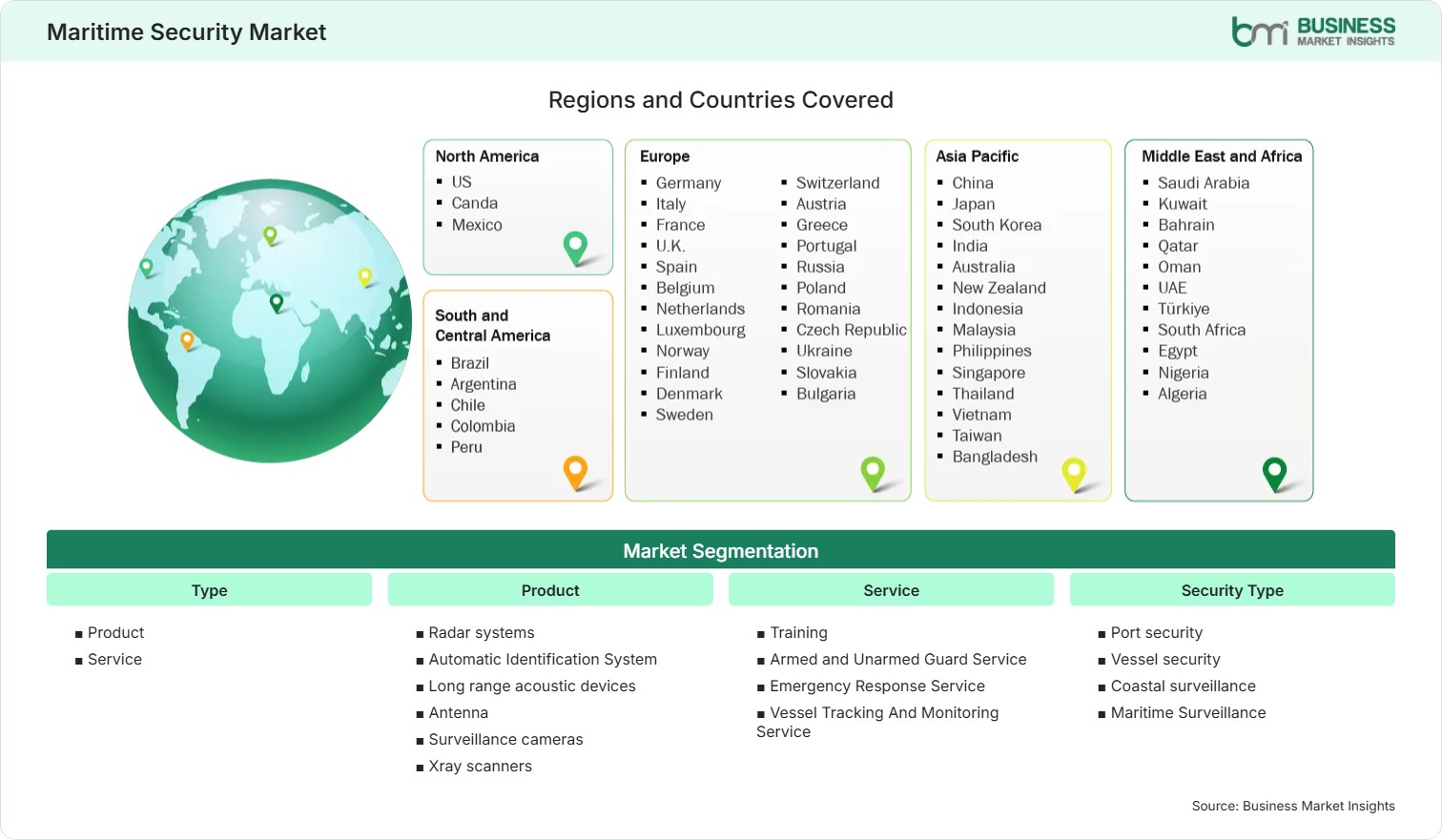
  • Type: Product, Service
  • Product: Radar systems, Automatic Identification System, Long range acoustic devices, Antenna, Surveillance cameras, Xray scanners
  • Service: Training, Armed and Unarmed Guard Service, Emergency Response Service, Vessel Tracking And Monitoring Service
  • Security Type: Port security, Vessel security, Coastal surveillance, Maritime Surveillance
  • End User: Shipping Companies, Government, Port Authorities
US$ 38.45 Bn Market size in 2025
US$ 53.78 Bn Market Size by 2033
4.28% CAGR, 2026 - 2033
2026-2033 Forecast Period

AI Overview

Maritime Security Market Summary

  • North America Region: North America holds a maritime security market share of 35%–38% in 2025, growing with a CAGR of 3.9%–4.4% during 2026–2033. Strong defense spending, advanced coastal surveillance networks, increasing port security investments, and growing maritime threat monitoring capabilities continue supporting regional leadership. The U.S. market is expected to register a CAGR of 4.0%–4.5%.
  • Fastest Growing Region: Asia Pacific accounts for 26%–29% share in 2025 and is projected to grow at a CAGR of 5.1%–5.7% through 2033. Expanding maritime trade routes, increasing naval modernization programs, rising port infrastructure investments, and growing coastal monitoring initiatives continue driving regional growth.
  • Leading Segment: Product represents 58%–61% share in 2025 and is expected to grow at a CAGR of 4.1%–4.7% through 2033. Increasing deployment of radar systems, AIS technologies, surveillance cameras, and maritime detection equipment continues supporting segment dominance.
  • High Growth Segment: Maritime Surveillance accounts for 18%–21% share in 2025 and is forecast to grow at a CAGR of 5.6%–6.2% during 2026–2033. Growing emphasis on maritime domain awareness, threat detection, and border protection initiatives is accelerating adoption.
  • Key Market Opportunity: Integration of artificial intelligence, vessel tracking analytics, unmanned surveillance platforms, and real-time maritime monitoring solutions is creating substantial opportunities for market participants.
  • Major Market Players: Kongsberg Gruppen ASA, OSI Maritime Systems Ltd., Terma A/S, Elbit Systems Ltd., BAE Systems plc, General Dynamics Corporation, Raytheon Technologies Corporation, Thales Group, Leonardo S.p.A., Harbor Lab.
Strategic Insights

Maritime Security Market: Strategic Insights

Maritime Security Market Strategic Framework
FREE PDF
Request your free sample
Request free sample
Stakeholder View

Key Takeaways

  • Maritime security solutions are becoming essential for protecting trade routes, ports, offshore assets, and national maritime boundaries.
  • Product-based solutions continue generating the highest revenue contribution due to widespread deployment of surveillance and detection technologies.
  • Maritime surveillance remains one of the fastest-growing segments supported by increasing investments in real-time maritime monitoring capabilities.
  • Asia Pacific presents significant growth opportunities due to rising maritime trade volumes and extensive coastal infrastructure development.
  • Artificial intelligence and advanced analytics are increasingly enhancing maritime threat detection and operational response capabilities.
  • Governments worldwide continue strengthening maritime security frameworks through investments in integrated monitoring and surveillance systems.
Geographic Outlook

Maritime Security Market Regional Highlights

North America Maritime Security Market

North America accounts for 35%–38% Maritime Security Market share in 2025 and is projected to grow at a CAGR of 3.9%–4.4% through 2033. Strong defense spending, advanced surveillance infrastructure, and growing focus on maritime border security continue supporting regional growth. Government agencies are increasingly modernizing monitoring capabilities to improve maritime domain awareness and threat response effectiveness.

  • Maritime authorities are investing in integrated surveillance systems that improve real-time monitoring of coastal zones, commercial shipping routes, and critical maritime infrastructure.
  • Growing concerns regarding smuggling, unauthorized vessel movements, and maritime cyber threats are driving adoption of advanced security technologies.
  • Increasing modernization of port facilities is creating demand for sophisticated monitoring and access-control solutions capable of enhancing security operations.
  • Defense organizations continue deploying advanced radar and vessel tracking systems to strengthen coastal security and maritime situational awareness.
  • Ongoing investments in digital maritime infrastructure are supporting wider adoption of data-driven monitoring and security management platforms.

US Maritime Security Market

The United States contributes approximately 82%–86% of North American revenue and is expected to register a CAGR of 4.0%–4.5% through 2033. Continuous investments in naval modernization, coastal protection programs, and advanced surveillance technologies continue supporting maritime security market leadership.

  • Government agencies continue emphasizing maritime border protection and critical infrastructure security through technology modernization initiatives.
  • Port authorities are increasingly deploying integrated security platforms that combine surveillance, vessel tracking, and threat detection capabilities.
  • Enhanced focus on cyber resilience within maritime environments is creating new opportunities for advanced security solutions.
  • Strategic maritime interests continue encouraging sustained investment in monitoring and defense-related technologies.

Europe Maritime Security Market

Europe represents 25%–28% of global revenue in 2025 and is anticipated to expand at a CAGR of 4.1%–4.7% through 2033. Increasing focus on maritime border management, port security, and protection of offshore infrastructure continues supporting regional growth. Germany remains the leading market while Poland demonstrates stronger growth momentum.

  • Germany continues leading regional adoption through strong defense capabilities and ongoing investments in maritime surveillance systems.
  • Poland is among the fastest-growing countries and is estimated to record a CAGR of 5.0%–5.6% during the forecast period.
  • Maritime authorities are enhancing vessel tracking and coastal surveillance capabilities to improve security operations.
  • Offshore energy infrastructure protection remains an important driver for advanced monitoring technologies.
  • Collaborative regional security programs continue encouraging investment in integrated maritime surveillance solutions.

Asia Pacific Maritime Security Market

Asia Pacific accounts for 26%–29% of global revenue in 2025 and is expected to achieve the fastest CAGR of 5.1%–5.7% through 2033. Rising maritime trade volumes, expanding naval capabilities, and increasing coastal infrastructure investments continue supporting strong regional growth.

  • China remains the largest regional maritime security market due to extensive coastline protection requirements and large-scale investments in maritime infrastructure.
  • India is projected to achieve approximately 5.8%–6.4% CAGR, supported by coastal security modernization, naval investments, and increasing maritime trade activity.
  • Growing concerns regarding territorial waters and maritime border protection are strengthening demand for advanced surveillance systems.
  • Expansion of commercial ports and shipping activities continues creating opportunities for maritime monitoring solutions.
  • Governments are increasingly adopting integrated security frameworks to improve maritime domain awareness and operational readiness.

Rest of World Maritime Security Market

Rest of World accounts for 9%–12% of global revenue in 2025 and is projected to expand at a CAGR of 4.3%–4.9% through 2033. Growing investments in port security, coastal monitoring, and maritime trade infrastructure continue supporting maritime security market development across emerging economies.

  • Brazil continues generating demand for maritime security technologies due to growing offshore energy activities and expanding port infrastructure.
  • The UAE is witnessing increased adoption of advanced maritime monitoring solutions to protect strategic shipping routes and commercial ports.
  • Saudi Arabia is expected to achieve approximately 5.0%–5.6% CAGR through 2033, driven by maritime infrastructure expansion and coastal security modernization initiatives.
  • Governments are increasingly prioritizing critical maritime infrastructure protection to support economic and national security objectives.
  • Growing adoption of integrated surveillance and vessel tracking technologies is improving maritime operational visibility across emerging regions.
Global Market Geography
FREE PDF
Request your free sample
Request free sample
Segment Analysis

Maritime Security Market Segmentation

Type

The type segment represents the primary structure of the maritime security industry, encompassing both hardware solutions and specialized security services designed to protect maritime assets, ports, vessels, and coastal infrastructure. The segment accounts for approximately 58%–61% share in 2025 and is projected to grow at a CAGR of 4.1%–4.7% through 2033. The expanding Maritime Security Market scope is supported by increasing maritime trade, growing security threats, rising defense expenditures, and expanding requirements for integrated maritime surveillance systems.

  • Product: Products dominate the market due to increasing deployment of radar systems, surveillance technologies, vessel monitoring equipment, and maritime detection solutions across commercial and defense applications.
  • Service: Services continue gaining importance as organizations seek professional training, vessel monitoring, guard services, and rapid response capabilities to improve maritime security preparedness.

Product

Product-based solutions continue forming the technological foundation of maritime security operations. This segment accounts for approximately 34%–37% share in 2025 and is expected to grow at a CAGR of 4.3%–4.9% through 2033. Current Maritime Security Market trends indicate increasing adoption of intelligent surveillance platforms and real-time monitoring technologies capable of strengthening maritime situational awareness.

  • Radar Systems: Radar systems remain a core component of maritime security infrastructure due to their ability to detect, track, and monitor vessel activity across large maritime zones.
  • Automatic Identification System (AIS): AIS technologies enable vessel identification, navigation monitoring, traffic management, and enhanced maritime domain awareness.
  • Long Range Acoustic Devices (LRAD): LRAD systems are increasingly used for communication, deterrence, crowd management, and vessel warning applications within maritime environments.
  • Antenna: Antenna systems support maritime communication networks, surveillance platforms, vessel tracking systems, and operational coordination capabilities.
  • Surveillance Cameras: Surveillance cameras provide real-time visual monitoring of ports, vessels, offshore assets, and maritime facilities to strengthen security operations.
  • X-ray Scanners: X-ray scanning solutions are widely utilized across ports and cargo facilities to detect contraband, unauthorized materials, and potential security threats.

Service

Maritime security services are becoming increasingly important as governments and commercial operators seek specialized expertise to address evolving threats. This segment accounts for approximately 27%–30% share in 2025 and is projected to grow at a CAGR of 4.7%–5.3% through 2033. Demand is increasing for proactive security management, threat response, and operational support services.

  • Training: Training services focus on improving preparedness, emergency response capabilities, regulatory compliance, and security awareness among maritime personnel.
  • Armed and Unarmed Guard Service: Security guard services help protect vessels, ports, cargo operations, and offshore assets against potential security threats.
  • Emergency Response Service: Emergency response services provide rapid intervention capabilities to address incidents involving piracy, security breaches, accidents, and operational disruptions.
  • Vessel Tracking and Monitoring Service: Tracking and monitoring services offer continuous vessel visibility, route management, threat assessment, and operational intelligence support.

Security Type

Security type segmentation reflects the diverse security requirements across maritime ecosystems. This segment accounts for approximately 31%–34% share in 2025 and is expected to expand at a CAGR of 4.8%–5.4% through 2033. Increasing geopolitical tensions and maritime threats continue driving investments across all security categories.

  • Port Security: Port security remains critical for safeguarding cargo operations, infrastructure assets, personnel, and logistics networks from security risks.
  • Vessel Security: Vessel security solutions focus on protecting ships, crew members, cargo, and onboard systems from piracy, theft, and unauthorized activities.
  • Coastal Surveillance: Coastal surveillance systems help governments monitor territorial waters, maritime boundaries, and illegal maritime activities.
  • Maritime Surveillance: Maritime surveillance represents the fastest-growing segment due to increasing demand for comprehensive maritime domain awareness, real-time monitoring, and threat detection capabilities.

End User

End-user demand continues expanding as both public and private organizations prioritize maritime safety and security investments. This segment accounts for approximately 36%–39% share in 2025 and is projected to grow at a CAGR of 4.5%–5.1% through 2033. Increasing vessel traffic and maritime infrastructure development are strengthening demand across all customer groups.

  • Shipping Companies: Shipping companies invest in maritime security solutions to protect vessels, cargo assets, crew safety, and business continuity across international trade routes.
  • Government: Government agencies remain major adopters due to coastal defense requirements, border protection initiatives, naval security programs, and critical infrastructure protection objectives.
  • Port Authorities: Port authorities increasingly deploy advanced security solutions to improve operational safety, cargo inspection capabilities, surveillance effectiveness, and regulatory compliance.
Market Forces

Maritime Security Market Dynamics

Key Market Drivers

Rising Threats from Piracy and Maritime Terrorism

Maritime transport is still experiencing the same security threats, such as piracy, criminal trafficking, smuggling, attacks and maritime terrorism. All these threats are a serious menace to the safety of the vessels, their crew, cargo operations, and maritime trade. Security in maritime transportation is becoming more and more sophisticated through the use of sophisticated surveillance systems, vessel monitoring systems and threat detection systems. Growing fear about the safety of strategic waterways and maritime assets creates consistent demand for maritime security solutions.

Growing Investments in Naval Fleet Modernization

Many countries are actively modernizing naval fleets and maritime defense capabilities to improve operational readiness and strengthen national security. Investments in advanced surveillance systems, maritime monitoring technologies, communication infrastructure, and integrated command platforms are increasing significantly. Modernization initiatives are creating demand for sophisticated maritime security products and support services capable of enhancing threat detection, information sharing, and operational coordination. As geopolitical concerns continue influencing defense spending decisions, maritime security technologies remain a strategic investment priority for numerous governments.

Increasing Protection Requirements for Critical Maritime Infrastructure

Ports, offshore energy facilities, shipping terminals, naval bases, and coastal infrastructure play a critical role in national economies and global supply chains. These assets face risks from physical security threats, operational disruptions, cyberattacks, and unauthorized activities. Governments and infrastructure operators are investing in advanced protection systems designed to improve monitoring, access control, and response capabilities. The growing importance of safeguarding maritime infrastructure continues driving demand for integrated security solutions and specialized services across global markets.

Key Market Opportunities

Rising Demand for Port and Harbor Security Solutions

Global growth in maritime trade and cargo handling activities is increasing the importance of securing ports and harbors. Port operators are adopting advanced surveillance platforms, scanning technologies, access control systems, and vessel tracking capabilities to improve operational security. Increasing regulatory requirements and security compliance standards are further encouraging technology adoption. As ports continue expanding capacity and handling larger cargo volumes, demand for comprehensive harbor security solutions is expected to grow significantly.

Expansion of Offshore Energy Infrastructure Protection

Offshore oil, gas, and renewable energy installations represent valuable assets that require continuous monitoring and protection. Security threats targeting offshore infrastructure can create economic, environmental, and operational risks. As offshore energy investments increase globally, operators are deploying surveillance systems, vessel monitoring services, and emergency response solutions to strengthen asset protection. This expansion is creating substantial opportunities for maritime security technology providers and service companies.

Growing Adoption of Unmanned Maritime Security Platforms

Unmanned maritime technologies are increasingly being utilized to enhance surveillance, reconnaissance, and monitoring operations across coastal and offshore environments. These platforms improve operational coverage, reduce personnel risks, and provide real-time intelligence capabilities. Integration with artificial intelligence, advanced sensors, and communication systems is further expanding their effectiveness. Long-term Maritime Security Market Forecasts remain favorable as maritime authorities increasingly adopt autonomous and remotely operated solutions to strengthen maritime domain awareness.

Market Restraints and Challenges

High Deployment and Operational Costs

Factor: Maritime security systems often require substantial investments in radar infrastructure, surveillance technologies, communication networks, vessel monitoring platforms, personnel training, and maintenance activities. Large-scale deployments across coastal areas and maritime facilities can be particularly capital intensive. Impact: High implementation and operational costs may limit adoption among budget-constrained organizations and smaller maritime operators. Financial considerations can delay modernization projects and influence purchasing decisions, particularly in developing regions.

Complex Cross-Border Maritime Security Regulations

Factor: Maritime operations frequently involve multiple jurisdictions, international waters, and diverse regulatory frameworks. Security requirements may vary across countries, organizations, and maritime authorities, creating compliance complexities for operators and technology providers. Impact: Regulatory inconsistencies can increase implementation challenges, delay deployments, and raise operational costs. Organizations must invest additional resources in compliance management and coordination efforts, potentially affecting market expansion and cross-border security collaboration initiatives.

Company Analysis

Competitive Landscape

The Maritime Security Market analysis highlights a competitive environment characterized by advancements in maritime surveillance systems, naval security technologies, vessel monitoring solutions, coastal defense infrastructure, and integrated security platforms. Companies are focusing on artificial intelligence-enabled surveillance, maritime domain awareness solutions, unmanned security systems, advanced radar technologies, and real-time threat detection capabilities to strengthen their market positions and address evolving maritime security requirements.

Company Name

Overview

Products and Services relevant to this market

Kongsberg Gruppen ASA

Defense and maritime technology company providing advanced monitoring, surveillance, and maritime operational solutions.

Maritime surveillance systems, vessel monitoring solutions, coastal security technologies, integrated command systems, and maritime situational awareness platforms.

OSI Maritime Systems Ltd.

Maritime navigation and integrated security solutions provider serving naval and commercial maritime sectors.

Maritime command systems, vessel tracking solutions, navigation technologies, maritime surveillance platforms, and security management systems.

Terma A/S

Defense technology company specializing in surveillance, radar, and critical infrastructure protection solutions.

Coastal surveillance systems, radar technologies, maritime domain awareness platforms, security monitoring systems, and naval defense solutions.

Elbit Systems Ltd.

Defense electronics company delivering integrated security and surveillance technologies across maritime environments.

Maritime intelligence systems, surveillance solutions, electro-optical monitoring systems, coastal security platforms, and vessel protection technologies.

BAE Systems plc

Global defense contractor providing advanced defense, surveillance, and maritime security solutions.

Maritime surveillance technologies, naval security systems, radar platforms, intelligence solutions, and integrated maritime defense systems.

General Dynamics Corporation

Aerospace and defense company serving naval, government, and maritime security applications.

Maritime command systems, coastal security solutions, naval surveillance technologies, vessel monitoring platforms, and defense communication systems.

Raytheon Technologies Corporation

Defense and aerospace company offering advanced detection and monitoring technologies for maritime operations.

Radar systems, maritime surveillance solutions, coastal monitoring technologies, sensor networks, and maritime threat detection systems.

Thales Group

Technology and defense company specializing in transportation, surveillance, and security infrastructures.

Maritime security platforms, coastal surveillance solutions, vessel monitoring systems, radar technologies, and maritime traffic management systems.

Leonardo S.p.A.

Aerospace, defense, and security technology provider with a strong maritime solutions portfolio.

Maritime monitoring systems, coastal surveillance technologies, radar platforms, naval security solutions, and integrated defense systems.

Harbor Lab

Maritime operations technology company providing digital solutions for vessel management and maritime efficiency.

Vessel monitoring solutions, maritime operational intelligence platforms, port optimization technologies, and maritime analytics services.

Trust & Transparency

Research Methodology

The market analysis combines proprietary research with secondary data from government agencies, company disclosures, regulatory filings, industry databases and expert interviews. Market estimates are validated through data triangulation, cross-market benchmarking and analyst review.

View Full Research Methodology

Questions Answered

Frequently Asked Questions

How are emerging technologies influencing maritime security operations?

Artificial intelligence, advanced analytics, unmanned maritime platforms, integrated surveillance systems, smart sensors, and real-time monitoring technologies are enhancing operational visibility, threat identification, and maritime response capabilities.

What does this Maritime Security Market Report cover?

This report covers type analysis, product and service segmentation, security type evaluation, end-user assessment, regional opportunities, competitive landscape analysis, market dynamics, and growth prospects through 2033.

Why is maritime surveillance the fastest-growing security type segment?

Maritime surveillance is witnessing strong growth because governments and commercial operators are increasingly prioritizing maritime domain awareness, threat detection, border protection, and real-time vessel monitoring capabilities.

Which type segment holds the largest market share?

The product segment dominates the market due to widespread deployment of radar systems, AIS technologies, surveillance cameras, vessel tracking systems, and maritime monitoring equipment.

What is driving growth in the maritime security market?

Increasing maritime trade activities, rising threats from piracy and maritime terrorism, growing naval modernization programs, and expanding investments in coastal surveillance infrastructure are key factors supporting market growth.

Access the Full Maritime Security Market Report

Get segment-level forecasts, regional estimates, competitive benchmarking, company profiles and downloadable Excel datasets.

Access the full Maritime Security Market Report
350 pages PDF & Excel | 2026-08-07