
Passenger Security Market Outlook: Size, Share, Trends, Growth Analysis, Competitive Landscape & Forecast, 2026-2033

Historic Data: 2022-2024   |   Base Year: 2025   |   Forecast Period: 2026-2033
Report Content: Market Scope, Market Segmentation, Market Dynamics, and Competitive Analysis

Report Coverage:
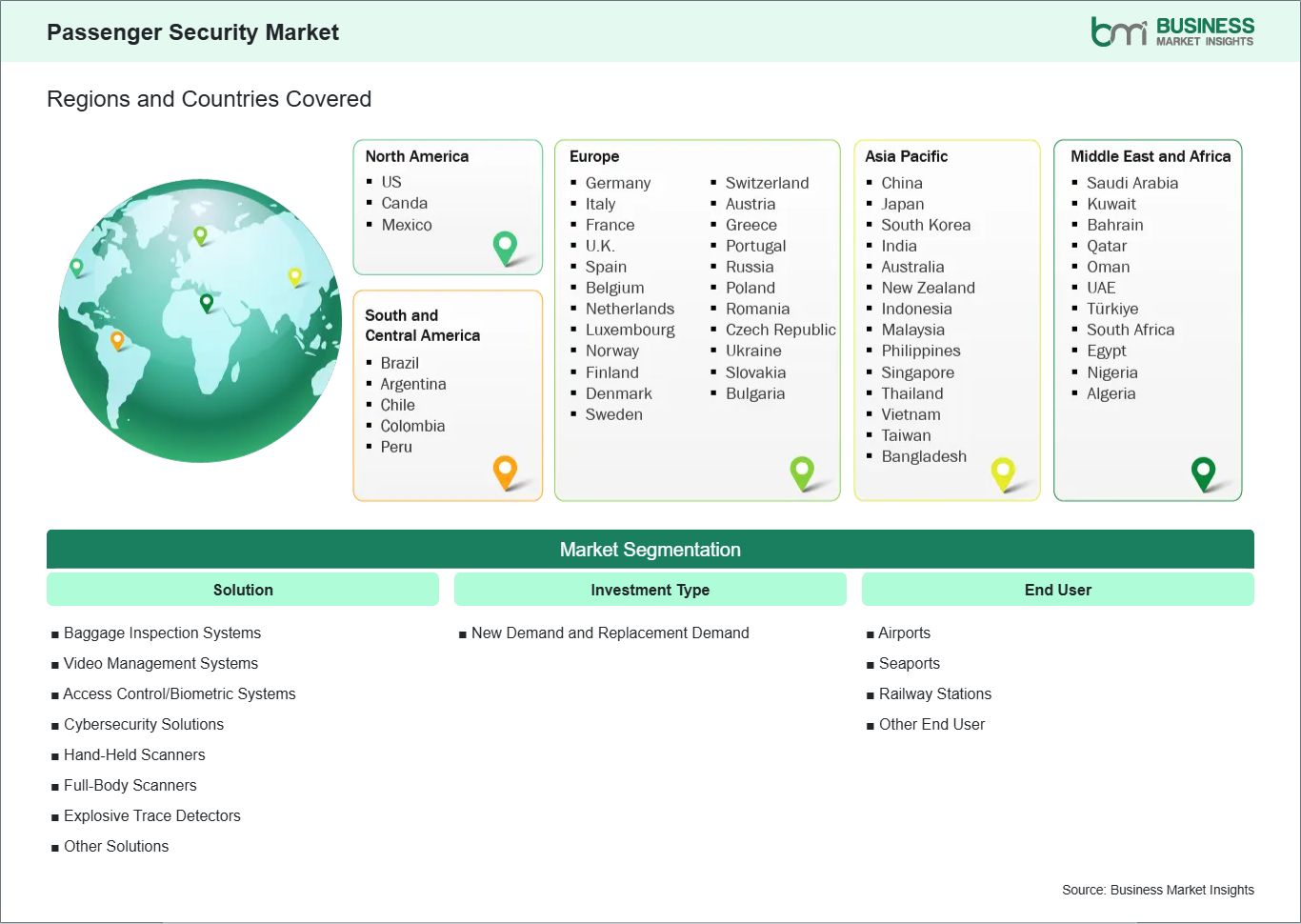
  • Solution (Baggage Inspection Systems, Video Management Systems, Access Control/Biometric Systems, Cybersecurity Solutions, Hand-Held Scanners, Full-Body Scanners, Explosive Trace Detectors, Other Solutions)
  • Investment Type (New Demand and Replacement Demand)
  • End User (Airports, Seaports, Railway Stations, Other End User)

No. of Pages: 400
Report Code: BMIPUB00035684
Category: Aerospace and Defense
Passenger Security Market

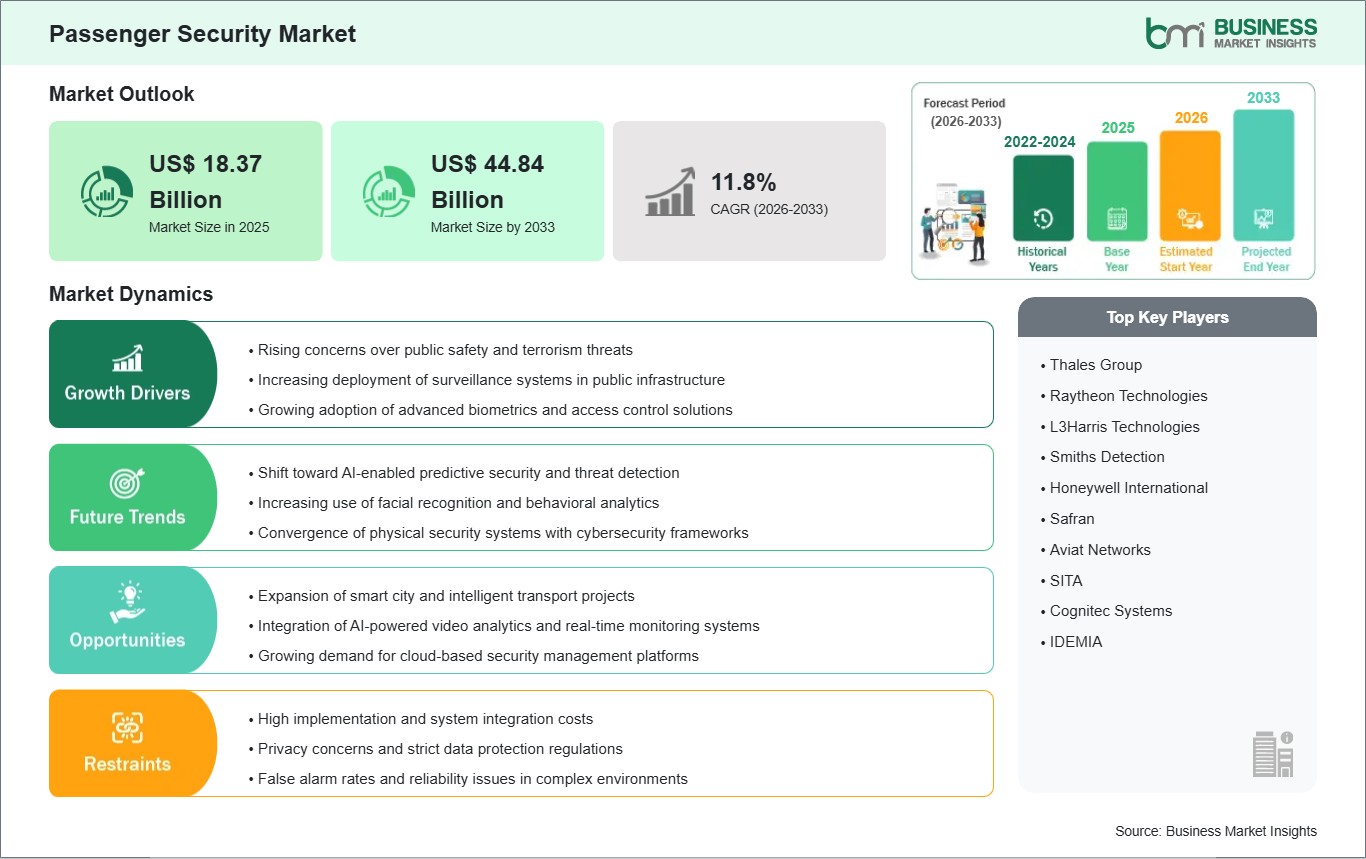
The passenger security market  size is expected to reach US$ 44.84 billion by 2033 from US$ 18.37 billion in 2025. The market is estimated to record a CAGR of 11.8% from 2026 to 2033.

Executive Summary and Global Market Analysis:

Passenger security systems encompass integrated technologies used to inspect individuals, baggage, and access points across transport environments. These systems combine detection hardware, identity verification tools, surveillance platforms, and software controls to prevent prohibited items, unauthorized entry, and operational disruption. Their role extends beyond checkpoint inspection by connecting physical screening with digital monitoring and response coordination.

Expansion in travel volumes, stricter security protocols, and the need for faster checkpoint throughput continue to reshape procurement priorities. Operators are modernizing screening lanes to improve detection accuracy while reducing friction in passenger movement. At the same time, cyber resilience has become more prominent because connected screening networks and biometric platforms require stronger protection against service interruption and data compromise.

Within the market, solution demand spans imaging systems, biometric access control, handheld devices, and trace detection tools, each serving distinct operational needs. Baggage inspection and video management remain central in high-traffic facilities, while biometric systems gain traction where identity assurance and controlled access are critical. New demand supports capacity expansion projects, whereas replacement demand reflects the transition from legacy infrastructure to more automated platforms.

Technology development is shifting the industry toward integrated security ecosystems rather than isolated equipment purchases. Screening architectures increasingly combine analytics, real-time monitoring, automated alerts, and interoperability across checkpoints, command centers, and terminal operations. This evolution supports more consistent threat assessment and enables security teams to manage passenger flow, incident response, and compliance requirements with greater operational precision.

The competitive environment is shaped by product breadth, compliance expertise, service capability, and the ability to support large-scale deployments. Vendors are differentiating through modular designs, software-led upgrades, and solutions that align security performance with passenger convenience. As procurement decisions become more strategic, buyers are favoring platforms that support long-term scalability, regulatory alignment, and coordinated management across multiple transport assets.

Passenger Security Market - Strategic Insights:

global-market-strategic-framework
Get more information on this report

Passenger Security Market Segmentation Analysis:

The passenger security market  is segmented based on solution, investment type, and end user, reflecting its critical role in global transportation networks by ensuring safety and preventing unlawful interference.

By Solution

Baggage Inspection Systems : Central to checkpoint accuracy and throughput in high-volume passenger hubs.

Video Management Systems : Enable continuous monitoring, event review, and coordinated incident visibility.

Access Control/Biometric Systems : Strengthen identity assurance across restricted and passenger-facing entry points.

Cybersecurity Solutions : Protect connected security infrastructure, data flows, and operational continuity.

Hand-Held Scanners : Support flexible screening in secondary inspection and mobile enforcement settings.

Full-Body Scanners : Improve concealed threat detection with standardized privacy-conscious screening workflows.

Explosive Trace Detectors : Provide targeted analysis for suspect items, surfaces, and passenger belongings.

Other Solutions : Address niche screening, monitoring, and integration requirements across transport facilities.

By Investment Type

New Demand : Linked to terminal expansion, greenfield projects, and first-time security modernization.

Replacement Demand : Reflects upgrades from aging systems to interoperable and automated platforms.

By End User

Airports : Represent the broadest deployment environment due to layered screening requirements.

Seaports : Emphasize access management and inspection across mixed passenger movement zones.

Railway Stations : Require rapid screening approaches compatible with dense and continuous traveler flows.

Other End User : Includes transit hubs and facilities with specialized public security needs.
Passenger Security Market Drivers and Opportunities:

Checkpoint modernization and integrated threat detection

Rising passenger movement across transport hubs is intensifying the need for screening systems that combine speed, consistency, and stronger threat recognition. Legacy checkpoints often rely on fragmented equipment and manual intervention, creating delays and uneven inspection outcomes. This operational gap is accelerating procurement of integrated passenger security platforms that connect baggage inspection, body screening, access control, and centralized monitoring within a more coordinated framework.

The impact extends beyond equipment replacement because operators now prioritize systems that improve throughput without weakening compliance obligations. In airports, ports, and rail terminals, modernization programs increasingly align security design with passenger flow management and real-time oversight. This relevance is reinforcing adoption of platforms that support automated alerts, clearer operator visualization, and more standardized screening procedures across facilities with diverse traffic intensity.

Convergence of biometrics, cybersecurity, and intelligent monitoring

Security architectures are moving toward connected environments where identity verification, surveillance, and digital safeguards operate as a unified layer. This transition is opening opportunities for vendors offering solutions that combine biometric access, video analytics, and cybersecurity controls within shared operational workflows. Use cases are emerging where passenger verification, restricted-area access, and checkpoint event monitoring can be managed through common software environments.

Future scope is expanding as transport operators seek security investments that remain adaptable across infrastructure upgrades and changing threat models. Opportunities are particularly strong where systems must scale across terminals, transport nodes, or multi-site networks without creating disconnected control points. The long-term impact favors solutions that support interoperability, secure data handling, and coordinated decision-making, enabling broader expansion of intelligent passenger security ecosystems.

Passenger Security Market Size and Share Analysis:

The passenger security market was valued at USD 18.37 Billion in 2025 and is projected to reach USD 44.84 Billion by 2033, registering a CAGR of 11.8% during 2026 - 2033. This trajectory reflects sustained investment in checkpoint modernization, identity assurance, and integrated monitoring capabilities across passenger transport environments. Market expansion also indicates a broader shift toward interoperable systems that can strengthen detection performance while supporting smoother passenger processing.

From a solution perspective, baggage inspection systems and access control or biometric platforms hold a strong position because they address both screening continuity and identity verification needs. Video management systems also maintain strategic importance by connecting live surveillance with operational oversight. Replacement demand remains relevant where operators are retiring older equipment in favor of platforms with stronger automation, interoperability, and software-centered management.

By application environment, airports account for the most prominent share due to layered screening workflows, regulatory oversight, and continuous infrastructure upgrades. Railway stations are gaining attention where rapid passenger movement requires efficient yet dependable screening design. Seaports and other end users contribute through targeted deployments that emphasize controlled access, surveillance integration, and adaptable inspection systems suited to varied operational layouts.

Passenger Security Market Report Highlights:

Report Attribute Details
Market size in 2025 US$ 18.37 Billion
Market Size by 2033 US$ 44.84 Billion
Global CAGR (2026 - 2033)11.8%
Historical Data 2022-2024
Forecast period 2026-2033
Segments Covered By Solution
  • Baggage Inspection Systems
  • Video Management Systems
  • Access Control/Biometric Systems
  • Cybersecurity Solutions
  • Hand-Held Scanners
  • Full-Body Scanners
  • Explosive Trace Detectors
  • Other Solutions
By Investment Type
  • New Demand and Replacement Demand
By End User
  • Airports
  • Seaports
  • Railway Stations
  • Other End User
Regions and Countries Covered
North America US, Canada, Mexico
Europe Germany, Italy, France, U.K., Spain, Belgium, Netherlands, Luxembourg, Norway, Finland, Denmark, Sweden, Switzerland, Austria, Greece, Portugal, Russia, Poland, Romania, Czech Republic, Ukraine, Slovakia, Bulgaria
Asia-Pacific China, Japan, South Korea, India, Australia, New Zealand, Indonesia, Malaysia, Philippines, Singapore, Thailand, Vietnam, Taiwan, Bangladesh
South and Central America Brazil, Argentina, Chile, Colombia, Peru
Middle East and Africa Saudi Arabia, United Arab Emirates, Kuwait, Bahrain, Qatar, Oman, Turkiye, South Africa, Egypt, Nigeria, Algeria
Market leaders and key company profiles
  • Thales Group
  • Raytheon Technologies
  • L3Harris Technologies
  • Smiths Detection
  • Honeywell International
  • Safran
  • Aviat Networks
  • SITA
  • Cognitec Systems
  • IDEMIA
Get more information on this report

Passenger Security Market Report Coverage and Deliverables:

The "Passenger Security Market Size and Forecast (2022:2033)" report provides a detailed analysis of the market covering below areas:

  • Market size and forecast at global, regional, and country levels for all market segments covered under the scope
  • Market trends, as well as drivers, restraints, and opportunities
  • Market analysis covering key trends, global and regional framework, major players, regulations, and recent developments
  • Industry landscape and competition analysis covering market concentration, heat map analysis, prominent players, and recent developments for the market
  • Detailed company profiles, including SWOT analysis

Passenger Security Market Geographic Insights:

The Passenger Security market shows diverse regional adoption patterns influenced by transport infrastructure maturity, regulatory interpretation, traveler volumes, and investment readiness. Across the global landscape, operators are moving toward integrated security environments that connect inspection, surveillance, access control, and digital oversight. Procurement priorities increasingly favor systems that balance detection precision with smoother passenger handling, particularly where networked transport assets require consistent standards across multiple sites.

North America demonstrates a structured upgrade environment shaped by established screening protocols, technology refresh cycles, and strong emphasis on operational continuity. Security buyers in the region often focus on systems that can strengthen checkpoint performance while fitting into complex legacy infrastructure. This has encouraged interest in modular screening equipment, software-led oversight, and cyber-protected architectures that support both compliance needs and day-to-day passenger processing demands.

Asia Pacific reflects a different momentum, with expansion tied to airport development, railway modernization, and broader transport capacity enhancement. Many operators are designing security infrastructure alongside new terminals and transit projects, allowing more integrated deployment from the outset. This creates favorable conditions for biometric access systems, intelligent video monitoring, and scalable inspection tools that can accommodate dense passenger volumes without relying solely on older procedural models.

Europe continues to prioritize security modernization within a framework shaped by privacy expectations, interoperability requirements, and evolving checkpoint standards. At the same time, emerging markets in the Middle East, Africa, and South and Central America are advancing through selective investments aligned with hub development and public safety priorities. These regions are creating opportunities for adaptable solutions that combine inspection performance, centralized monitoring, and phased deployment suited to mixed infrastructure conditions.

global-market-geography
Get more information on this report

Passenger Security Market Research Report Guidance:

  • The Passenger Security market report includes qualitative and quantitative data in the passenger security market  across solution, investment type, end user, and geography.
  • The report starts with the key takeaways (chapter 2), highlighting the key trends and outlook of the passenger security market .
  • Chapter 3 focuses on the research methodology of the study.
  • Chapter 4 includes ecosystem analysis.
  • Chapter 5 highlights the major industry dynamics in the passenger security market , including factors that are driving the market, prevailing deterrents, potential opportunities, as well as future trends. Impact analysis of these drivers and restraints is also covered in this section.
  • Chapter 6 discusses the passenger security market  scenario, in terms of historical market revenues, and forecast till the year 2033.
  • Chapters 7 to 10 cover passenger security market  segments by solution, investment type, end user, and geography across North America, Europe, Asia Pacific, Middle East and Africa, and South and Central America. They cover the market revenue, forecast, and factors driving the market.
  • Chapter 11 describes the competitive analysis along with the heat map analysis for the key players operating in the market.
  • Chapter 12 describes the industry landscape analysis. It provides detailed descriptions of business activities such as market initiatives, new developments, mergers, and joint ventures globally, along with a competitive landscape.
  • Chapter 13 provides detailed profiles of the major companies operating in the passenger security market . Companies have been profiled on the basis of their key facts, business descriptions, products and services, financial overview, SWOT analysis, and key developments.
  • Chapter 14, i.e., the appendix, is inclusive of a brief overview of the company, list of abbreviations, and disclaimer.

Passenger Security Market News and Key Development:

The passenger security market is evaluated by gathering qualitative and quantitative data post primary and secondary research, which includes important corporate publications, association data, and databases. A few of the key developments in the passenger security market  are:

  • In April 2025, Delhi International Airport Limited (DIAL) announced that it will begin trials of advanced full-body scanners at Indira Gandhi International Airport from May 2025, following the latest guidelines from the Bureau of Civil Aviation Security (BCAS). Four scanners have been procured, with two installed at Terminal 1 and two at Terminal 3. The IT interface for these machines is being finalized, and upon completion of the three-to-four-month trial, a BCAS-led committee will evaluate the findings and establish a standard operating procedure for full-scale implementation.  Using millimeterwave technology operating between 70Ghz and 80GHz, these scanners are designed to safely enhance security while ensuring passenger privacy and improving wait times. The scanners detect both metallic and non-metallic threats, including explosives.
  • In January 2025, the S&T Screening at Speed Program, in collaboration with TSA, is developing new concepts and technologies to help the Department of Homeland Security (DHS) meet the needs of passengers while also fine-tuning detection performance, so TSA continues to stay ahead of evolving threats and keep the traveling public safe. The Screening at Speed Program is working with the Department of Energy’s Pacific Northwest National Laboratory (PNNL) to develop improved detection capabilities and a more user-friendly passenger experience. High Definition-Advanced Imaging Technology (HD-AIT) is the backbone of this development.

Key Sources Referred:

  • World Bank – Global Trade Indicators
  • World Trade Organization (WTO)
  • (International Monetary Fund )IMF
  • International Trade Administration (ITA)
  • Company website
  • Company annual reports
  • Company investor presentations
The List of Companies - Passenger Security Market
  • Thales Group
  • Raytheon Technologies
  • L3Harris Technologies
  • Smiths Detection
  • Honeywell International
  • Safran
  • Aviat Networks
  • SITA
  • Cognitec Systems
  • IDEMIA
Frequently Asked Questions
How big is the Passenger Security Market?

The Passenger Security Market is valued at US$ 18.37 Billion in 2025, it is projected to reach US$ 44.84 Billion by 2033.

What is the CAGR for Passenger Security Market by (2026 - 2033)?

As per our report Passenger Security Market, the market size is valued at US$ 18.37 Billion in 2025, projecting it to reach US$ 44.84 Billion by 2033. This translates to a CAGR of approximately 11.8% during the forecast period.

What segments are covered in this report?

The Passenger Security Market report typically cover these key segments-

  • Solution (Baggage Inspection Systems, Video Management Systems, Access Control/Biometric Systems, Cybersecurity Solutions, Hand-Held Scanners, Full-Body Scanners, Explosive Trace Detectors, Other Solutions)
  • Investment Type (New Demand and Replacement Demand)
  • End User (Airports, Seaports, Railway Stations, Other End User)

What is the historic period, base year, and forecast period taken for Passenger Security Market?

The historic period, base year, and forecast period can vary slightly depending on the specific market research report. However, for the Passenger Security Market report:

  • Historic Period : 2022-2024
  • Base Year : 2025
  • Forecast Period : 2026-2033
  • Who are the major players in Passenger Security Market?

    The Passenger Security Market is populated by several key players, each contributing to its growth and innovation. Some of the major players include:

  • Thales Group
  • Raytheon Technologies
  • L3Harris Technologies
  • Smiths Detection
  • Honeywell International
  • Safran
  • Aviat Networks
  • SITA
  • Cognitec Systems
  • IDEMIA
  • Who should buy this report?

    The Passenger Security Market report is valuable for diverse stakeholders, including:

    • Investors: Provides insights for investment decisions pertaining to market growth, companies, or industry insights. Helps assess market attractiveness and potential returns.
    • Industry Players: Offers competitive intelligence, market sizing, and trend analysis to inform strategic planning, product development, and sales strategies.
    • Suppliers and Manufacturers: Helps understand market demand for components, materials, and services related to concerned industry.
    • Researchers and Consultants: Provides data and analysis for academic research, consulting projects, and market studies.
    • Financial Institutions: Helps assess risks and opportunities associated with financing or investing in the concerned market.

    Essentially, anyone involved in or considering involvement in the Passenger Security Market value chain can benefit from the information contained in a comprehensive market report.

    Available Report Formats

    pdf-format excel-format pptx-format
    Buy Now
    Sales Assistance
    +1 646 791 7070 (US & UK)
    Customization Form

    Please tell us your area of interest
    (Market Segments/ Regions and Countries/ Companies)