
Port Security Systems Market Outlook: Size, Share, Trends, Growth Analysis, Competitive Landscape & Forecast, 2026-2033

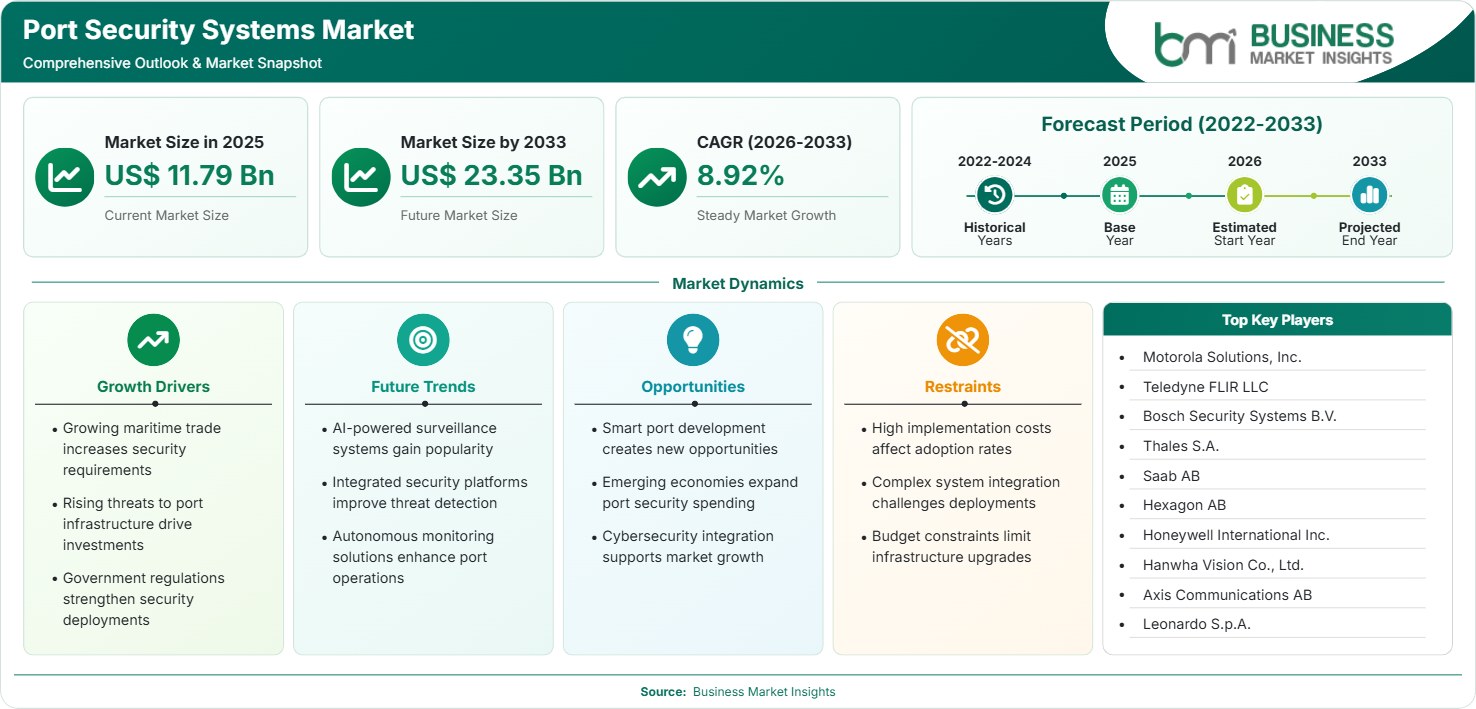
The Port Security Systems Market size was valued at US$ 11.79 Billion in 2025 and is projected to reach US$ 23.35 Billion by 2033, growing at a CAGR of 8.92% during 2026–2033. Rising maritime trade volumes, critical infrastructure protection initiatives, AI-enabled surveillance adoption, and smart-port investments are accelerating deployment opportunities across commercial, defense, and energy ports worldwide.

Report Coverage
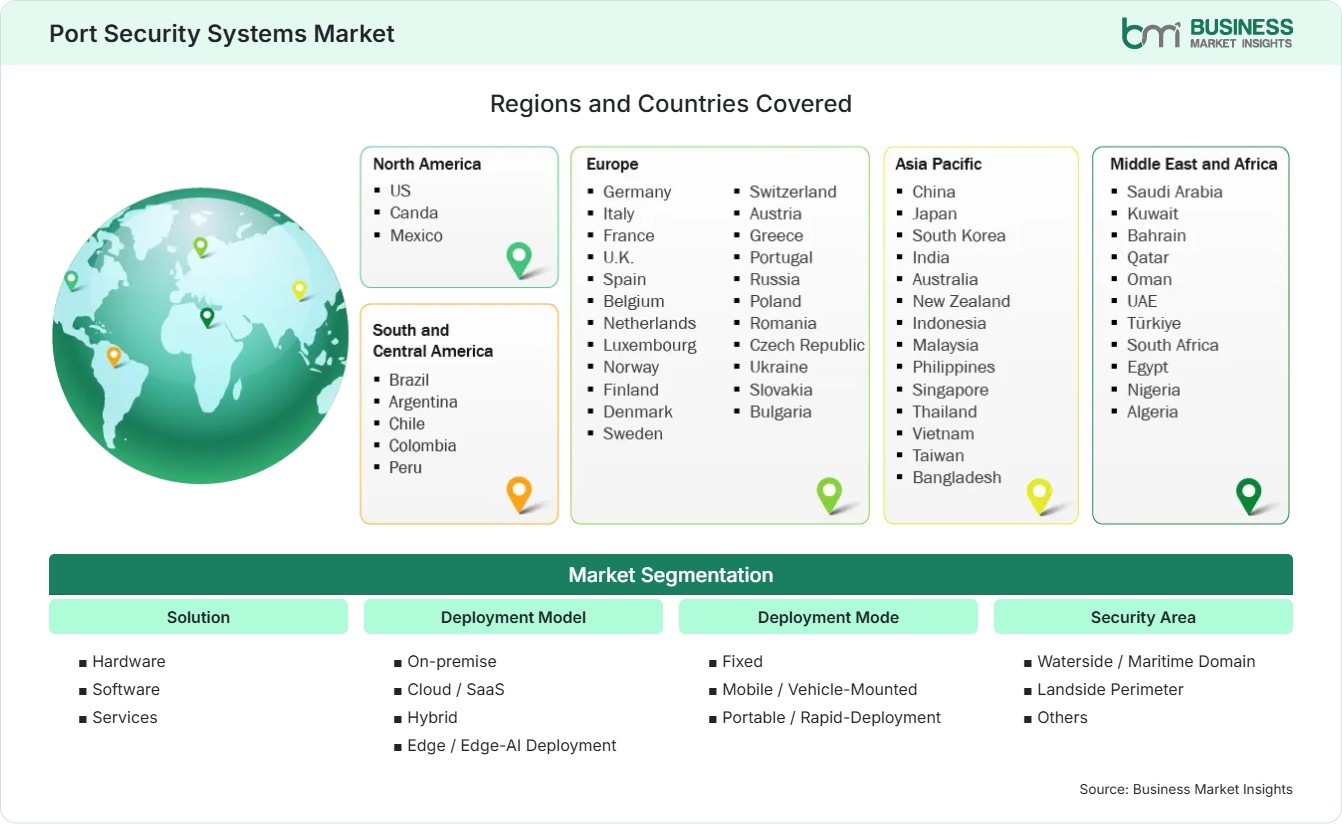
  • Solution: Hardware, Software, Services
  • Deployment Model: On-premise, Cloud / SaaS, Hybrid, Edge / Edge-AI Deployment
  • Deployment Mode: Fixed, Mobile / Vehicle-Mounted, Portable / Rapid-Deployment
  • Security Area: Waterside / Maritime Domain, Landside Perimeter, Others
  • System: Video Surveillance and VMS, AI Video Analytics, Others
US$ 11.79 Bn Market size in 2025
US$ 23.35 Bn Market Size by 2033
8.92% CAGR, 2026 - 2033
2026-2033 Forecast Period

AI Overview

Port Security Systems Market Summary

  • North America Region: North America holds a market share of 34%–37% in 2025, growing with a CAGR of 7.8%–8.4% during 2026–2033. Key drivers include critical infrastructure modernization, maritime threat monitoring, cybersecurity integration, naval spending, AI surveillance deployment, and expanding smart-port programs supporting operational resilience and compliance requirements. US market remains technology-led, supported by federal port security grants and digital monitoring investments, recording 7.9%–8.5% CAGR.
  • Fastest Growing Region: Asia Pacific holds Port Security Systems Market share of 25%–28% in 2025, growing with a CAGR of 10.2%–11.0% during 2026–2033. Expansion of container terminals, coastal security initiatives, smart-port development, maritime trade growth, and increasing investments in AI-enabled monitoring systems continue accelerating regional demand.
  • Leading Segment: Video Surveillance and VMS accounts for 30%–33% share in 2025 and expands at 8.5%–9.1% CAGR. Demand is supported by situational awareness requirements, real-time incident detection, centralized monitoring platforms, compliance mandates, and integration with intelligent analytics architectures.
  • High Growth Segment: AI Video Analytics represents 17%–20% of the Port Security Systems Market share in 2025 and advances at 11.5%–12.3% CAGR. Growing adoption of automated threat detection, behavioral analytics, vessel tracking, workforce efficiency tools, and reduced operator dependence supports accelerated implementation.
  • Key Market Opportunity: Integration of AI, edge computing, radar fusion, biometric access control, and cloud-based command centers enables predictive security operations, creating substantial opportunities across greenfield ports and modernization projects globally.
  • Major Market Players: Motorola Solutions, Inc.; Teledyne FLIR LLC; Bosch Security Systems B.V.; Thales S.A.; Saab AB; Hexagon AB; Honeywell International Inc.; Hanwha Vision Co., Ltd.; Axis Communications AB; Leonardo S.p.A.
Strategic Insights

Port Security Systems Market: Strategic Insights

Port Security Systems Market Strategic Framework
FREE PDF
Request your free sample
Request free sample
Stakeholder View

Key Takeaways

  • Security value chains are increasingly converging around integrated platforms combining surveillance, radar, access control, analytics, communications, and cybersecurity functions.
  • AI-driven video intelligence applications offer the strongest upside due to operational efficiency gains and improved threat classification accuracy.
  • Investment priorities are shifting from standalone hardware toward software-centric architectures with predictive analytics and centralized command capabilities.
  • Asia Pacific provides a compelling investment case due to large-scale port expansion projects and accelerating smart-port adoption initiatives.
  • Mergers, acquisitions, and strategic partnerships increasingly focus on sensor fusion, maritime analytics, and cloud-based monitoring capabilities.
  • Defense, energy, and container-handling facilities remain high-priority end users because of their exposure to operational disruption and infrastructure risks.
Geographic Outlook

Port Security Systems Market Regional Highlights

North America Port Security Systems Market

North America accounts for 34%–37% of global revenue in 2025 and advances at a 7.8%–8.4% CAGR through 2033. Strong investment in port resilience, maritime infrastructure protection, digital security architectures, and integrated surveillance supports regional leadership. The region benefits from active modernization programs, mature technology adoption, and extensive deployment of intelligent monitoring solutions across commercial and defense facilities. The Port Security Systems Market share remains highest in this region because operators prioritize continuous monitoring, cyber-physical security, and compliance-driven technology upgrades.

  • Federal funding programs support surveillance modernization and perimeter protection projects across strategically important maritime facilities.
  • Growing container traffic increases requirements for real-time monitoring, cargo verification, and intelligent access management.
  • Integration of cybersecurity and operational technology protection solutions strengthens infrastructure resilience.
  • Defense-linked procurement continues supporting adoption of advanced radar, analytics, and maritime awareness technologies.

US Port Security Systems Market

The U.S. contributes 72%–76% of regional revenue and is expected to expand at 7.9%–8.5% CAGR through 2033. Homeland security priorities, large-scale container throughput, and critical infrastructure protection requirements drive sustained capital investment. Advanced sensor deployment, AI-enabled surveillance systems, and integrated command platforms remain central procurement areas. The country continues influencing global innovation as leading vendors and technology integrators expand intelligent monitoring and maritime domain awareness capabilities.

  • Port authorities increasingly deploy AI-enabled monitoring systems to improve situational awareness and operational efficiency.
  • Major coastal facilities invest in integrated command-and-control infrastructures supporting multi-agency coordination.
  • Cybersecurity adoption continues to increase as digitized port operations expand.
  • Public funding programs support modernization of security systems and critical monitoring assets.

Europe Port Security Systems Market

Europe accounts for 27% to 30% of market share by 2025 and has a CAGR of 8.2% to 8.9%. Regulatory compliance needs, border control efforts, and maritime infrastructure development contribute to the growth of the Port Security Systems Market. Advanced security systems are being adopted in Western Europe, while Eastern Europe shows potential for incremental growth. Germany holds the top position, while Poland has shown rapid growth due to logistics modernization and increased infrastructure investment.

  • Port operators prioritize environmental monitoring integration alongside traditional security functions.
  • Cross-border cargo movement encourages deployment of interoperable monitoring platforms.
  • Germany maintains technology leadership through advanced surveillance and analytics adoption.
  • Poland records strong expansion supported by logistics and infrastructure development programs.
  • Growing public-private collaboration strengthens procurement pipelines.

Asia Pacific Port Security Systems Market

The Asia Pacific region holds the largest share, at 25%-28%, and experiences the highest growth, at 10.2%-11.0% CAGR, up to 2033. Factors such as the bulk volume of containers, port development, and increased demand for security systems are driving investments. China is the largest market in the region, while India has the highest growth potential due to smart port developments and logistics. Ongoing digital transformation projects increasingly combine automation, analytics, and comprehensive monitoring technologies.

  • Smart-port investments accelerate deployment of AI, sensor fusion, and centralized monitoring systems.
  • China maintains regional leadership through extensive maritime infrastructure development.
  • India demonstrates rapid adoption supported by modernization and trade facilitation initiatives.
  • Growing regional trade encourages investments in integrated monitoring ecosystems.
  • Public infrastructure spending remains a major growth catalyst.

Rest of World Port Security Systems Market

The Rest of World region holds a 10%–13% share and grows at 8.8%–9.6% CAGR. Middle East ports benefit from logistics diversification strategies and energy terminal protection needs. South and Central America are gradually increasing adoption as trade infrastructure improves. Saudi Arabia leads regional investment activity, while the UAE and Brazil continue expanding digital port initiatives. The Port Security Systems Market growth outlook remains supported by modernization plans and maritime trade development.

  • Energy-export hubs prioritize advanced monitoring and perimeter security investments.
  • Saudi Arabia continues expanding smart infrastructure programs across maritime facilities.
  • UAE ports strengthen adoption of digital command-and-control architectures.
  • Brazil invests in cargo security and surveillance modernization programs.
  • Long-term trade expansion supports procurement confidence.
Global Market Geography
FREE PDF
Request your free sample
Request free sample
Segment Analysis

Port Security Systems Market Segmentation

Solution

This segment accounts for around 38%-41% of market share in 2025 and is expected to register a CAGR of 8.6%-9.2%. The scope of the Port Security Systems Market is continually widening due to the growing need to integrate technology solutions into systems.

  • Hardware: Cameras, radar devices, sensors, and access-control products remain essential infrastructure components supporting perimeter monitoring and maritime awareness.
  • Software: Centralized command platforms, analytics engines, and security management applications enhance visibility, event management, and decision-making efficiency.
  • Services: Consulting, integration, maintenance, and managed security services support lifecycle management and system optimization objectives.

Deployment Model

Deployment Model accounts for 24%–27% share and advances at 9.3%–10.0% CAGR. Organizations increasingly balance scalability, security, performance, and regulatory requirements when selecting deployment architectures.

  • On-premise: Preferred by security-sensitive facilities requiring extensive control over infrastructure and operational data.
  • Cloud/SaaS: Expanding adoption due to scalability, remote management capabilities, and lower infrastructure complexity.
  • Hybrid: Combines cloud flexibility with localized control, supporting gradual digital transformation strategies.
  • Edge/Edge-AI Deployment: Enables real-time analytics near security endpoints, reducing latency and bandwidth requirements.

Deployment Mode

Deployment Mode contributes around 12%–15% share and grows at 8.8%–9.5% CAGR. Demand is influenced by operational flexibility and incident-response requirements.

  • Fixed: Widely deployed across terminals, gates, and infrastructure requiring continuous monitoring coverage.
  • Mobile/Vehicle-Mounted: Supports dynamic monitoring activities for patrols, inspections, and temporary security operations.
  • Portable/Rapid-Deployment: Used in emergency response, temporary facilities, and heightened security situations.

Security Area

Security Area solutions maintain a 15%–18% share and expand at 8.9%–9.7% CAGR. Operators increasingly adopt layered monitoring strategies across maritime and land-based environments.

  • Waterside/Maritime Domain: Focuses on vessel detection, maritime awareness, and coastal threat monitoring applications.
  • Landside Perimeter: Protects terminals, warehouses, cargo facilities, and access points from unauthorized intrusion.

System

This market segment captures 30%–33% market share in 2025, with a CAGR of 8.5%–9.1%. The Port Security Systems Market trends are moving towards intelligence-led monitoring systems that enable proactive responses.

  • Video Surveillance and VMS: Dominant category enabling centralized visual monitoring, recording, and incident investigation.
  • AI Video Analytics: Enhances threat detection, behavioral recognition, and automated security workflows.

Technology

Technology solutions account for a 20%–23% share and achieve 9.0%–9.8% CAGR. Adoption is driven by evolving threat landscapes and digital transformation initiatives.

  • Video Surveillance: Provides continuous visibility and event documentation across critical operational zones.
  • Radar Systems: Support long-range vessel detection and maritime situational awareness capabilities.
  • Perimeter Intrusion Detection: Enables rapid identification of unauthorized access attempts and perimeter breaches.
Market Forces

Port Security Systems Market Dynamics

Key Market Drivers

Expansion of Global Maritime Trade Infrastructure

Growing cargo volumes, port expansion programs, and increasing container-handling volumes are driving the need for modern security systems. The Asia, North America, and Europe corridors are continually enhancing their infrastructure to maintain cargo functionality and security. It is important to have security measures to help manage ship movements and logistics operations. Such investments in infrastructure, including the installation of surveillance and monitoring devices, help handle these cases and ensure compliance with regulations. The rising trend of cargo theft and smuggling is affecting the procurement process for both private and public carriers worldwide.

Growing Adoption of AI-Enabled Monitoring Technologies

AI is revolutionizing threat detection processes by recognizing patterns and anomalies and even generating predictive alerts. It is becoming common for security forces to rely on analytics to ease their burden and ensure precise responses. The combination of video feeds, radar information, and access control data improves situational awareness. As computers become more powerful, such systems are becoming more widespread across facilities of different sizes. Such technological evolution not only increases efficiency but also improves incident management results and cooperation in large maritime settings.

Rising Critical Infrastructure Protection Requirements

Port facilities are increasingly recognized as strategic assets that require sophisticated security systems. Resilient monitoring systems are being developed to handle both physical and cyber threats. Constant monitoring, real-time communication integration, and information sharing improve security. Improved regulatory standards promote modernization efforts that entail upgrading old technologies to new networked systems. Therefore, funding is becoming increasingly important for surveillance, intrusion detection, and maritime situational awareness technologies that support operational continuity and national security objectives.

Key Market Opportunities

Smart Port Transformation Programs

The big picture of smart port programs holds great promise for technology companies. They are developing digital infrastructures that integrate automation, analytics, connectivity, and intelligent security systems into a single ecosystem. Monitoring enables efficient usage of assets, employee efficiency, and transparency in operations. Technology companies capable of providing interoperable architectures will have the opportunity to capitalize on modernization cycles. Investment pipelines in smart ports, digital logistics, and automation continue to show strong growth potential across developed and emerging maritime economies.

Expansion of Edge-AI Security Architectures

Edge-enabled analytics support faster decision-making by processing the data close to where it occurs. Edge computing helps reduce network traffic and enhances responsiveness in threat detection applications. Port operators are becoming increasingly concerned about real-time intelligence and reduced latency, hence making the deployment of edge-enabled security platforms more prevalent. Leading security providers are developing small, scalable systems with embedded AI capabilities that can be integrated into existing surveillance architectures. Port Security Systems Market Forecasts indicate a rising need for systems capable of supporting distributed intelligence, operational resilience, and cost-effective deployment.

Integration of Multi-Sensor Intelligence Platforms

The use of combinations of cameras, radar, drones, thermal sensors, and access-control technology offers significant business opportunities for platform companies. Multi-sensor systems offer benefits such as enhanced situational awareness, improved detection capabilities, and reduced information silos. End users are looking for vendors that can provide complete solutions rather than fragmented solutions. The shift towards unified command centers helps generate recurring software and service revenues. Therefore, investments in sensor fusion technology are expected to increase going forward.

Market Restraints and Challenges

High Capital Requirements for Modernization

Factor: Advanced surveillance, radar systems, software platforms, and integration services require substantial upfront investment. Impact: Smaller operators may delay modernization initiatives due to budget constraints and competing infrastructure priorities. Complex procurement cycles further extend deployment timelines and influence purchasing decisions. Maintenance expenses, training requirements, and system upgrades add lifecycle costs that affect ownership economics. Although security benefits are significant, funding availability remains a major consideration for many facilities. This challenge is particularly relevant in developing regions where infrastructure investment priorities extend beyond security modernization.

Integration Complexity Across Legacy Environments

Factor: Many ports operate heterogeneous legacy systems developed through years of incremental procurement. Impact: Integrating disparate platforms can increase implementation complexity, project costs, and operational disruption risks. Data interoperability challenges often limit information sharing and reduce efficiency gains. Multiple vendors, proprietary architectures, and evolving cybersecurity requirements complicate deployment strategies. Organizations must invest in system harmonization, workforce training, and governance processes to realize expected benefits. These challenges can slow adoption rates even when modernization budgets are available and strategic needs are clearly established.

Company Analysis

Competitive Landscape

The Port Security Systems Market analysis indicates competition centered on integrated surveillance, sensor fusion, maritime awareness, AI-powered analytics, and critical infrastructure protection capabilities.

Company Name

Overview

Products and Services relevant to this market

Motorola Solutions, Inc.

Global provider of mission-critical safety and security technologies for public and private infrastructure.

Video security, command centers, analytics, communications, monitoring software.

Teledyne FLIR LLC

Specialist in thermal imaging and intelligent sensing technologies.

Thermal cameras, maritime surveillance, radar integration, perimeter monitoring.

Bosch Security Systems B.V.

Security technology provider with broad surveillance portfolio.

Video management, cameras, analytics, access control solutions.

Thales S.A.

Defense and security leader serving critical infrastructure operators.

Maritime surveillance, command systems, radar technologies, integrated security.

Saab AB

Advanced defense and maritime technology company.

Coastal surveillance, radar systems, maritime awareness platforms.

Hexagon AB

Industrial technology provider focusing on intelligence solutions.

Geospatial intelligence, monitoring software, operational awareness systems.

Honeywell International Inc.

Diversified technology company active in critical infrastructure protection.

Integrated security management, access control, analytics platforms.

Hanwha Vision Co., Ltd.

Global surveillance solutions provider.

Cameras, intelligent analytics, VMS, monitoring systems.

Axis Communications AB

Network video specialist serving transportation and infrastructure sectors.

IP cameras, analytics, edge intelligence, surveillance solutions.

Leonardo S.p.A.

Aerospace and defense company with strong maritime capabilities.

Radar, coastal monitoring, command-and-control systems.

Trust & Transparency

Research Methodology

The market analysis combines proprietary research with secondary data from government agencies, company disclosures, regulatory filings, industry databases and expert interviews. Market estimates are validated through data triangulation, cross-market benchmarking and analyst review.

View Full Research Methodology

Questions Answered

Frequently Asked Questions

What does a Port Security Systems Market Report typically evaluate?

It generally assesses market size, competitive positioning, technology adoption, regulatory influences, segment performance, regional outlooks, growth drivers, opportunities, and strategic developments.

How are cloud and edge deployments influencing the industry?

Cloud and edge architectures enhance scalability, enable remote management, reduce latency, and support real-time intelligence generation across distributed port environments.

Which technology segment shows the highest growth potential?

AI video analytics demonstrates the highest growth potential because it improves detection accuracy, automates monitoring workflows, and supports predictive security operations.

Which region is expected to expand the fastest through 2033?

Asia Pacific is anticipated to record the fastest growth due to smart-port investments, expanding trade infrastructure, digital transformation initiatives, and increasing security modernization programs.

What is driving adoption of advanced security technologies in ports?

Rising maritime trade volumes, critical infrastructure protection requirements, regulatory compliance obligations, and AI-enabled threat detection capabilities are increasing deployment of integrated security systems across commercial and defense facilities.

Access the Full Port Security Systems Market Report

Get segment-level forecasts, regional estimates, competitive benchmarking, company profiles and downloadable Excel datasets.

Access the full Port Security Systems Market Report
350 pages PDF & Excel | 2026-08-31