Airport Robot Market Regional Highlights
North America Airport Robot Market
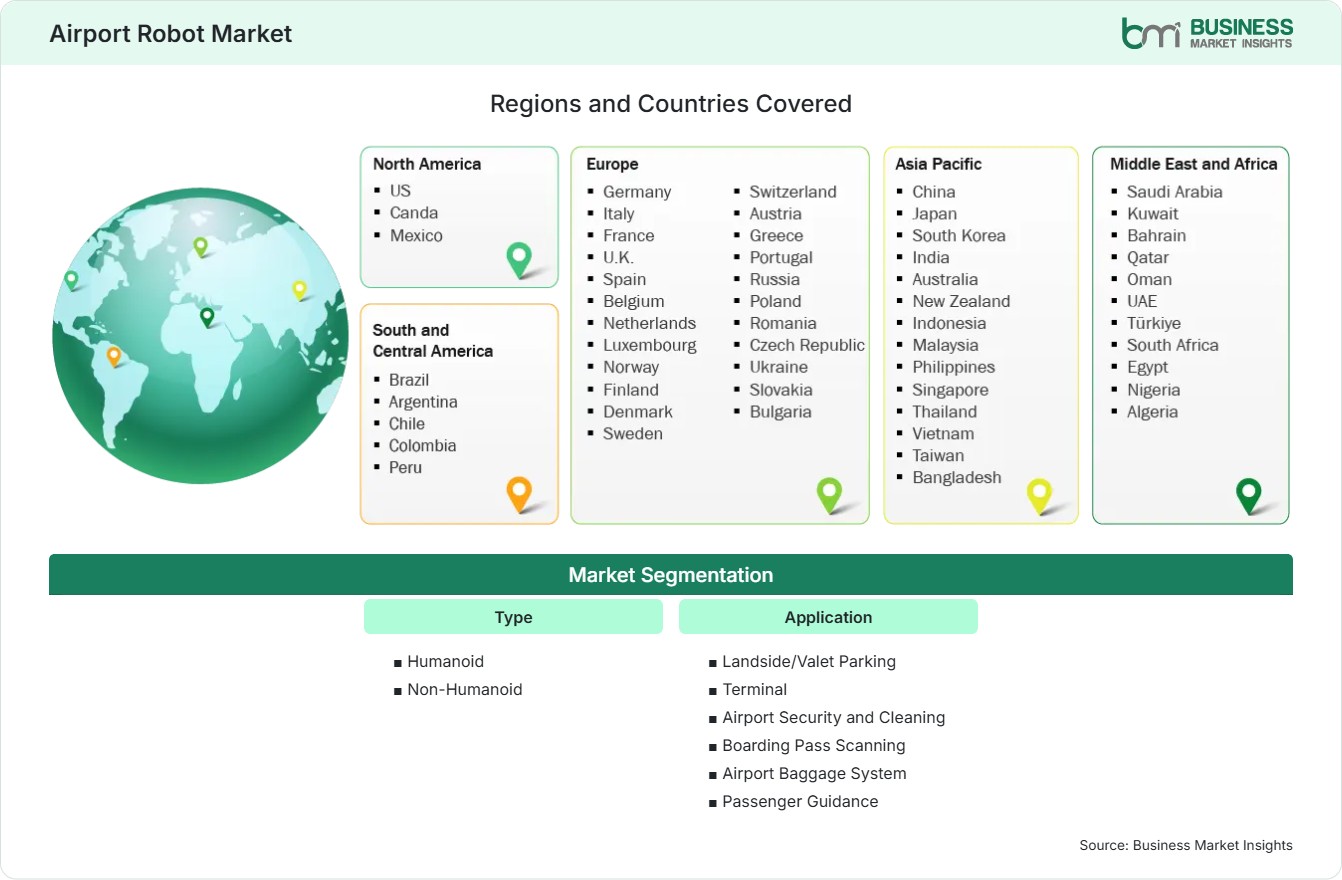
North America accounts for 35%–38% of global revenue in 2025 and is projected to expand at a CAGR of 6.8%–7.4% during 2026–2033. Strong airport infrastructure, high labor costs, established automation capabilities, and large international hubs support adoption. The Airport Robot Market share remains concentrated in the U.S., although Canada provides additional opportunities through terminal modernization, autonomous cleaning, passenger-service automation, and security applications.
- Autonomous cleaning and facility support robots are gaining popularity among airports due to the fact that certain repetitive tasks involve ongoing staffing needs as well as increased efficiency opportunities.
- The robotics vendors introduce fleet management systems, remote diagnostics and operational analysis systems that help airport managers to control a number of autonomous robots from a single platform.
- Security applications are possible with autonomy in the form of monitoring and patrol, but there are certain cybersecurity, privacy, and safety challenges involved in such deployment.
- Canada presents some growth potential through upgrading of terminals and their digital transformation, especially when automation helps increase facility efficiency without growing staffing significantly.
- The high level of passenger flow and complexity of operations allow for continuing investments into robots with autonomous navigation and obstacle avoidance functionality.
US Airport Robot Market
The U.S. represents 78%–82% of North American demand and is projected to grow at a CAGR of 6.9%–7.5% through 2033. The large size of the hubs, advanced technology vendors, high labor costs, and airport improvement projects are factors that drive this trend. The USA continues to be an innovative market for cleaning, security, passenger assistance, and autonomous logistics. The demand now depends more on the integration, cybersecurity, availability of services, and cost-saving.
- The major U.S. airports offer an appropriate environment for robotics, as their large terminal footprint allows achieving tangible increases in efficiency through cleaning, inspecting, delivering, and assisting passengers.
- Autonomous cleaning is commercially attractive since there is the possibility to quantify such metrics as coverage, hours of operation, labor inputs, consumption of supplies, and fleet efficiency.
- Security robots have potential for expanding the reach of monitoring, though their deployment will be contingent on airport governance with respect to security, privacy, cybersecurity, emergencies, and intervention.
- Suppliers with the national support for maintenance, software, training, and reliable lifecycle cost will be able to scale up the pilot project in an airport to the fleet.
Europe Airport Robot Market
Europe holds 24%–27% of global revenue in 2025 and is anticipated to grow at a CAGR of 7.2%–7.9% during 2026–2033. Modern airport facilities, labor issues, sustainability goals, and robotic expertise create conditions favorable for regional deployment. Germany is a strong market, but France and the United Kingdom offer key areas for implementation. Spain is projected to record comparatively high growth at 8.0%–8.8%, supported by tourism and airport modernization.
- Germany’s combination of sophisticated expertise in industrial automation along with significant airport infrastructure will be beneficial for cleaning, logistics, inspection, facility management, and passenger-related applications.
- France presents the possibility for passenger robotics due to multilingual communication needs at international airports, as well as automation in an environment of airport management systems.
- The U.K. market is positively affected by modernization of airports and investments in passenger experience; increasing procurement emphasis on safety, cybersecurity, and system compatibility.
- Spain is expected to grow at 8.0%–8.8%, supported by tourism-oriented passenger volumes and opportunities to automate cleaning, guidance, parking, and terminal services.
Asia Pacific Airport Robot Market
Asia Pacific accounts for 27%–30% of global revenue in 2025 and is projected to register the highest CAGR of 9.0%–9.8% during 2026–2033. Airport expansion, urbanization, increase in passenger traffic, manufacturing of robotics, and smart airport initiatives favor adoption. China is at the forefront of regional demand, whereas India is a key market for expansion. Japan and South Korea provide sophisticated automation ecosystems that favor commercial adoption and innovation.
- China provides an extensive market owing to its wide network of airports, large domestic passenger numbers, and expertise in robotics, automation, and AI.
- India provides strong growth prospects due to expanding airport capacity and demand for technology that helps move passengers, makes processes efficient, provides cleaning, and ensures consistency of service delivery.
- Japan is a country of high-level robotics capabilities coupled with labor shortages and expectations of service quality, providing room for applications in passenger assistance, cleaning, inspections, logistics, and airport management.
- South Korea is a country of advanced digital connectivity and robust robotics market, providing opportunities for implementation of service robots, autonomous mobility solutions, and passenger interaction via AI.
- Aviation centers in Southeast Asia provide an opportunity to introduce robotics solutions into new terminal buildings and smart city concepts of airports.
Rest of World Airport Robot Market
Rest of World contributes 8%–11% of global revenue in 2025 and is projected to grow at a CAGR of 7.8%–8.6% during 2026–2033. The South and Central America markets are gaining because of airport modernization as well as passenger growths, while the Middle East and Africa markets are benefiting because of their development as well as digitization. Gulf aviation hubs represent the strongest opportunity, with Saudi Arabia projected to expand at 9.2%–10.0%.
Brazil and Mexico have presented significant opportunities for Latin America due to higher automation needs arising out of rising passenger traffic, modernizing airports, and more efficient logistics operations in airline food services. The Middle East has seen growth due to airport development programs as well as premium service offerings for passengers. Africa is relatively less penetrated, but presents long-term opportunities wherein the new infrastructure makes it easier to incorporate autonomous technology during construction.
- The Gulf airports have the potential to incorporate robotics in their new airport terminals.
- Saudi Arabia is projected to grow at 9.2%–10.0%, supported by airport infrastructure investment, tourism expansion, and government emphasis on digital technologies.
- Brazil represents a leading Latin American market, supported by large passenger volumes, airport infrastructure, and opportunities in cleaning, security, and internal logistics.
- Mexico provides opportunities linked to airport modernization and increasing passenger traffic, particularly for modular robotic systems that can be introduced progressively.