
Signals Intelligence Market Outlook: Size, Share, Trends, Growth Analysis, Competitive Landscape & Forecast, 2026–2033

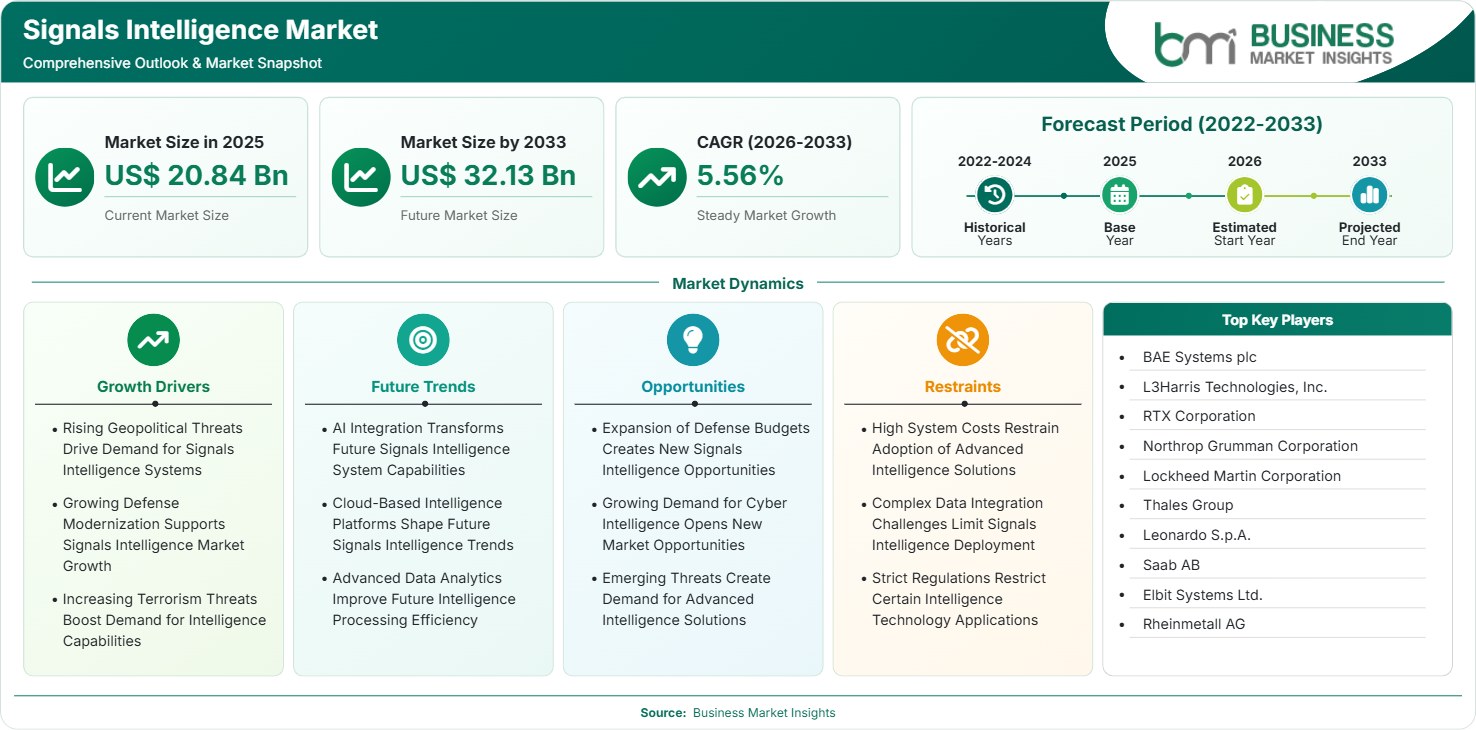
The Signals Intelligence Market size was valued at US$ 20.84 Billion in 2025 and is projected to reach US$ 32.13 Billion by 2033, growing at a CAGR of 5.56% during 2026–2033, driven by geopolitical tensions, defense modernization, cyber intelligence demand, counterterrorism requirements, and advanced data analytics.

Report Coverage
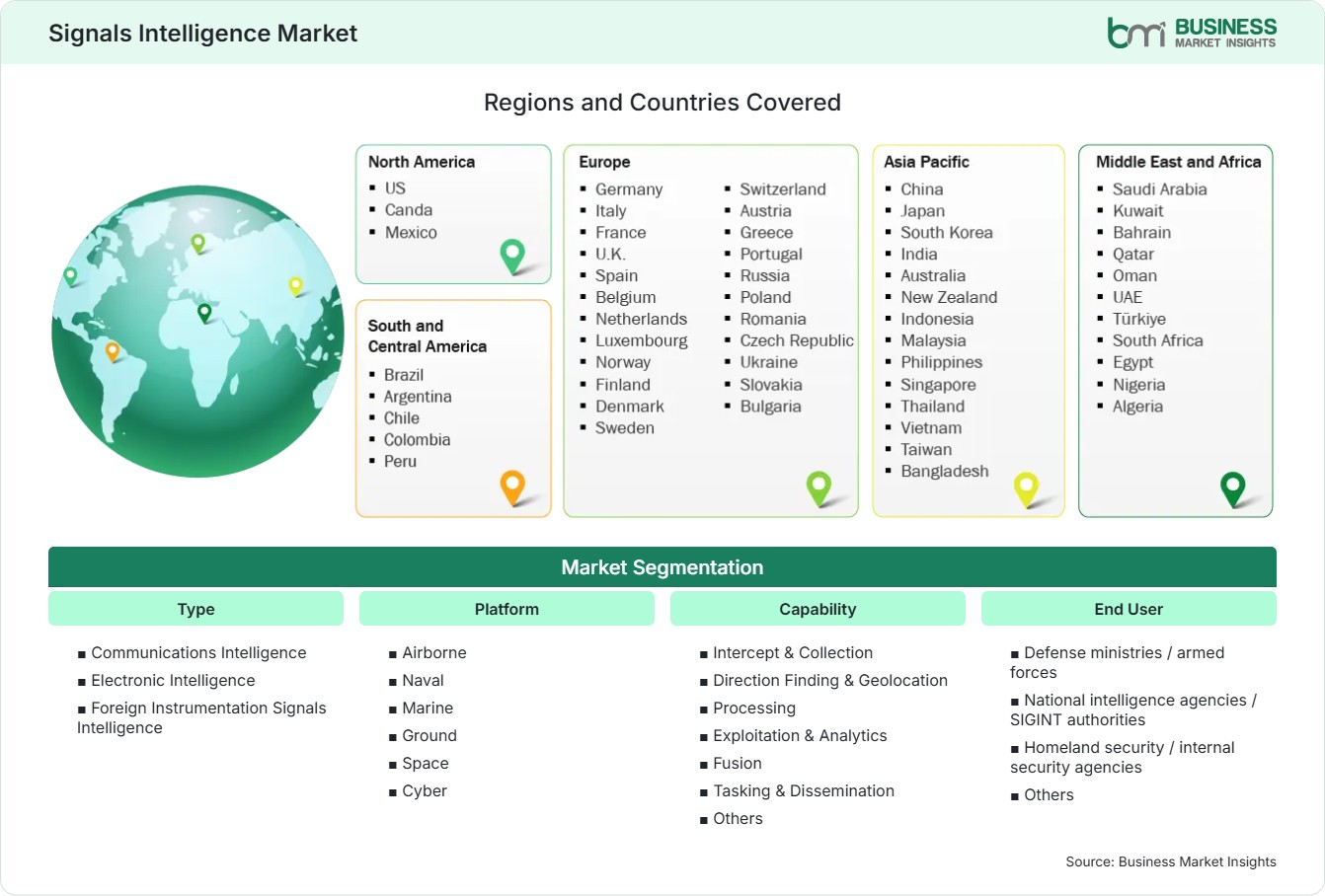
  • Type: Communications Intelligence , Electronic Intelligence , Foreign Instrumentation Signals Intelligence
  • Platform: Airborne, Naval, Marine, Ground, Space, Cyber
  • Capability: Intercept & Collection, Direction Finding & Geolocation, Processing, Exploitation & Analytics, Fusion, Tasking & Dissemination, Others
  • End User: Defense ministries / armed forces, National intelligence agencies / SIGINT authorities, Homeland security / internal security agencies, Others
US$ 20.84 Bn Market size in 2025
US$ 32.13 Bn Market Size by 2033
5.56% CAGR, 2026 - 2033
2026-2033 Forecast Period

01 AI Overview

Signals Intelligence Market Summary

  • North America Region: North America holds a 35%–39% share in 2025, growing at a CAGR of 5.10%–5.70%, supported by defense modernization, intelligence infrastructure investment, cyber convergence, and demand for multi-domain situational awareness. The US remains the regional anchor, supported by sustained intelligence and defense expenditure, with a 5.20%–5.80% CAGR through 2033.
  • Fastest Growing Region: Asia Pacific holds a 22%–26% share in 2025, expanding at a CAGR of 6.40%–7.20%, driven by military modernization, regional security competition, maritime surveillance requirements, cyber intelligence investments, and expanding national intelligence capabilities across major defense-spending economies.
  • Leading Segment: Communications Intelligence (COMINT) holds a 40%–44% share in 2025, growing at a CAGR of 5.40%–6.00%, supported by increasing communications activity, multi-domain intelligence requirements, advanced collection technologies, and demand for actionable information across defense and national security operations.
  • High Growth Segment: Cyber holds a 14%–18% share in 2025, expanding at a CAGR of 7.20%–8.00%, driven by convergence between cyber operations and intelligence missions, growing digital communications, expanding attack surfaces, and increasing demand for persistent threat monitoring capabilities.
  • Key Market Opportunity: Defense intelligence modernization creates opportunities for integrated solutions combining signal collection, geolocation, analytics, cyber intelligence, and multi-domain data fusion to improve operational awareness and accelerate decision-making.
  • Major Market Players: BAE Systems plc, L3Harris Technologies, Inc., RTX Corporation, Northrop Grumman Corporation, Lockheed Martin Corporation, Thales Group, Leonardo S.p.A., Saab AB, Elbit Systems Ltd., Rheinmetall AG.
02 Strategic Insights

Signals Intelligence Market: Strategic Insights

Signals Intelligence Market Strategic Framework
FREE PDF
Request your free sample
Request free sample
03 Stakeholder View

Key Takeaways

  • The industry value chain is shifting from standalone collection hardware toward integrated intelligence ecosystems combining sensors, processing infrastructure, analytics, secure communications, and dissemination capabilities.
  • Cyber-enabled intelligence and multi-domain collection represent attractive areas for investment as defense organizations seek greater visibility across digital, electromagnetic, communications, and physical environments.
  • Artificial intelligence and advanced analytics are becoming central to signal processing as data volumes increase. Automated classification, anomaly detection, pattern recognition, and prioritization can improve analyst productivity.
  • Asia Pacific offers a compelling regional opportunity because military expenditure and rising defense investment is supporting modernization across intelligence and surveillance capabilities.
  • Defense spending growth is improving the funding environment for intelligence modernization. This is strengthening the long-term procurement environment for advanced defense technologies.
  • Procurement priorities are increasingly moving toward modular and upgradeable architectures that can integrate new sensors, software, and analytical tools. Suppliers with open architectures and strong lifecycle support can benefit from recurring modernization.
04 Geographic Outlook

Signals Intelligence Market Regional Highlights

North America Signals Intelligence Market

North America holds a 35%–39% share in 2025 and is projected to expand at a 5.10%–5.70% CAGR through 2033. The region benefits from established defense-industrial capabilities, substantial intelligence infrastructure, and sustained investment in advanced surveillance and information systems. The United States represents the largest regional contributor, supported by extensive defense and intelligence programs. Canada provides additional demand through modernization of defense and security capabilities.

  • The United States remains the principal regional market, supported by large-scale defense programs, established intelligence organizations, and sustained investment in multi-domain information superiority capabilities.
  • Defense modernization is increasingly emphasizing interoperability between intelligence collection, electronic warfare, cyber operations, and command systems, encouraging demand for integrated architectures and software-enabled capabilities.
  • Advanced analytics and automation are gaining importance as organizations seek to process expanding signal volumes while reducing analyst workload and improving the speed of intelligence dissemination.
  • North American suppliers benefit from established defense relationships, extensive research capabilities, and access to large government procurement programs supporting long-term technology development and lifecycle modernization.

US Signals Intelligence Market

The US holds a 29%–33% share of the global Signals Intelligence Market in 2025 and is projected to grow at a 5.20%–5.80% CAGR through 2033. Demand is supported by defense modernization, intelligence requirements, cyber convergence, and investment in multi-domain operations.

  • Intelligence modernization is increasingly connected to multi-domain operations, requiring collection and analytical capabilities that can operate across communications, electromagnetic, cyber, space, air, maritime, and terrestrial environments.
  • Growing data volumes are strengthening demand for automated processing, machine-assisted analysis, and advanced analytics that can identify relevant signals and improve intelligence prioritization.

Europe Signals Intelligence Market

Europe signals intelligence market represents a 27%–31% share in 2025 and is projected to grow at a 5.80%–6.50% CAGR through 2033. Germany, the United Kingdom, France, and Italy are leading markets, while Poland and Nordic countries provide high-growth opportunities. Germany is projected to expand at a 6.20%–6.90% CAGR, while Poland could achieve 7.00%–7.80%.

  • Germany is becoming an increasingly important procurement market as higher defense expenditure supports modernization of intelligence, surveillance, communications, and electronic warfare capabilities.
  • The United Kingdom and France benefit from established national intelligence ecosystems and advanced defense industries, supporting demand for sophisticated collection and analytical technologies.
  • Poland offers stronger growth potential as defense modernization accelerates and security concerns increase demand for advanced surveillance, intelligence, and situational awareness capabilities.
  • Nordic markets are prioritizing resilient defense architectures and secure information systems, creating opportunities for specialized intelligence technologies supporting distributed and multi-domain operational environments.

Asia Pacific Signals Intelligence Market

Asia Pacific holds a 22%–26% share in 2025 and APAC signals intelligence market forecast to record a 6.40%–7.20% CAGR through 2033. China, Japan, India, South Korea, and Australia represent leading demand centers, while India and selected Southeast Asian markets offer higher growth potential.

  • China represents a major regional intelligence technology market as sustained military modernization increases requirements for sophisticated electronic, communications, and multi-domain intelligence capabilities.
  • India provides attractive growth potential as defense modernization and domestic technology development support increased focus on intelligence, surveillance, reconnaissance, and secure information infrastructure.
  • Japan and South Korea are strengthening advanced defense capabilities in response to regional security concerns, supporting demand for high-performance intelligence collection and analytical systems.
  • Australia is investing in advanced defense capabilities and secure information architectures, creating opportunities for suppliers supporting integrated intelligence across maritime, air, space, and cyber domains.

Rest of World Signals Intelligence Market

South and Central America signals intelligence market represent a 7%–10% share in 2025 and are projected to grow at a 4.80%–5.60% CAGR through 2033. Brazil and Mexico are leading markets, while Colombia and selected countries with expanding security requirements provide growth opportunities. Brazil is projected to expand at a 5.20%–6.00% CAGR, supported by defense modernization and border security priorities. The Middle East and Africa account for a 9%–12% share in 2025 and are projected to expand at a 5.70%–6.50% CAGR. Saudi Arabia, the United Arab Emirates, and Israel are leading markets, while selected African economies offer emerging potential.

  • Brazil remains an important market where defense modernization and border monitoring requirements support demand for advanced intelligence, surveillance, and secure communications capabilities.
  • Mexico and Colombia present opportunities associated with national security requirements, organized crime challenges, and modernization of surveillance and intelligence infrastructure.
  • Gulf markets are investing in advanced defense and national security capabilities, supporting demand for integrated intelligence technologies and sophisticated information-processing infrastructure.
  • African markets remain more selective, but increasing security requirements and investments in national intelligence infrastructure are creating opportunities for scalable and cost-effective solutions.
Global Market Geography
FREE PDF
Request your free sample
Request free sample
05 Segment Analysis

Signals Intelligence Market Segmentation

Type

Communications Intelligence (COMINT) represented a 40%–44% share in 2025 and is projected to grow at a 5.40%–6.00% CAGR through 2033. Electronic Intelligence and Foreign Instrumentation Signals Intelligence address specialized collection requirements.

  • Communications Intelligence (COMINT): Supports collection and analysis of communications signals, with demand driven by persistent monitoring requirements, secure communications environments, and expanding multi-domain intelligence operations.
  • Electronic Intelligence (ELINT): Focuses on non-communications electromagnetic emissions, supporting identification, characterization, and analysis requirements across defense surveillance and electronic warfare applications.
  • Foreign Instrumentation Signals Intelligence: Addresses telemetry and instrumentation emissions, providing specialized information for understanding foreign systems and supporting strategic intelligence requirements.

Platform

Airborne platforms represented a 24%–28% signals intelligence market share in 2025 and are projected to grow at a 5.80%–6.40% CAGR through 2033. Naval, Marine, Ground, Space, and Cyber platforms provide complementary collection environments. Platform diversification is increasing as defense organizations seek persistent intelligence coverage across multiple operational domains and geographic areas.

  • Airborne: Provides flexible collection coverage and mobility, supporting intelligence missions requiring broad geographic reach, persistent surveillance, and rapid deployment across changing operational environments.
  • Naval: Supports maritime intelligence requirements by providing collection capabilities across strategic waterways, coastal areas, and contested maritime environments requiring persistent monitoring.
  • Marine: Addresses specialized maritime and littoral intelligence requirements, supporting situational awareness across coastal operating environments and complex electromagnetic conditions.
  • Ground: Provides fixed and mobile collection capabilities for terrestrial intelligence missions, supporting border monitoring, tactical operations, and regional surveillance requirements.
  • Space: Extends intelligence collection beyond terrestrial limitations, supporting broad-area monitoring, strategic awareness, and integration with multi-domain defense architectures.
  • Cyber: Expands intelligence collection into digital environments, supporting monitoring of network activity, digital communications, and emerging cyber-related security requirements.

Capability

Intercept & Collection held a 28%–32% share in 2025 and is projected to grow at a 5.20%–5.80% CAGR through 2033. Direction Finding & Geolocation, Processing, Exploitation & Analytics, Fusion, and Tasking & Dissemination are increasingly integrated to improve intelligence workflows. Capability development is moving toward automated, software-driven architectures.

  • Intercept & Collection: Remains foundational to intelligence operations, requiring scalable systems capable of collecting diverse signals across complex electromagnetic and communications environments.
  • Direction Finding & Geolocation: Supports accurate localization and situational awareness, with demand influenced by requirements for faster identification of relevant signal sources.
  • Processing, Exploitation & Analytics: Benefits from artificial intelligence and automation as organizations seek to manage growing data volumes and accelerate intelligence interpretation.
  • Fusion: Combines information from multiple sources to create more comprehensive intelligence outputs, improving operational context and reducing dependence on isolated data streams.
  • Tasking & Dissemination: Supports efficient allocation of collection resources and delivery of intelligence products to authorized users, strengthening decision-making and mission responsiveness.

End User

Defense ministries / armed forces represented a 52%–56% share in 2025 and are projected to grow at a 5.50%–6.10% CAGR through 2033. National intelligence agencies / SIGINT authorities and Homeland security / internal security agencies provide additional demand. End users increasingly prioritize interoperable systems capable of supporting strategic, operational, and tactical intelligence requirements.

  • Defense ministries / armed forces: Represent the largest demand base because intelligence capabilities support defense planning, situational awareness, electronic warfare, operational coordination, and multi-domain missions.
  • National intelligence agencies / SIGINT authorities: Require advanced collection and analytical capabilities for strategic intelligence, threat monitoring, national security assessment, and long-term information gathering.
  • Homeland security / internal security agencies: Use intelligence capabilities to strengthen national security monitoring, border awareness, counterterrorism activities, and protection of critical infrastructure.
06 Market Forces

Signals Intelligence Market Dynamics

Key Market Drivers

Rising Geopolitical Threats Drive Demand for Signals Intelligence Systems

Rising geopolitical tensions are strengthening demand for intelligence capabilities that provide timely visibility into evolving security environments. The market growth is increasingly linked to requirements for persistent monitoring, multi-domain awareness, and faster threat assessment. Signals Intelligence Market trends also show greater integration of communications, electronic, cyber, and space-based information. Governments are prioritizing capabilities that can process complex data environments and support decision-making under rapidly changing security conditions.

Growing Defense Modernization Supports Signals Intelligence Market Growth

Defense modernization is increasing demand for intelligence systems that can operate within digitally connected and multi-domain architectures. Governments are replacing legacy systems with software-enabled platforms capable of integrating new sensors, processing technologies, and analytical tools. Modernization programs increasingly emphasize interoperability, automation, and secure information exchange rather than isolated collection capabilities. Suppliers that combine collection hardware, advanced software, analytics, cybersecurity, and systems integration are positioned to benefit from modernization cycles and long-term technology refresh requirements.

Increasing Terrorism Threats Boost Demand for Intelligence Capabilities

Persistent terrorism and internal security concerns continue to support demand for intelligence capabilities that improve threat detection and situational awareness. Security agencies require timely information from communications, electromagnetic, and digital environments to identify emerging risks and support coordinated responses. Demand is also expanding beyond traditional defense users toward homeland security and internal security organizations. This broadens the customer base for specialized intelligence systems while increasing requirements for scalable architectures and secure information sharing. As threats become more distributed across physical and digital environments, organizations are placing greater emphasis on flexible systems capable of supporting diverse intelligence requirements.

Key Market Opportunities

Expansion of Defense Budgets Creates New Signals Intelligence Opportunities

Expansion of defense budgets creates opportunities for suppliers as governments allocate greater resources toward modernization, surveillance, intelligence, and electronic warfare capabilities. Signals Intelligence Forecasts therefore point toward continued opportunities for suppliers offering modular architectures, advanced processing, and integrated multi-domain solutions. Companies with established government relationships can benefit from long procurement cycles, while technology providers with flexible software architectures can address modernization requirements without requiring complete platform replacement.

Growing Demand for Cyber Intelligence Opens New Market Opportunities

Growing demand for cyber intelligence is creating opportunities at the intersection of digital security, communications monitoring, and traditional intelligence operations. Organizations increasingly require visibility across network environments, digital communications, and emerging threat vectors. This is encouraging convergence between cyber and signals intelligence capabilities, creating demand for platforms capable of integrating data from multiple sources. Software-based analytics, automated detection, and machine-assisted processing can improve the ability to identify relevant activity within high-volume environments. The opportunity is particularly relevant as digitalization increases the volume and complexity of information requiring continuous monitoring and analysis.

Emerging Threats Create Demand for Advanced Intelligence Solutions

Emerging threats are increasing demand for intelligence solutions capable of addressing rapidly changing technologies, distributed operations, and increasingly complex information environments. Modern systems must process diverse signals while supporting faster identification, classification, geolocation, and dissemination. This creates opportunities for suppliers developing artificial intelligence-enabled analytics, automated signal recognition, advanced sensor fusion, and scalable processing architectures. Space and cyber domains are also expanding the scope of intelligence operations, requiring greater integration across traditionally separate systems.

Market Restraints and Challenges

High System Costs Restrain Adoption of Advanced Intelligence Solutions

Factor: The development of advanced intelligence technologies requires considerable expenditure on hardware, communications, processing, software, integration, training, and maintenance. Sophisticated architectures may also entail considerable expense prior to achieving a mature state of operation. Impact: The high cost of development and ownership can limit the use of these technologies by institutions that have limited budgets for defense or security, especially when procurement considerations conflict with other aspects of modernization.

Complex Data Integration Challenges Limit Signals Intelligence Deployment

Factor: The intelligence community relies more on large quantities of information gathered through different sensors, communication environments, cyberspace, and other diverse sources. Diversities in data format, architecture, security classification, and processing standards can make integration difficult. Impact: Inadequate interoperability can diminish the significance of gathered information, duplicate processes, and postpone information dissemination. Companies may require extensive systems integration and specialized technical expertise to connect legacy infrastructure with newer platforms.

07 Company Analysis

Competitive Landscape

The Signals Intelligence Market analysis indicates that competition is shaped by defense relationships, systems integration capabilities, sensor technologies, secure communications, electronic warfare expertise, software development, and advanced analytics. Leading companies are increasingly positioning their portfolios around integrated multi-domain architectures rather than standalone collection equipment.

Company Name

Overview

Products and Services relevant to this market

BAE Systems plc

Global defense technology company with extensive expertise across electronic systems, intelligence, surveillance, security, and advanced defense platforms.

Electronic intelligence, communications intelligence, electronic warfare, signal processing, surveillance systems, intelligence analytics, and integrated defense solutions.

L3Harris Technologies, Inc.

Defense technology company specializing in communications, intelligence, surveillance, reconnaissance, electronic warfare, and mission-critical systems.

Signals intelligence systems, electronic warfare, communications, airborne intelligence, mission systems, signal processing, and multi-domain intelligence capabilities.

RTX Corporation

Aerospace and defense company providing advanced sensing, surveillance, communications, and electronic warfare technologies for government customers.

Intelligence and surveillance systems, electronic warfare, radar, sensors, communications, signal processing, and integrated defense technologies.

Northrop Grumman Corporation

Major defense technology provider with capabilities spanning intelligence, surveillance, space, cyber, and advanced mission systems.

Signals intelligence, electronic warfare, space-based intelligence, surveillance systems, mission processing, cyber capabilities, and advanced analytics.

Lockheed Martin Corporation

Global aerospace and defense company providing integrated systems for intelligence, surveillance, reconnaissance, space, cyber, and national security missions.

Intelligence systems, electronic warfare, surveillance, space capabilities, cyber solutions, mission systems, and advanced data processing technologies.

Thales Group

International technology and defense company with expertise in secure communications, intelligence, cybersecurity, aerospace, and defense electronics.

Signals intelligence, electronic warfare, secure communications, intelligence processing, cybersecurity, surveillance, and integrated command systems.

Leonardo S.p.A.

Aerospace and defense company with broad capabilities across electronics, helicopters, aircraft, cybersecurity, and integrated defense systems.

Electronic intelligence, surveillance systems, electronic warfare, mission systems, secure communications, and intelligence-related technologies.

Saab AB

Swedish defense and security company developing advanced systems for surveillance, electronic warfare, sensors, and command capabilities.

Signals intelligence, electronic warfare, surveillance, sensor systems, intelligence processing, and integrated command and control technologies.

Elbit Systems Ltd.

International defense technology company offering advanced intelligence, surveillance, reconnaissance, electronic warfare, and mission systems.

Signals intelligence, electronic warfare, intelligence collection, surveillance, communications, data processing, and multi-domain mission solutions.

Rheinmetall AG

Defense technology company expanding capabilities across sensors, digitalization, electronics, protection, and integrated military systems.

Electronic intelligence, reconnaissance, sensors, communications, digital mission systems, surveillance technologies, and defense information solutions.

10 Trust & Transparency

Research Methodology

The market analysis combines proprietary research with secondary data from government agencies, company disclosures, regulatory filings, industry databases and expert interviews. Market estimates are validated through data triangulation, cross-market benchmarking and analyst review.

View Full Research Methodology

11 Questions Answered

Frequently Asked Questions

How are defense organizations addressing legacy system limitations?

Organizations are increasingly adopting modular and upgradeable architectures that allow new sensors, software, and analytics to integrate with existing infrastructure, reducing the need for complete system replacement.

What is influencing intelligence procurement decisions?

Procurement decisions increasingly emphasize interoperability, secure data handling, scalability, automation, lifecycle support, and compatibility with existing systems rather than standalone technical performance.

Why is multi-domain intelligence becoming important?

Security environments increasingly span physical, electromagnetic, digital, air, maritime, and space domains, requiring integrated intelligence architectures that combine information from multiple operational environments.

How is artificial intelligence affecting signals intelligence market report?

Artificial intelligence is improving automated signal classification, anomaly detection, pattern recognition, data prioritization, and analytical workflows, helping intelligence organizations manage larger information volumes more efficiently.

Which platform segment offers the strongest growth potential?

Cyber and space platforms offer attractive growth potential as intelligence operations expand into digital and orbital environments, increasing demand for persistent collection and advanced data processing capabilities.

Access the Full Signals Intelligence Market Report

Get segment-level forecasts, regional estimates, competitive benchmarking, company profiles and downloadable Excel datasets.

Access the full Signals Intelligence Market Report
350 pages PDF & Excel | 2026-08-12