
Counter UAS Market Outlook: Size, Share, Trends, Growth Analysis, Competitive Landscape & Forecast, 2026-2033

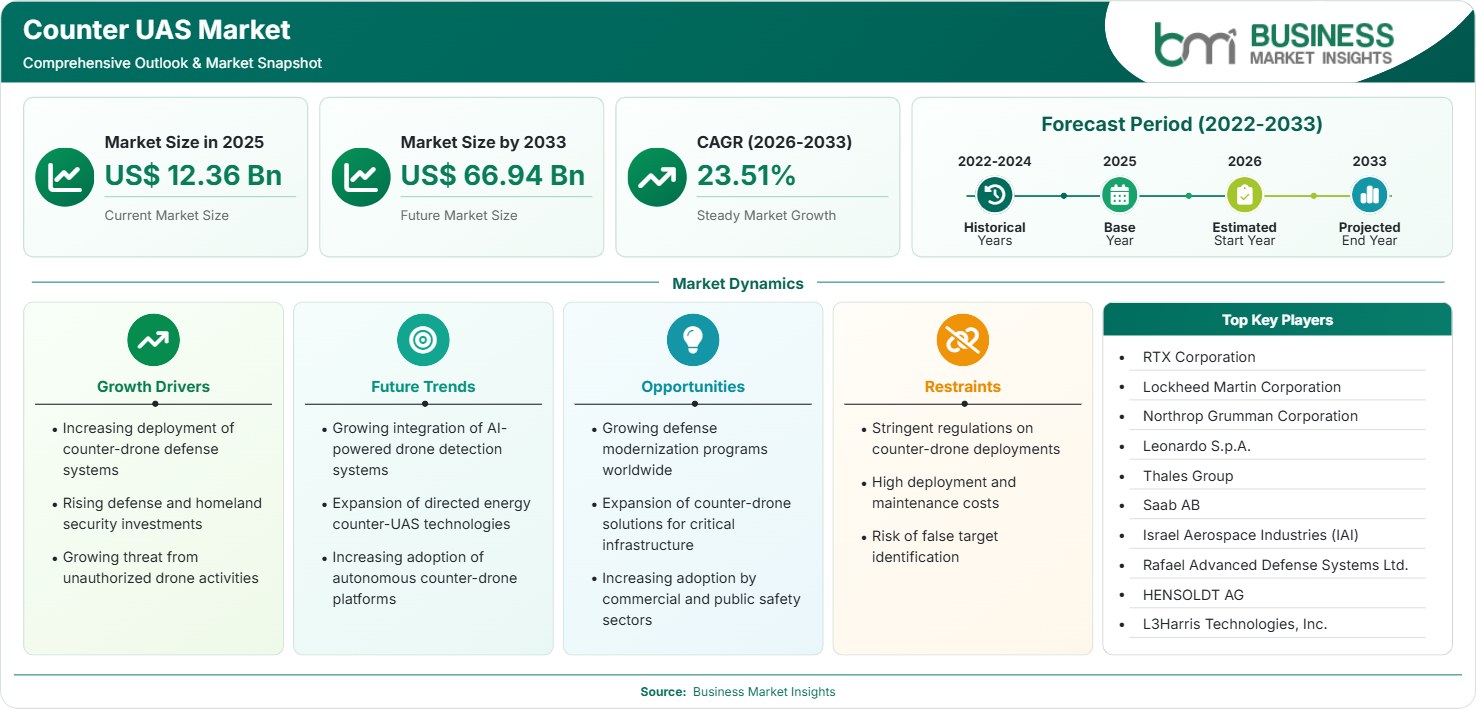
The Counter UAS Market size was valued at US$ 12.36 Billion in 2025 and is projected to reach US$ 66.94 Billion by 2033, growing at a CAGR of 23.51% from 2026 to 2033, driven by rising drone threats, defense modernization initiatives, critical infrastructure protection requirements, and increasing adoption of advanced detection and neutralization technologies.

Report Coverage
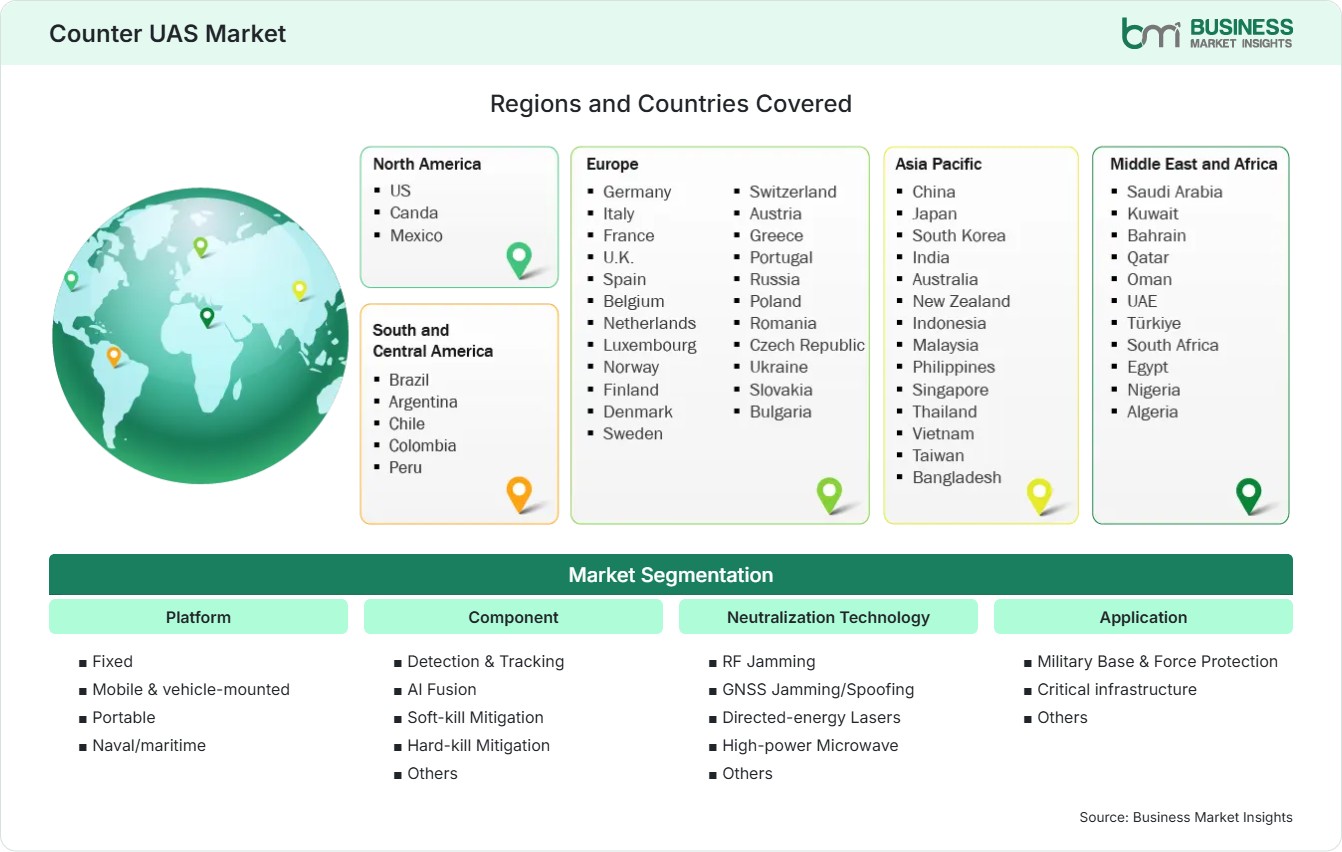
  • Platform: Fixed, Mobile & vehicle-mounted, Portable, Naval/maritime
  • Component: Detection & Tracking, AI Fusion, Soft-kill Mitigation, Hard-kill Mitigation, Others
  • Neutralization Technology: RF Jamming, GNSS Jamming/Spoofing, Directed-energy Lasers, High-power Microwave, Others
  • Application: Military Base & Force Protection, Critical infrastructure, Others
  • End User: Defense & Military Forces, Homeland Security & Border Agencies, Others
US$ 12.36 Bn Market size in 2025
US$ 66.94 Bn Market Size by 2033
23.51% CAGR, 2026 - 2033
2026-2033 Forecast Period

01 AI Overview

Counter UAS Market Summary

  • North America Region: North America holds a market share of 38%–42% in 2025, growing with a CAGR of 22.80%–23.40% influenced by military procurement programs, homeland security investments, advanced defense technology adoption, and critical infrastructure protection needs. The U.S. market analysis shows expansion with a CAGR of 23.00%–23.60% due to increasing deployment of counter-drone systems.
  • Fastest Growing Region: Asia Pacific holds a market share of 25%–29% in 2025, growing with a CAGR of 24.20%–25.00% influenced by defense modernization programs, border security requirements, regional military competition, and rising demand for autonomous threat detection capabilities.
  • Leading Segment: Detection & Tracking holds a market share of 32%–35% in 2025, growing with a CAGR of 22.90%–23.50% influenced by increasing demand for radar systems, electro-optical sensors, RF detection technologies, and integrated situational awareness platforms.
  • High Growth Segment: Directed-energy Lasers hold a market share of 10%–13% in 2025, growing with a CAGR of 25.00%–26.00% influenced by precision engagement requirements, reduced ammunition dependency, technological advancement, and increasing interest in cost-effective drone neutralization.
  • Key Market Opportunity: Expansion of counter-drone solutions across military, commercial, and public safety applications creates opportunities through AI-enabled detection, automated response systems, infrastructure protection, and integration with existing defense networks.
  • Major Market Players: RTX Corporation, Lockheed Martin Corporation, Northrop Grumman Corporation, Leonardo S.p.A., Thales Group, Saab AB, Israel Aerospace Industries Ltd., Rafael Advanced Defense Systems Ltd., HENSOLDT AG, L3Harris Technologies, Inc.
02 Strategic Insights

Counter UAS Market: Strategic Insights

Counter UAS Market Strategic Framework
FREE PDF
Request your free sample
Request free sample
03 Stakeholder View

Key Takeaways

  • The market ecosystem is evolving from standalone detection equipment toward integrated counter-drone defense networks combining sensors, command systems, electronic warfare tools, and kinetic response mechanisms. Companies offering complete layered protection architectures are gaining competitive advantages.
  • Military and defense applications remain the primary growth contributor, but commercial opportunities are expanding through airport security, energy infrastructure protection, public event monitoring, and industrial facility safeguarding against unauthorized drone activities.
  • Artificial intelligence, machine learning, and autonomous response technologies are becoming central innovation areas. Manufacturers are focusing on improving threat classification accuracy, reducing response time, and enabling real-time decision support for operators.
  • Asia Pacific presents a strong investment opportunity due to increasing defense expenditure, modernization of armed forces, border security challenges, and rising adoption of indigenous defense technology programs across major economies.
  • Strategic partnerships, acquisitions, and defense contracts are influencing competitive positioning as established defense companies expand their counter-UAS portfolios through advanced sensors, electronic warfare capabilities, and integrated security solutions.
  • Commercial adoption is expected to increase as regulatory frameworks mature and organizations seek reliable protection against drone-based surveillance, smuggling activities, and operational disruptions.
04 Geographic Outlook

Counter UAS Market Regional Highlights

North America Counter UAS Market

North America accounted for 38%–42% share in 2025 and is projected to expand at a CAGR of 22.80%–23.40% during 2026–2033. The region maintains leadership due to advanced defense infrastructure, substantial military spending, strong homeland security capabilities, and early adoption of counter-drone technologies. The Counter UAS Market share in North America is supported by increasing deployment across military bases, airports, government facilities, and critical infrastructure sites requiring layered protection against unauthorized aerial threats.

  • The United States represents the largest regional contributor due to extensive defense procurement programs, increasing military base protection requirements, and advanced electronic warfare capabilities.
  • Canada is strengthening counter-drone capabilities through investments in border protection, public safety applications, and infrastructure security modernization initiatives.
  • Defense contractors are expanding integrated solutions combining radar, RF detection, artificial intelligence, and electronic countermeasure technologies for government customers.
  • Growing drone security concerns around airports and public facilities are encouraging adoption of automated detection and mitigation platforms.

US Counter UAS Market

The United States represents 33%–36% share within North America in 2025 and is expected to grow at a CAGR of 23.00%–23.60% between 2026–2033. The country remains a dominant market due to high defense expenditure, increasing military modernization programs, and growing demand for protection against hostile unmanned systems. The Counter UAS Market continues expanding through investments from defense agencies, homeland security organizations, and infrastructure operators.

  • The U.S. Department of Defense continues prioritizing counter-drone capabilities to protect deployed forces, military installations, and strategic assets.
  • Increasing adoption of artificial intelligence-enabled systems is improving detection accuracy and reducing response time against emerging drone threats.
  • Commercial operators are investing in counter-UAS technologies for airport security, energy facilities, and large-scale public event protection.

Europe Counter UAS Market

Europe accounted for 20%–24% share in 2025 and is forecast to grow at a CAGR of 22.00%–22.70% from 2026–2033. Germany, France, the United Kingdom, and Poland represent major markets due to increasing defense investments, regional security concerns, and modernization initiatives. Germany and the United Kingdom are among high-growth countries, supported by military technology upgrades and increasing demand for advanced surveillance and protection systems in Counter UAS Market.

  • Germany is increasing investment in defense technology modernization, supporting demand for advanced drone detection and mitigation systems.
  • The United Kingdom is expanding counter-UAS capabilities through defense procurement programs and protection requirements for critical national infrastructure.
  • France is strengthening domestic defense capabilities through investments in electronic warfare and autonomous threat management solutions.
  • Poland is increasing adoption due to regional security priorities and modernization of military surveillance infrastructure.

Asia Pacific Counter UAS Market

Asia Pacific represented 25%–29% share in 2025 and is expected to grow at a CAGR of 24.20%–25.00% during 2026–2033. China, India, Japan, South Korea, and Australia are key markets driven by defense modernization, border security requirements, and increasing adoption of advanced military technologies. The Counter UAS Market trends in Asia Pacific are influenced by rising geopolitical tensions, expanding unmanned system usage, and government investment in indigenous defense capabilities.

  • China is expanding counter-drone research and deployment capabilities through investments in electronic warfare, radar systems, and autonomous defense technologies.
  • India is increasing procurement of counter-UAS systems to strengthen border security, military installations, and critical asset protection.
  • Japan is improving defense readiness through investments in advanced surveillance and integrated air defense capabilities.
  • South Korea is adopting counter-drone technologies to protect strategic locations and enhance national security preparedness.

Rest of World Counter UAS Market

Rest of World accounted for 8%–12% share in 2025 and is projected to grow at a CAGR of 21.00%–22.00% from 2026–2033. South America and Middle East and Africa regions are experiencing increasing demand due to border security challenges, protection of oil and gas facilities, and military modernization programs in Counter UAS Market.

  • Brazil is improving security capabilities through adoption of surveillance technologies for defense and public safety applications.
  • Middle Eastern countries are investing heavily in counter-UAS systems to protect energy infrastructure, military assets, and government facilities.
  • The UAE is expanding security technology adoption through smart infrastructure initiatives and advanced defense procurement programs.
  • African nations are gradually increasing demand through border monitoring programs and international defense cooperation initiatives.
Global Market Geography
FREE PDF
Request your free sample
Request free sample
05 Segment Analysis

Counter UAS Market Segmentation

Platform

Platform segmentation reflects diverse deployment requirements across military and security environments. Fixed systems remain widely adopted for permanent protection of strategic locations, while mobile and portable solutions provide operational flexibility. The segment accounted for 42%–46% share in 2025 and is projected to grow at a CAGR of 23.00%–23.70% during 2026–2033. The Counter UAS Market scope is expanding as users demand adaptable systems for multiple operational scenarios.

  • Fixed: Fixed platforms provide continuous protection for military bases, airports, and critical infrastructure through permanent detection and mitigation installations.
  • Mobile & vehicle-mounted: Mobile systems enable rapid deployment and operational flexibility for military missions, border operations, and temporary security requirements.
  • Portable: Portable systems support individual units and field operations by providing lightweight counter-drone capabilities in remote locations.
  • Naval/maritime: Naval and maritime systems protect vessels, ports, and offshore assets from drone-based surveillance and attack threats.

Component

Component segmentation is driven by increasing demand for integrated counter-drone architectures combining detection, analysis, and neutralization capabilities. Detection and tracking components represent the largest category in Counter UAS Market due to their importance in identifying threats before engagement. The segment accounted for 32%–35% share in 2025 and is expected to grow at a CAGR of 22.90%–23.50% through 2026–2033.

  • Detection & Tracking: Detection and tracking systems identify, classify, and monitor unmanned aerial threats using radar, RF sensors, and electro-optical technologies.
  • AI Fusion: AI fusion technologies combine multiple data sources to improve threat recognition, decision-making speed, and operational accuracy.
  • Soft-kill Mitigation: Soft-kill systems neutralize drones through electronic disruption methods including jamming and communication interference techniques.
  • Hard-kill Mitigation: Hard-kill systems provide physical destruction capabilities through advanced interceptors and directed-energy technologies.

Neutralization Technology

Neutralization technology segmentation is expanding as defense organizations seek effective methods to counter increasingly sophisticated unmanned aerial threats. Electronic and directed-energy solutions are gaining adoption due to operational flexibility, reduced collateral risks, and cost advantages compared with conventional interception methods. The segment accounted for 40%–44% share in 2025 and is projected to grow at a CAGR of 23.50%–24.20% during 2026–2033 in Counter UAS Market as military and security agencies enhance layered defense capabilities.

  • RF Jamming: RF jamming technology disrupts communication links between drones and operators, enabling rapid mitigation of unauthorized unmanned aerial activities.
  • GNSS Jamming/Spoofing: GNSS jamming and spoofing technologies interfere with navigation signals, preventing accurate drone positioning and reducing operational effectiveness.
  • Directed-energy Lasers: Directed-energy lasers provide precision engagement capabilities with low operating costs and increasing adoption for repeated drone threat scenarios.
  • High-power Microwave: High-power microwave systems disable electronic components of multiple drones simultaneously, supporting defense against coordinated aerial attacks.

Application

Application segmentation is influenced by increasing security requirements across military, infrastructure, and public safety environments. Military base and force protection remains the leading application in Counter UAS Market due to rising deployment of drones in modern conflicts and security operations. The segment accounted for 55%–58% share in 2025 and is expected to grow at a CAGR of 22.80%–23.40% between 2026–2033. Expanding commercial adoption is creating additional opportunities.

  • Military Base & Force Protection: Military applications dominate demand as armed forces deploy counter-UAS systems to protect personnel, assets, and strategic installations.
  • Critical infrastructure: Critical infrastructure operators are adopting counter-drone technologies to secure airports, energy facilities, communication networks, and transportation systems.

End User

End-user segmentation reflects increasing adoption by defense organizations, government agencies, and commercial operators. Defense and military forces represent the largest user category due to operational requirements and rising battlefield drone threats. The segment accounted for 60%–63% share in 2025 and is projected to grow at a CAGR of 23.20%–23.80% during 2026–2033. Expanding homeland security applications are also supporting market development.

  • Defense & Military Forces: Defense organizations utilize counter-UAS systems for battlefield protection, base security, intelligence operations, and force protection missions.
  • Homeland Security & Border Agencies: Homeland security agencies deploy counter-drone solutions for border monitoring, public safety, and protection against unauthorized aerial activities.
06 Market Forces

Counter UAS Market Dynamics

Key Market Drivers

Increasing deployment of counter-drone defense systems

The increasing deployment of counter-drone defense systems is a primary growth factor as governments, defense forces, and infrastructure operators strengthen protection against unauthorized unmanned aerial vehicles. Modern military environments are witnessing greater reliance on drones for surveillance, intelligence gathering, and tactical operations, creating demand for layered counter-UAS architectures. The market growth is supported by rising procurement of radar-based detection, radio frequency monitoring, artificial intelligence-enabled threat classification, and electronic mitigation solutions. The Counter UAS Market trends indicate increasing preference for integrated platforms capable of detecting, tracking, identifying, and neutralizing multiple drone threats simultaneously.

Rising defense and homeland security investments

Increasing defense and homeland security investments are accelerating adoption of counter-UAS technologies as governments prioritize protection of military assets, borders, and sensitive infrastructure. Rising geopolitical tensions and evolving security challenges are encouraging nations to modernize surveillance and electronic warfare capabilities. Defense budgets are increasingly allocated toward advanced detection systems, command-and-control platforms, and non-kinetic neutralization technologies. Homeland security agencies are also expanding investments to address unauthorized drone activities near airports, government facilities, and public venues. Growing financial commitments are enabling defense manufacturers to enhance product development, expand production capabilities, and introduce advanced solutions with improved accuracy, faster response times, and greater operational flexibility across multiple security applications.

Growing threat from unauthorized drone activities

The growing threat from unauthorized drone activities is creating strong demand for counter-UAS solutions across defense, commercial, and public safety sectors. Increasing misuse of drones for surveillance, smuggling, security breaches, and potential attacks has highlighted vulnerabilities around critical locations. Military compounds, airports, power plants, and government buildings are implementing modern systems of detection and mitigation to enhance their security preparedness. The growing availability of drones for commercial use has made managing such aerial threats more complicated. Companies are developing innovative technologies to tackle the threats posed by autonomous flights, encryption, and swarms of drones.

Key Market Opportunities

Growing defense modernization programs worldwide

Growing defense modernization programs worldwide are creating significant opportunities for counter-UAS technology providers as armed forces upgrade their security capabilities. Countries are building up sophisticated surveillance, electronic warfare, and air defense systems as a response to evolving needs on the battlefield. Modern warfare demands adaptable counter-drone systems that will work in various missions. There is a need for solutions that can perform the tasks of detection, tracking, identification, and destruction of drones in one single system. Companies with scalable technologies and good defense industry connections stand to gain from such acquisition plans.

Expansion of counter-drone solutions for critical infrastructure

Counter-drone systems for critical infrastructure are an emerging trend that provides significant opportunities in protecting critical assets from drone attacks. Increasingly, operators of airports, power stations, communications networks, seaports, and transportation centers evaluate counter-drone systems to protect their operations from disruption. There is a demand for effective tools that will allow detecting, alerting about, and addressing drones. Systems based on artificial intelligence and automation are becoming popular. As governments set higher requirements for the protection of critical infrastructures, the demand for counter-drone systems will grow.

Increasing adoption by commercial and public safety sectors

Growing usage of the technology in both the private and public sector is creating new avenues for use of counter UAS technology which are not traditionally limited to defense. Many security organizations, event planners, industrial firms, and emergency services are looking into ways to protect themselves from the threats posed by drones using technology. Growing fears of privacy infringement, disturbances, and safety risks are driving the adoption of counter-drone technology. Private users need technologies that are affordable, easily deployable, and suitable for both temporary and permanent security purposes.

Market Restraints and Challenges


Stringent regulations on counter-drone deployments

Factor: Stringent regulations governing counter-drone deployments create operational limitations due to airspace management requirements, communication interference restrictions, and legal compliance obligations. Impact: Regulatory complexity can delay system adoption, increase approval timelines, and restrict deployment flexibility across several regions. Governments must balance security requirements with aviation safety, privacy protection, and communication network stability. Different regulatory approaches across countries create challenges for manufacturers seeking international commercialization. Defense and security organizations require solutions that comply with national regulations while maintaining effective threat response capabilities. Companies are increasingly focusing on adaptable technologies and regulatory partnerships to overcome deployment barriers and support wider adoption.

High deployment and maintenance costs

Factor: High deployment and maintenance costs associated with advanced counter-UAS systems increase financial requirements for procurement, operation, training, and technology upgrades. Impact: Higher ownership costs can limit adoption among smaller organizations and budget-constrained security agencies. Complex systems require continuous software improvements, hardware maintenance, skilled operators, and integration with existing security infrastructure. Rapid evolution of drone technologies further increases the need for regular system enhancements. Organizations are exploring modular platforms, service-based models, and scalable architectures to improve affordability.

07 Company Analysis

Competitive Landscape

The Counter UAS Market analysis highlights a rapidly evolving competitive environment shaped by defense technology companies developing integrated detection, tracking, identification, and neutralization solutions. Market participants are strengthening their positions through defense contracts, technology partnerships, artificial intelligence integration, electronic warfare capabilities, and expansion of multi-domain security platforms.

Company Name

Overview

Products and Services relevant to this market

RTX Corporation

Global aerospace and defense company developing advanced sensing, electronic warfare, and integrated defense solutions.

Provides counter-UAS capabilities through radar systems, command networks, electronic warfare technologies, and air defense solutions.

Lockheed Martin Corporation

Major defense contractor focused on advanced security systems, military technologies, and integrated battlefield solutions.

Develops counter-drone technologies through sensors, directed-energy systems, command platforms, and defense integration expertise.

Northrop Grumman Corporation

Defense technology leader specializing in autonomous systems, surveillance, and advanced military solutions.

Provides detection systems, electronic warfare capabilities, and integrated defense solutions supporting counter-UAS operations.

Leonardo S.p.A.

Global aerospace and defense company offering advanced electronics, surveillance, and security technologies.

Develops radar systems, sensors, and defense electronics applicable to unmanned aerial threat detection and response.

Thales Group

International technology company providing defense, security, and aerospace solutions worldwide.

Offers integrated counter-drone systems combining radar, radio frequency detection, command systems, and mitigation technologies.

Saab AB

Swedish defense company specializing in surveillance, electronic warfare, and military security solutions.

Provides sensor systems, radar technologies, and defense platforms supporting drone detection and protection missions.

Israel Aerospace Industries Ltd.

Aerospace and defense organization developing advanced unmanned systems and security technologies.

Provides Drone Guard and integrated counter-UAS solutions including detection and neutralization capabilities.

Rafael Advanced Defense Systems Ltd.

Defense technology company focused on air defense, electronic warfare, and advanced security systems.

Develops counter-drone solutions including detection systems, electronic mitigation, and interception technologies.

HENSOLDT AG

Defense electronics company specializing in sensors, surveillance, and security technologies.

Provides radar, sensor fusion, and situational awareness solutions for counter-UAS applications.

L3Harris Technologies, Inc.

Technology company delivering communication, electronic warfare, and defense solutions.

Offers RF detection, electronic warfare systems, and integrated counter-drone technologies for military users.

10 Trust & Transparency

Research Methodology

The market analysis combines proprietary research with secondary data from government agencies, company disclosures, regulatory filings, industry databases and expert interviews. Market estimates are validated through data triangulation, cross-market benchmarking and analyst review.

View Full Research Methodology

11 Questions Answered

Frequently Asked Questions

5. What insights does the Counter UAS Market Report provide?

The report provides analysis of market size, technology trends, regional developments, competitive landscape, segmentation, growth drivers, challenges, and future opportunities influencing industry expansion.

Why are critical infrastructure operators investing in counter-UAS technologies?

Critical infrastructure operators are investing in counter-UAS technologies because unauthorized drones can create security vulnerabilities, operational disruptions, surveillance risks, and potential safety concerns around sensitive facilities.

How does artificial intelligence improve counter-UAS capabilities?

Artificial intelligence improves counter-UAS performance by enhancing threat classification, reducing detection time, analyzing multiple data sources, and supporting automated decision-making during complex aerial security situations.

What industries are adopting counter-drone solutions beyond defense Counter UAS Market forecasts?

Airports, energy facilities, transportation networks, government buildings, industrial sites, and public safety organizations are increasingly adopting counter-drone technologies to protect operations from unauthorized aerial activities and security risks.

What technologies are used in counter-UAS systems?

Counter-UAS systems use radar, radio frequency sensors, electro-optical and infrared cameras, artificial intelligence platforms, electronic jamming, spoofing technologies, directed-energy systems, and kinetic interception methods to detect and neutralize unauthorized drones.

Access the Full Counter UAS Market Report

Get segment-level forecasts, regional estimates, competitive benchmarking, company profiles and downloadable Excel datasets.

Access the full Counter UAS Market Report
350 pages PDF & Excel | 2026-08-12