
BVLOS UAV Market Outlook: Size, Share, Trends, Growth Analysis, Competitive Landscape & Forecast, 2026-2033

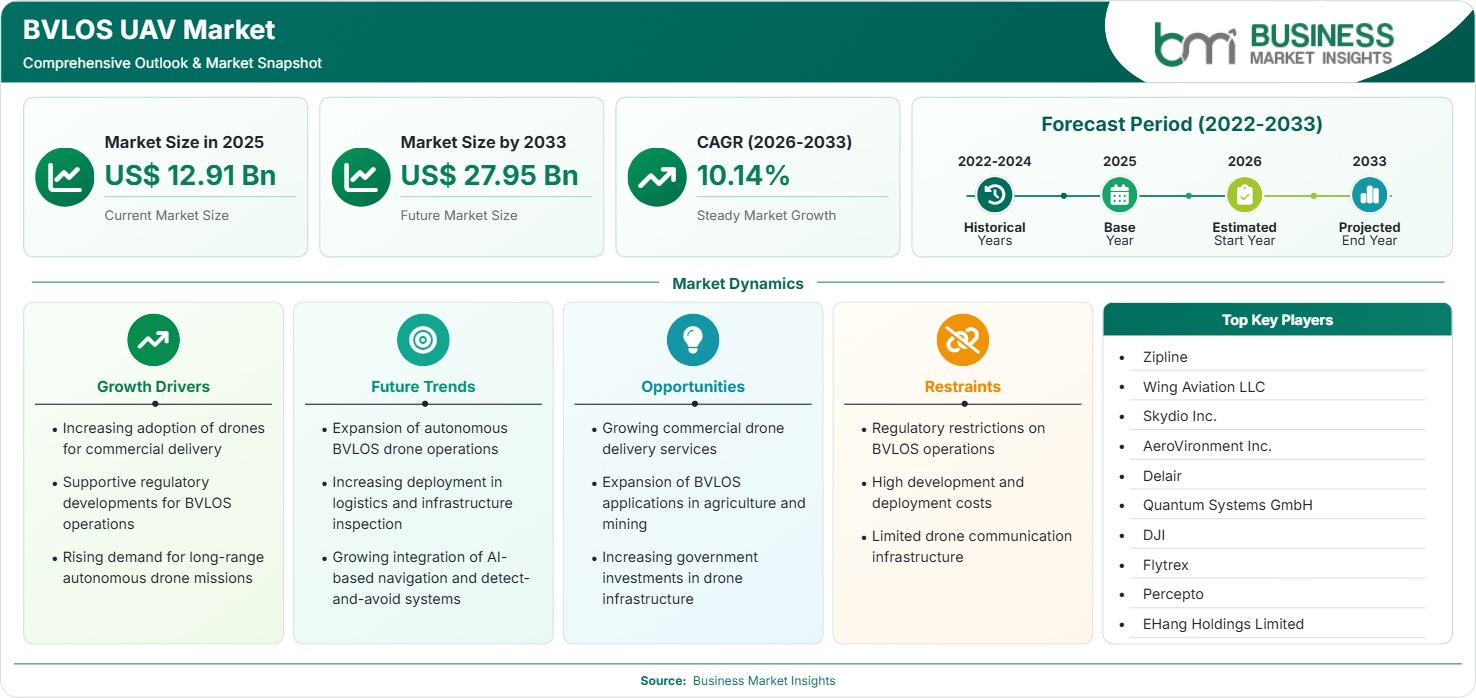
The BVLOS UAV Market size was valued at US$ 12.91 Billion in 2025 and is projected to reach US$ 27.95 Billion by 2033, growing at a CAGR of 10.14% during 2026–2033, driven by commercial drone delivery expansion, regulatory advancements, autonomous mission adoption, infrastructure monitoring, defense modernization, and increasing demand for long-range unmanned operations.

Report Coverage
  • Platform Type: Fixed-Wing, Rotary-Wing, Hybrid VTOL UAVs
  • Component: Airframe & Structures, Propulsion & Power System, Avionics & Flight Control System, Surveillance & Detect-and-Avoid System, Payloads & Mission Systems, Others
  • Application: Infrastructure Inspection & Utilities, Precision Agriculture, Cargo, Parcel & Medical Delivery, Defense, ISR & Tactical Missions
  • End User: Commercial Enterprises, Civil Government & Public Safety Agencies, Defense & Military Users
US$ 12.91 Bn Market size in 2025
US$ 27.95 Bn Market Size by 2033
10.14% CAGR, 2026 - 2033
2026-2033 Forecast Period

AI Overview

BVLOS UAV Market Summary

  • North America Region: North America holds a 34%–38% share in 2025, expanding at a CAGR of 9.8%–10.3% during 2026–2033, supported by commercial drone delivery programs, favorable aviation frameworks, defense applications, and autonomous technology investments. The US market demonstrates strong growth with a CAGR of 10.0%–10.5% from 2026–2033 due to regulatory progress, logistics adoption, and increasing enterprise drone deployment.
  • Fastest Growing Region: Asia Pacific represents a 27%–31% share in 2025, advancing at a CAGR of 10.5%–11.2% during 2026–2033, driven by urban logistics demand, agricultural automation, infrastructure monitoring, smart city initiatives, and government-supported unmanned aviation development.
  • Leading Segment: Rotary-Wing UAVs account for a 45%–49% share in 2025, growing at a CAGR of 9.9%–10.4% during 2026–2033, supported by operational flexibility, hovering capability, delivery applications, surveillance requirements, and adoption across commercial and public safety missions.
  • High Growth Segment: Parcel & Medical Delivery applications represent a 20%–24% share in 2025, expanding at a CAGR of 11.0%–11.6% during 2026–2033, supported by logistics automation, healthcare accessibility needs, last-mile delivery challenges, and increasing commercial drone networks.
  • Key Market Opportunity: The market opportunity is concentrated in autonomous delivery networks, agricultural monitoring, mining operations, infrastructure inspection, and government drone infrastructure investments enabling scalable BVLOS missions.
  • Major Market Players: Zipline, Wing Aviation LLC, Skydio Inc., AeroVironment Inc., Delair, Quantum Systems GmbH, DJI, Flytrex, Percepto, and EHang Holdings Limited.
Strategic Insights

BVLOS UAV Market: Strategic Insights

BVLOS UAV Market Strategic Framework
FREE PDF
Request your free sample
Request free sample
Stakeholder View

Key Takeaways

  • The BVLOS ecosystem is evolving from hardware-focused solutions toward integrated platforms combining autonomous aircraft, software systems, communication networks, and operational services.
  • Commercial delivery represents a major growth opportunity as companies develop drone networks capable of supporting faster, automated, and cost-efficient logistics operations.
  • Innovation is centered on artificial intelligence-based navigation, advanced detect-and-avoid systems, improved battery technologies, and autonomous mission management capabilities.
  • North America provides a strong investment environment due to regulatory advancement, defense applications, technology leadership, and commercial drone deployment initiatives.
  • Strategic partnerships and funding activities are increasing as drone manufacturers collaborate with logistics companies, government agencies, and infrastructure operators to expand BVLOS capabilities.
  • Mining, agriculture, and utility sectors are creating additional opportunities by adopting autonomous aerial monitoring solutions for large-scale operational efficiency improvements.
Geographic Outlook

BVLOS UAV Market Regional Highlights

North America BVLOS UAV Market

North America accounted for a 34%–38% share in 2025 and is projected to grow at a CAGR of 9.8%–10.3% during 2026–2033. The region benefits from advanced aviation infrastructure, commercial drone delivery adoption, defense modernization, and regulatory advancements supporting expanded BVLOS operations. The BVLOS UAV Market share remains concentrated in the US due to strong technology development, enterprise adoption, and government initiatives. Canada contributes through infrastructure monitoring, public safety applications, and resource management activities.

  • The US leads regional adoption through commercial drone delivery programs, defense applications, and increasing enterprise deployment of autonomous aerial platforms.
  • Regulatory progress is enabling broader BVLOS operations by establishing frameworks for safer drone integration into national airspace systems.
  • Utility companies are adopting UAV solutions for powerline, pipeline, and infrastructure inspections to improve operational efficiency.
  • Technology providers are investing in autonomous navigation, artificial intelligence, and detect-and-avoid systems for advanced missions.

US BVLOS UAV Market

The US represented a 29%–33% share in 2025 and is estimated to expand at a CAGR of 10.0%–10.5% during 2026–2033. The country remains a leading market due to strong drone technology capabilities, commercial delivery expansion, defense applications, and supportive regulatory developments. The BVLOS UAV Market share in the US is supported by increasing adoption among logistics companies, utilities, and government agencies. Growth is further influenced by investments in autonomous flight systems and drone infrastructure.

  • Commercial drone delivery companies are expanding operations to improve last-mile logistics efficiency and service accessibility.
  • Defense organizations are adopting long-range autonomous systems for surveillance, reconnaissance, and tactical mission support.
  • Infrastructure operators are using BVLOS UAVs for monitoring large-scale assets and reducing inspection costs.
  • Artificial intelligence integration is improving autonomous decision-making and operational reliability during extended flight missions.

Europe BVLOS UAV Market

Europe represented a 22%–26% share in 2025 and is expected to grow at a CAGR of 9.5%–10.1% during 2026–2033. The region benefits from evolving drone regulations, smart mobility initiatives, industrial automation, and increasing demand for autonomous inspection solutions. Germany, France, the UK, and Switzerland are key contributors due to advanced aerospace capabilities and technology development. The BVLOS UAV Market growth in Europe is supported by logistics innovation, agriculture applications, and public safety deployments.

  • Germany supports regional growth through industrial automation, infrastructure inspection, and advanced unmanned aviation research activities.
  • France is expanding drone applications across defense, agriculture, and commercial operations through technology-focused initiatives.
  • The UK is developing drone service ecosystems supporting delivery, surveillance, and infrastructure monitoring applications.
  • European regulatory harmonization is improving operational opportunities for commercial BVLOS drone deployment.

Asia Pacific BVLOS UAV Market

Asia Pacific accounted for a 27%–31% share in 2025 and is projected to register the fastest growth at a CAGR of 10.5%–11.2% during 2026–2033. The region benefits from growing logistics demand, agricultural automation, infrastructure development, and government-supported drone programs. China, Japan, India, South Korea, and Australia are major contributors in BVLOS UAV market

  • China contributes significantly through drone manufacturing capabilities, commercial applications, and large-scale technology development programs.
  • India is expanding BVLOS adoption through agricultural monitoring, delivery trials, and emerging drone infrastructure initiatives.
  • Japan supports market growth through robotics expertise, industrial automation, and precision inspection applications.
  • Australia is adopting BVLOS UAVs for mining, agriculture, and remote area monitoring requirements.

Rest of World BVLOS UAV Market

South America accounted for a 5%–7% share in 2025 and is expected to grow at a CAGR of 8.8%–9.5% during 2026–2033, supported by agriculture monitoring, mining operations, and infrastructure inspection requirements. Brazil represents a key BVLOS UAV market due to large agricultural areas and industrial applications. The Middle East and Africa accounted for a 4%–6% share in 2025, growing at a CAGR of 8.5%–9.2% through defense investments, smart infrastructure projects, and remote area applications.

  • Brazil is adopting UAV technologies for precision agriculture, environmental monitoring, and infrastructure assessment activities.
  • Mining industries across South America are deploying drones to improve safety, productivity, and remote site monitoring.
  • Middle Eastern countries are investing in autonomous technologies for security, logistics, and infrastructure development programs.
  • African markets offer opportunities through agriculture modernization, healthcare delivery, and remote region connectivity solutions.
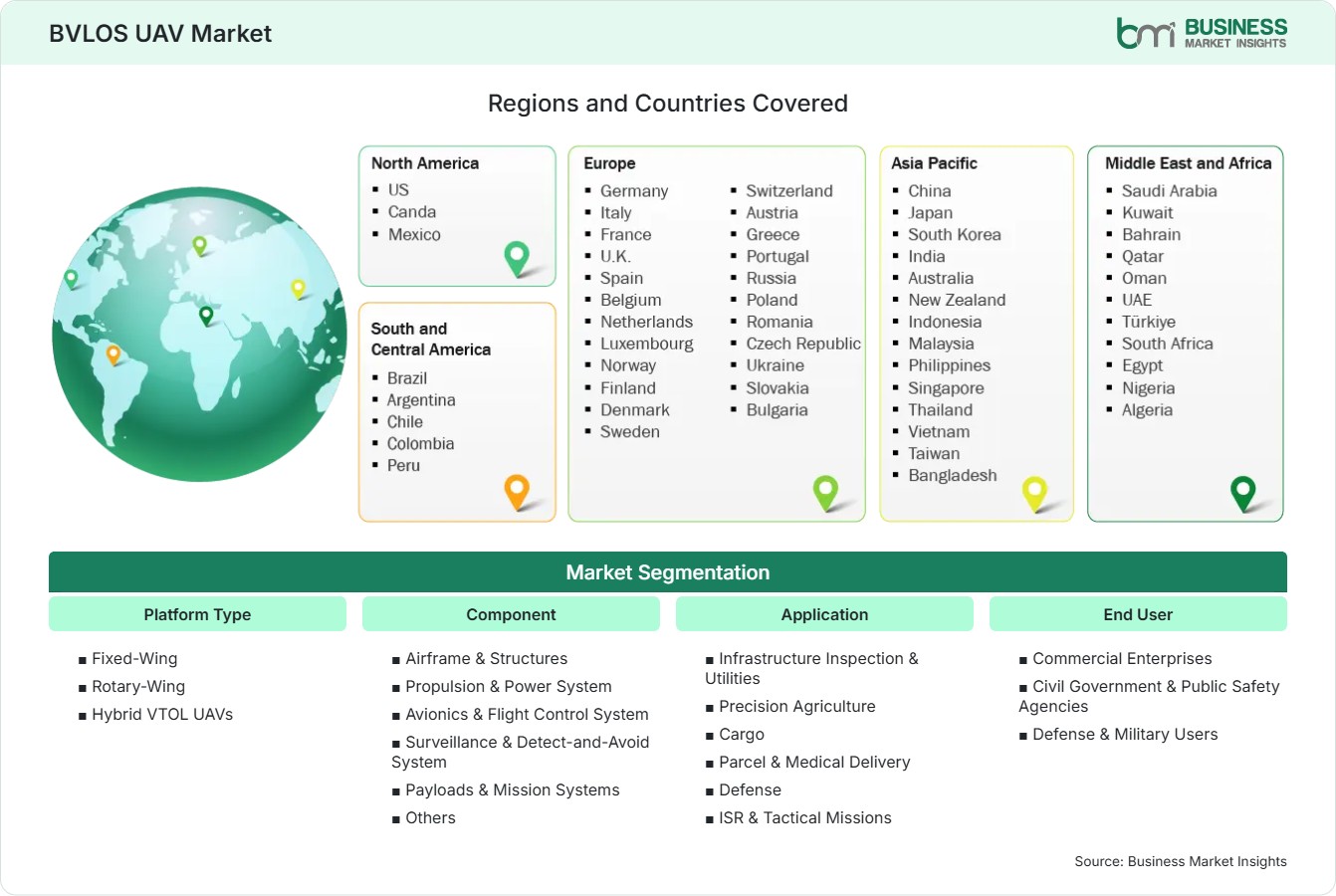
Global Market Geography
FREE PDF
Request your free sample
Request free sample
Segment Analysis

BVLOS UAV Market Segmentation

Platform Type

Platform Type segmentation is influenced by increasing demand for UAV platforms designed for extended range, operational flexibility, and autonomous mission execution. Rotary-Wing UAVs represented the leading platform category with a 45%–49% share in 2025 and are projected to grow at a CAGR of 9.9%–10.4% during 2026–2033, supported by hovering capability, vertical takeoff advantages, and suitability for delivery, inspection, and surveillance applications BVLOS UAV market forecasts.

  • Fixed-Wing: Fixed-wing UAVs support long-duration missions with efficient flight capabilities, making them suitable for mapping, surveillance, agriculture monitoring, and large-area inspection applications.
  • Rotary-Wing: Rotary-wing UAVs dominate due to vertical takeoff capability, hovering performance, maneuverability, and suitability for commercial delivery, infrastructure inspection, and public safety operations.
  • Hybrid VTOL UAVs: Hybrid VTOL UAVs combine vertical takeoff flexibility with fixed-wing endurance, enabling long-range missions requiring improved efficiency, payload capacity, and operational versatility.

Component

Component segmentation is driven by demand for autonomous flight reliability, safety systems, and advanced communication capabilities. Avionics & Flight Control Systems remain a key segment, supported by autonomous navigation, AI-based flight management, and BVLOS operations. The segment is projected to grow at a CAGR of 10.1%–10.7% during 2026–2033 in BVLOS UAV market.

  • Airframe & Structures: Airframe systems provide structural strength, aerodynamic efficiency, and payload support required for extended-range UAV operations across commercial and defense applications.
  • Propulsion & Power System: Propulsion and power systems enable longer flight endurance, improved energy efficiency, and reliable performance for complex autonomous missions.
  • Avionics & Flight Control System: Avionics and flight control systems support autonomous navigation, communication, stabilization, and mission management capabilities required for BVLOS operations.
  • Surveillance & Detect-and-Avoid System: Detect-and-avoid systems enhance operational safety by enabling obstacle recognition, collision prevention, and improved airspace awareness during autonomous flights.
  • Payloads & Mission Systems: Payload and mission systems enable specialized applications including inspection, delivery, surveillance, imaging, and data collection activities.

Application

Application segmentation is driven by rising BVLOS UAV adoption across infrastructure, agriculture, logistics, healthcare, and defense. Infrastructure Inspection & Utilities led with a 24%–28% share in 2025 and is projected to grow at a CAGR of 9.6%–10.1% during 2026–2033. Parcel & Medical Delivery is the fastest-growing segment, expanding at a CAGR of 11.0%–11.6% due to autonomous logistics growth in BVLOS UAV market.

  • Infrastructure Inspection & Utilities: BVLOS UAVs support power grids, pipelines, telecom networks, and utility asset inspections by improving safety, reducing downtime, and enabling efficient monitoring of distributed infrastructure.
  • Precision Agriculture: Precision agriculture applications use UAVs for crop monitoring, field analysis, imaging, and data collection, helping farmers optimize resources, improve productivity, and manage extensive agricultural areas.
  • Cargo: Cargo applications are expanding through autonomous transportation solutions designed for industrial logistics, remote supply movement, and efficient movement of larger payloads across challenging environments.
  • Parcel & Medical Delivery: Parcel and medical delivery applications are growing through automated last-mile logistics, emergency healthcare supply transportation, and improved access to essential products in remote regions.
  • Defense: Defense applications utilize BVLOS UAVs for surveillance, reconnaissance, border monitoring, and tactical operations requiring extended flight capabilities and reduced human exposure to high-risk environments.
  • ISR & Tactical Missions: ISR and tactical mission applications rely on advanced UAV platforms for intelligence gathering, persistent observation, battlefield awareness, and autonomous mission execution.

End User

End User segmentation is driven by rising BVLOS UAV adoption across commercial, government, public safety, and defense sectors. Commercial Enterprises held a significant share in 2025, supported by delivery services, asset inspection, and automation demand. Defense & Military adoption continues to grow through surveillance and strategic missions, with the segment projected to expand at a CAGR of 10.0%–10.6% during 2026–2033 in BVLOS UAV market.

  • Commercial Enterprises: Commercial enterprises adopt BVLOS UAVs for logistics, infrastructure inspection, agriculture, and industrial applications requiring improved efficiency and reduced operational costs.
  • Civil Government & Public Safety Agencies: Civil government and public safety agencies use UAVs for emergency response, disaster management, search operations, and public infrastructure monitoring.
  • Defense & Military Users: Defense and military users deploy BVLOS UAVs for intelligence, surveillance, reconnaissance, tactical missions, and long-range autonomous operational requirements.
Market Forces

BVLOS UAV Market Dynamics

Key Market Drivers

Increasing Adoption of Drones for Commercial Delivery

The increasing adoption of drones for commercial delivery is accelerating demand for BVLOS UAV solutions as logistics providers seek faster, flexible, and cost-efficient transportation alternatives. Companies are developing autonomous delivery networks capable of operating beyond visual range to improve last-mile logistics performance. E-commerce growth, healthcare delivery requirements, and remote area accessibility are encouraging businesses to invest in drone-based distribution models. The growth is supported by advancements in autonomous navigation, communication systems, and safety technologies. The BVLOS UAV Market trends indicate increasing collaboration between drone manufacturers, logistics companies, and regulators to establish scalable delivery operations. Improved payload capabilities and route optimization technologies are further enhancing commercial viability.

Supportive Regulatory Developments for BVLOS Operations

Several supportive regulatory advancements are encouraging the use of drones in commercial and government operations. Efforts by governments are being made to create an enabling regulatory framework for drones, in which they will be able to be expanded and used safely. This regulatory framework and pilot initiatives have enabled companies to adopt BVLOS technologies. Proper operational guidelines reduce ambiguity for both drone vendors and operators. There have been government efforts to invest in drone traffic management, communication networks, and safety systems to support future expansion. The process of regulation sets a path for conducting business activities and for moving from R&D projects to BVLOS UAVs.

Rising Demand for Long-Range Autonomous Drone Missions

Rising demand for long-range autonomous drone missions is increasing adoption of BVLOS UAVs across industries requiring extended coverage, remote monitoring, and efficient data collection. Utility companies, mining companies, defense agencies, and agricultural firms are using autonomous technology to manage large operational areas. Propulsion systems, better battery technology, satellite communication, and use of artificial intelligence in navigation have made UAV missions more reliable and durable. Firms are using long-range UAVs as a risk mitigation measure to ensure that workers remain safe. With the growing demand for surveillance and autonomy, UAVs with increased endurance, payload capacity, and mission management capability are being developed.

Key Market Opportunities

Growing Commercial Drone Delivery Services

Growing commercial drone delivery services are creating significant opportunities for BVLOS UAV manufacturers as businesses seek automated logistics solutions. Delivery drones can now be seen in the retail, healthcare, and e-commerce industries. This will help improve delivery speed, reduce transport costs, and provide services even to remote locations. Delivery drones capable of serving larger regions have been developed by companies. The growing acceptance of UAV delivery services is creating new investments in fleet management software, charging stations, and airspace management systems. This would be beneficial for companies that offer dependable BVLOS services.

Expansion of BVLOS Applications in Agriculture and Mining

The expansion of BVLOS applications in agriculture and mining is creating opportunities driven by large-scale monitoring requirements and the demand for operational efficiency. Agricultural companies are using autonomous drones for crop analysis, field monitoring, and precision farming activities across extensive areas. Mining companies are using BVLOS UAVs for surveying, safety inspections, stockpile monitoring, and environmental assessment. These uses have the advantage of extended flight times and reduced exposure of people to hazardous environments. Technology manufacturers are creating customized products that have advanced sensors, cameras, and autonomous navigation systems. An increased emphasis on productivity enhancement is expected to boost the use of BVLOS UAVs in these industries.

Increasing Government Investments in Drone Infrastructure

Increasing government investments in drone infrastructure are generating opportunities by supporting airspace management systems, communication networks, testing facilities, and regulatory frameworks. The public authorities have started to realize that the UAV technology plays an important part in the transportation and emergency response systems of the future. The developments in the drone corridors, unmanned traffic management systems, and research initiatives are bringing in more preparedness for BVLOS operations. The governments are also facilitating innovation by engaging with the technology firms and research institutions. Companies involved in autonomous systems, communication technologies, and drone services are well-positioned to benefit from the expansion of government-led infrastructure development.

Market Restraints and Challenges

Regulatory Restrictions on BVLOS Operations

Factor: Regulatory restrictions on BVLOS operations create challenges due to strict aviation requirements, safety assessments, airspace limitations, and approval procedures. Aviation authorities require operators to demonstrate reliable communication, detect-and-avoid capabilities, and operational safety before granting permissions. Impact: Complex regulatory processes can delay commercial deployment, increase compliance costs, and limit expansion of drone services across certain regions. Companies are addressing these challenges through improved safety technologies, regulatory partnerships, and operational testing programs. Although regulatory frameworks are gradually evolving, differences between countries continue creating challenges for global BVLOS UAV deployment. Successful market expansion depends on harmonized standards, improved airspace management systems, and continued collaboration between industry participants and aviation regulators.

High Development and Deployment Costs

Factor: High development and deployment costs affect BVLOS UAV adoption due to expensive research, advanced sensors, communication systems, autonomous software, and infrastructure requirements. Developing reliable long-range UAV platforms requires significant investment in engineering, testing, certification, and operational support systems. Impact: Higher costs can restrict adoption among small enterprises and delay implementation of large-scale drone networks. Manufacturers are focusing on modular designs, improved production efficiency, and scalable service models to reduce deployment barriers. As technology matures and production volumes increase, costs are expected to become more manageable. However, investment requirements remain a key challenge for companies seeking to commercialize advanced BVLOS UAV solutions across diverse applications.

Company Analysis

Competitive Landscape

The BVLOS UAV Market analysis highlights a competitive environment driven by autonomous flight innovation, advanced navigation systems, long-range communication technologies, and application-specific drone solutions. Companies are strengthening their market positions through platform development, strategic partnerships, regulatory approvals, and expansion into commercial, defense, and industrial applications.

Company Name

Overview

Products and Services relevant to this market

Zipline

Autonomous delivery company specializing in drone logistics networks and healthcare delivery solutions.

Provides long-range delivery drones, autonomous logistics platforms, and medical supply transportation services.

Wing Aviation LLC

Drone delivery company focused on autonomous aerial delivery operations.

Develops delivery UAVs, flight management systems, and commercial drone delivery services.

Skydio Inc.

US-based autonomous drone technology company focused on intelligent flight systems.

Offers autonomous UAV platforms, AI navigation, inspection solutions, and enterprise drone technologies.

AeroVironment Inc.

Defense and commercial drone manufacturer providing unmanned aerial solutions.

Supplies tactical UAVs, autonomous systems, surveillance platforms, and mission-focused aerial technologies.

Delair

European drone manufacturer specializing in industrial and defense applications.

Provides long-range UAV platforms, inspection drones, mapping solutions, and mission systems.

Quantum Systems GmbH

German aerospace technology company developing advanced unmanned aerial systems.

Offers hybrid VTOL UAVs, intelligence platforms, mapping solutions, and autonomous flight systems.

DJI

Global drone technology company serving commercial and consumer applications.

Provides enterprise drones, aerial imaging systems, surveying solutions, and autonomous flight technologies.

Flytrex

Drone delivery company focused on automated food and retail delivery services.

Operates delivery drone networks, logistics platforms, and autonomous delivery solutions.

Percepto

Autonomous drone-in-a-box technology provider for industrial monitoring applications.

Provides autonomous inspection drones, remote monitoring systems, and industrial security solutions.

EHang Holdings Limited

Autonomous aerial vehicle company developing passenger and logistics drone technologies.

Manufactures autonomous UAV platforms, aerial mobility systems, and logistics drone solutions.

Trust & Transparency

Research Methodology

The market analysis combines proprietary research with secondary data from government agencies, company disclosures, regulatory filings, industry databases and expert interviews. Market estimates are validated through data triangulation, cross-market benchmarking and analyst review.

View Full Research Methodology

Questions Answered

Frequently Asked Questions

What factors will influence future BVLOS UAV market report?

Future expansion will depend on regulatory approvals, communication infrastructure development, autonomous technology improvements, cost reduction, and increasing investments in commercial drone ecosystems.

How are AI technologies improving BVLOS UAV performance?

Artificial intelligence improves autonomous navigation, obstacle detection, route optimization, mission planning, and real-time decision-making, enabling safer and more efficient long-distance drone operations.

Which industries benefit most from BVLOS UAV technology?

Logistics, agriculture, mining, utilities, defense, public safety, and infrastructure management industries benefit from BVLOS UAVs through improved monitoring, automation, safety, and operational efficiency.

Why are BVLOS operations important for commercial drone services?

BVLOS operations allow drones to cover larger areas, complete longer missions, improve delivery efficiency, and support scalable commercial applications without requiring continuous visual monitoring by operators.

What is driving BVLOS UAV market adoption across industries?

BVLOS UAV adoption is increasing due to demand for autonomous delivery, infrastructure inspection, agricultural monitoring, defense operations, and remote-area services requiring extended flight capabilities beyond visual range.

Access the Full BVLOS UAV Market Report

Get segment-level forecasts, regional estimates, competitive benchmarking, company profiles and downloadable Excel datasets.

Access the full BVLOS UAV Market Report
350 pages PDF & Excel | 2026-08-06
Similar Research

Related Market Reports