
In-Flight Entertainment and Connectivity Market Outlook: Size, Share, Trends, Growth Analysis, Competitive Landscape & Forecast, 2026-2033

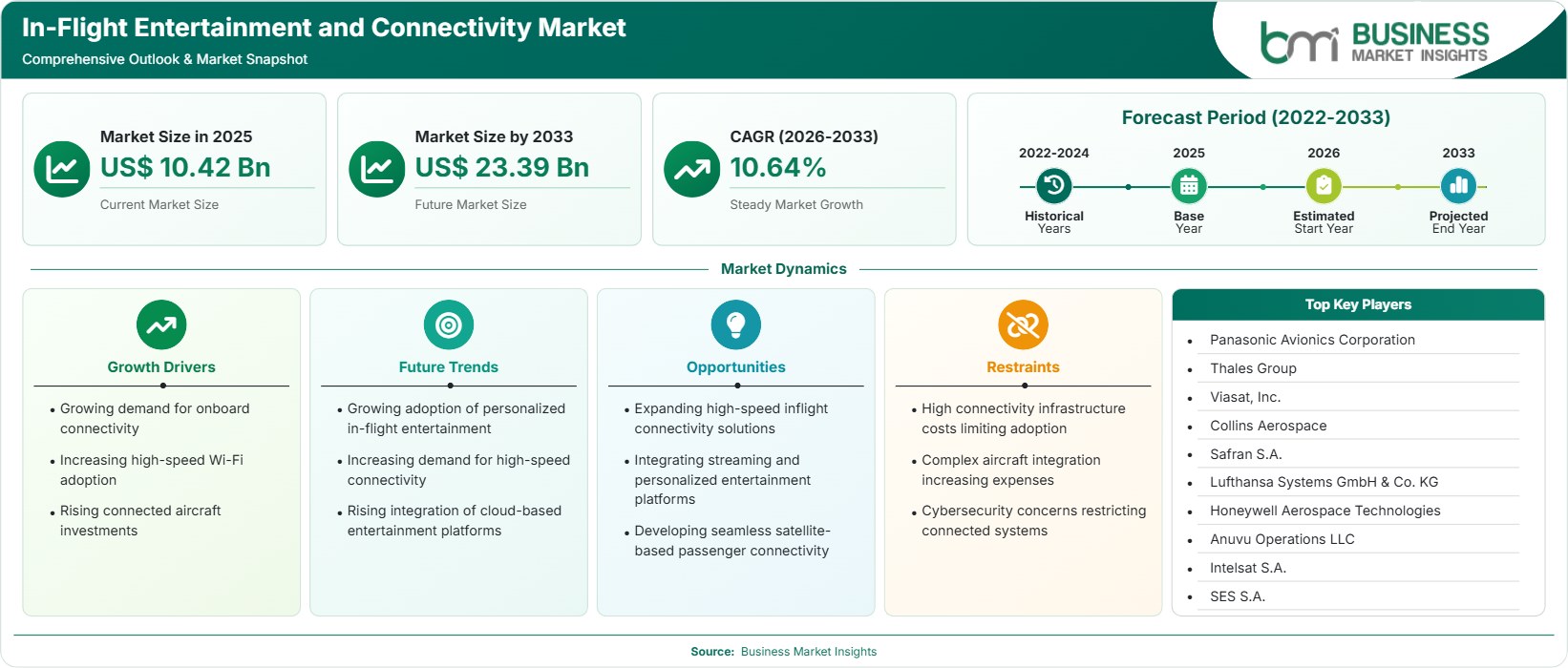
The In-Flight Entertainment and Connectivity Market size was valued at US$ 10.42 Billion in 2025 and is projected to reach US$ 23.39 Billion by 2033, growing at a CAGR of 10.64% during 2026–2033. Growing demand for onboard connectivity, increasing adoption of high-speed Wi-Fi services, and rising investments in connected aircraft are supporting market expansion. Opportunities are emerging through advanced satellite connectivity solutions, personalized entertainment platforms, and seamless passenger digital experiences.

Report Coverage
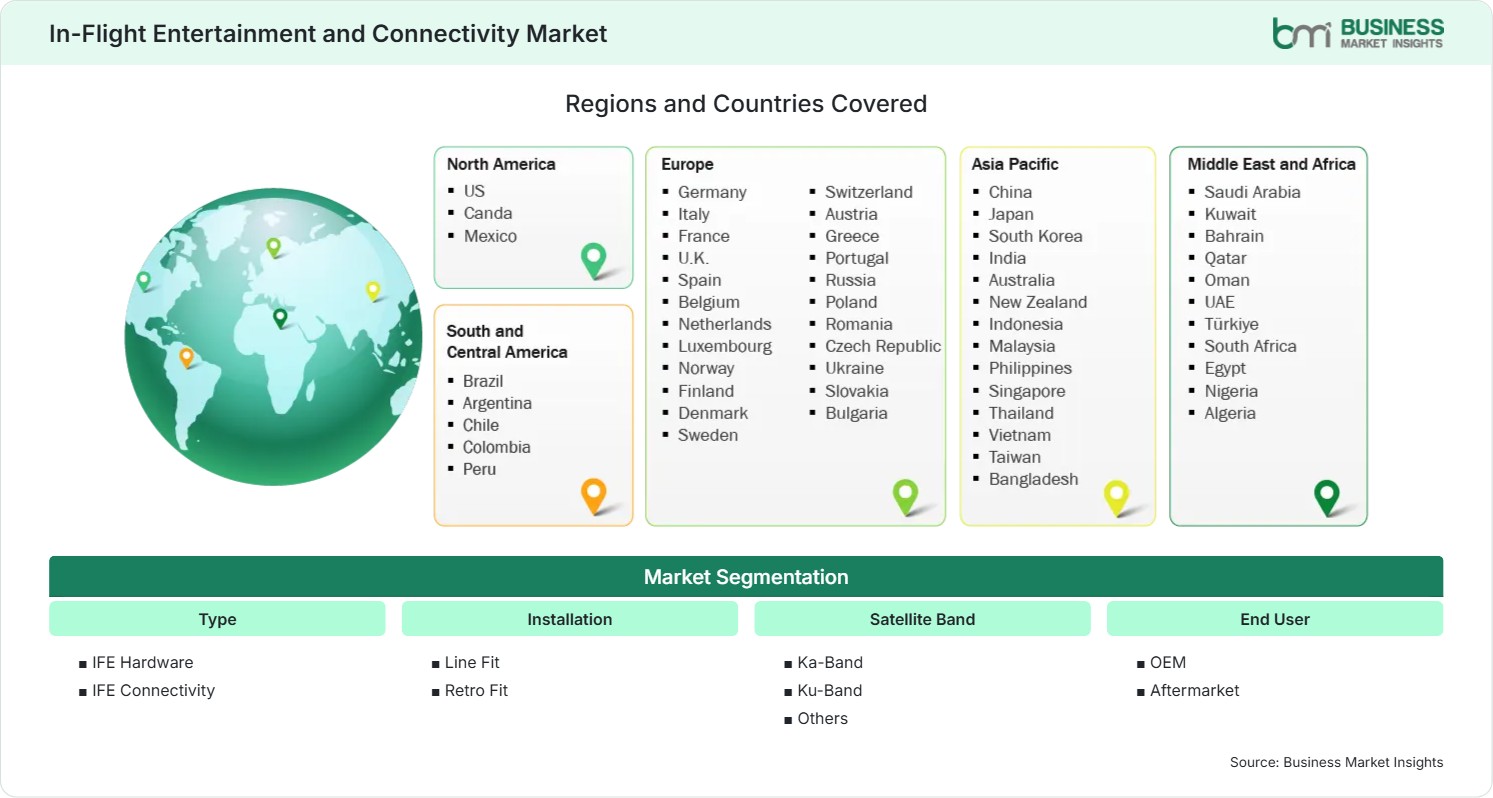
  • Type: IFE Hardware, IFE Connectivity
  • Installation: Line Fit, Retro Fit
  • Satellite Band: Ka-Band, Ku-Band, Others
  • End User: OEM, Aftermarket
  • Platform: Narrow Body, Wide Body, Business Jet, Regional Jets
US$ 10.42 Bn Market size in 2025
US$ 23.39 Bn Market Size by 2033
10.64% CAGR, 2026 - 2033
2026-2033 Forecast Period

01 AI Overview

In-Flight Entertainment and Connectivity Market Summary

  • North America Region: Holds a market share of 34%–37% in 2025, growing at a CAGR of 9.8%–10.3% during 2026–2033. Strong airline investments, widespread connected aircraft deployment, premium passenger expectations, fleet modernization initiatives, and increasing demand for uninterrupted onboard connectivity continue supporting regional growth. The U.S. remains the dominant contributor, growing at a CAGR of 10.0%–10.5% during 2026–2033.
  • Fastest Growing Region: Asia Pacific accounts for 27%–30% share in 2025 and is expected to grow at a CAGR of 11.8%–12.4% during 2026–2033. Expanding airline fleets, rising air passenger traffic, increasing low-cost carrier penetration, and growing investments in digital cabin experiences are accelerating regional adoption.
  • Leading Segment: IFE Connectivity holds 56%–59% share in 2025 and is projected to expand at a CAGR of 11.2%–11.8% during 2026–2033. Passenger preference for uninterrupted internet access, streaming services, and real-time communication continues supporting segment leadership.
  • High Growth Segment: Ka-Band holds 41%–44% share in 2025 and is forecast to grow at a CAGR of 12.4%–13.0% during 2026–2033. Higher bandwidth capabilities, improved network efficiency, and increasing deployment of high-throughput satellites support rapid adoption.
  • Key Market Opportunity: Airlines are increasingly investing in next-generation connectivity ecosystems that integrate broadband internet, streaming entertainment, e-commerce platforms, and passenger engagement tools to improve customer experience and ancillary revenue generation.
  • Major Market Players: Panasonic Avionics Corporation, Thales Group, Viasat, Inc., Collins Aerospace, Safran S.A., Lufthansa Systems GmbH & Co. KG, Honeywell Aerospace Technologies, Anuvu Operations LLC, Intelsat S.A., and SES S.A.
02 Strategic Insights

In-Flight Entertainment and Connectivity Market: Strategic Insights

In-Flight Entertainment and Connectivity Market Strategic Framework
FREE PDF
Request your free sample
Request free sample
03 Stakeholder View

Key Takeaways

  • The market ecosystem is increasingly centered on strategic collaboration between airlines, satellite operators, hardware manufacturers, and content providers to deliver integrated connectivity experiences.
  • Connectivity-based solutions present greater growth opportunities than traditional entertainment systems due to rising passenger demand for continuous internet access during flights.
  • Technological developments are shifting toward high-throughput satellites, cloud-based content delivery, and personalized digital engagement platforms that improve passenger satisfaction.
  • Asia Pacific offers the strongest investment opportunity because of rapid fleet expansion, increasing air travel demand, and ongoing airline modernization initiatives.
  • Airlines are allocating higher budgets toward retrofit programs, enabling older aircraft fleets to support advanced connectivity and digital entertainment capabilities.
  • Ancillary revenue opportunities generated through onboard e-commerce, advertising, premium connectivity packages, and subscription services are becoming increasingly important to airline profitability.
04 Geographic Outlook

In-Flight Entertainment and Connectivity Market Regional Highlights

North America In-Flight Entertainment and Connectivity Market

North America accounted for 34%–37% of global revenue in 2025 and is expected to expand at a CAGR of 9.8%–10.3% during 2026–2033. The region benefits from high connected-aircraft penetration, advanced aviation infrastructure, and strong investments by commercial airlines in digital passenger experiences. Major carriers continue upgrading fleets with next-generation connectivity systems, enabling faster internet access, enhanced streaming services, and improved operational communication capabilities throughout the flight experience in In-Flight Entertainment and Connectivity Market.

  • Airlines are increasingly deploying high-throughput satellite connectivity to improve bandwidth quality and passenger satisfaction levels.
  • Fleet modernization programs continue creating opportunities for connectivity hardware and software providers.
  • Demand for premium inflight experiences is supporting adoption of advanced entertainment and communication platforms.
  • Strategic partnerships between airlines and satellite operators are improving service coverage and operational efficiency.

US In-Flight Entertainment and Connectivity Market

The United States represents approximately 74%–78% of North American demand in 2025 and is projected to grow at a CAGR of 10.0%–10.5% during 2026–2033. Strong domestic air travel activity, extensive commercial airline fleets, and growing consumer expectations for seamless onboard internet access continue driving In-Flight Entertainment and Connectivity Market expansion. Airlines are prioritizing digital transformation strategies that combine entertainment, connectivity, and passenger personalization into a unified travel experience.

  • Increasing adoption of free and sponsored Wi-Fi services is enhancing passenger engagement.
  • Large commercial fleets continue creating significant retrofit and upgrade opportunities.
  • Airlines are investing in digital ecosystems to generate additional onboard revenue streams.
  • Demand for streaming-compatible networks is accelerating connectivity infrastructure deployment.

Europe In-Flight Entertainment and Connectivity Market

Europe accounted for 24%–27% of global revenue in 2025 and is projected to grow at a CAGR of 10.2%–10.7% during 2026–2033 in In-Flight Entertainment and Connectivity Market. The market is supported by strong airline modernization initiatives, increasing passenger expectations for digital services, and growing adoption of connected cabin technologies. Major carriers across Western Europe are investing in advanced inflight connectivity systems to improve customer satisfaction and operational performance. The region is also benefiting from increased deployment of satellite-based communication systems across commercial and business aviation fleets.

  • Airlines are prioritizing digital passenger experiences through enhanced entertainment content and broadband connectivity capabilities.
  • Germany remains a leading market owing to substantial aircraft retrofit activity and airline technology investments.
  • The UK and France continue adopting advanced connectivity services to improve passenger retention and brand differentiation.
  • Growing demand for real-time aircraft communication is accelerating deployment of next-generation inflight systems.
  • Business aviation operators are increasingly investing in premium connectivity offerings for corporate travelers.

Asia Pacific In-Flight Entertainment and Connectivity Market

Asia Pacific held 27%–30% of global revenue in 2025 and is expected to record the fastest growth with a CAGR of 11.8%–12.4% during 2026–2033. Strong growth in air passenger traffic, increasing aircraft deliveries, and expanding airline fleets are driving market demand. Airlines across China, India, Southeast Asia, and Australia are enhancing onboard digital experiences to remain competitive. Rising middle-class populations and strong tourism activity continue creating favorable conditions for connectivity and entertainment solution providers in In-Flight Entertainment and Connectivity Market.

  • China remains the largest regional market supported by extensive fleet expansion and rising domestic air travel demand.
  • India is emerging as a high-growth market due to increasing airline investments and expanding aviation infrastructure.
  • Low-cost carriers are gradually adopting connectivity solutions to improve passenger engagement and ancillary revenues.
  • Airlines are incorporating streaming-based entertainment platforms to reduce operating costs and improve flexibility.
  • Growing aircraft deliveries continue strengthening opportunities for line-fit installations across the region.

Rest of World In-Flight Entertainment and Connectivity Market

The Rest of World region accounted for 9%–12% of global revenue in 2025 and is projected to grow at a CAGR of 10.5%–11.1% during 2026–2033. Expansion in the Middle East, Latin America, and Africa is supporting demand for advanced inflight connectivity systems. Airlines are investing in passenger experience enhancement initiatives to remain competitive in international markets. Connectivity solutions are increasingly viewed as a strategic differentiator that supports customer retention and operational efficiency.

  • Gulf carriers continue leading adoption of premium inflight connectivity and entertainment technologies.
  • Saudi Arabia and the UAE are investing heavily in aviation expansion and fleet modernization initiatives.
  • Latin American airlines are gradually upgrading cabin connectivity capabilities to meet evolving passenger expectations.
  • African carriers are adopting connectivity technologies as part of broader aviation modernization strategies.
  • Increasing international travel is strengthening demand for seamless digital passenger experiences.
Global Market Geography
FREE PDF
Request your free sample
Request free sample
05 Segment Analysis

In-Flight Entertainment and Connectivity Market Segmentation

Type

The type segment is dominated by IFE Connectivity, which accounted for 56%–59% share in 2025 and is expected to grow at a CAGR of 11.2%–11.8% during 2026–2033. The In-Flight Entertainment and Connectivity Market scope continues expanding as airlines prioritize broadband internet access, real-time communication, and passenger streaming capabilities. Connectivity solutions are becoming central to airline digital transformation strategies while supporting operational efficiencies and customer engagement initiatives.

  • IFE Hardware: Supports content delivery, display systems, and passenger entertainment functionality across commercial and business aircraft fleets.
    • Portable IFE System: Increasingly adopted by airlines seeking cost-effective solutions that require minimal aircraft modifications while supporting digital content distribution.
    • Non-Portable IFE System: Widely installed in premium and long-haul aircraft where integrated entertainment displays remain an important differentiating feature.
  • IFE Connectivity: Represents the largest category due to strong passenger demand for internet access and connected travel experiences.
    • Satellite Connectivity: Preferred for long-haul and international routes because of wider coverage and higher service continuity.
    • Air to Ground Connectivity: Utilized predominantly on domestic routes where terrestrial communication infrastructure can deliver reliable connectivity.

Installation

The Installation segment accounted for approximately 46%–49% share in 2025 and is projected to grow at a 10.1%–10.7% CAGR during 2026–2033. Demand is influenced by new aircraft deliveries and retrofit programs across existing fleets. Airlines are increasingly upgrading aircraft cabins to support evolving passenger expectations and improve operational performance. Line-fit programs benefit from aircraft production growth, while retrofit projects remain critical for extending aircraft connectivity capabilities.

  • Line Fit: Driven by increasing aircraft deliveries and growing airline demand for pre-installed connectivity solutions from original equipment manufacturers.
  • Retro Fit: Supported by fleet modernization programs that enable airlines to upgrade connectivity and entertainment capabilities on existing aircraft.

Satellite Band

The Satellite Band segment accounted for approximately 32%–35% share in 2025 and is expected to expand at a 11.6%–12.2% CAGR during 2026–2033. Airlines are investing in advanced satellite technologies capable of delivering greater bandwidth, lower latency, and improved coverage across domestic and international flight routes, supporting the In-Flight Entertainment and Connectivity Market trends adoption of next-generation inflight connectivity solutions.

  • Ka-Band: Preferred for high-throughput connectivity requirements, enabling enhanced passenger internet experiences through improved bandwidth capacity and network efficiency.
  • Ku-Band: Remains widely used across commercial aviation because of established infrastructure and broad service availability.

End User

The End User segment accounted for approximately 51%–54% share in 2025 and is projected to register a 10.8%–11.3% CAGR during 2026–2033. Demand is driven by aircraft production activity and aftermarket technology upgrades. OEM demand benefits from new aircraft manufacturing programs, while the aftermarket segment is experiencing growth as airlines modernize fleets to enhance passenger experiences and connectivity performance.

  • OEM: Supported by increasing aircraft deliveries and rising integration of advanced connectivity systems during aircraft production.
  • Aftermarket: Benefits from retrofit programs focused on upgrading existing aircraft with next-generation communication and entertainment capabilities.

Platform

The Platform segment accounted for approximately 44%–47% In-Flight Entertainment and Connectivity Market share in 2025 and is expected to grow at a 10.5%–11.0% CAGR during 2026–2033. Demand varies according to aircraft size, route structures, and passenger-service requirements. Airlines are investing in tailored connectivity solutions that match operational needs across different aircraft categories while supporting passenger engagement and revenue generation.

  • Narrow Body: Largest platform category due to substantial global fleet numbers and increasing deployment of connectivity systems on short- and medium-haul routes.
  • Wide Body: Strong demand driven by long-haul operations that require continuous connectivity and premium entertainment experiences.
  • Business Jet: Growing adoption of premium broadband solutions to support corporate travelers and high-net-worth passengers.
  • Regional Jets: Increasing implementation of cost-effective connectivity solutions to improve passenger satisfaction on regional routes.
06 Market Forces

In-Flight Entertainment and Connectivity Market Dynamics

Key Market Drivers

Growing Demand for Onboard Connectivity

Increasingly, air passengers are demanding reliable internet connectivity at all stages of their flights, as is experienced on the ground. The aviation sector is making provisions for this by introducing advanced connectivity systems that facilitate messages, video streaming, browsing, and business applications. Increased use of electronic gadgets on board flights has resulted in increased demand for bandwidths, which has seen aviation companies embrace new forms of communication technology. Advanced connectivity options not only help increase customer satisfaction, improve loyalty, and create additional revenue streams but also present significant growth opportunities for the airline industry.

Increasing High-Speed Wi-Fi Adoption

High-speed Wi-Fi services are gaining popularity rapidly, as connectivity has become a top priority for passengers when traveling. Airlines are installing high-throughput satellite systems and advanced network management technologies to improve browsing speed and avoid disruptions during service delivery. High-speed connectivity allows passengers to perform bandwidth-heavy operations such as streaming media content, videoconferencing, gaming, and accessing cloud services. Such functionality becomes increasingly relevant for both tourists and businessmen. In addition, the competitive environment encourages the development of innovative Wi-Fi solutions and is an important driver of market expansion.

Rising Connected Aircraft Investments

Air transport companies and aircraft owners have been making significant investments in connected aircraft technologies to ensure operational efficiency and improve passenger experience. Connectivity technology enables real-time aircraft tracking, predictive maintenance, flight optimization, and integration of aircraft and ground operations. Such solutions allow air transport companies to achieve better performance and reduce maintenance and disruption costs. Meanwhile, investments in entertainment and connectivity ecosystems help to create individual passenger experience and develop innovative services. With the introduction of connectivity technologies in new aircraft generations, investment levels continue to grow across both line-fit and retrofit installations.

Key Market Opportunities

Expanding High-Speed Inflight Connectivity Solutions

The expansion of high-speed inflight connectivity solutions represents a major opportunity for industry participants. Advancements in satellite technologies, including high-throughput and low-earth-orbit satellite networks, are significantly improving connection quality, bandwidth availability, and coverage reliability. Airlines are leveraging these developments to provide premium internet services that meet evolving passenger expectations. High-speed connectivity also supports onboard e-commerce, digital advertising, and ancillary revenue generation. As connectivity transitions from a premium feature to a standard passenger expectation, technology providers have substantial opportunities to expand service portfolios and strengthen long-term partnerships with airlines globally.

Integrating Streaming and Personalized Entertainment Platforms

Passenger preferences are shifting toward personalized content consumption through personal devices rather than traditional seatback entertainment systems. This trend is creating opportunities for streaming-enabled inflight platforms that deliver customized content recommendations, multilingual entertainment options, and interactive engagement tools. Airlines can utilize passenger data analytics to enhance personalization and improve customer satisfaction. Streaming-based entertainment ecosystems also reduce hardware requirements and lower maintenance expenses. As digital entertainment increasingly becomes central to passenger experience strategies, airlines and technology providers are investing in innovative content delivery solutions capable of supporting evolving consumer preferences.

Developing Seamless Satellite-Based Passenger Connectivity

Satellite-based connectivity technologies continue evolving to deliver seamless global coverage across domestic and international flight routes. The integration of next-generation satellite networks with advanced aviation communication systems is enabling more consistent performance and lower service latency. Airlines are seeking connectivity solutions that provide uninterrupted user experiences regardless of geographic location. These developments create opportunities for satellite operators, connectivity providers, and technology manufacturers to support expanding market demand. Favorable In-Flight Entertainment and Connectivity Market Forecasts are closely linked to ongoing advancements in satellite communication technologies and increasing airline investments in connected cabin ecosystems.

Market Restraints and Challenges

High Connectivity Infrastructure Costs Limiting Adoption

Factor: Advanced inflight connectivity systems require substantial investments in hardware, satellite bandwidth, certification processes, and network infrastructure. Deployment often involves significant upfront capital expenditure and ongoing operational costs. Impact: Smaller airlines and regional operators may delay adoption due to financial constraints, limiting market penetration. High implementation costs can also extend return-on-investment timelines and affect profitability. While larger airlines possess greater financial capacity to invest in advanced connectivity technologies, cost-related barriers remain a significant challenge across portions of the global aviation industry.

Complex Aircraft Integration Increasing Expenses

Factor: Installing entertainment and connectivity systems requires complex integration with existing aircraft infrastructure, avionics systems, and cabin configurations. Certification requirements and engineering modifications can add considerable complexity to implementation programs. Impact: Longer installation timelines, increased downtime, and higher project costs may affect adoption decisions. Retrofit installations can be particularly challenging due to differences in aircraft age, configuration, and technical requirements. These complexities create operational and financial challenges for airlines while increasing execution risks associated with large-scale connectivity deployment initiatives.

07 Company Analysis

Competitive Landscape

The following In-Flight Entertainment and Connectivity Market analysis highlights major participants operating across entertainment systems, connectivity infrastructure, satellite communications, and digital aviation ecosystems. Market competition is driven by technological innovation, satellite bandwidth capabilities, airline partnerships, and the ability to deliver seamless passenger connectivity experiences across global aviation networks.

Company Name

Overview

Products and Services Relevant to this Market

Panasonic Avionics Corporation

Leading provider of aviation entertainment and communication solutions with a broad airline customer base.

Inflight entertainment systems, connectivity solutions, passenger engagement platforms, cabin technologies.

Thales Group

Global aerospace technology company focused on connected cabin experiences.

Digital inflight entertainment, connectivity systems, avionics and communication solutions.

Viasat, Inc.

Major satellite communications company serving commercial aviation customers worldwide.

High-speed satellite connectivity, broadband services and aviation networking solutions.

Collins Aerospace

Aerospace systems provider offering integrated cabin technology solutions.

Inflight connectivity, communication systems, cabin management and passenger experience technologies.

Safran S.A.

Aviation technology company supporting aircraft interiors and passenger systems.

Entertainment systems, cabin electronics and aircraft connectivity solutions.

Lufthansa Systems GmbH & Co. KG

Aviation IT specialist serving airlines globally.

Digital passenger services, inflight entertainment software and connectivity platforms.

Honeywell Aerospace Technologies

Provider of avionics and communication technologies for commercial aviation.

Satellite communication systems, cabin connectivity and operational efficiency solutions.

Anuvu Operations LLC

Specialized provider of mobility and entertainment solutions.

Inflight Wi-Fi, media content services and passenger engagement platforms.

Intelsat S.A.

Global satellite operator supporting aviation connectivity markets.

Satellite bandwidth, inflight communication infrastructure and aviation connectivity services.

SES S.A.

International satellite communications provider with aviation service offerings.

Satellite-based connectivity, network services and global communication solutions.

10 Trust & Transparency

Research Methodology

The market analysis combines proprietary research with secondary data from government agencies, company disclosures, regulatory filings, industry databases and expert interviews. Market estimates are validated through data triangulation, cross-market benchmarking and analyst review.

View Full Research Methodology

11 Questions Answered

Frequently Asked Questions

What benefits do airlines gain from advanced connectivity solutions?

Airlines benefit through improved passenger satisfaction, operational efficiency, ancillary revenue generation, real-time aircraft communication, enhanced brand differentiation, and stronger customer retention.

Why is Ka-Band technology growing rapidly?

Ka-Band supports higher bandwidth capacity, better network efficiency, and improved passenger connectivity experiences, making it increasingly attractive for airlines seeking high-speed inflight internet solutions.

Which segment dominates the In-Flight Entertainment and Connectivity Market report?

IFE Connectivity is the leading segment, accounting for approximately 56%–59% of the market in 2025, driven by growing demand for broadband internet access and real-time digital services.

Which region leads the market?

North America holds the largest market share due to its high penetration of connected aircraft, strong airline investments, advanced aviation infrastructure, and widespread deployment of inflight connectivity systems.

What is the primary factor driving In-Flight Entertainment and Connectivity Market growth?

The market is primarily driven by increasing passenger demand for uninterrupted onboard internet access, streaming services, digital communication platforms, and enhanced travel experiences supported by connected aircraft technologies.

Access the Full In-Flight Entertainment and Connectivity Market Report

Get segment-level forecasts, regional estimates, competitive benchmarking, company profiles and downloadable Excel datasets.

Access the full In-Flight Entertainment and Connectivity Market Report
350 pages PDF & Excel | 2026-08-24