
Commercial Aerospace Market Outlook: Size, Share, Trends, Growth Analysis, Competitive Landscape & Forecast, 2026-2033

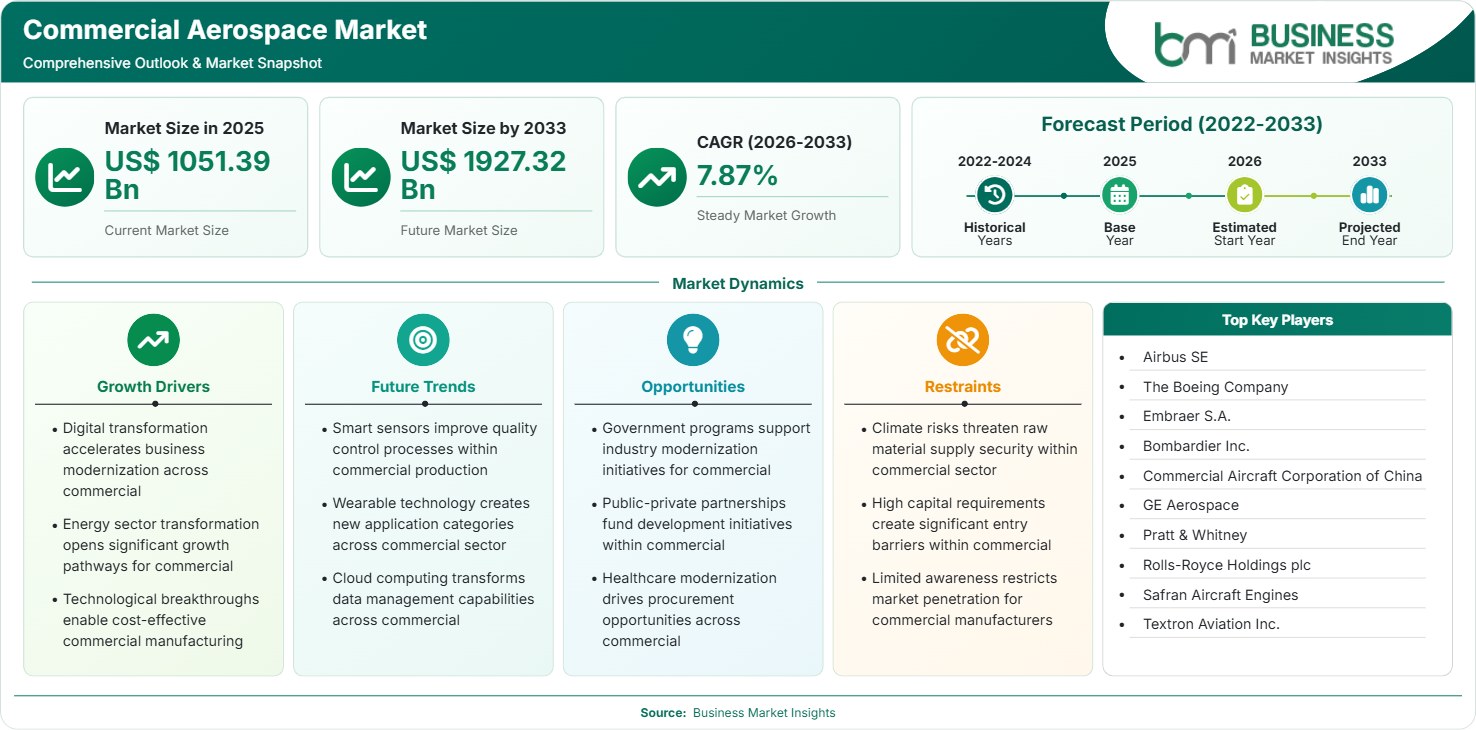
The Commercial Aerospace Market size was valued at US$ 1051.39 billion in 2025 and is projected to reach US$ 1927.32 billion by 2033, growing at a CAGR of 7.87% during 2026–2033, driven by expanding global air passenger traffic, fleet modernization, sustainable aviation technologies, and rising investments in fuel-efficient commercial aircraft.

Report Coverage
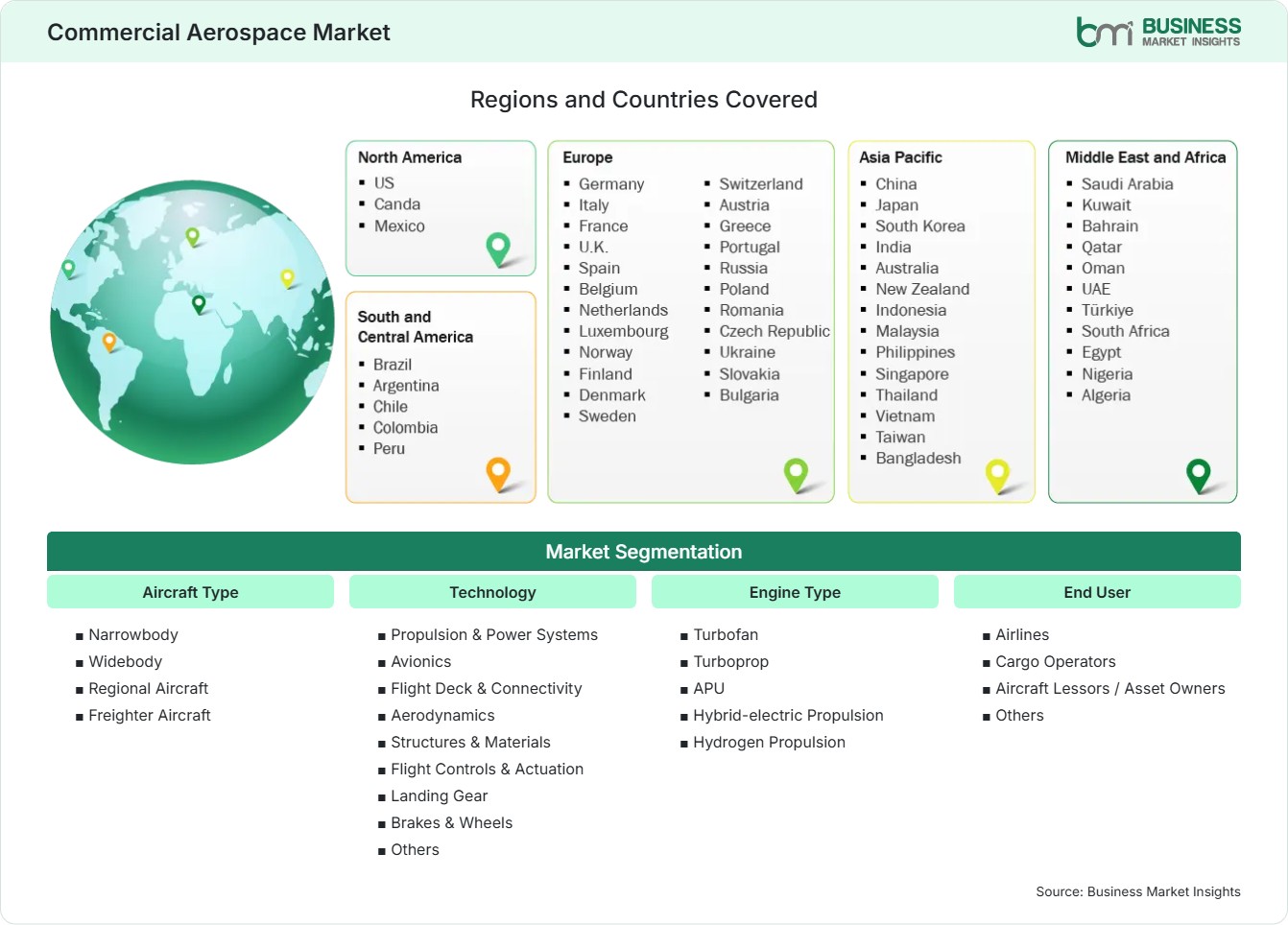
  • Aircraft Type: Narrowbody , Widebody , Regional Aircraft, Freighter Aircraft
  • Technology: Propulsion & Power Systems, Avionics, Flight Deck & Connectivity, Aerodynamics, Structures & Materials, Flight Controls & Actuation, Landing Gear, Brakes & Wheels, Others
  • Engine Type: Turbofan, Turboprop, APU, Hybrid-electric Propulsion, Hydrogen Propulsion
  • End User: Airlines, Cargo Operators, Aircraft Lessors / Asset Owners, Others
US$ 1051.39 Bn Market size in 2025
US$ 1927.32 Bn Market Size by 2033
7.87% CAGR, 2026 - 2033
2026-2033 Forecast Period

AI Overview

Commercial Aerospace Market Summary

  • North America Region: North America holds a 36%–40% share in 2025, growing with a CAGR of 7.20%–8.00% during 2026–2033, supported by aircraft manufacturing leadership, fleet replacement programs, aerospace innovation, expanding MRO capabilities, and increasing airline investments. The US market records a CAGR of 7.30%–7.90%, supported by strong aircraft production, advanced aerospace technologies, and sustained commercial aviation demand.
  • Fastest Growing Region: Asia Pacific accounts for a 28%–32% share in 2025, expanding at a CAGR of 8.60%–9.40% during 2026–2033, driven by rising passenger traffic, airline fleet expansion, airport infrastructure investments, and growing domestic aviation markets.
  • Leading Segment: Narrowbody (Single-aisle) aircraft represent a 48%–53% share in 2025, expanding at a CAGR of 8.00%–8.80% during 2026–2033, supported by short-haul route demand, fleet replacement, fuel efficiency, and airline capacity optimization.
  • High Growth Segment: Hybrid-electric Propulsion records a 2025 share of 4%–7% while expanding at a CAGR of 18.00%–20.00% during 2026–2033, driven by decarbonization initiatives, sustainable aviation investment, and next-generation propulsion research.
  • Key Market Opportunity: Sustainable aircraft technologies, digital manufacturing, advanced propulsion systems, predictive maintenance, and expanding aviation infrastructure create long-term opportunities for manufacturers, suppliers, and technology developers.
  • Major Market Players: Airbus SE, The Boeing Company, Embraer S.A., Bombardier Inc., Commercial Aircraft Corporation of China, GE Aerospace, Pratt & Whitney, Rolls-Royce Holdings plc, Safran Aircraft Engines, and Textron Aviation Inc.
Strategic Insights

Commercial Aerospace Market: Strategic Insights

Commercial Aerospace Market Strategic Framework
FREE PDF
Request your free sample
Request free sample
Stakeholder View

Key Takeaways

  • Integration in the aerospace value chain through collaboration between aircraft manufacturers, engine manufacturers, avionics providers, material providers, and airline companies will continue to develop through more efficient production processes and better performance of aircraft.
  • Narrow-body aircraft, propulsion technologies that are sustainable, and digital aviation systems will present the best growth opportunities for the future because airlines will update their fleet and optimize their operations.
  • Advanced composite materials, artificial intelligence-based aircraft maintenance, additive manufacturing, and digital twins are the drivers of aerospace innovation and reduction in operating costs.
  • Asia Pacific region will become the most interesting market for investments due to increased numbers of airline fleet, demand from the middle class to fly, and infrastructure development.
  • Strategic partnerships, long-term engine servicing contracts, localized supply chains, and investments in sustainable aviation technologies will change the nature of competition in global commercial aerospace market.
Geographic Outlook

Commercial Aerospace Market Regional Highlights

North America Commercial Aerospace Market

North America accounted for a 36%–40% share of the market in 2025 and is projected to expand at a CAGR of 7.20%–8.00% during 2026–2033. The region maintains leadership through established aircraft manufacturing capabilities, advanced aerospace supply chains, strong airline investments, and continuous technological innovation. Commercial Aerospace Market share remains supported by fleet modernization programs, growing aircraft deliveries, and rising demand for fuel-efficient aircraft. Market growth is further strengthened by sustained investments in digital manufacturing, maintenance capabilities, and next-generation propulsion technologies.

  • The United States remains the largest aerospace manufacturing hub, supported by major OEMs, extensive supplier networks, and sustained investments in advanced aircraft technologies.
  • Airlines continue replacing aging fleets with fuel-efficient aircraft to improve operational performance and comply with evolving environmental standards.
  • Digital engineering, predictive maintenance, and advanced manufacturing technologies are improving production efficiency and aircraft lifecycle management.
  • Long-term aircraft order backlogs continue supporting production expansion across commercial aircraft and engine manufacturing facilities.

US Commercial Aerospace Market

The US accounted for a 78%–82% share of the North American Commercial Aerospace Market in 2025 and is expected to register a CAGR of 7.30%–7.90% during 2026–2033. The country benefits from advanced aerospace research, global aircraft manufacturing leadership, strong airline demand, and continued investments in sustainable aviation technologies. Aircraft production expansion, technological innovation, and increasing exports continue strengthening the country's competitive position within the global aerospace industry.

  • Major aircraft manufacturers continue expanding production capacity to address growing commercial aircraft order backlogs worldwide.
  • Investments in sustainable aviation fuel compatibility and advanced propulsion technologies are supporting long-term industry competitiveness.
  • Digital manufacturing platforms and automation are improving production quality, supply chain visibility, and operational efficiency.
  • Expanding maintenance, repair, and overhaul capabilities continue supporting aircraft lifecycle management across domestic and international fleets.

Europe Commercial Aerospace Market

Europe represented a 25%–29% share of the Commercial Aerospace Market in 2025 and is estimated to grow at a CAGR of 7.40%–8.20% during 2026–2033. Strong aerospace manufacturing capabilities, sustainability initiatives, and investments in next-generation aircraft technologies continue supporting regional expansion. France and Germany lead aircraft manufacturing activities, while the United Kingdom remains an important center for aerospace engineering and engine development. Growing investments in hydrogen aviation research are strengthening Europe's future competitiveness.

  • France remains the largest regional contributor through commercial aircraft production and advanced aerospace manufacturing capabilities.
  • Germany supports industry expansion through precision engineering, component manufacturing, and research into lightweight aerospace materials.
  • The United Kingdom continues advancing aircraft engine technologies, digital engineering, and sustainable aviation innovation.
  • European manufacturers are accelerating investments in low-emission aircraft technologies to meet long-term climate objectives.
  • Regional supply chain modernization is improving manufacturing resilience and production efficiency.

Asia Pacific Commercial Aerospace Market

Asia Pacific accounted for a 28%–32% share of the Commercial Aerospace Market in 2025 and is projected to achieve a CAGR of 8.60%–9.40% during 2026–2033, making it the fastest-growing regional market. Rapid passenger traffic growth, expanding low-cost carriers, airport infrastructure investments, and increasing aircraft procurement are accelerating regional demand. China, India, Japan, South Korea, and Southeast Asian economies are investing heavily in aviation capacity to accommodate growing domestic and international travel requirements.

  • China is expanding aircraft procurement while strengthening domestic aerospace manufacturing and commercial aviation capabilities.
  • India is witnessing rapid airline fleet expansion supported by rising passenger traffic and large commercial aircraft orders.
  • Japan and South Korea continue investing in aerospace technologies, advanced materials, and precision manufacturing capabilities.
  • Southeast Asian airlines are expanding narrowbody fleets to serve growing regional travel demand efficiently.
  • Government investments in airport modernization are supporting long-term commercial aviation growth across the region.

Rest of World Commercial Aerospace Market

Rest of World accounted for a 8%–12% share of the Commercial Aerospace Market in 2025 and is expected to expand at a CAGR of 7.80%–8.60% during 2026–2033. Commercial aviation is growing steadily across Latin America, the Middle East, and Africa as airlines expand fleets, improve connectivity, and modernize aircraft. Increasing tourism, cargo transportation, and aviation infrastructure investments are supporting demand for new commercial aircraft and aviation services.

  • Middle Eastern airlines continue investing in widebody fleet expansion to strengthen global connectivity and international passenger services.
  • Brazil remains a major aerospace manufacturing center supported by regional aircraft production and export capabilities.
  • African aviation markets are gradually expanding through airport modernization and regional airline fleet development.
  • Cargo operators continue increasing investments in dedicated freighter aircraft to support international logistics growth.
  • Cross-border aviation partnerships are strengthening aircraft financing, maintenance capabilities, and regional aerospace development.
Global Market Geography
FREE PDF
Request your free sample
Request free sample
Segment Analysis

Commercial Aerospace Market Segmentation

Aircraft Type

Aircraft Type remains the largest revenue-generating segment within the market, reflecting airline fleet expansion, replacement of aging aircraft, and growing passenger demand. The segment accounted for a 46%–50% share in 2025 and is projected to expand at a CAGR of 7.90%–8.60% during 2026–2033. Airlines are increasingly investing in fuel-efficient aircraft with improved operational economics. The Commercial Aerospace Market scope continues expanding as manufacturers introduce advanced airframes, lightweight materials, and digital technologies across multiple aircraft categories.

  • Narrowbody (Single-aisle): Narrowbody aircraft remain the preferred choice for domestic and regional routes because of fuel efficiency, lower operating costs, and high passenger demand across short- and medium-haul networks.
  • Widebody (Twin-aisle): Widebody aircraft support long-haul international operations with greater passenger capacity, improved range, and enhanced cabin comfort for intercontinental travel.
  • Regional Aircraft: Regional aircraft continue serving short-distance markets by improving connectivity between secondary cities while supporting efficient airline operations on lower-capacity routes.
  • Freighter Aircraft: Freighter aircraft demand is supported by expanding e-commerce logistics, global cargo transportation, and increasing investments in dedicated air freight capacity.

By Technology

Technology advancements are transforming aircraft efficiency, safety, and lifecycle performance. This segment accounted for a 34%–38% share in 2025 and is projected to register a CAGR of 8.20%–9.00% during 2026–2033. Manufacturers continue investing in digital engineering, advanced avionics, and lightweight materials to improve operational performance. Commercial Aerospace Market trends indicate that integrated digital systems and sustainable technologies will remain central to future aircraft development.

  • Propulsion & Power Systems: Continuous improvements in propulsion technologies are enhancing fuel efficiency, operational reliability, and emissions performance across commercial aircraft.
  • Avionics: Modern avionics improve navigation, communication, flight safety, and operational efficiency using integrated digital systems.
  • Flight Deck & Connectivity: Connected cockpit technologies improve pilot decision-making, operational visibility, and aircraft communication capabilities.
  • Aerodynamics: Advanced aerodynamic designs reduce drag, improve fuel economy, and enhance aircraft operating performance.
  • Structures & Materials: Composite materials and lightweight alloys improve structural strength while reducing aircraft weight and operating costs.
  • Flight Controls & Actuation: Advanced flight control systems enhance aircraft handling, safety, and automation capabilities.
  • Landing Gear, Brakes & Wheels: Continuous component innovation improves operational safety, durability, and maintenance efficiency across commercial fleets.

By Engine Type

Engine technology remains a major innovation area as manufacturers prioritize efficiency, sustainability, and lower operating costs. The segment accounted for a 28%–32% share in 2025 and is expected to grow at a CAGR of 8.00%–9.20% during 2026–2033. The Commercial Aerospace Market analysis indicates increasing investments in advanced propulsion systems capable of reducing emissions while improving aircraft performance and operational reliability.

  • Turbofan: Turbofan engines dominate commercial aviation through superior fuel efficiency, high thrust capability, and widespread adoption across modern passenger aircraft.
  • Turboprop: Turboprop engines remain important for regional aircraft operating on shorter routes with lower fuel consumption requirements.
  • APU: Auxiliary Power Units provide onboard power and operational support during ground operations while improving aircraft functionality.
  • Hybrid-electric Propulsion: Hybrid-electric technologies are gaining industry attention through research programs focused on reducing aviation emissions and fuel consumption.
  • Hydrogen Propulsion: Hydrogen propulsion technologies remain under development to support long-term decarbonization goals and sustainable commercial aviation.

By End User

End-user demand reflects evolving fleet strategies, passenger traffic growth, and aircraft financing models. The segment accounted for a 42%–46% share in 2025 and is projected to expand at a CAGR of 7.60%–8.40% during 2026–2033. Airlines remain the largest purchasers of commercial aircraft, while leasing companies continue increasing their role in fleet financing and aircraft asset management.

  • Airlines: Airlines account for the largest aircraft demand through continuous fleet expansion, modernization, and replacement of aging aircraft to improve operational efficiency.
  • Cargo Operators: Cargo operators continue investing in dedicated freighter aircraft to support expanding global logistics, express delivery services, and e-commerce growth.
  • Aircraft Lessors / Asset Owners: Aircraft lessors strengthen fleet availability by providing flexible financing solutions and lease arrangements for global airline operators.
Market Forces

Commercial Aerospace Market Dynamics

Key Market Drivers

Digital transformation accelerates business modernization across commercial

Digital transformation accelerates business modernization across commercial by enabling aircraft manufacturers, airlines, and suppliers to improve productivity, reduce costs, and enhance operational visibility. Digital twins, artificial intelligence, predictive maintenance, cloud-based engineering platforms, and industrial automation are transforming aircraft design, manufacturing, and lifecycle management. Connected production facilities improve quality control while reducing assembly time and supply chain inefficiencies. Airlines increasingly utilize data analytics to optimize fleet utilization and maintenance scheduling. These technological advancements strengthen Commercial Aerospace Market growth by improving efficiency throughout the aerospace value chain.

Energy sector transformation opens significant growth pathways for commercial

Transformation within the energy sector provides major opportunities for business growth via increased use of sustainable fuels, innovative propulsion systems, and fuel-efficient technologies in aviation. Airlines are making efforts to consume less fuel as a way of cutting costs and meeting emissions reduction targets set forth by international bodies governing the aviation sector. Aerospace manufacturers are continuously working on developing lightweight materials, improving the aerodynamics of planes and manufacturing fuel-efficient engines. Growth of infrastructure related to sustainable fuels production and renewable energy sources in manufacturing facilities is contributing to the development of the sector.

Technological breakthroughs enable cost-effective commercial manufacturing

The advances in technology make cost-efficient mass production possible using additive manufacturing, robotics, composite materials, automation in assembling, and engineering technologies. The aerospace industry is decreasing the production costs while raising the quality of products and production efficiency. Three-dimensional printing allows rapid prototyping and production of lightweight parts with minimal waste of material. Composite structures increase the durability of planes while decreasing their weight and operational costs. Intelligent manufacturing systems contribute to better coordination of the supply chain and production management. Continuous innovations help in fast innovation cycles, increasing manufacturing competitiveness globally and raising the production of commercial airplanes to meet the global demand in aviation.

Key Market Opportunities

Government programs support industry modernization initiatives for commercial

Government programs support industry modernization initiatives for commercial through aerospace research funding, industrial development incentives, export promotion, and infrastructure investments. National aviation strategies encourage aircraft manufacturing expansion, technological innovation, workforce development, and sustainable aviation initiatives. Public investments in airport modernization and aerospace industrial clusters strengthen manufacturing capabilities while improving long-term competitiveness. Governments also support research into hydrogen aviation, advanced propulsion systems, and digital manufacturing technologies. Commercial Aerospace Market Forecasts remain favorable as long-term policy support encourages private investment, accelerates commercialization of innovative aircraft technologies, and strengthens domestic aerospace supply chains across developed and emerging economies.

Public-private partnerships fund development initiatives within commercial

The public-private partnership model finances development projects within the industry through the collaboration of government funding and private sector know-how to facilitate aerospace advancements and infrastructural development. Collaboration financing helps in conducting research on advanced aircrafts, modernizing manufacturing processes, expanding airports, and development of training programs. The collaboration of aircraft manufacturers with universities and technology companies is helping in commercializing advanced aerospace technologies. Collaboration financing also helps in strengthening regional supply chains as well as promoting the development of sustainable aviation technologies.

Healthcare modernization drives procurement opportunities across commercial

Healthcare modernization creates opportunities in procurement of commercial through higher demand for reliable medical logistics, emergency air transport, and cargo operations using commercial aviation assets. Pharmaceutical logistics and temperature-controlled logistics create additional demands on commercial cargo airlines and airport logistics. Freight carriers and airlines keep investing in dedicated freight capacity to cater to the needs of the health sector. Manufacturers of aircraft benefit from increased spending on modern freighter aircraft and logistics infrastructure for medical transports. This creates additional revenue streams and higher demands for technology-enabled commercial aircraft for specialized cargo and humanitarian services.

Market Restraints and Challenges

Climate risks threaten raw material supply security within commercial sector

Factor: Climate risks threaten raw material supply security within commercial sector by affecting availability of aluminum, titanium, composite materials, and other critical aerospace inputs through extreme weather events and supply disruptions. Manufacturing operations increasingly face challenges related to transportation delays, energy availability, and supplier reliability. Impact: Supply chain disruptions may increase production costs, extend aircraft delivery schedules, and reduce manufacturing efficiency. Companies are responding through supplier diversification, strategic inventory planning, and investment in resilient procurement strategies. Strengthening supply chain resilience remains essential for maintaining stable commercial aircraft production amid evolving climate-related risks.

High capital requirements create significant entry barriers within commercial

Factor: High capital requirements create significant entry barriers within commercial because aircraft development, certification, manufacturing infrastructure, and global support networks require substantial long-term investment. Extensive research, regulatory compliance, advanced production facilities, and skilled workforce development significantly increase financial commitments for new market participants. Impact: These requirements limit new entrants, slow competitive expansion, and encourage market concentration among established aerospace manufacturers. Companies must secure significant financing, maintain long development timelines, and achieve production scale before generating sustainable returns. High investment intensity continues shaping competition across the global commercial aerospace industry.

Company Analysis

Competitive Landscape

The Commercial Aerospace Market analysis reflects a highly consolidated industry led by global aircraft manufacturers, propulsion system developers, and aerospace technology providers. Companies are investing in sustainable aviation technologies, digital manufacturing, advanced engine platforms, lightweight materials, and long-term aftermarket services to strengthen competitive positioning. Strategic collaborations, production capacity expansion, and continuous research and development remain central to maintaining market leadership.

Company Name

Overview

Products and Services relevant to this market

Airbus SE

Global commercial aircraft manufacturer serving airlines worldwide with advanced passenger and cargo aircraft platforms.

Narrowbody and widebody aircraft, freighters, digital aviation services, aircraft support, and fleet lifecycle solutions.

The Boeing Company

Leading aerospace manufacturer with extensive commercial aircraft production and global aviation support capabilities.

Commercial aircraft, digital aviation platforms, maintenance services, fleet management, and aerospace engineering solutions.

Embraer S.A.

Aircraft manufacturer specializing in regional and commercial aviation solutions with global customer presence.

Regional jets, commercial aircraft, aviation support services, engineering solutions, and aftermarket services.

Bombardier Inc.

Aerospace company recognized for advanced aircraft engineering and aviation technology expertise.

Commercial aviation engineering, aircraft support services, maintenance capabilities, and aerospace technology solutions.

Commercial Aircraft Corporation of China

Chinese aircraft manufacturer focused on expanding domestic and international commercial aviation capabilities.

Commercial passenger aircraft, aircraft development, engineering services, and aviation technology solutions.

GE Aerospace

Global aircraft engine manufacturer serving commercial aviation with advanced propulsion technologies.

Turbofan engines, engine maintenance, digital aviation software, predictive maintenance, and aftermarket support.

Pratt & Whitney

Aircraft engine manufacturer focused on efficient propulsion technologies for commercial aviation.

Commercial aircraft engines, engine maintenance, fleet support, propulsion technologies, and engineering services.

Rolls-Royce Holdings plc

Aerospace company specializing in advanced aircraft propulsion systems and long-term engine services.

Aircraft engines, digital engine monitoring, maintenance services, propulsion technologies, and lifecycle support.

Safran Aircraft Engines

Engine manufacturer delivering propulsion technologies for commercial aircraft worldwide.

Aircraft engines, engine components, maintenance solutions, propulsion systems, and aftermarket support.

Textron Aviation Inc.

Aviation manufacturer serving commercial aviation through advanced aircraft development and customer support.

Aircraft manufacturing, aviation services, engineering support, maintenance solutions, and customer support services.

Trust & Transparency

Research Methodology

The market analysis combines proprietary research with secondary data from government agencies, company disclosures, regulatory filings, industry databases and expert interviews. Market estimates are validated through data triangulation, cross-market benchmarking and analyst review.

View Full Research Methodology

Questions Answered

Frequently Asked Questions

What does the market report indicate about future opportunities?

The Commercial Aerospace Market Report indicates strong opportunities in sustainable propulsion systems, predictive maintenance technologies, digital manufacturing, commercial aircraft replacement programs, and expanding aviation infrastructure across emerging economies.

How are sustainability initiatives influencing aircraft manufacturers?

Manufacturers are investing in lightweight materials, fuel-efficient engines, hydrogen propulsion research, hybrid-electric technologies, and sustainable aviation fuel compatibility to reduce lifecycle emissions.

Why is Asia Pacific the fastest-growing regional market?

Rapid urbanization, rising middle-class air travel, airport infrastructure development, expanding airline fleets, and strong domestic aviation demand are accelerating regional commercial aerospace investments.

Which aircraft segment leads the market?

Narrowbody (Single-aisle) aircraft represent the leading segment because of their fuel efficiency, lower operating costs, and widespread deployment across domestic and regional airline networks.

What factors are driving demand in the Commercial Aerospace Market?

Growing passenger traffic, airline fleet modernization, increasing aircraft deliveries, sustainable aviation technologies, digital manufacturing, and expansion of low-cost carriers continue supporting long-term market demand.

Access the Full Commercial Aerospace Market Report

Get segment-level forecasts, regional estimates, competitive benchmarking, company profiles and downloadable Excel datasets.

Access the full Commercial Aerospace Market Report
350 pages PDF & Excel | 2026-08-24