
Aerospace Testing Market Outlook: Size, Share, Trends, Growth Analysis, Competitive Landscape & Forecast, 2026-2033

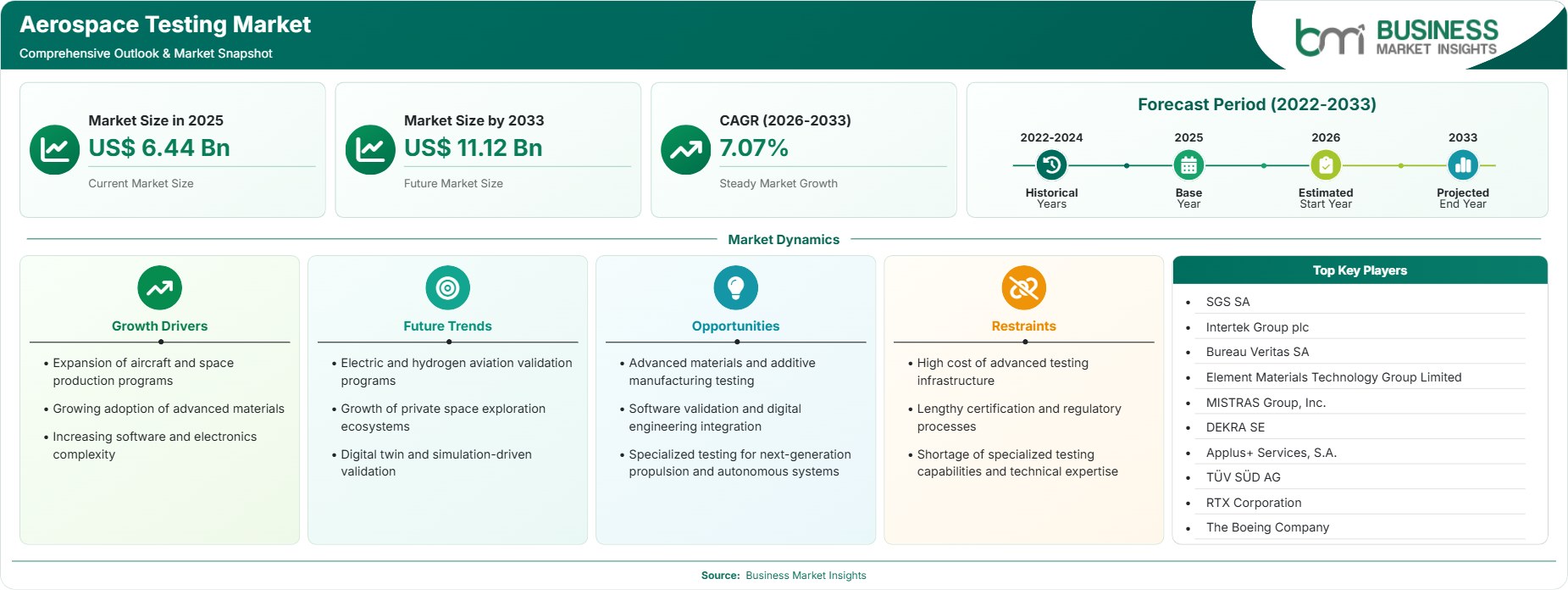
The Aerospace Testing Market size was valued at US$ 6.44 Billion in 2025 and is projected to reach US$ 11.12 Billion by 2033, growing at a CAGR of 7.07% during 2026–2033. Demand is supported by aircraft production expansion, space-launch activity, advanced materials adoption, certification requirements, digital engineering integration, and increasing testing intensity across commercial, defense, and aerospace programs.

Report Coverage
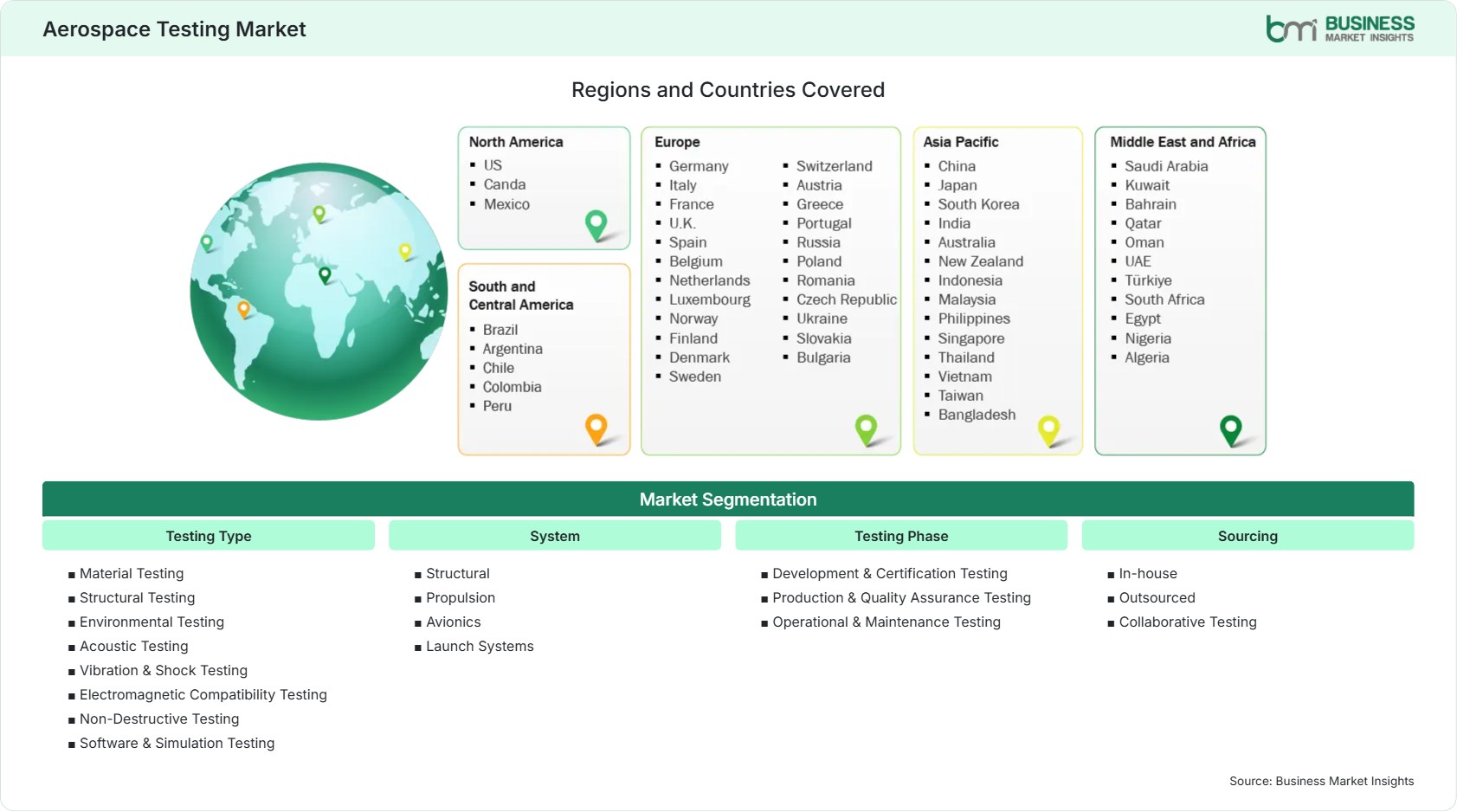
  • Testing Type: Material Testing, Structural Testing, Environmental Testing, Acoustic Testing, Vibration & Shock Testing, Electromagnetic Compatibility Testing, Non-Destructive Testing, Software & Simulation Testing
  • System: Structural, Propulsion, Avionics, Launch Systems
  • Testing Phase: Development & Certification Testing, Production & Quality Assurance Testing, Operational & Maintenance Testing
  • Sourcing: In-house, Outsourced, Collaborative Testing
US$ 6.44 Bn Market size in 2025
US$ 11.12 Bn Market Size by 2033
7.07% CAGR, 2026 - 2033
2026-2033 Forecast Period

AI Overview

Aerospace Testing Market Summary

  • North America Region: North America holds 37%–40% market share in 2025, growing at a CAGR of 6.4%–7.0% during 2026–2033. Key drivers include aircraft backlogs, defense modernization, certification spending, private space investments, and digital validation adoption across aerospace supply chains and advanced propulsion programs. US market benefits from OEM concentration, defense budgets, and testing infrastructure, advancing at 6.5%–7.1% CAGR.
  • Fastest Growing Region: Asia Pacific holds 24%–27% market share in 2025, growing at a CAGR of 8.2%–8.8% during 2026–2033. Growth stems from indigenous aircraft programs, expanding MRO networks, satellite development, defense procurement, aerospace manufacturing localization, and increasing certification requirements.
  • Leading Segment: Development & Certification Testing holds 43%–46% market share in 2025, growing at a CAGR of 6.8%–7.4% during 2026–2033. Program qualification needs, regulatory compliance obligations, airworthiness validation, and new technology integration continue supporting segment leadership globally.
  • High Growth Segment: Software & Simulation Testing holds 9%–12% market share in 2025, growing at a CAGR of 9.2%–9.8% during 2026–2033. Digital twins, model-based engineering, autonomous systems validation, accelerated design cycles, and computing advancements strengthen adoption across aerospace programs.
  • Key Market Opportunity: Expanding electric aircraft, hydrogen propulsion, reusable launch systems, and autonomous aviation platforms require extensive validation environments, creating long-term demand for specialty laboratories, simulation capabilities, and certification expertise.
  • Major Market Players: SGS SA, Intertek Group plc, Bureau Veritas SA, Element Materials Technology Group Limited, MISTRAS Group, Inc., DEKRA SE, Applus+ Services, S.A., TÜV SÜD AG, RTX Corporation, The Boeing Company.
Strategic Insights

Aerospace Testing Market: Strategic Insights

Aerospace Testing Market Strategic Framework
FREE PDF
Request your free sample
Request free sample
Stakeholder View

Key Takeaways

  • The value chain increasingly integrates OEMs, certification agencies, testing laboratories, simulation specialists, and component suppliers, creating strong demand for multidisciplinary validation capabilities.
  • Software validation, advanced propulsion testing, and space systems qualification represent the most attractive growth avenues as program complexity increases.
  • Digital twins, AI-supported defect detection, and model-based systems engineering are shifting testing from purely physical validation toward hybrid physical-digital environments.
  • Asia Pacific offers compelling investment prospects due to indigenous aircraft production, defense modernization, and rapidly expanding aerospace manufacturing ecosystems.
  • Consolidation among TIC and engineering service providers is strengthening access to accredited facilities, specialist expertise, and global certification networks.
  • Sustainability-driven aviation technologies including hydrogen, sustainable aviation fuel compatibility, and electric propulsion systems are generating new testing requirements.
Geographic Outlook

Aerospace Testing Market Regional Highlights

North America Aerospace Testing Market

North America accounts for 37%–40% of revenue in 2025 and is projected to expand at a CAGR of 6.4%–7.0% through 2033. The region benefits from large aircraft production programs, defense modernization efforts, strong space-launch activity, and a dense network of accredited testing facilities. Aerospace Testing Market share leadership is supported by Boeing, RTX, major defense contractors, and advanced certification infrastructure. Rising investments in autonomous aircraft, next-generation propulsion, and reusable space systems continue driving testing demand.

  • Aircraft manufacturing backlogs continue supporting structural, material, and environmental testing demand across commercial programs.
  • Defense modernization initiatives increase qualification activities for avionics, propulsion, and mission-critical components.
  • Private space companies drive launch-system verification, vibration testing, and mission assurance requirements.
  • Digital engineering adoption encourages integration of simulation-driven validation and physical testing frameworks.
  • Regulatory oversight maintains consistent demand for certification-focused services across aerospace applications.

US Aerospace Testing Market

The United States represents 77%–81% of North American revenue and advances at a CAGR of 6.5%–7.1%. Strong aerospace R&D expenditure, extensive defense procurement programs, and leadership in space exploration contribute to demand expansion. Testing infrastructure spans government laboratories, OEM facilities, and independent providers. Continued innovation in hypersonics, advanced air mobility, and software-intensive aerospace systems supports sustained market opportunities.

  • FAA certification requirements create recurring validation needs across commercial and emerging aviation programs.
  • Defense initiatives encourage investment in durability, EMI, environmental, and propulsion testing activities.
  • Private launch providers increase demand for launch-system performance verification.
  • Autonomous aviation developments support expanded simulation and software validation requirements.

Europe Aerospace Testing Market

Europe holds 27%–30% market share in 2025 and records a CAGR of 6.8%–7.4% through 2033. Airbus-led manufacturing activity, sustainability initiatives, and collaborative aerospace research programs strengthen testing demand. Germany leads regional revenue generation, while France maintains a strong certification ecosystem. Spain demonstrates among the fastest growth rates at approximately 7.5%–8.1% due to expanding aerospace engineering investments and industrial participation in European programs.

  • Hydrogen aviation initiatives generate specialized testing requirements.
  • Aerospace research partnerships support advanced materials qualification.
  • Increased defense spending strengthens propulsion and systems testing demand.
  • Space-sector development expands environmental and vibration testing activities.
  • Regulatory rigor sustains continuous certification and compliance expenditure.

Asia Pacific Aerospace Testing Market

Asia Pacific holds the largest market share of 24%-27%, with a high CAGR of 8.2%-8.8% between 2025-2033. China holds the largest regional revenue share due to aircraft development and manufacturing. India witnesses one of the highest CAGRs, at 8.8%-9.4%. The factors driving demand for test systems include aerospace industrialization, satellite programs, aircraft development, and MRO services, which contribute significantly to testing demand across the region.

  • Indigenous aviation platforms require extensive development and certification validation.
  • Space-sector investments support launch-system and environmental testing.
  • MRO capacity expansion increases operational testing requirements.
  • Defense procurement programs stimulate advanced systems validation activities.
  • Localization strategies strengthen regional testing infrastructure investment.

Rest of World Aerospace Testing Market

Rest of World constitutes 8%-11% of worldwide revenues with a growth rate of 7.0%-7.6% CAGR up to 2033. The Middle East is driven by investments in aviation infrastructure and national policies in the aerospace sector. South & Central America have regional policies in place due to aircraft production and maintenance in the region. The UAE is leading among Middle Eastern nations, while Brazil plays a key role in aerospace manufacturing and exports.

  • National aerospace diversification programs encourage specialized testing investments.
  • Airline fleet expansion increases maintenance-related validation requirements.
  • Space and defense initiatives create opportunities for advanced testing services.
  • Industrial partnerships strengthen local certification capabilities.
  • Regional manufacturing growth supports material and component qualification demand.
Global Market Geography
FREE PDF
Request your free sample
Request free sample
Segment Analysis

Aerospace Testing Market Segmentation

Testing Type

This category holds 32% to 35% market share and grows at 7.1% to 7.7% CAGR. The scope of the Aerospace Testing Market is expanding continuously due to the increasing integration of advanced materials, electronics, and software-based systems into aerospace systems.

  • Material Testing: Evaluates composite materials, alloys, and additive-manufactured components to ensure durability, reliability, and airworthiness performance.
  • Structural Testing: Assesses airframe strength, fatigue resistance, and operational integrity under simulated flight conditions.
  • Environmental Testing: Validates component performance against temperature, humidity, altitude, and climatic stresses.
  • Acoustic Testing: Measures noise behavior, cabin performance, and aerospace component acoustic characteristics.
  • Vibration & Shock Testing: Determines resilience against operational vibration loads, launch conditions, and mechanical impacts.
  • Electromagnetic Compatibility (EMC) Testing: Ensures electronics operate reliably without interference across aerospace environments.
  • Non-Destructive Testing (NDT): Identifies hidden defects while preserving component usability and operational readiness.
  • Software & Simulation Testing: Validates software reliability, digital twins, and system behavior across mission scenarios.

System

System testing contributes 29%–32% market share and grows at 7.0%–7.6% CAGR. Greater aircraft complexity and integrated system architectures are increasing demand for comprehensive subsystem validation.

  • Structural: Focuses on airframe integrity, fatigue assessment, and lifecycle performance verification.
  • Propulsion: Examines engine efficiency, reliability, emissions characteristics, and operational durability requirements.
  • Avionics: Addresses navigation, communication, sensor integration, and flight-control performance validation.
  • Launch Systems: Evaluates launch vehicle performance, environmental resilience, and mission readiness.

Testing Phase

Development and Certification Testing is the dominant sector, contributing to a 43%-46% market share and a 6.8%-7.4% CAGR. The Aerospace Testing Market trends point toward an increasing focus on early-stage validation to mitigate risk.

  • Development & Certification Testing: Supports qualification, compliance, and airworthiness approval processes across aerospace programs.
  • Production & Quality Assurance Testing: Ensures manufacturing consistency, performance conformity, and defect reduction.
  • Operational & Maintenance Testing: Supports lifecycle management, maintenance planning, and continued operational reliability.

Sourcing

Sourcing activities account for 18%–21% of industry revenues and grow at 7.3%–7.9% CAGR. Organizations increasingly balance internal capabilities with specialist external expertise.

  • In-house: Preferred for proprietary technologies, sensitive defense programs, and immediate engineering collaboration.
  • Outsourced: Gains adoption through access to accredited laboratories and advanced testing expertise.
  • Collaborative Testing: Expands through partnerships involving OEMs, laboratories, research institutes, and regulators.
Market Forces

Aerospace Testing Market Dynamics

Key Market Drivers

Expansion of Aircraft and Space Production Programs

Test demands for commercial aircraft backlog, defense platform upgrades, and rapid satellite deployment have been rising over time. Industry bodies such as the IATA have predicted a long-term increase in air travel demand, which will fuel aircraft production and expansion. Certification testing must be conducted on each new aerospace vehicle before it can enter service. Hence, the market for Aerospace Testing will be closely correlated with production volume, technological complexity, and regulatory requirements. Growth in investment in reusable launchers and air mobility platforms has also increased the testing workload for propulsion systems, avionics, and safety-critical components.

Growing Adoption of Advanced Materials

There is a growing trend toward the use of composite materials, lightweight alloys, and parts manufactured via additive manufacturing in aerospace applications. These materials have unique testing requirements that do not go well with conventional testing procedures. As a result, there is a need for more mechanical, fatigue, and environmental testing operations. Aerospace companies are pouring a lot of money into validation systems, which is driving a greater need for specialized laboratories, and this need continues to strengthen.

Increasing Software and Electronics Complexity

Current aerospace platforms depend on software-intensive systems, interconnected avionics, and enhanced autonomy. In this regard, there is a need to test for cybersecurity, software dependability, electromagnetic compatibility, and system performance. The Aerospace Testing Market trends increasingly demonstrate the tendency towards simulation-based validation and digital engineering processes. The regulatory authorities also require that safety-critical software functions be thoroughly verified before certification is granted. With the increasing level of interconnection in mission systems, testing service providers with software validation capabilities gain new opportunities to capture market share across commercial, defense, and space programs.

Key Market Opportunities

Electric and Hydrogen Aviation Validation Programs

Innovation in electric propulsion systems and hydrogen aircraft presents considerable opportunities for testing providers. Novel propulsion system designs require evaluation for thermal efficiency, safety assurance, energy storage capability, and certification services. New programs under development include innovative technology pathways with limited operational experience, thus making them more reliant on effective testing programs. The Aerospace Testing Market forecasts more specialized test centers capable of assessing novel propulsion systems. Investors channel money into green aviation technologies, reinforcing demand for dedicated testing expertise.

Growth of Private Space Exploration Ecosystems

Commercial launcher companies, satellite developers, and space infrastructure builders are all growing very quickly. Environmental testing, launcher qualification, vibration testing, and mission assurance are becoming increasingly important in all these industries. Financial backing from government programs for space activities will also provide strong support for investment growth. Test facilities that develop expertise in space testing are expected to earn substantial revenue opportunities as launch frequency and spacecraft complexity increase.

Digital Twin and Simulation-Driven Validation

Digital engineering methodologies allow companies to improve designs before conducting costly physical tests. State-of-the-art simulation capabilities provide additional support for traditional testing activities by shortening development cycles and improving risk management. Companies are increasingly opting for a hybrid approach that combines virtual and physical validation methods for greater efficiency. Companies that can link simulation, digital twins, and analytics with traditional labs can create value-added services.

Market Restraints and Challenges

High Cost of Advanced Testing Infrastructure

Specialized equipment and processes for aerospace testing facilities entail considerable investments in technology, certification, safety, and technical manpower. Such a capital-intensive process acts as a barrier to entry for potential players in the market and may affect the expansion of the testing facilities in some areas. Infrastructure such as environmental test chambers, propulsion test stands, and vibration testing systems requires regular maintenance and calibration. This means providers will take longer to recoup their investments and expand their businesses, as demand for aerospace testing is on the rise.

Lengthy Certification and Regulatory Processes

Aerospace projects must operate under extremely stringent regulatory regimes that require comprehensive documentation, thorough validation, full traceability, and strict adherence to safety and quality standards throughout the project's entire life cycle. The certification process often involves extensive testing and approvals that may prolong it and delay product launches and the income generated by testing. Regulations often vary from country to country and region to region, which makes multinational projects more complicated. Evolving regulations make it necessary for testing companies to invest in compliance, administration, and process improvement.

Company Analysis

Competitive Landscape

The Aerospace Testing Market analysis highlights a competitive environment shaped by accreditation depth, global laboratory networks, aerospace certification expertise, and advanced simulation capabilities.

Company Name

Overview

Products and Services relevant to this market

SGS SA

Global testing, inspection, and certification provider serving aerospace manufacturers and suppliers.

NDT, material testing, certification support, environmental testing, quality assurance services.

Intertek Group plc

International assurance and testing company with broad aerospace validation capabilities.

Structural testing, compliance services, laboratory evaluations, aerospace certification support.

Bureau Veritas SA

Major TIC organization supporting aerospace quality and safety requirements worldwide.

Inspection services, compliance verification, audit support, materials and systems testing.

Element Materials Technology Group Limited

Specialist testing company focused on high-performance industrial and aerospace applications.

Materials characterization, fatigue testing, environmental testing, certification programs.

MISTRAS Group, Inc.

Asset protection and advanced inspection technology provider.

Non-destructive testing, structural health monitoring, engineering evaluation services.

DEKRA SE

International testing and certification firm with aerospace expertise.

Compliance assessment, quality verification, inspection and testing solutions.

Applus+ Services, S.A.

Engineering, inspection, and testing specialist serving aerospace value chains.

NDT, integrity assessment, laboratory testing, qualification services.

TÜV SÜD AG

Technical services organization supporting safety and certification programs.

Product testing, regulatory compliance, inspection, and certification activities.

RTX Corporation

Aerospace and defense technology leader conducting extensive validation programs.

Avionics, propulsion, systems testing, defense-related qualification services.

The Boeing Company

Major aircraft manufacturer with advanced development and certification infrastructure.

Structural, flight, environmental, and systems validation capabilities.

Trust & Transparency

Research Methodology

The market analysis combines proprietary research with secondary data from government agencies, company disclosures, regulatory filings, industry databases and expert interviews. Market estimates are validated through data triangulation, cross-market benchmarking and analyst review.

View Full Research Methodology

Questions Answered

Frequently Asked Questions

What does an Aerospace Testing Market Report typically evaluate?

It assesses market size, technology developments, competition, regulations, regional opportunities, segment performance, investment trends, and future demand drivers influencing industry expansion.

Why are outsourced testing services gaining popularity?

External providers offer accredited facilities, specialist expertise, and advanced equipment that may be costly for manufacturers to maintain internally, improving efficiency and certification readiness.

Which end-use area offers substantial future potential?

Space exploration and commercial launch activities present strong opportunities because spacecraft, satellites, and launch vehicles require extensive qualification, environmental, and mission assurance testing.

How is software changing aerospace validation processes?

Software-driven architectures require extensive verification, simulation, cybersecurity assessment, and digital-twin validation. This expands demand for hybrid testing approaches combining physical and virtual environments.

What factors make aerospace testing critical for aircraft certification?

Testing validates structural integrity, safety, durability, electronics performance, and regulatory compliance before aircraft or components enter commercial or defense service, reducing operational and certification risks.

Access the Full Aerospace Testing Market Report

Get segment-level forecasts, regional estimates, competitive benchmarking, company profiles and downloadable Excel datasets.

Access the full Aerospace Testing Market Report
350 pages PDF & Excel | 2026-08-31