
Aerospace Ground Handling System Market Outlook: Size, Share, Trends, Growth Analysis, Competitive Landscape & Forecast, 2026-2033

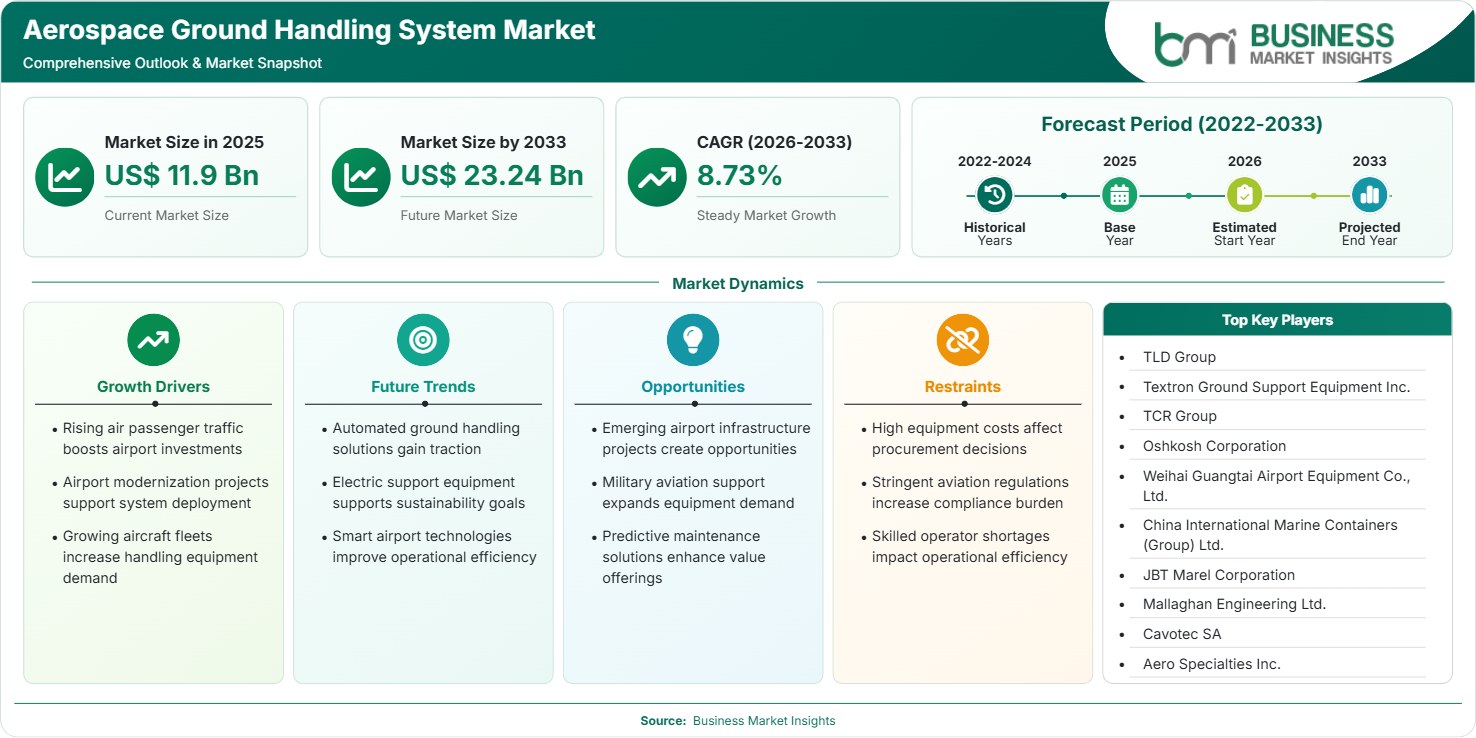
The Aerospace Ground Handling System Market size was valued at US$ 11.9 Billion in 2025 and is projected to reach US$ 23.24 Billion by 2033, growing at a CAGR of 8.73% during 2026–2033. Key growth drivers include airport modernization, rising passenger traffic, electrification of ground support fleets, digital ramp operations, cargo expansion, and sustainability-focused investments across commercial aviation ecosystems.

Report Coverage
  • Offering: Ground Support Equipment, Software / Digital Ramp Systems
  • Application: Passenger Handling, Baggage Handling, Cargo and Mail Handling, Others
  • Power Source: Diesel / ICE, Electric Battery, Hybrid, Others
  • Aircraft Type: Commercial Aircraft , General Aviation, Others
US$ 11.9 Bn Market size in 2025
US$ 23.24 Bn Market Size by 2033
8.73% CAGR, 2026 - 2033
2026-2033 Forecast Period

AI Overview

Aerospace Ground Handling System Market Summary

  • North America Region: Holds 34%–37% share in 2025, growing at 7.5%–8.2% CAGR during 2026–2033. Growth is supported by airport automation, fleet renewal, electrified equipment adoption, smart maintenance platforms, cargo handling upgrades, airline operational efficiency initiatives, sustainability programs, and infrastructure modernization investments. The U.S. remains the largest regional market, expanding at 7.8%–8.4% CAGR through airport digitization.
  • Fastest Growing Region: Asia Pacific accounts for 27%–30% share in 2025 and advances at 10.2%–11.0% CAGR. Expansion is driven by airport construction, airline fleet additions, cargo growth, tourism recovery, smart airport investments, automation adoption, and government-backed aviation capacity enhancement programs.
  • Leading Segment: Ground Support Equipment represents 72%–76% share in 2025 and grows at 8.0%–8.8% CAGR. Demand benefits from aircraft turnaround optimization, airport capacity upgrades, electric vehicle deployment, maintenance efficiency improvements, safety compliance requirements, and increasing airline service frequencies globally.
  • High Growth Segment: Software/Digital Ramp Systems account for 24%–28% share in 2025 and expand at 11.5%–12.5% CAGR. Adoption is fueled by predictive analytics, operational visibility, workforce optimization, turnaround management, resource allocation efficiency, digital transformation strategies, and integration with airport management platforms.
  • Key Market Opportunity: Large-scale conversion from diesel-powered support fleets to electric and hybrid alternatives creates opportunities across charging infrastructure, fleet management software, data analytics, and emissions reduction compliance solutions.
  • Major Market Players: TLD Group, Textron Ground Support Equipment Inc., TCR Group, Oshkosh Corporation, Weihai Guangtai Airport Equipment Co., Ltd., China International Marine Containers (Group) Ltd., JBT Marel Corporation, Mallaghan Engineering Ltd., Cavotec SA, and Aero Specialties Inc.
Strategic Insights

Aerospace Ground Handling System Market: Strategic Insights

Aerospace Ground Handling System Market Strategic Framework
FREE PDF
Request your free sample
Request free sample
Stakeholder View

Key Takeaways

  • The value chain is becoming increasingly integrated as equipment manufacturers collaborate with software providers to deliver connected ground operations ecosystems.
  • Digital ramp systems and electric ground service fleets present the highest medium-term revenue expansion opportunities.
  • Innovation is shifting toward autonomous towing, IoT-enabled diagnostics, fleet telematics, and predictive maintenance capabilities.
  • Asia Pacific offers the strongest long-term investment potential due to airport construction activity and expanding airline fleets.
  • Strategic acquisitions increasingly focus on electrification technologies, fleet management capabilities, and airport automation solutions.
  • Sustainability-linked procurement requirements are influencing supplier selection and equipment replacement cycles globally.
Geographic Outlook

Aerospace Ground Handling System Market Regional Highlights

North America Aerospace Ground Handling System Market

The North America region accounted for about 34%-37% of global consumption in 2025 and is anticipated to grow at a CAGR of 7.5%-8.2% through 2033. This region is well equipped with developed airport facilities, an airline fleet, and early adoption of electric ground-handling equipment. Aerospace Ground Handling System Market share in this region remains the largest due to extensive commercial aviation activity and airport modernization.

  • Major airport expansion projects continue supporting replacement demand for advanced support equipment.
  • Airlines increasingly deploy telematics and predictive maintenance solutions to optimize equipment utilization.
  • Sustainability targets are accelerating transitions from diesel-powered assets to battery-electric alternatives.
  • Cargo handling modernization remains a key investment priority across leading logistics hubs.

US Aerospace Ground Handling System Market

The United States accounts for around 76%-80% of the regional revenues and is forecasted to grow at a CAGR of 7.8%-8.4%. The presence of extensive airport networks, good domestic traffic volumes, and smart airport infrastructure investments drives future demand. Federal sustainability initiatives further encourage the deployment of electrified fleets.

  • Airport automation programs support adoption of digital operations platforms.
  • Cargo handling facilities continue expanding to accommodate e-commerce growth.
  • Equipment replacement cycles favor energy-efficient and connected solutions.
  • Airline operational efficiency programs drive investment in turnaround optimization.

Europe Aerospace Ground Handling System Market

Europe represents 25%-28% market share by 2025 and is forecasted to record 8.0%-8.8% CAGR. Sustainability regulations significantly impact technology adoption. Germany leads in regional revenue, whereas Eastern Europe shows higher growth rates due to airport renovations and increased passenger traffic.

  • Decarbonization initiatives accelerate electric ground support deployments.
  • Digital airport management investments enhance resource allocation efficiency.
  • Germany remains the leading market, while Poland shows higher growth momentum.
  • Airline operational cost pressures support automation investments.

Asia Pacific Aerospace Ground Handling System Market

Asia Pacific accounts for 27%–30% share in 2025 and records the fastest CAGR of 10.2%–11.0%. Aerospace Ground Handling System Market share is steadily increasing as airport construction, tourism growth, and airline fleet expansion drive equipment demand. China leads regional revenues, while India demonstrates the strongest growth profile.

  • New airport developments generate procurement opportunities across equipment categories.
  • Rising air cargo activity supports loader and transporter deployments.
  • Government aviation programs encourage modernization investments.
  • India demonstrates double-digit infrastructure-led growth.
  • Smart airport technology adoption continues accelerating.

Rest of World Aerospace Ground Handling System Market

The Rest of World region represents a 10%–13% share in 2025 and advances at 8.8%–9.6% CAGR. Middle Eastern aviation hubs continue upgrading infrastructure to strengthen global connectivity. South and Central American markets benefit from gradual passenger traffic recovery and airport modernization initiatives.

  • UAE and Saudi Arabia remain leading Middle Eastern demand centers.
  • Brazil drives regional opportunities within South America.
  • Cargo infrastructure investments support equipment procurement.
  • Tourism recovery is strengthening airport throughput growth.
  • Sustainability initiatives encourage fleet electrification projects.
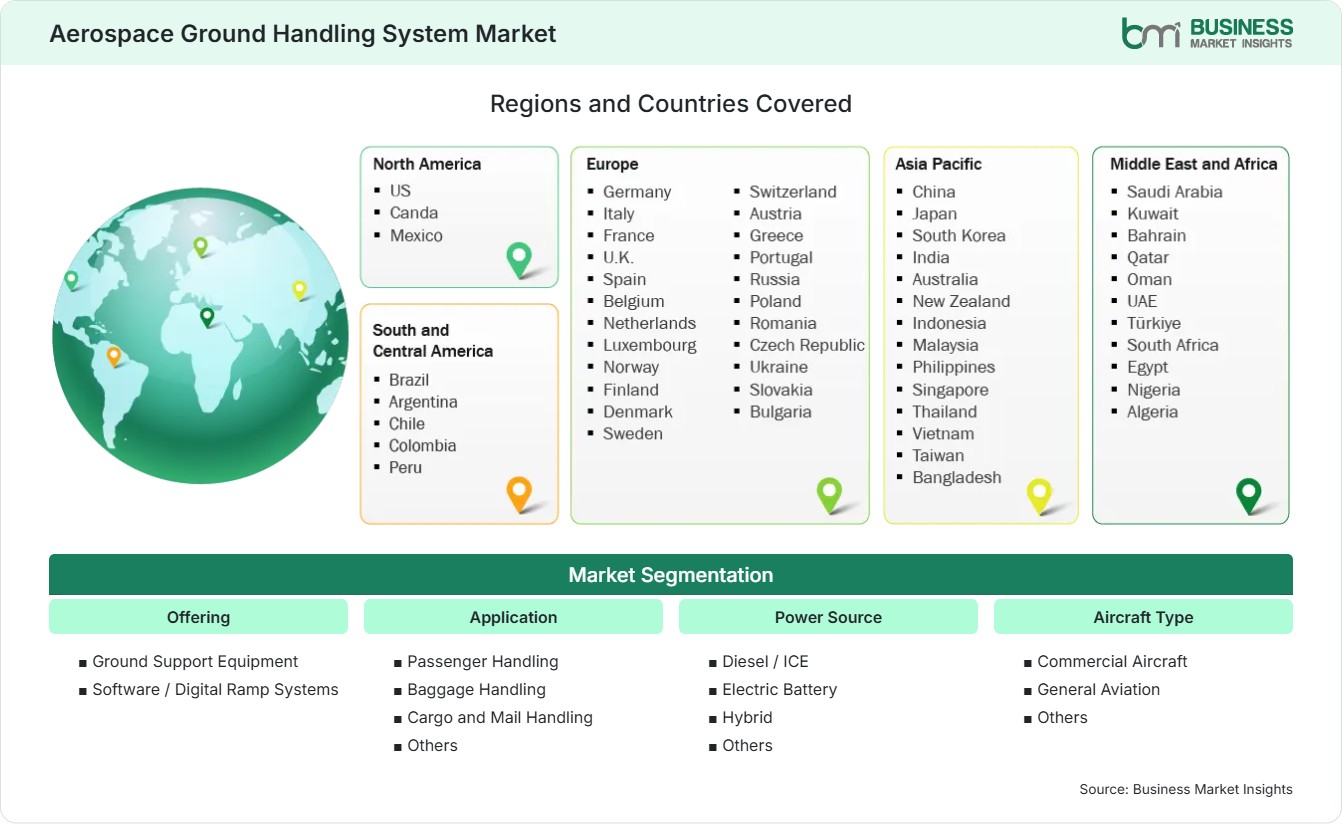
Global Market Geography
FREE PDF
Request your free sample
Request free sample
Segment Analysis

Aerospace Ground Handling System Market Segmentation

Offering

This segment accounts for around 74%-78% of the market share in 2025 and is anticipated to grow at an 8.6%-9.2% CAGR. The scope of the Aerospace Ground Handling System Market has been expanding steadily due to the increasing use of physical equipment alongside digital operational platforms to improve aircraft performance.

  • Pushback Tugs & Tractors: Critical for aircraft movement operations, with demand supported by fleet growth, airport congestion management, and increasing focus on operational efficiency.
  • Ground Power Units (GPUs): Adoption rises as airports seek reduced aircraft auxiliary power usage and lower emissions during gate operations.
  • Baggage & Cargo Loaders: Growing cargo throughput and passenger volumes support deployment across commercial and logistics facilities.
  • Aircraft Refuelers: Essential for servicing expanding airline fleets while meeting stringent safety and operational standards.
  • Software/Digital Ramp Systems: Fastest-growing area driven by resource optimization, predictive analytics, and real-time operational visibility.

Application

This segment is in high demand due to the increasing number of aircraft operations and the airport's development. The segment represents approximately 100% utilization within the airport ecosystem and is growing at a rate close to the industry-average CAGR.

  • Passenger Handling: Airports prioritize seamless passenger movement and service quality improvements.
  • Baggage Handling: Automation and tracking technologies support improved processing efficiency and accuracy.
  • Cargo and Mail Handling: Expansion of e-commerce logistics drives infrastructure and equipment investment.

Power Source

Electrification remains a defining industry transition. The Aerospace Ground Handling System Market trends increasingly favor low-emission solutions as airports pursue sustainability targets and lower operating costs.

  • Diesel/ICE: Maintains substantial installed base despite gradual replacement activity.
  • Electric Battery: Fastest-growing sub-segment supported by environmental compliance requirements.
  • Hybrid: Provides operational flexibility where charging infrastructure remains limited.

Aircraft Type

Commercial aviation continues to represent the core demand source, supported by fleet expansion and airport throughput growth.

  • Narrow-body Aircraft: Largest deployment category due to dominant global fleet presence.
  • Wide-body Aircraft: Supports long-haul traffic and international cargo operations.
  • Regional Aircraft: Demand linked to regional connectivity and secondary airport development.
  • General Aviation: Requires specialized handling solutions for private and business aircraft operations.
Market Forces

Aerospace Ground Handling System Market Dynamics

Key Market Drivers

Airport Modernization and Capacity Expansion

Airport authorities worldwide are making significant investments in infrastructure upgrades due to increased passenger demand, rising air freight traffic, and increasingly sophisticated aircraft handling requirements. Airport expansion projects, which include the construction of new terminal structures, the enlargement of apron areas, the implementation of baggage-handling automation, and the creation of smart airports, have required continuous investments in state-of-the-art ground-handling systems. The application of ground-handling equipment such as pushback tugs, ground power units, cargo-handling systems, and smart ramps has proved crucial to enhancing the efficiency and safety of airport operations.

Electrification of Ground Support Fleets

Sustainability initiatives at airports and pledges to reduce carbon footprints are driving the shift towards electric and hybrid ground support equipment worldwide. Fleet managers are now opting to replace their diesel vehicles with more environmentally friendly battery-electric models to cut greenhouse gas emissions, reduce fuel dependence, and increase efficiency. The use of battery-electric equipment, such as baggage tractors, pushback tugs, and ground power units, is easier to maintain and cheaper than vehicles that use internal combustion engines. Additionally, supportive government programs, environmental policies, and the decarbonization of airports are also contributing to this trend. Furthermore, advancements in battery technology, charging infrastructure, and fleet management systems are improving equipment efficiency at modern airports.

Growth in Passenger and Air Cargo Traffic

Growing passenger traffic and fast-moving air cargo flows are creating a strong need for more sophisticated ground-handling equipment at airports and airlines. Increased frequencies, fleet growth, and new destinations necessitate proper equipment for towing, baggage handling, aircraft maintenance, refueling, and cargo loading. The fast development of e-commerce and time-sensitive freight delivery systems has added extra challenges for cargo handling at leading air transport facilities. An increase in flights and greater use of airport capacity call for more automation, digital ramps, and high-speed support systems to reduce turnaround times, increase efficiency, and maintain service reliability.

Key Market Opportunities

Digital Ramp and Predictive Operations Platforms

The use of integrated digital ramp and predictive operations solutions presents an excellent business opportunity for airports desiring improved efficiency and robustness in their operations. Through a centralized software system, airports will be able to coordinate employee deployment, equipment distribution, and gate and aircraft turnaround operations. By using advanced analytical tools and predictive technologies, airports will be able to forecast issues, reduce delays, and improve resource utilization. Improved visibility in airport operations facilitates cooperation among all parties and better decision-making through data.

Electric Infrastructure Deployment

The establishment of large-scale charging infrastructure has presented immense opportunities beyond the sale of electric ground support equipment. Enterprises specializing in providing energy management systems, smart charging systems, battery management, software solutions, and predictive maintenance will benefit from the opportunity. The increasing efforts by airports and aerospace players to adopt electric systems have created growing demand for these technologies. These investments are expected to affect Aerospace Ground Handling System Market forecasts by enhancing efficiency, sustainability, and long-term cost savings across airport operations.

Emerging Airport Development Programs

With the rapid deployment of airport infrastructure investments in Asia, the Middle East, and Africa, numerous business opportunities have emerged for providers of technology, services, and equipment. With funding for construction and expansion projects at these airports, there has been increased demand for sophisticated systems, including automation, security, air traffic management, and sustainable energy systems. Given that these airports are planned and developed using modern technology, there is ample opportunity to integrate one's product and form business relationships in the process.

Market Restraints and Challenges

High Capital Investment Requirements

Factor: The adoption of advanced electric ground support vehicles, autonomous equipment, and digital fleet-management platforms requires substantial upfront capital investments. For many smaller airports and independent operators, budget constraints make large-scale fleet replacement financially challenging despite the long-term operational savings and sustainability benefits associated with these technologies. Impact: The high initial investment burden is extending equipment replacement cycles and delaying procurement decisions across several airport operators. Organizations with limited capital resources often prioritize maintaining existing assets rather than investing in next-generation technologies, slowing overall market penetration. While electric and digitally connected solutions can deliver lower operating costs over time, the need for significant upfront expenditure continues to create a barrier to widespread adoption, particularly among regional airports and smaller service providers

Infrastructure and Interoperability Constraints

Factor: The successful deployment of modern airport ground support equipment depends on supporting infrastructure such as charging networks, digital connectivity platforms, and software integration capabilities. In addition, compatibility issues between new technologies and legacy equipment or airport management systems can create significant operational and technical complexities. Impact: These infrastructure and interoperability constraints often lead to longer implementation timelines and higher integration costs for airport operators. Airports managing mixed fleets and legacy operational systems may face difficulties in achieving seamless communication between equipment, software platforms, and existing workflows. As a result, deployment projects can become more resource-intensive, reducing short-term adoption rates and prompting some operators to postpone modernization initiatives until supporting infrastructure and integration capabilities are more fully developed.

Company Analysis

Competitive Landscape

The Aerospace Ground Handling System Market analysis highlights increasing competition focused on electrification, automation, fleet optimization, and connected airport operations.

Company Name

Overview

Products and Services relevant to this market

TLD Group

Global manufacturer specializing in airport ground support technologies.

Aircraft tractors, loaders, GPUs, air starters, baggage equipment.

Textron Ground Support Equipment Inc.

Leading supplier focused on electrification and airport productivity.

Pushback tractors, baggage tractors, deicers, loaders, fleet solutions.

TCR Group

Global GSE solutions provider and fleet management specialist.

Rental fleets, maintenance, telematics, airport equipment services.

Oshkosh Corporation

Diversified industrial manufacturer serving specialty vehicle markets.

Aviation support vehicles and airport operational equipment.

Weihai Guangtai Airport Equipment Co., Ltd.

Major Chinese airport equipment manufacturer.

Refuelers, loaders, tractors, passenger service equipment.

China International Marine Containers (Group) Ltd.

Industrial conglomerate active in airport equipment solutions.

Cargo handling systems and aviation ground equipment.

JBT Marel Corporation

Technology-driven provider of aviation support systems.

Airport cargo and ground handling equipment solutions.

Mallaghan Engineering Ltd.

Specialist manufacturer serving global airports.

Passenger stairs, loaders, service vehicles, deicers.

Cavotec SA

Engineering company focused on airport electrification solutions.

Ground power systems, charging infrastructure, automation technologies.

Aero Specialties Inc.

Provider of aviation ground support products.

Towbars, GPUs, servicing equipment, maintenance solutions.

Trust & Transparency

Research Methodology

The market analysis combines proprietary research with secondary data from government agencies, company disclosures, regulatory filings, industry databases and expert interviews. Market estimates are validated through data triangulation, cross-market benchmarking and analyst review.

View Full Research Methodology

Questions Answered

Frequently Asked Questions

What does the Aerospace Ground Handling System Market Report typically evaluate?

The Market Report assesses demand trends, competitive positioning, technology adoption, segmentation performance, regional opportunities, and strategic developments influencing long-term industry growth.

What role does electrification play in market development?

Electrification helps airports reduce emissions, lower operating costs, comply with sustainability objectives, and improve equipment lifecycle economics.

Which region presents the strongest growth potential?

Asia Pacific offers the highest growth potential due to airport construction activity, fleet expansion, government aviation investments, and increasing passenger volumes.

How important is software in future airport operations?

Software platforms are becoming central to fleet visibility, resource allocation, predictive maintenance, and turnaround management, making digital capabilities critical for operational efficiency.

What is driving demand for aerospace ground handling systems?

Airport modernization, aircraft traffic growth, cargo expansion, electrification initiatives, and increasing adoption of digital airport operations platforms are the primary demand drivers.

Access the Full Aerospace Ground Handling System Market Report

Get segment-level forecasts, regional estimates, competitive benchmarking, company profiles and downloadable Excel datasets.

Access the full Aerospace Ground Handling System Market Report
350 pages PDF & Excel | 2026-08-31