
Baggage Handling System Market Outlook: Size, Share, Trends, Growth Analysis, Competitive Landscape & Forecast, 2022-2033

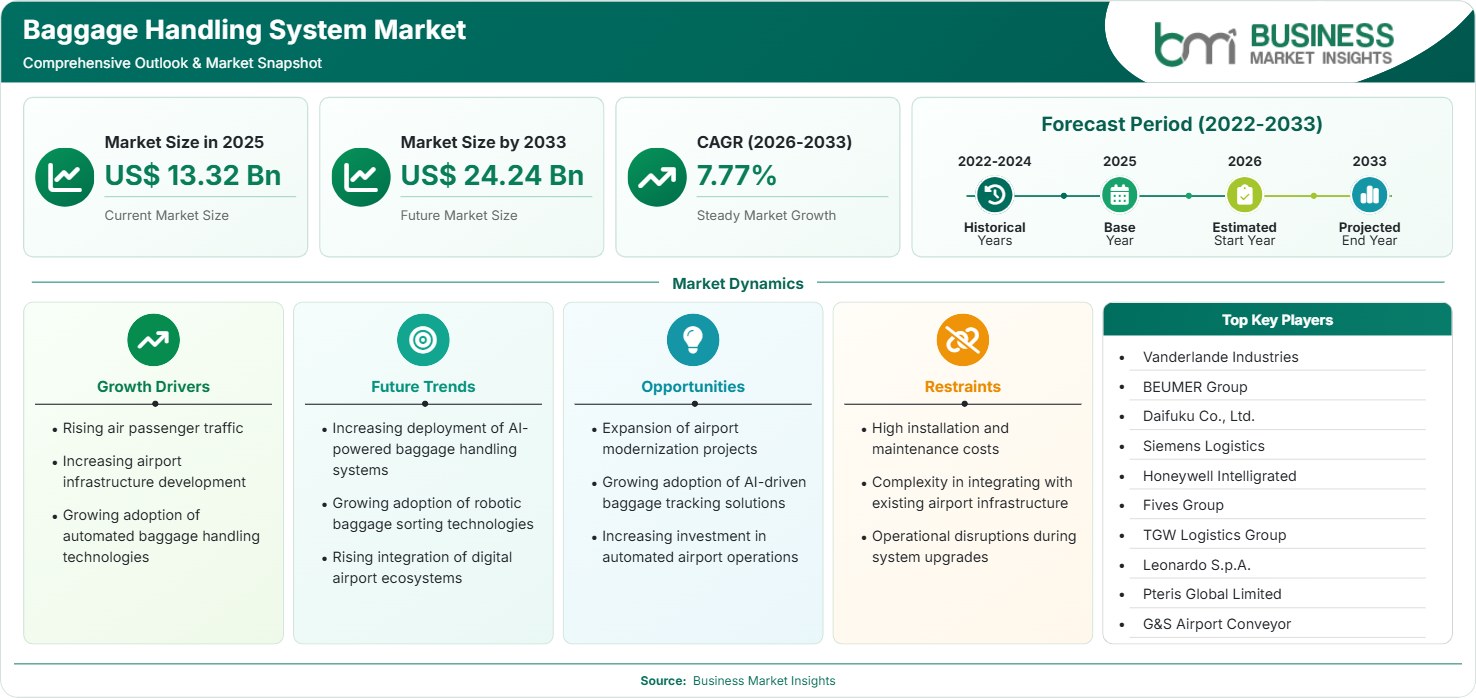
The Baggage Handling System Market was valued at US$ 13.32 Billion in 2025 and is projected to reach US$ 24.24 Billion by 2033, registering a CAGR of 7.77% during 2026–2033. Rising air passenger traffic, expanding airport infrastructure development, and the growing adoption of automated baggage-handling technologies are accelerating market expansion. Continuous investments in airport modernization and digital baggage management solutions are further supporting long-term industry growth.

Report Coverage
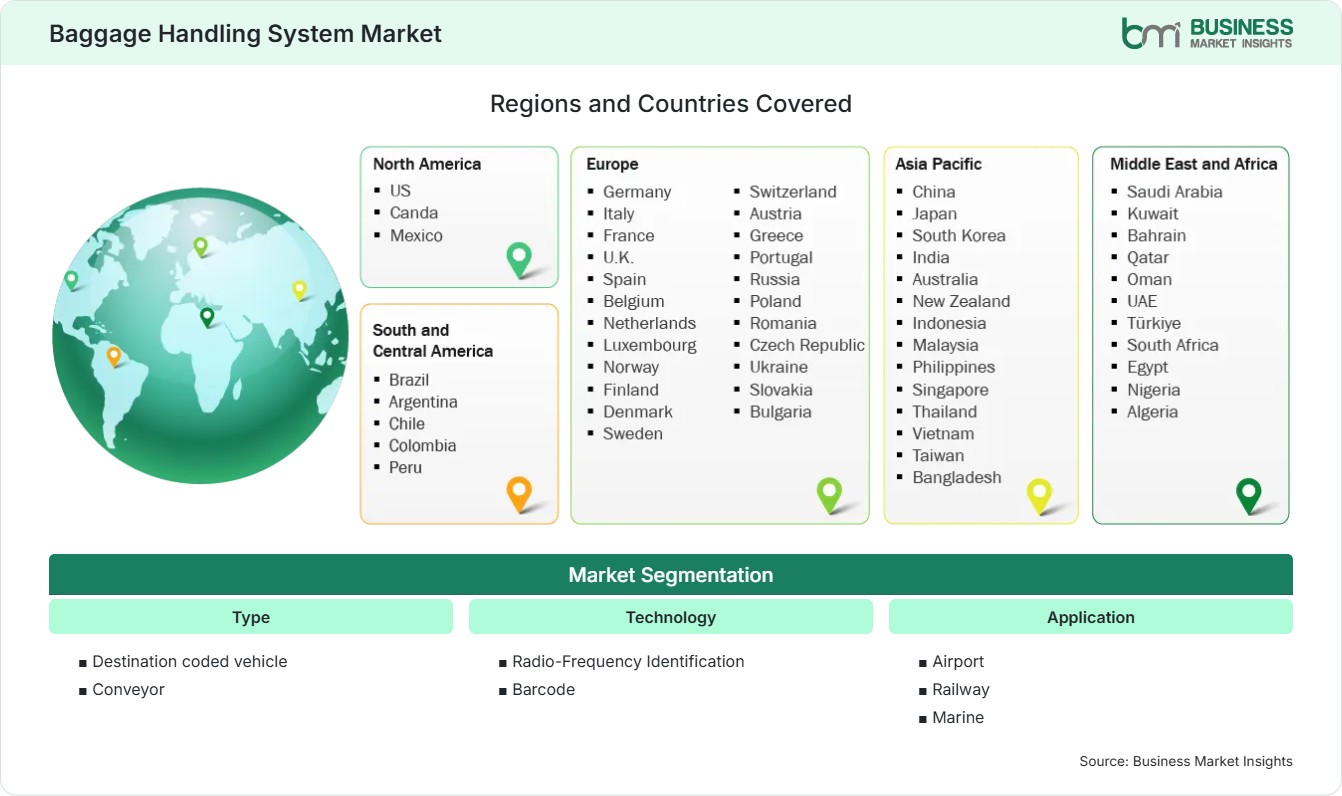
  • Type: Destination coded vehicle, Conveyor
  • Technology: Radio-Frequency Identification, Barcode
  • Application: Airport, Railway, Marine
US$ 13.32 Bn Market size in 2025
US$ 24.24 Bn Market Size by 2033
7.77% CAGR, 2026 - 2033
2026-2033 Forecast Period

01 AI Overview

Baggage Handling System Market Summary

  • North America Region: North America accounted for 27%–30% share in 2025 and is expected to expand at a 7.3%–7.9% CAGR through 2033. Growth is supported by airport expansion projects, modernization of baggage handling infrastructure, and increasing adoption of automated airport technologies. The US market is projected to grow at a 7.5%–8.1% CAGR during the forecast period.
  • Fastest Growing Region: Asia Pacific represented 38%–41% share in 2025 and is forecast to register the highest 8.4%–9.0% CAGR, driven by rapid airport construction, increasing passenger traffic, and government investments in transportation infrastructure.
  • Leading Segment: Conveyor systems held 63%–66% share in 2025 and are projected to grow at a 7.4%–8.0% CAGR, supported by widespread deployment across airports for efficient baggage transportation and sorting.
  • High Growth Segment: RFID technology accounted for 40%–43% share in 2025 and is anticipated to register a 8.7%–9.3% CAGR, owing to increasing demand for real-time baggage tracking, higher operational accuracy, and improved passenger experience.
  • Key Market Opportunity: Growing investments in AI-enabled baggage tracking, airport automation, and smart terminal development are creating significant opportunities for technology providers and system integrators.
  • Major Market Players: Vanderlande Industries, BEUMER Group, Daifuku Co., Ltd., Siemens Logistics, Honeywell Intelligrated, Fives Group, TGW Logistics Group, Leonardo S.p.A., Pteris Global Limited, and G&S Airport Conveyor.
02 Strategic Insights

Baggage Handling System Market: Strategic Insights

Baggage Handling System Market Strategic Framework
FREE PDF
Request your free sample
Request free sample
03 Stakeholder View

Key Takeaways

  • Increasing passenger traffic and airport capacity expansion continue driving demand for automated baggage handling systems worldwide.
  • Conveyor systems remain the dominant technology, while RFID-enabled baggage tracking represents the fastest-growing segment due to improved operational visibility.
  • Artificial intelligence, automation, and predictive maintenance technologies are enhancing baggage handling efficiency and reducing operational disruptions.
  • Asia Pacific offers the strongest long-term growth potential due to extensive airport development and rising demand for commercial aviation.
  • Strategic partnerships among airport authorities, airlines, and automation technology providers continue to accelerate innovation in baggage-handling infrastructure.
04 Geographic Outlook

Baggage Handling System Market Regional Highlights

North America Baggage Handling System Market

North America represents 27%–30% of the Baggage Handling System Market share in 2025 and is projected to expand at a 7.3%–7.9% CAGR during 2026–2033. Growth is driven by airport modernization initiatives, expansion of passenger terminals, and increasing investments in intelligent airport infrastructure. Airlines and airport operators are adopting automated baggage handling technologies to improve operational efficiency, reduce baggage delays, and enhance passenger service quality.

  • Airport modernization projects continue increasing deployment of advanced baggage handling and sorting systems.
  • Airlines are investing in automated baggage management to reduce handling errors and improve operational reliability.
  • Integration of digital monitoring platforms is enhancing baggage visibility and maintenance efficiency.
  • Smart airport initiatives continue supporting implementation of AI-enabled baggage handling technologies.
  • Growing passenger volumes are encouraging infrastructure upgrades across major international airports.

US Baggage Handling System Market

The United States accounted for 21%–23% regional share in 2025 and is projected to register a 7.5%–8.1% CAGR through 2033. Continuous airport expansion, modernization of baggage processing facilities, and increasing adoption of intelligent airport technologies continue supporting market growth. Investments in automated baggage tracking and integrated airport management systems are improving operational performance while enhancing the passenger experience.

  • Airport operators continue to upgrade baggage-handling infrastructure to accommodate rising passenger traffic.
  • RFID deployment is improving baggage traceability and reducing mishandled baggage incidents.
  • Automation investments are strengthening operational efficiency across major aviation hubs.
  • Digital airport transformation initiatives continue to accelerate the adoption of intelligent baggage management solutions.

Europe Baggage Handling System Market

Europe accounted for 24%–27% share in 2025 and is projected to expand at a 7.5%–8.1% CAGR of the Baggage Handling System Market during 2026–2033. Growth is supported by airport modernization, digital transformation, and increased investment in passenger-handling infrastructure. Airports across Germany, France, Spain, and the United Kingdom are replacing conventional baggage systems with automated conveyor networks, RFID-enabled tracking, and intelligent sorting solutions to improve efficiency and reduce baggage mishandling. Germany remains the largest regional market, while Poland is expected to register the fastest growth at 8.1%–8.7% CAGR due to expanding airport infrastructure and increasing passenger traffic.

  • Airport modernization projects continue accelerating deployment of automated baggage handling technologies.
  • Germany leads regional demand through continuous investments in airport logistics and automation.
  • Poland is expanding aviation infrastructure to accommodate rising domestic and international passenger volumes.
  • Smart airport initiatives support greater adoption of AI-based baggage monitoring and predictive maintenance systems.

Asia Pacific Baggage Handling System Market

Asia Pacific represented 38%–41% share in 2025 and is forecast to register the highest 8.4%–9.0% CAGR through 2033. Rapid airport construction, rising disposable incomes, expanding tourism, and increasing air passenger traffic continue driving demand for advanced baggage handling solutions. China remains the largest regional market due to ongoing investment in aviation infrastructure, while India is projected to grow at an 8.8%–9.4% CAGR, supported by new airport developments and the modernization of existing terminals.

  • China continues expanding airport capacity through large-scale infrastructure investments.
  • India is increasing adoption of automated baggage systems under national airport development initiatives.
  • Airlines and airport operators are implementing RFID-based tracking to improve baggage visibility.
  • Smart airport projects continue supporting AI, IoT, and cloud-enabled baggage management platforms.

Rest of World Baggage Handling System Market

Rest of World accounted for an 8%–10% share in 2025 and is projected to expand at a 7.6%–8.2% CAGR during the forecast period. Airport expansion across the Middle East, Latin America, and parts of Africa is increasing demand for automated baggage handling solutions. Saudi Arabia is expected to register a 8.2%–8.8% CAGR owing to major investments in aviation infrastructure, tourism development, and smart airport projects.

  • Airport expansion continues creating demand for high-capacity baggage handling infrastructure.
  • Governments are investing in digital airport technologies to improve operational efficiency.
  • Tourism growth supports modernization of baggage handling facilities across international airports.
  • Increasing commercial aviation activity strengthens long-term market demand.
Global Market Geography
FREE PDF
Request your free sample
Request free sample
05 Segment Analysis

Baggage Handling System Market Segmentation

Type

The type segment is dominated by conveyor systems because they provide continuous, reliable, and cost-effective baggage transportation across airports of all sizes. Destination coded vehicle (DCV) systems are increasingly deployed in large international airports where complex routing and high passenger throughput require greater operational flexibility. The segment accounted for 63%–66% share in 2025 and is projected to expand at a 7.4%–8.0% CAGR during the forecast period. The Baggage Handling System Market scope continues expanding as airports invest in scalable systems capable of supporting future passenger growth and improving baggage handling efficiency.

  • Destination coded vehicle (DCV): Provides flexible baggage routing through independently controlled vehicles, improving transport speed, scalability, and operational efficiency in large airport terminals.
  • Conveyor: Remains the preferred technology because of dependable operation, lower maintenance requirements, and seamless integration with baggage screening and sorting equipment.

Technology

Technology innovation continues improving baggage traceability, operational visibility, and passenger experience. The technology segment accounted for Radio-Frequency Identification (RFID) with 40%–43% share in 2025, making it the fastest-growing technology due to its ability to provide real-time baggage tracking, higher identification accuracy, reduced baggage mishandling, and improved operational efficiency.

  • Radio-Frequency Identification (RFID): Enables real-time baggage tracking, reduces mishandling, improves operational visibility, and enhances passenger confidence.
  • Barcode: Provides reliable baggage identification through established scanning systems that remain widely deployed across airports worldwide.

Application

Airport applications dominate the market because efficient baggage movement is essential for passenger operations, airline performance, and terminal efficiency. The application segment was led by Airport with 76%–79% share in 2025 and is projected to grow at a 7.5%–8.1% CAGR during 2026–2033, supported by rising passenger traffic, airport expansion projects, and increasing deployment of automated baggage handling technologies. Railway and marine terminals are gradually adopting automation, digital passenger services, and improved baggage management capabilities as transportation hubs invest in these capabilities.

  • Airport: Largest application supported by airport expansion, terminal modernization, and increasing deployment of automated baggage sorting technologies.
  • Railway: Adoption is increasing in major passenger terminals to improve baggage movement and multimodal transport services.
  • Marine: Cruise terminals and passenger ports are deploying automated baggage systems to streamline passenger handling and reduce processing time.
06 Market Forces

Baggage Handling System Market Dynamics

Key Market Drivers

Rising air passenger traffic

Global air traffic is rising as the number of tourists and business travelers increases and more regions are adding air routes. The growing volume of passengers at airports is raising concerns about the need to develop efficient baggage-handling facilities to minimize delays and baggage issues. With automated baggage handling systems, it is possible to manage baggage sorting, handling, and delivery, making it easy to work efficiently during peak hours. Construction of new terminal facilities and airport expansion projects contributes to the high demand for baggage handling equipment. Baggage Handling System market growth and development depend on the need for an effective baggage-handling system.

Increasing airport infrastructure development

Governments and airport authorities are making substantial investments in building new airports, upgrading terminals, and renovating existing ones to accommodate the growing number of passengers. In modern airport infrastructure, advanced baggage handling systems are essential because they ensure faster movement, greater efficiency, and a better passenger experience by eliminating bottlenecks. Integrations with airport database operations, screening devices, airline systems, RFID technology, and monitoring systems make it even more efficient and effective. With the continued development of aviation infrastructure, facilitated by rising air travel, smart airport programs, and investments in digital transformation, there will always be a need for such baggage-handling systems.

Growing adoption of automated baggage handling technologies

Automation is revolutionizing airport management through fewer manual handling procedures, improved baggage-handling accuracy, and reduced operational costs. Through technologies such as RFID, artificial intelligence-powered routing, automatic sorting, predictive maintenance, Internet of Things-based monitoring, and analytics, airports can handle higher baggage volumes efficiently. Additionally, automation and advanced technology increase system reliability, improve the passenger experience, and minimize baggage transfer errors. The Baggage Handling System Market trends indicate that increased digitization, automation, and investment in smart airport infrastructure will remain important for future airport management.

Key Market Opportunities

Expansion of airport modernization projects

Developments in modernization efforts at airports in developed and emerging markets have created many opportunities for baggage-handling systems vendors. Older airports are upgrading their existing systems and installing newer systems that deliver higher throughput and energy efficiency, along with digitized connectivity capabilities. Many smart terminal development initiatives are calling for the installation of automated baggage handling systems to enable real-time monitoring and predictive maintenance. Baggage Handling System Market Forecasts suggest that continued investments in airport expansion and modernization will drive long-term demand for advanced baggage-handling technologies.

Growing adoption of AI-driven baggage tracking solutions

Artificial intelligence will improve baggage management through automated routing, predictive analytics, and real-time monitoring. Intelligent decision-making helps identify congestion and optimize baggage movement. The combination of artificial intelligence with RFID, Internet of Things sensors, and cloud connectivity helps improve baggage visibility during passengers' journeys. There are increasing efforts towards developing smart airports, in addition to ongoing digitalization projects, which will drive the use of artificial intelligence in baggage management.

Increasing investment in automated airport operations

Airport operators are adopting automation across passenger check-in, security screening, baggage handling, and terminal management to improve operational productivity, operational accuracy, and passenger satisfaction. Automated baggage handling systems reduce reliance on manual processes while enabling faster passenger movement, higher service quality, improved baggage tracking, and fewer operational errors. Future growth potential in intelligent airport infrastructure, IT services, artificial intelligence, IoT-enabled surveillance systems, and airport management systems is expected to create business opportunities for technology companies and system integrators while enabling efficient airport operations and advanced infrastructure.

Market Restraints and Challenges

High installation and maintenance costs

Factor: Advanced baggage handling systems require significant capital investment for equipment procurement, installation, software integration, infrastructure modification, and long-term maintenance. Impact: High cost of implementation might slow down the process of modernization, especially in smaller and medium-sized airports which have lower budgets to spare. The high financial burden of capital investment required to implement the automatic systems might also hinder the process of purchasing and implementing these systems. The solution offered by manufacturers of these systems is to provide modular systems that offer predictive maintenance, are scalable, and are energy-efficient.

Complexity in integrating with existing airport infrastructure

Factor: Integrating modern baggage handling technologies with existing airport infrastructure, airline systems, security equipment, and legacy software can be technically complex and time-consuming. Impact: Integration difficulties might extend the project duration, increase implementation costs, and disrupt the system upgrade process. The lack of compatibility among old airport infrastructure, baggage-handling devices, software solutions, and automated systems can pose even greater difficulties. Software vendors are creating flexible software platforms, standard interfaces, scalable automation architectures, and interoperability solutions that facilitate system deployment, improve compatibility with airport infrastructure, and minimize integration challenges.

07 Company Analysis

Competitive Landscape

The market remains highly competitive as manufacturers focus on automation, intelligent baggage tracking, digital airport integration, and energy-efficient handling technologies. Baggage Handling System Market analysis indicates that companies are strengthening their competitive position through product innovation, strategic partnerships, airport modernization projects, and investments in AI-enabled baggage management solutions.

Company

Overview

Products and Services Relevant to this Market

Vanderlande Industries

Global provider of automated logistics and airport solutions.

Automated baggage handling systems, conveyor solutions, digital airport platforms.

BEUMER Group

International supplier of intralogistics and baggage handling technologies.

Baggage transport systems, sorting equipment, airport automation solutions.

Daifuku

Leading manufacturer of material handling and airport automation systems.

Conveyor systems, baggage sorting technologies, integrated airport solutions.

Siemens Logistics

Provider of intelligent airport logistics technologies.

Baggage handling systems, digital airport software, automation solutions.

Honeywell Intelligrated

Automation company serving logistics and transportation industries.

Automated handling equipment, controls, warehouse and airport automation.

Fives Group

Industrial engineering company specializing in automated handling solutions.

Airport baggage handling systems, conveyor technologies, automation platforms.

TGW Logistics Group

Global provider of automated logistics technologies.

Material handling systems, automated transport equipment, logistics software.

Leonardo

Technology company serving aerospace and transportation industries.

Airport security integration, baggage screening and automation technologies.

Pteris Global

Specialist in airport baggage handling and material handling systems.

Conveyor systems, baggage sortation solutions, airport logistics equipment.

G&S Airport Conveyor

Manufacturer focused on airport baggage handling equipment.

Conveyor systems, baggage transport solutions, airport support equipment.


10 Trust & Transparency

Research Methodology

The market analysis combines proprietary research with secondary data from government agencies, company disclosures, regulatory filings, industry databases and expert interviews. Market estimates are validated through data triangulation, cross-market benchmarking and analyst review.

View Full Research Methodology

11 Questions Answered

Frequently Asked Questions

What does the Baggage Handling System Market Report include?

The report provides comprehensive analysis of market size, regional outlook, segment performance, competitive landscape, key growth drivers, emerging opportunities, market restraints, recent developments, and forecasts through 2033.

Which region is expected to grow the fastest during the forecast period?

Asia Pacific is projected to register the highest growth owing to rapid airport construction, increasing passenger traffic, government investments in aviation infrastructure, and widespread adoption of smart airport technologies across major economies.

Why is RFID technology witnessing rapid adoption?

RFID technology enables real-time baggage tracking, improves baggage identification accuracy, reduces mishandling, enhances operational visibility, and supports better passenger communication throughout the baggage handling process.

Which type segment holds the largest share in the Baggage Handling System Market?

Conveyor systems hold the largest market share because they provide reliable, continuous, and cost-effective baggage transportation while integrating efficiently with baggage screening, sorting, and airport automation systems.

What factors are driving the Market?

The market is driven by rising global air passenger traffic, increasing airport infrastructure development, growing adoption of automated baggage handling technologies, expansion of smart airport projects, and continuous investments in operational efficiency and passenger experience.

Access the Full Baggage Handling System Market Report

Get segment-level forecasts, regional estimates, competitive benchmarking, company profiles and downloadable Excel datasets.

Access the full Baggage Handling System Market Report
350 pages PDF & Excel | 2026-08-03