
Aerospace Fasteners Market Outlook: Size, Share, Trends, Growth Analysis, Competitive Landscape & Forecast, 2026-2033

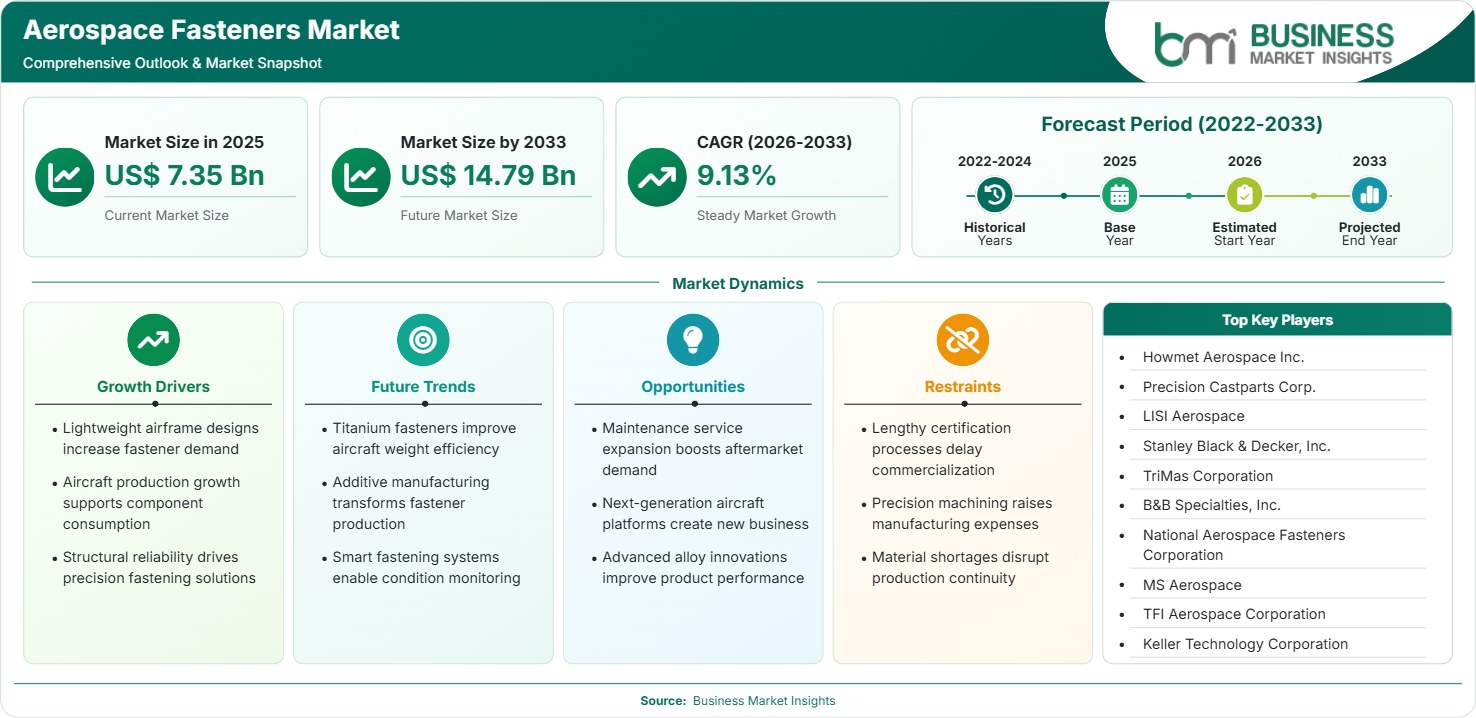
The Aerospace Fasteners Market size was valued at US$ 7.35 billion in 2025 and is projected to reach US$ 14.79 billion by 2033, growing at a CAGR of 9.13% during 2026–2033. Rising aircraft production, increasing lightweight airframe adoption, and growing aftermarket maintenance requirements are driving demand for advanced fastening solutions across commercial and defense aviation sectors.

Report Coverage
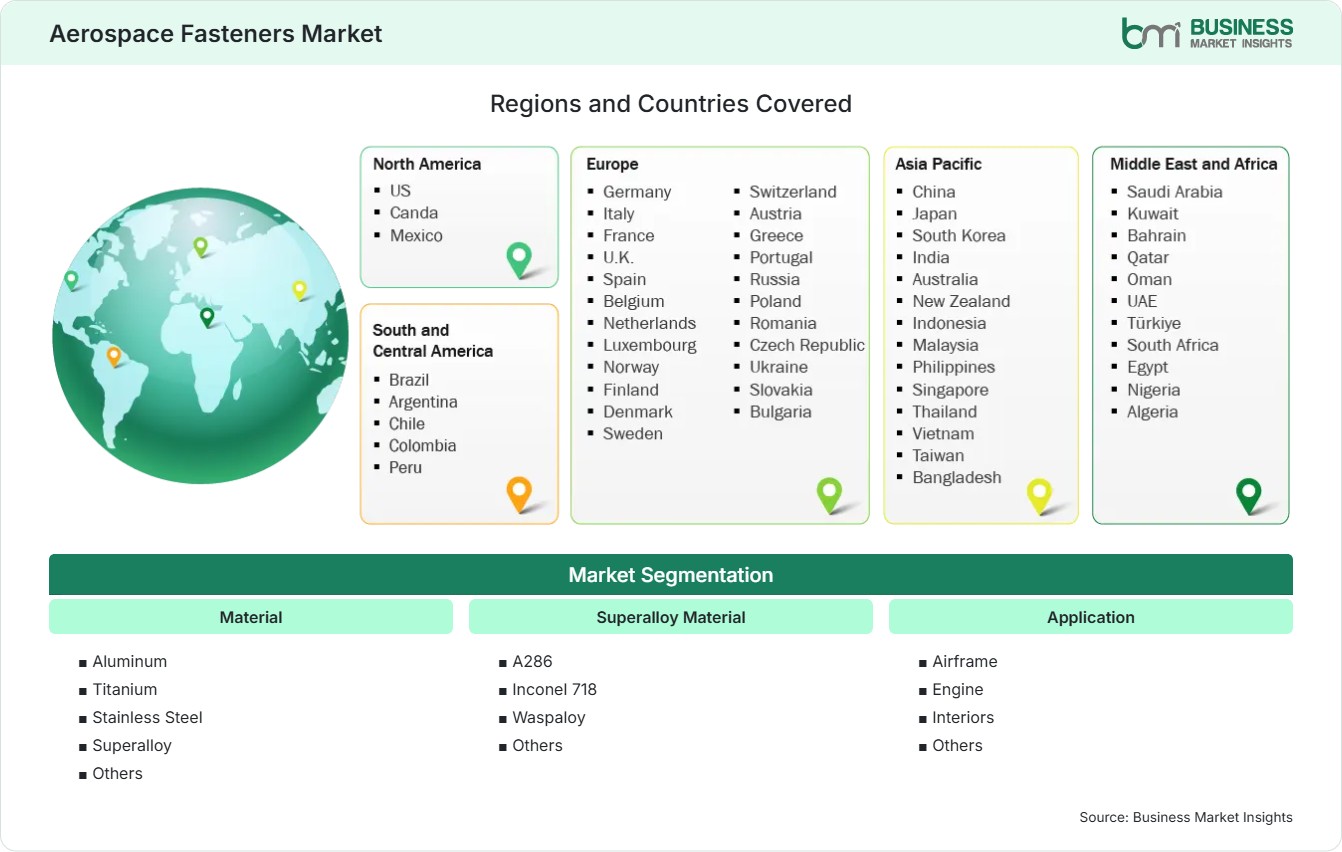
  • Material: Aluminum, Titanium, Stainless Steel, Superalloy, Others
  • Superalloy Material: A286, Inconel 718, Waspaloy, Others
  • Application: Airframe, Engine, Interiors, Others
US$ 7.35 Bn Market size in 2025
US$ 14.79 Bn Market Size by 2033
9.13% CAGR, 2026 - 2033
2026-2033 Forecast Period

AI Overview

Aerospace Fasteners Market Summary

  • North America Region: North America holds 36%–39% market share in 2025 and is expected to expand at a CAGR of 8.7%–9.2% during 2026–2033, supported by aircraft manufacturing capabilities, defense aviation programs, and strong MRO infrastructure. The U.S. represents the dominant contributor with a CAGR of 8.8%–9.3%, driven by aerospace production growth, advanced material adoption, and precision component manufacturing.
  • Fastest Growing Region: Asia Pacific accounts for 27%–30% market share in 2025 and is projected to register a CAGR of 10.1%–10.6%, supported by expanding aircraft fleets, commercial aviation investments, regional aircraft production, and increasing maintenance capabilities across emerging economies.
  • Leading Segment: Titanium fasteners represent 28%–31% market share in 2025 and are expected to grow at a CAGR of 9.4%–9.9%, driven by lightweight requirements, corrosion resistance, high strength-to-weight ratio, and increasing usage in modern aircraft structures.
  • High Growth Segment: Engine applications account for 32%–35% market share in 2025 and are projected to expand at a CAGR of 10.0%–10.5%, supported by rising aircraft engine production, advanced alloy adoption, and demand for high-temperature fastening solutions.
  • Key Market Opportunity: Increasing aircraft deliveries, expanding aftermarket services, and adoption of advanced alloys create opportunities for manufacturers developing lightweight, durable, and high-performance aerospace fastening technologies.
  • Major Market Players: Howmet Aerospace Inc., Precision Castparts Corp., LISI Aerospace, Stanley Black & Decker, Inc., TriMas Corporation, B&B Specialties, Inc., National Aerospace Fasteners Corporation, MS Aerospace, TFI Aerospace Corporation, and Keller Technology Corporation.
Strategic Insights

Aerospace Fasteners Market: Strategic Insights

Aerospace Fasteners Market Strategic Framework
FREE PDF
Request your free sample
Request free sample
Stakeholder View

Key Takeaways

  • Aerospace fasteners remain a critical component category within aircraft manufacturing, with suppliers focusing on material innovation, certification compliance, and precision production capabilities.
  • Commercial aircraft expansion and fleet modernization programs are creating significant opportunities for fastener manufacturers supplying airframe, engine, and interior applications.
  • Advanced titanium alloys, superalloys, and corrosion-resistant materials are becoming increasingly important as aircraft manufacturers prioritize weight reduction and durability.
  • Asia Pacific provides strong investment potential due to rising aircraft deliveries, expanding aviation infrastructure, and growing regional aerospace manufacturing capabilities.
  • Strategic partnerships, acquisitions, and technology investments are increasing as aerospace suppliers seek advanced manufacturing expertise and broader global market access.
  • Aftermarket maintenance demand is becoming an important revenue stream as airlines extend aircraft operational lifecycles and require replacement fastening components.
Geographic Outlook

Aerospace Fasteners Market Regional Highlights

North America Aerospace Fasteners Market

North America represents 36%–39% Aerospace Fasteners Market share in 2025 and is projected to grow at a CAGR of 8.7%–9.2% during 2026–2033. The region benefits from established aircraft manufacturing ecosystems, defense aviation programs, and advanced aerospace supply chains. The United States remains the largest regional contributor due to major aircraft producers, engine manufacturers, and extensive maintenance networks supporting continuous demand for precision fastening components.

  • Aerospace manufacturers continue increasing adoption of lightweight titanium and superalloy fasteners for advanced aircraft programs.
  • Defense modernization initiatives support demand for high-performance fastening systems in military aircraft applications.
  • Strong MRO infrastructure creates recurring aftermarket demand for replacement aerospace components.
  • Advanced manufacturing technologies improve production accuracy and reduce component development timelines.

US Aerospace Fasteners Market

The United States contributes 84%–87% of North American demand and is expected to expand at a CAGR of 8.8%–9.3% during 2026–2033. Strong aerospace manufacturing capabilities, defense investments, and commercial aircraft production continue supporting market development. The country remains a key hub for aerospace fastener innovation and supplier collaboration.

  • Aircraft production programs continue increasing demand for certified fastening solutions.
  • Aerospace suppliers are investing in automation and precision machining capabilities.
  • Defense aircraft modernization supports consumption of advanced alloy fasteners.
  • Long-term airline maintenance requirements strengthen aftermarket opportunities.

Europe Aerospace Fasteners Market

Europe holds 24%–27% market share in 2025 and is expected to register a CAGR of 8.3%–8.8% through 2033. The region benefits from strong aircraft manufacturing capabilities, commercial aviation demand, and established aerospace component suppliers. France, Germany, and the United Kingdom remain leading markets, while Spain and Italy continue expanding aerospace manufacturing activities through industrial partnerships and supply chain development.

  • European aircraft programs continue supporting demand for precision-engineered fastening components.
  • Sustainability initiatives encourage lightweight material adoption in aircraft structures.
  • Aerospace manufacturers are increasing investments in advanced production technologies.
  • MRO expansion across Europe strengthens replacement fastener demand.

Asia Pacific Aerospace Fasteners Market

Asia Pacific accounts for 27%–30% market share in 2025 and is projected to achieve the fastest 10.1%–10.6% CAGR during 2026–2033. Growing commercial aircraft fleets, expanding aviation infrastructure, and increasing aerospace manufacturing investments are driving regional demand. China, India, and Japan are key markets, with India showing strong growth due to aerospace manufacturing expansion and domestic aviation development.

  • Increasing aircraft deliveries are creating demand for structural and engine fastening systems.
  • Regional governments are supporting aerospace manufacturing localization initiatives.
  • Expanding MRO facilities improve aftermarket component availability.
  • Rising passenger traffic encourages fleet expansion and aircraft procurement.

Rest of World Aerospace Fasteners Market

The Rest of World region accounts for 7%–10% market share in 2025 and is expected to grow at a CAGR of 9.0%–9.5% during 2026–2033. Latin America, Middle East, and Africa are witnessing increasing aviation investments, fleet modernization programs, and airport development activities. Growing airline networks and defense aviation requirements continue supporting demand for aerospace fastening solutions.

  • Middle Eastern airlines continue expanding fleets through new aircraft procurement programs.
  • Latin American aviation growth supports commercial aircraft maintenance requirements.
  • African aviation infrastructure investments create long-term aerospace supply opportunities.
  • Regional aerospace partnerships improve access to advanced component technologies.
Global Market Geography
FREE PDF
Request your free sample
Request free sample
Segment Analysis

Aerospace Fasteners Market Segmentation

Material

The material segment plays a critical role in determining aerospace fastener performance, weight efficiency, durability, and resistance against extreme operating conditions. This segment accounted for 28%–31% market share in 2025 and is expected to register a CAGR of 9.4%–9.9% during 2026–2033. Increasing aircraft lightweighting initiatives, composite airframe adoption, and demand for corrosion-resistant fastening systems are shaping material selection strategies. Manufacturers are focusing on advanced alloys and precision processing technologies to meet strict aerospace requirements while improving aircraft efficiency and operational reliability.

  • Aluminum: Aluminum fasteners are widely used in aircraft structures due to their lightweight characteristics, corrosion resistance, and compatibility with aluminum-based airframe components requiring efficient weight management.
  • Titanium: Titanium fasteners experience strong adoption because of their high strength-to-weight ratio, excellent corrosion resistance, and suitability for advanced aircraft structures exposed to demanding operating conditions.
  • Stainless Steel: Stainless steel fasteners remain important for applications requiring durability, temperature resistance, and reliable mechanical performance in aircraft interiors, structures, and specialized components.
  • Superalloy: Superalloy fasteners are increasingly utilized in high-temperature applications, particularly aircraft engines, because of their exceptional strength retention, fatigue resistance, and performance under extreme conditions.

By Superalloy Material

The superalloy material segment is gaining importance as aircraft manufacturers require fasteners capable of operating under higher temperatures, mechanical stress, and challenging environmental conditions. The segment represented 32%–35% market share in 2025 and is projected to achieve a CAGR of 10.0%–10.5% during 2026–2033. Increasing engine efficiency targets and next-generation aircraft development are encouraging adoption of advanced superalloy fastening solutions across aerospace applications.

  • A286: A286 superalloy fasteners are preferred for their high tensile strength, corrosion resistance, and ability to maintain mechanical properties in elevated temperature aerospace environments.
  • Inconel 718: Inconel 718 fasteners are widely adopted in engine applications due to excellent fatigue resistance, thermal stability, and performance under extreme aerospace operating conditions.
  • Waspaloy: Waspaloy fasteners support high-temperature engine applications where superior creep resistance, strength retention, and durability are required for critical aircraft components.

By Superalloy Material Application

Application-based demand is influenced by aircraft design requirements, operational conditions, and the need for reliable fastening performance across different aircraft systems. The segment accounted for 32%–35% market share in 2025 and is expected to grow at a CAGR of 10.0%–10.5% during 2026–2033. Rising aircraft production, engine technology advancements, and increasing maintenance activities continue supporting demand across airframe, engine, and interior applications.

  • Airframe: Airframe applications represent a major demand area as manufacturers require lightweight, high-strength fasteners for aircraft structures, wings, fuselage assemblies, and composite components.
  • Engine: Engine applications are experiencing rapid growth due to rising demand for high-temperature fasteners capable of maintaining performance under extreme pressure, vibration, and thermal conditions.
  • Interiors: Interior applications utilize specialized fasteners designed for lightweight construction, passenger safety, cabin durability, and efficient installation within modern aircraft interiors.
Market Forces

Aerospace Fasteners Market Dynamics

Key Market Drivers

Lightweight airframe designs increase fastener demand

Aircraft manufacturers are increasingly focusing on designing lightweight airframes to boost fuel economy and performance and reduce emissions. The need for fasteners with high tensile strength while adding very little weight is especially pronounced when using composite materials and aluminum alloys in airframe manufacture. Fasteners made from titanium and alloys are becoming common in both commercial and military aircrafts. These developments are accelerating Aerospace Fasteners Market growth as suppliers focus on producing lightweight, high-performance components that meet evolving aircraft design requirements. Rising demand for fuel-efficient aircraft and next-generation platforms continues creating opportunities for manufacturers with advanced material expertise.

Aircraft production growth supports component consumption

The growth in the production of aircraft within the commercial aviation, military aviation, and regional aviation industries is directly fueling the demand for aerospace parts, which includes fasteners. The aircraft companies have been increasing their production capacity to cater to the increased need for passengers, replacements, and military modernization programs. An aircraft uses thousands of fastening parts in its construction. Aerospace companies are upgrading their manufacturing and logistics capacity to meet the increased demand. The increased manufacturing of aircraft continues to build demand for aerospace fasteners.

Structural reliability drives precision fastening solutions

Aviation safety standards demand fastening systems that can withstand extreme conditions, such as vibration and temperature changes, and that retain their integrity even under such conditions. Fastening systems have to meet high standards of accuracy and material quality because aerospace companies rely on high-quality fastening systems to ensure the reliability of aircraft. These requirements are shaping Aerospace Fasteners Market trends as suppliers develop customized fastening solutions for complex aircraft structures, engines, and critical components. The growing emphasis on operational safety continues increasing demand for reliable and certified aerospace hardware.

Key Market Opportunities

Maintenance service expansion boosts aftermarket demand

Expanding aircraft maintenance, repair, and overhaul services are creating new opportunities for fastener producers in the aerospace industry. Airline companies have been trying to extend the lifespan of their aircrafts in order to maximize investments, thus the need for fasteners for repairs has increased. Additionally, new aviation markets are developing local maintenance, repair, and overhaul facilities to maintain their aircraft fleets. Aerospace Fasteners Market Forecasts indicate that increasing aircraft maintenance requirements and fleet modernization programs will continue supporting revenue opportunities for suppliers focused on aftermarket aviation applications.

Next-generation aircraft platforms create new business

Development of next-generation aircraft platforms is opening new business opportunities for companies producing advanced fastening technologies. Contemporary aircraft use lightweight structures, composites, and propulsion systems that require fasteners with enhanced mechanical properties. Modern aerospace manufacturers are now working more often together with fastener providers while designing aircrafts. Firms that can provide certified fastening solutions are likely to take advantage of future aircraft programs. Greater interest in developing new commercial aircrafts and military aircraft is anticipated to lead to higher demand for the fastening systems in aerospace industry.

Advanced alloy innovations improve product performance

Innovation in titanium alloys, nickel-based superalloys, and other high-performance materials is creating opportunities for aerospace fastener manufacturers to improve product capabilities. Advanced alloys provide superior strength, corrosion resistance, fatigue performance, and thermal stability compared with conventional materials. These properties are especially valuable in engine and structural applications where fasteners operate under demanding conditions. Manufacturers are investing in research, material processing, and precision production methods to develop next-generation fastening solutions. Expanding adoption of advanced materials across aircraft programs is expected to create additional growth opportunities for companies specializing in engineered aerospace components.

Market Restraints and Challenges

Lengthy certification processes delay commercialization

Aerospace fasteners must comply with strict aviation regulations and undergo extensive testing before being approved for aircraft use. Factor: Certification procedures require detailed material validation, performance testing, documentation, and regulatory approvals, increasing development timelines for new fastening products. Impact: Extended certification cycles can delay commercialization, increase development expenses, and restrict market entry for smaller manufacturers with limited resources. Companies must maintain strong quality management systems and invest continuously in compliance capabilities to successfully introduce new aerospace fastening solutions.

Precision machining raises manufacturing expenses

Aerospace fasteners require highly accurate machining processes, specialized equipment, and advanced quality inspection systems to meet aviation performance standards. Factor: The use of premium materials, complex manufacturing techniques, and strict tolerance requirements increases production complexity and operational costs. Impact: Higher manufacturing expenses can reduce profit margins and increase component pricing for aircraft manufacturers and suppliers. Companies are adopting automation, digital manufacturing tools, and process optimization strategies to control costs while maintaining the precision and reliability required for aerospace applications.

Company Analysis

Competitive Landscape

The competitive environment is shaped by advanced material development, precision manufacturing capabilities, certification expertise, and strategic partnerships with aircraft manufacturers. Aerospace Fasteners Market analysis indicates that leading companies are focusing on lightweight alloy solutions, production automation, aftermarket support, and specialized fastening technologies to meet increasing requirements from commercial aviation, defense programs, and aircraft maintenance providers.

Company Name

Overview

Products and Services Relevant to this Market

Howmet Aerospace Inc.

Global aerospace components manufacturer specializing in lightweight engineered solutions and advanced fastening technologies.

Aerospace fasteners, titanium fasteners, nickel-based alloy fasteners, structural components, and precision-engineered fastening systems.

Precision Castparts Corp.

Aerospace manufacturing company producing complex metal components and solutions for aircraft and industrial applications.

Aerospace fasteners, forged components, superalloy products, precision components, and aircraft structural solutions.

LISI Aerospace

Aerospace supplier focused on high-performance fastening systems and structural assembly solutions for aircraft manufacturers.

Titanium fasteners, structural fasteners, engine fasteners, assembly systems, and aerospace hardware solutions.

Stanley Black & Decker, Inc.

Industrial manufacturer offering engineered fastening products and specialized solutions for aerospace applications.

Aerospace fastening systems, precision hardware, engineered components, and industrial fastening technologies.

TriMas Corporation

Diversified manufacturer supplying aerospace components through specialized engineering and manufacturing operations.

Aerospace fasteners, blind bolts, structural fastening systems, and specialty aerospace hardware.

B&B Specialties, Inc.

Aerospace fastener manufacturer providing precision-engineered components for demanding aviation applications.

Custom aerospace fasteners, specialty bolts, screws, threaded components, and precision hardware solutions.

National Aerospace Fasteners Corporation

Supplier specializing in aerospace-grade fasteners and hardware for commercial and defense aviation markets.

Aircraft fasteners, bolts, nuts, screws, precision hardware, and certified aerospace fastening products.

MS Aerospace

Aerospace fastener manufacturer producing high-strength fastening solutions for aircraft applications.

Titanium fasteners, specialty bolts, precision-machined components, and engineered aerospace hardware.

TFI Aerospace Corporation

Aerospace supplier providing complex fastening and structural component solutions for aircraft manufacturers.

Aerospace fasteners, structural hardware, machining services, and engineered aircraft components.

Keller Technology Corporation

Manufacturer offering precision fabrication and engineered solutions for aerospace and industrial applications.

Custom fasteners, precision components, fabrication services, and specialized aerospace manufacturing solutions.

Trust & Transparency

Research Methodology

The market analysis combines proprietary research with secondary data from government agencies, company disclosures, regulatory filings, industry databases and expert interviews. Market estimates are validated through data triangulation, cross-market benchmarking and analyst review.

View Full Research Methodology

Questions Answered

Frequently Asked Questions

What does the Aerospace Fasteners Market Report cover?

The Market Report covers market size, segmentation, regional analysis, competitive developments, technology trends, investment opportunities, and strategic insights for industry participants.

Which region offers strong growth opportunities for aerospace fasteners?

Asia Pacific provides significant opportunities due to expanding aircraft fleets, increasing aviation infrastructure investment, growing MRO capabilities, and rising aerospace manufacturing activities.

Why are superalloy fasteners important for aircraft engines?

Superalloy fasteners maintain mechanical strength under extreme temperatures, pressure, and vibration conditions, making them essential for advanced aircraft engine applications requiring long-term reliability.

Which material type is widely used in aerospace fasteners?

Titanium is widely used because of its high strength-to-weight ratio, corrosion resistance, durability, and suitability for modern aircraft structures requiring lightweight performance.

What factors are driving the Aerospace Fasteners Market?

The market is driven by increasing aircraft production, lightweight airframe adoption, growing MRO activities, rising demand for advanced alloys, and strict requirements for reliable aircraft fastening systems.

Access the Full Aerospace Fasteners Market Report

Get segment-level forecasts, regional estimates, competitive benchmarking, company profiles and downloadable Excel datasets.

Access the full Aerospace Fasteners Market Report
350 pages PDF & Excel | 2026-08-25