
Airport Ground and Cargo Handling Services Market Outlook: Size, Share, Trends, Growth Analysis, Competitive Landscape & Forecast, 2026-2033

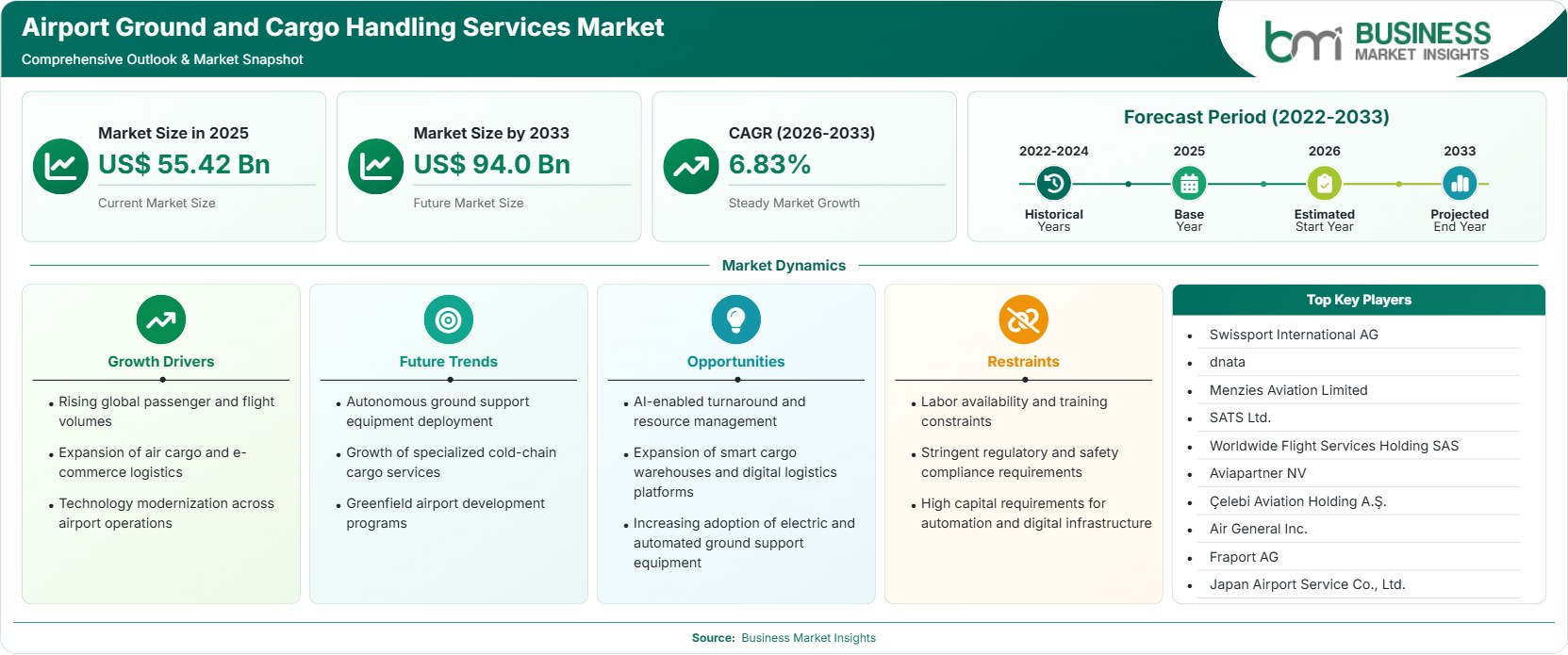
The Airport Ground and Cargo Handling Services Market size was valued at US$ 55.42 billion in 2025 and is projected to reach US$ 94.0 billion by 2033, growing at a CAGR of 6.83% during 2026–2033. Key drivers include rising passenger traffic, e-commerce air freight demand, airport privatization, digital ramp operations, automation adoption, sustainability investments, and expanding international airport infrastructure creating long-term service outsourcing opportunities.

Report Coverage
  • Services: Passenger Handling, Baggage Handling, Cargo and Mail Handling, Aircraft Handling, Ramp Handling
  • Airport Type: Domestic, International
  • Infrastructure Type: Greenfield Airport, Brownfield Airport
US$ 55.42 Bn Market size in 2025
US$ 94.0 Bn Market Size by 2033
6.83% CAGR, 2026 - 2033
2026-2033 Forecast Period

AI Overview

Airport Ground and Cargo Handling Services Market Summary

  • North America Region: Holds a market share of 34%–37% in 2025, growing at a CAGR of 5.8%–6.4% during 2026–2033. Growth is supported by airline outsourcing, cargo modernization, digital ramp systems, airport expansion programs, strong freight volumes, sustainability investments, advanced service standards, and integrated operational technologies. The U.S. accounts for 78%–82% of regional revenue and is projected to expand at 5.9%–6.5% CAGR through 2033.
  • Fastest Growing Region: Asia Pacific holds 26%–29% share in 2025 and advances at 8.0%–8.8% CAGR. Expansion is driven by aviation infrastructure investment, cross-border e-commerce, new airport development, low-cost carriers, rising passenger mobility, cargo hub growth, automation deployment, and increasing airline service contracts.
  • Leading Segment: Cargo and Mail Handling represents 24%–28% share in 2025 and grows at 7.0%–7.6% CAGR. Demand benefits from e-commerce shipments, pharmaceutical logistics, time-sensitive freight requirements, digital cargo tracking, expanded cold-chain facilities, integrated warehousing capabilities, and growing international trade connectivity.
  • High Growth Segment: International Airports hold 57%–61% share in 2025 and expand at 7.4%–8.0% CAGR. Strong growth stems from long-haul passenger recovery, premium cargo demand, airport upgrades, airline route additions, cross-border traffic growth, customs modernization, and increasing outsourcing of ground operations.
  • Key Market Opportunity: AI-enabled turnaround management, autonomous ground support equipment, smart cargo warehouses, predictive maintenance systems, and digital service orchestration platforms offer operators opportunities to improve margins, capacity utilization, service reliability, and sustainability performance.
  • Major Market Players: Swissport International AG, dnata, Menzies Aviation Limited, SATS Ltd., Worldwide Flight Services Holding SAS, Aviapartner NV, Çelebi Aviation Holding A.Ş., Air General Inc., Fraport AG, Japan Airport Service Co., Ltd.
Strategic Insights

Airport Ground and Cargo Handling Services Market: Strategic Insights

Airport Ground and Cargo Handling Services Market Strategic Framework
FREE PDF
Request your free sample
Request free sample
Stakeholder View

Key Takeaways

  • The value chain is becoming increasingly outsourced, with independent handling specialists managing passenger, ramp, baggage, and cargo functions on behalf of airlines seeking operational flexibility.
  • International airport operations and cargo-centric services present the strongest medium-term upside due to rising freight demand, pharmaceutical logistics, and cross-border e-commerce flows.
  • Automation technologies including AI scheduling, digital twin operations, autonomous vehicles, and smart baggage systems are reshaping competitive differentiation.
  • Asia Pacific offers the most compelling investment case, supported by airport capacity additions, airline fleet growth, and expanding regional trade corridors.
  • Strategic acquisitions and network expansion agreements continue to strengthen market concentration among major global handlers seeking scale advantages.
  • Sustainability-linked investments in electric GSE fleets, renewable energy integration, and emissions reporting are becoming critical procurement criteria.
Geographic Outlook

Airport Ground and Cargo Handling Services Market Regional Highlights

North America Airport Ground and Cargo Handling Services Market

North America accounted for approximately 34%–37% Airport Ground and Cargo Handling Services Market share in 2025 and is expected to register a 5.8%–6.4% CAGR through 2033. Strong airline outsourcing activity, high air cargo throughput, and extensive airport modernization programs support regional demand. Large hub airports continue investing in digital turnaround management and baggage automation. Market maturity is balanced by replacement demand for advanced equipment and sustainability-driven upgrades, strengthening operational productivity across major aviation gateways.

  • U.S. and Canadian airports continue expanding automated baggage management and biometric passenger processing capabilities.
  • Cargo hubs increasingly deploy warehouse robotics, real-time shipment visibility tools, and digital documentation systems.
  • Electric ground support equipment adoption is accelerating through airport decarbonization initiatives.
  • Major airlines favor multi-airport service partnerships, improving contract opportunities for specialized providers.

US Airport Ground and Cargo Handling Services Market

The United States represented 78%–82% of North American Airport Ground and Cargo Handling Services Market revenue in 2025 and is forecast to grow at 5.9%–6.5% CAGR. Large airport infrastructure programs, strong domestic travel activity, and expanding cargo operations support sustained service demand. Airport authorities are focusing on operational efficiency, workforce productivity, and advanced logistics capabilities. Growing collaboration between airlines and independent handlers continues reshaping service delivery models while supporting capacity optimization and cost management initiatives.

  • Major cargo airports continue expanding temperature-controlled and e-commerce handling infrastructure.
  • Labor optimization technologies are improving ramp productivity and aircraft turnaround times.
  • Airport concession modernization increasingly includes integrated service management platforms.
  • Strong domestic aviation activity supports consistent passenger handling demand.

Europe Airport Ground and Cargo Handling Services Market

Europe held 27%–30% Airport Ground and Cargo Handling Services Market share in 2025 and is projected to record 6.0%–6.8% CAGR through 2033. Liberalized airport service frameworks and a high concentration of international aviation hubs support market expansion. Germany remains the leading national market, while Eastern European countries demonstrate faster growth at 7%–8% CAGR. Sustainability mandates, airport digitization strategies, and increasing cargo specialization reinforce demand for technologically advanced service providers across regional aviation networks.

  • European operators increasingly invest in electric ramp vehicles and sustainable airport operations.
  • Pharmaceutical and perishables handling demand supports specialized cargo facility development.
  • Germany leads revenue generation, while Poland and Romania display accelerated expansion.
  • Aviation data integration platforms are improving asset utilization and operational planning.
  • Outsourcing penetration remains high among regional and international carriers.

Asia Pacific Airport Ground and Cargo Handling Services Market

Asia Pacific generated 26%–29% share in 2025 and remains the fastest-growing region with an 8.0%–8.8% CAGR. Massive airport capacity additions, growing tourism, rising middle-class travel, and expanding air cargo activity are shaping industry momentum. China maintains regional leadership, while India records among the highest growth rates at 9%–10% CAGR. Continued investment in greenfield airports and integrated logistics infrastructure creates substantial long-term opportunities for service operators.

  • Airport Ground and Cargo Handling Services Market growth is strongly linked to cargo expansion and tourism recovery.
  • China leads regional revenues through extensive airport and logistics investments.
  • India benefits from airport privatization, fleet growth, and new terminal developments.
  • Southeast Asian hubs increasingly support e-commerce transshipment volumes.
  • Automation adoption is improving efficiency in cargo and passenger service operations.

Rest of World Airport Ground and Cargo Handling Services Market

Rest of World represented 9%–12% share in 2025 and is expected to expand at 6.5%–7.3% CAGR through 2033. The Middle East benefits from global transit traffic and large-scale airport investments, while South and Central America gain support from aviation connectivity improvements. Major hub development, tourism-led passenger growth, and freight corridor expansion continue strengthening demand across both regions.

  • UAE and Saudi Arabia remain leading Middle Eastern aviation service markets.
  • Brazil leads South and Central America, while Colombia shows faster growth potential.
  • Investment in cargo villages is boosting regional logistics competitiveness.
  • International airline network expansion supports handling service outsourcing demand.
  • Smart airport infrastructure projects are improving operational standards.
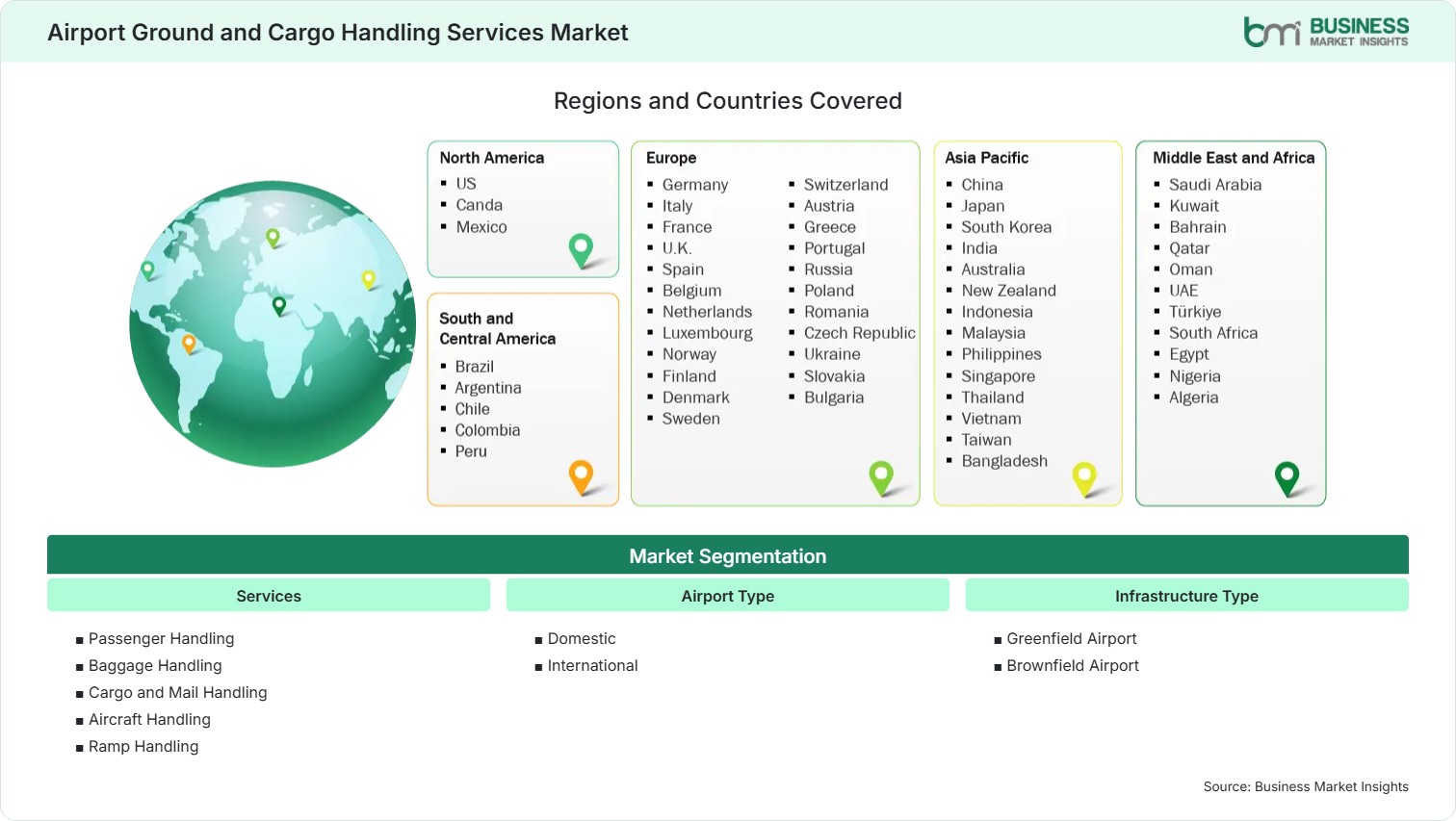
Global Market Geography
FREE PDF
Request your free sample
Request free sample
Segment Analysis

Airport Ground and Cargo Handling Services Market Segmentation

Services

Services accounted for the complete market structure, with Cargo and Mail Handling representing the leading operational category at 24%–28% share in 2025 and expanding at 7.0%–7.6% CAGR. The Airport Ground and Cargo Handling Services Market scope continues widening as airports integrate automation, digital tracking, and performance-based contracts to improve efficiency across passenger and cargo service environments.

  • Passenger Handling: Rising traveler volumes, biometric processing, self-service technologies, and premium airport experiences continue increasing service sophistication and operational importance across major aviation hubs.
  • Baggage Handling: Automated sorting systems, RFID tracking, and intelligent routing solutions improve efficiency while reducing losses, delays, and operational complexity.
  • Cargo and Mail Handling: E-commerce growth, cold-chain logistics, and cross-border trade strengthen demand for specialized warehousing, documentation, and cargo movement capabilities.
  • Aircraft Handling: Pushback, towing, technical support, and turnaround requirements remain essential for airline operational performance and schedule reliability.
  • Ramp Handling: Fleet expansion and rising aircraft movements encourage broader deployment of digital ramp scheduling and resource optimization systems.

Airport Type

International Airports led with 57%–61% share in 2025 and are forecast to grow at 7.4%–8.0% CAGR. Airport Ground and Cargo Handling Services Market trends indicate a continuing shift toward integrated service platforms supporting long-haul passenger traffic, premium freight handling, and complex operational coordination across global aviation networks.

  • Domestic: Consistent passenger movement, regional airline activity, and point-to-point connectivity sustain handling demand across domestic airport ecosystems.
  • International: Cross-border traffic, customs processing requirements, and premium logistics workflows support higher-value service opportunities and operational complexity.

Infrastructure Type

Brownfield Airport projects maintain the larger installed base, accounting for 63%–67% share in 2025, while Greenfield Airport developments demonstrate stronger expansion potential at 7.8%–8.4% CAGR due to capacity additions and modernization initiatives.

  • Greenfield Airport: New airport construction enables deployment of digital-first operating models, advanced automation technologies, and scalable cargo infrastructure from inception.
  • Brownfield Airport: Upgrades focused on capacity expansion, process optimization, and sustainability improvements continue creating substantial service contracting opportunities.
Market Forces

Airport Ground and Cargo Handling Services Market Dynamics

Key Market Drivers

Rising Global Passenger and Flight Volumes

Global air travel expansion continues increasing demand for passenger, baggage, ramp, and aircraft services. Airlines require efficient turnaround times to maximize fleet utilization while airports seek operational consistency during peak traffic periods. International aviation organizations report continued growth in passenger demand across major travel corridors, creating sustained requirements for outsourced handling support. Increased airport congestion, larger aircraft fleets, and broader route networks elevate the importance of coordinated service delivery. As service complexity rises, operators increasingly deploy digital monitoring and workforce optimization systems. These factors collectively strengthen long-term service demand throughout commercial aviation ecosystems.

Expansion of Air Cargo and E-commerce Logistics

Air freight remains essential for high-value, time-sensitive, and pharmaceutical shipments. Rapid e-commerce adoption is increasing shipment frequency while placing greater emphasis on cargo visibility, handling speed, and warehouse productivity. Airports are expanding cargo villages and temperature-controlled facilities to accommodate higher throughput volumes. Integration of automated storage systems, digital documentation platforms, and predictive logistics solutions supports efficiency gains. Cargo specialization allows operators to command premium service contracts and diversify revenue streams. Growing international trade flows further reinforce demand for value-added cargo management capabilities across major aviation markets.

Technology Modernization Across Airport Operations

Digital transformation is reshaping operational workflows through AI scheduling, automated baggage handling, IoT-enabled equipment monitoring, and autonomous ground support systems. Airports with personnel issues are increasingly turning to technology solutions that help them allocate resources better and cut down on delays. Operational intelligence, using data, helps optimize aircraft turnaround and provides visibility into services. The need for sustainability drives the use of electric and energy-efficient systems. Technology-enabled productivity gains help the operators keep costs from rising in tandem with increased traffic.

Key Market Opportunities

Autonomous Ground Support Equipment Deployment

Autonomous and semi-autonomous vehicles for ground support provide an important productivity avenue. Airports can manage turnaround variability, improve safety performance, and address labor shortages through intelligent automation. Autonomous baggage tractors, automated cargo handling, and intelligent ramp management have grown across the globe. Airport Ground and Cargo Handling Services Market Forecasts increasingly reflect demand for scalable automation architectures capable of supporting future traffic growth. Providers with strong integration capabilities can gain competitive advantages through higher service consistency, reduced operational costs, and improved asset utilization.

Growth of Specialized Cold-Chain Cargo Services

The expansion of pharmaceutical logistics, biotechnology products, and perishables distribution supports investment in temperature-controlled handling facilities. High certification standards provide high entry barriers and high-priced services. Cargo companies are beginning to design sophisticated cold chain systems, monitoring tools, and compliance systems. With the internationalization of healthcare supply chains, there is a growing demand for reliable cold chain infrastructure at airports. Businesses located in major cargo hubs will be able to extract more value from the regulated freight categories.

Greenfield Airport Development Programs

Large-scale airport construction projects across Asia, the Middle East, and Africa create opportunities to establish long-term operational contracts from project inception. New airports make use of digitally native infrastructure and platforms of services. Ground handling companies can be involved in the planning, provisioning of the equipment, designing of the workforce, and management of the operations. Greenfield sites enable the implementation of advanced technology without restrictions from existing systems and ensure better efficiency and profitability.

Market Restraints and Challenges

Labor Availability and Training Constraints

Factor: Ground handling operations depend on skilled personnel across safety-critical functions, including ramp services, baggage processing, and cargo operations. Impact: Labor shortages lead to higher recruiting costs, reduced flexibility, and service interruptions during periods of high demand. The additional cost is created by the need for intensive training, certifications, and labor turnover. Airports that have experienced fast-growing demand for their services have even more problems with keeping up the quality of service and expanding capacity.

Stringent Regulatory and Safety Compliance Requirements

Factor: Aviation authorities impose rigorous operational, security, customs, and environmental compliance standards. Impact: Compliance requirements entail higher capital outlays, increased administrative difficulties, and high costs of operation. Non-compliance with either safety or service standards attracts sanctions, contract cancellations, and reputational damage. Differences in regulations across regions pose challenges for operators of multinational firms operating at multiple airports. Continuous training, documentation, system technology, and certification processes are key. Compliance requirements may restrict small service companies while giving a competitive edge to large players in the industry.

Company Analysis

Competitive Landscape

Airport Ground and Cargo Handling Services Market analysis indicates a competitive environment characterized by network scale, cargo specialization, technology adoption, and long-term airline partnerships.

Company Name

Overview

Products and Services relevant to this market

Swissport International AG

Global aviation services provider operating across hundreds of airports with extensive cargo expertise.

Ground handling, air cargo handling, lounge services, ramp operations, passenger assistance.

dnata

Major airport services company with strong international cargo and travel operations footprint.

Cargo handling, ramp services, passenger services, logistics, aircraft support operations.

Menzies Aviation Limited

Large independent aviation services provider serving airlines across global airport networks.

Ground handling, fuel services, cargo management, passenger support, executive aviation.

SATS Ltd.

Leading Asian aviation services organization with extensive ground and cargo capabilities.

Cargo handling, gateway services, passenger processing, aviation support operations.

Worldwide Flight Services Holding SAS

Global cargo-focused handling specialist with extensive airline customer relationships.

Cargo warehousing, ramp services, freight handling, logistics support.

Aviapartner NV

European airport service provider focused on operational efficiency and airline support.

Passenger, baggage, aircraft, and ramp handling services.

Çelebi Aviation Holding A.Ş.

International aviation services operator with presence across multiple emerging markets.

Ground handling, cargo warehousing, warehouse management, passenger services.

Air General Inc.

U.S.-based air cargo services specialist with extensive airport coverage.

Cargo terminal management, warehousing, documentation, logistics support.

Fraport AG

Airport operator with aviation service and infrastructure management capabilities.

Ground operations support, cargo infrastructure, airport services management.

Japan Airport Service Co., Ltd.

Established airport support company serving passenger and airline operational requirements.

Passenger handling, aircraft services, cargo support, airport operational assistance.

Trust & Transparency

Research Methodology

The market analysis combines proprietary research with secondary data from government agencies, company disclosures, regulatory filings, industry databases and expert interviews. Market estimates are validated through data triangulation, cross-market benchmarking and analyst review.

View Full Research Methodology

Questions Answered

Frequently Asked Questions

What does the Airport Ground and Cargo Handling Services Market Report typically evaluate?

The Airport Ground and Cargo Handling Services Market Report evaluates market size, competitive positioning, service trends, regional performance, technology adoption, investment opportunities, regulatory factors, and future growth outlook.

How does infrastructure development affect demand?

Greenfield airports create new service contracts from inception, while brownfield modernization projects generate ongoing opportunities related to automation, cargo expansion, capacity enhancement, and sustainability upgrades.

What technologies are transforming handling operations?

AI scheduling, autonomous ground support equipment, digital twin platforms, IoT-enabled asset tracking, advanced baggage automation, and predictive maintenance solutions are significantly improving airport productivity.

Why are international airports growing faster than domestic airports?

International airports manage higher-value passenger flows, long-haul airline operations, customs-intensive cargo movements, and premium logistics services, creating stronger outsourcing and handling service demand.

Which service segment generates the highest revenue?

Cargo and Mail Handling generates the largest revenue contribution due to growing e-commerce shipments, pharmaceutical logistics requirements, cross-border trade activity, and increasing demand for specialized warehouse infrastructure.

Access the Full Airport Ground and Cargo Handling Services Market Report

Get segment-level forecasts, regional estimates, competitive benchmarking, company profiles and downloadable Excel datasets.

Access the full Airport Ground and Cargo Handling Services Market Report
350 pages PDF & Excel | 2026-08-27