OTA Testing Market Regional Highlights
North America OTA Testing Market
North America held an estimated 34%–38% share in 2025 and is projected to grow at a 8.8%–9.2% CAGR through 2033. The region benefits from strong wireless technology development, extensive 5G deployment, advanced semiconductor ecosystems, and connected vehicle innovation. The U.S. dominates regional demand, supported by major technology companies, telecommunications operators, defense applications, and research into advanced wireless standards.
- The U.S. remains a major testing hub because device manufacturers and wireless technology developers require sophisticated validation capabilities for smartphones, connected vehicles, IoT systems, and infrastructure equipment.
- 5G network expansion is supporting demand for advanced testing solutions capable of assessing beamforming, antenna performance, throughput, and device behavior across complex operating conditions.
- Automotive technology development is creating opportunities for OTA testing as vehicles increasingly depend on cellular, Wi-Fi, Bluetooth, and other wireless connectivity systems.
- Early 6G research is encouraging investment in high-frequency measurement technologies and advanced test environments capable of supporting experimental communications architectures.
US OTA Testing Market
The U.S. represented an estimated 31%–35% share in 2025 and is projected to grow at a 8.9%–9.3% CAGR through 2033. Strong telecommunications investment, advanced device development, connected vehicle innovation, and substantial research activity support demand. Technology companies and test providers are increasingly focused on validating complex antenna systems and wireless performance under realistic operating conditions.
- Smartphone and wireless infrastructure manufacturers require sophisticated OTA validation as devices incorporate multiple radios, advanced antenna arrays, and increasingly complex connectivity configurations.
- Connected vehicle development is creating new testing requirements covering cellular communication, Wi-Fi, Bluetooth, vehicle-to-everything connectivity, and integrated antenna performance.
- Telecommunications research organizations are investing in advanced measurement environments to support 5G optimization and emerging research into future wireless communications technologies.
- Defense and aerospace applications provide additional demand for high-performance testing capabilities where wireless reliability and radiated performance are critical operational requirements.
Europe OTA Testing Market
Europe held an estimated 22%–26% share in 2025 and is projected to grow at a 8.2%–8.6% CAGR through 2033. Germany, the UK, and France are leading OTA Testing Markets supported by automotive engineering, telecommunications research, industrial automation, and connected device development. Germany is projected to grow at a 8.7%–9.1% CAGR, while France benefits from aerospace, telecommunications, and advanced electronics applications.
- Germany benefits from its automotive engineering base, supporting demand for testing solutions that validate increasingly connected vehicles and sophisticated wireless communication systems.
- France offers opportunities through telecommunications, aerospace, defense, and electronics development, where radiated performance testing supports demanding wireless technology requirements.
- The UK has a strong research ecosystem supporting wireless communications innovation, creating demand for specialized test environments and advanced measurement capabilities.
- European industrial automation is increasing demand for reliable wireless connectivity, encouraging manufacturers to validate performance across challenging factory and industrial operating environments.
Asia Pacific OTA Testing Market
Asia Pacific represented an estimated 29%–33% OTA Testing Market share in 2025 and is projected to grow at a 10.2%–10.6% CAGR through 2033. China, South Korea, Japan, and India are leading markets, with India projected to grow at a 11.2%–11.6% CAGR. Electronics manufacturing, smartphone production, 5G deployment, automotive connectivity, and expanding IoT ecosystems are strengthening regional testing requirements.
- China offers significant potential because of its large electronics manufacturing ecosystem, smartphone production, 5G infrastructure investment, and growing development of connected consumer and industrial devices.
- South Korea benefits from advanced telecommunications infrastructure and strong electronics companies, supporting demand for sophisticated testing systems across smartphones, networks, and connected technologies.
- Japan's automotive and electronics industries create demand for OTA validation as manufacturers integrate increasingly sophisticated wireless connectivity into vehicles and consumer products.
- India is developing rapidly as an electronics manufacturing and digital infrastructure hub, creating opportunities for testing providers supporting new device production and wireless network deployment.
Rest of World OTA Testing Market
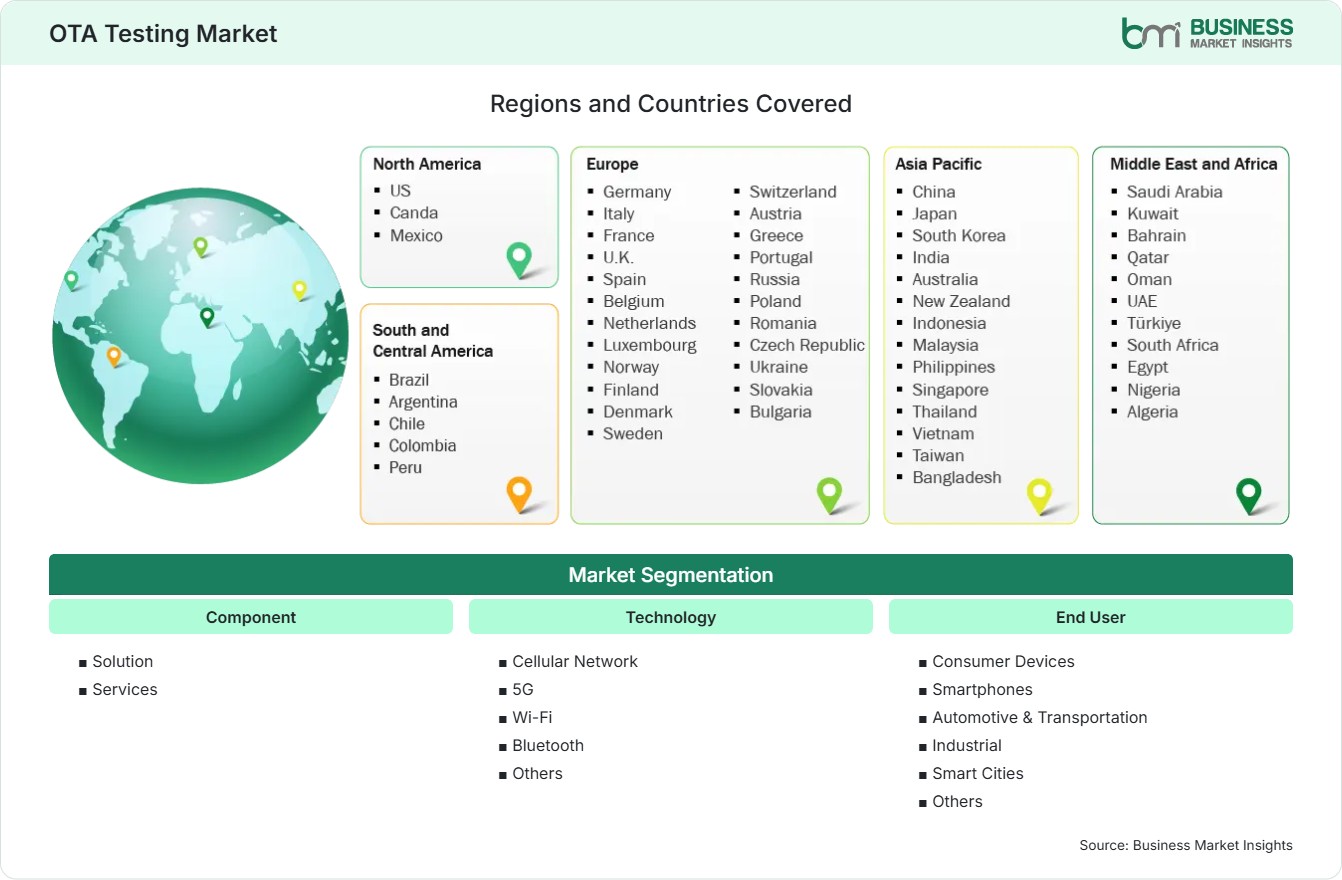
South and Central America accounted for an estimated 5%–7% share in 2025 and are projected to grow at a 8.0%–8.4% CAGR through 2033. Brazil and Mexico lead regional opportunities. The Middle East and Africa represented an estimated 8%–10% share and are projected to grow at a 9.0%–9.4% CAGR, supported by smart city programs and telecommunications modernization.
- Brazil offers opportunities as telecommunications infrastructure expands and connected consumer devices become more widespread, increasing demand for wireless performance validation and certification capabilities.
- Mexico benefits from electronics manufacturing and proximity to North American supply chains, supporting demand for testing services associated with connected devices and automotive electronics.
- The UAE is investing in smart city infrastructure and advanced communications, creating opportunities for OTA testing across connected infrastructure, IoT devices, and next-generation wireless networks.
- Saudi Arabia's digital transformation programs are supporting connected technologies and telecommunications modernization, creating longer-term demand for wireless device validation and performance testing capabilities.