Market Summary
Executive Summary and Global Market Analysis
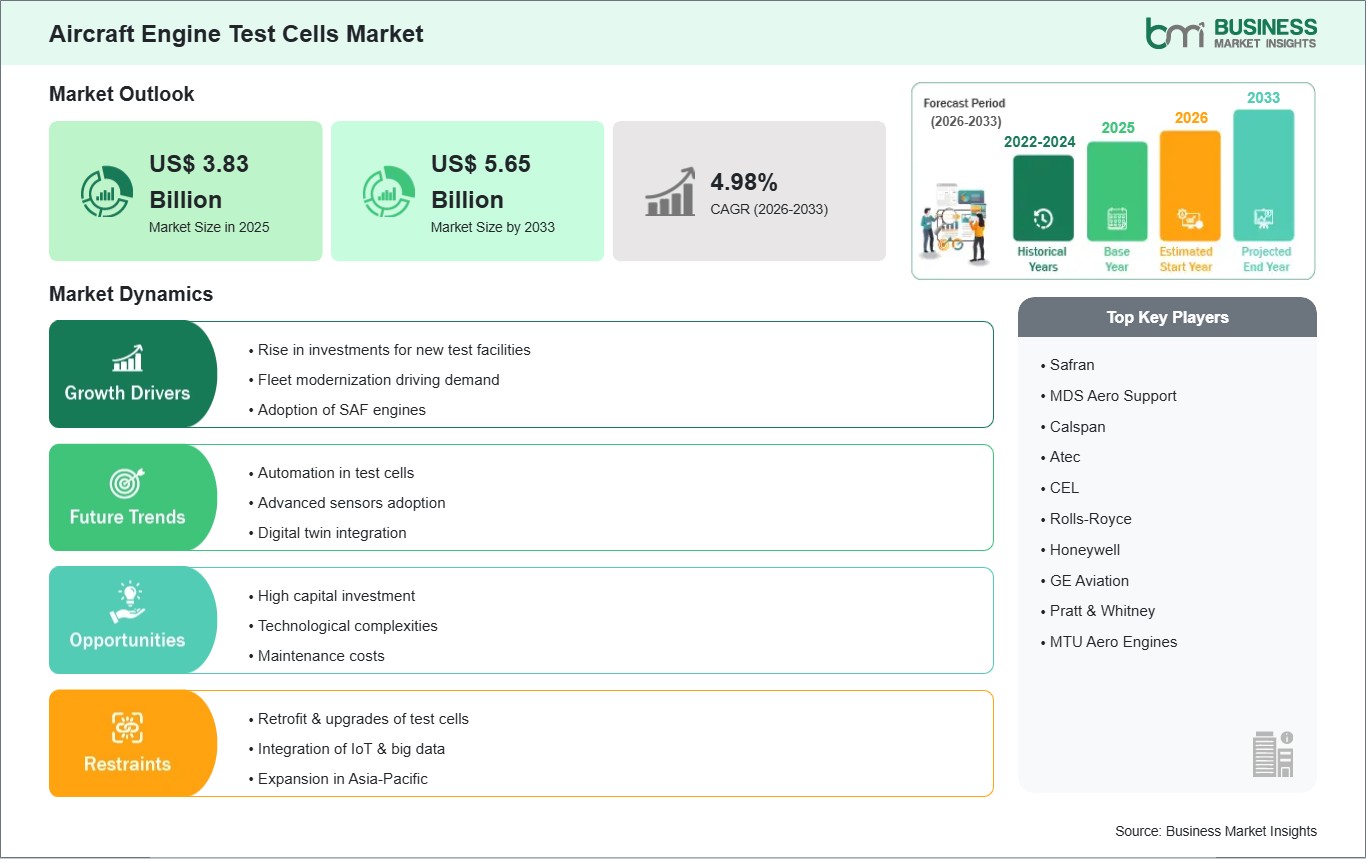
Aircraft engine test cells are specialized facilities used to test, inspect, validate, and certify aircraft engines under controlled operating conditions. These systems help evaluate engine thrust, fuel efficiency, vibration levels, thermal performance, emissions, and operational safety before engines are installed on aircraft or returned to service after maintenance. Test cells are widely used by aircraft engine manufacturers, maintenance providers, defense organizations, and airline operators to ensure engine reliability and compliance with aviation regulations. The market is gaining attention as global aviation activity increases and airlines focus more on fleet safety, maintenance efficiency, and operational reliability. Growing demand for fuel-efficient engines and the introduction of next-generation propulsion technologies are also increasing the need for advanced testing infrastructure and digital monitoring systems.
There are several operational and financial challenges influencing market development. Establishing engine test facilities requires significant investment in infrastructure, acoustic control systems, exhaust treatment equipment, and safety mechanisms. Regulatory compliance related to emissions and noise management also adds complexity to facility operations. Older test infrastructure often requires modernization to support advanced turbofan and hybrid propulsion systems, creating additional cost burdens for operators. Skilled technical personnel are also required to manage testing procedures, calibration, and data interpretation, which can create workforce limitations in some regions.
Despite these challenges, the Aircraft Engine Test Cells market is expected to grow steadily with the expansion of commercial aviation, military fleet modernization, and global MRO activities. Increasing use of automation, digital twin technologies, and real-time engine diagnostics is improving testing accuracy and operational efficiency. Commercial aviation continues to represent a major area of demand, while military programs and emerging propulsion technologies are creating new opportunities for specialized and high-capacity testing facilities worldwide.
Segment Analysis
Aircraft Engine Test Cells Market Segmentation
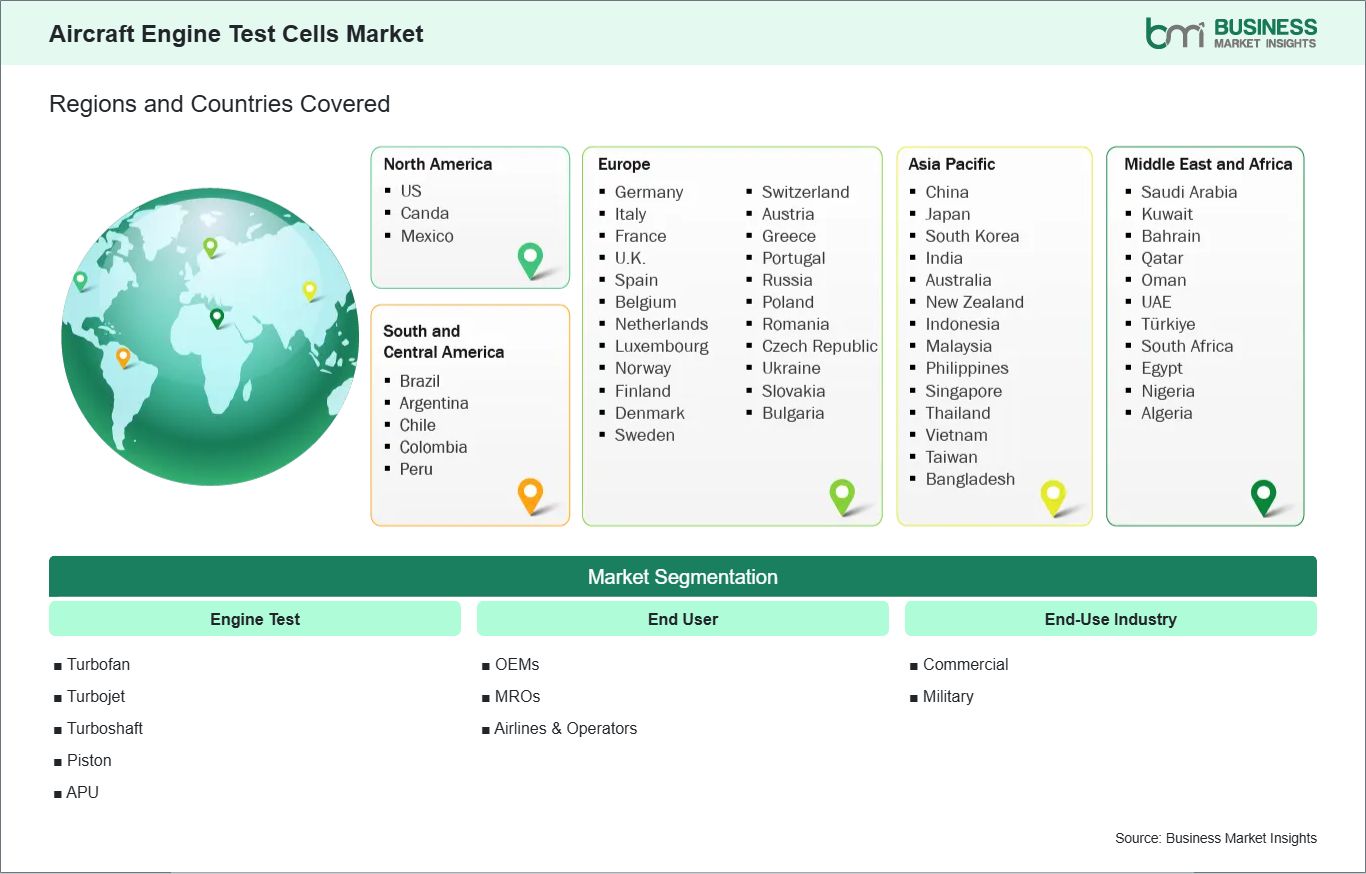
The Aircraft Engine Test Cells market is segmented based on engine test type, end-user, and end-use industry. Different testing requirements across commercial and defense aviation continue to influence market demand and infrastructure development.
By Engine Test
- Turbofan: Widely used for commercial aircraft engine validation and performance testing due to high demand for passenger aviation.
- Turbojet: Utilized mainly in military and legacy aviation applications requiring high-speed propulsion systems.
- Turboshaft: Commonly used for helicopter engine testing and rotary-wing aircraft maintenance activities.
- Piston: Used in general aviation and smaller aircraft engine performance evaluation.
- APU: Focuses on auxiliary power unit testing for onboard power generation and operational efficiency verification.
By End-User
- OEMs: Major users of engine test cells for product development, certification, and production testing.
- MROs: Increasingly adopting advanced test facilities for engine overhaul, maintenance validation, and repair services.
- Airlines & Operators: Utilize testing systems to support operational reliability and maintenance planning.
By End-Use Industry
- Commercial: Dominates the market due to increasing aircraft fleet expansion and rising maintenance requirements.
- Military: Growing steadily with defense modernization programs and increasing investment in aircraft readiness.
Market Forces
Aircraft Engine Test Cells Market Drivers and Opportunities
Rising Aircraft Maintenance and Engine Overhaul Activities
The growing global aircraft fleet and increasing air travel activity are significantly driving demand for aircraft engine test cells. Airlines and fleet operators are placing greater emphasis on preventive maintenance, engine reliability, and operational safety to minimize downtime and improve efficiency. As aircraft engines become more advanced and fuel-efficient, testing procedures are becoming more complex and technically demanding. This is encouraging the adoption of modern test cells equipped with advanced monitoring systems, digital controls, and automated diagnostics.
Regulatory authorities continue to enforce strict standards related to engine safety, emissions, and operational performance, making testing and certification essential across both commercial and military aviation. Maintenance, repair, and overhaul providers are also expanding their testing capabilities to manage increasing engine servicing requirements. In addition, the growing use of high-bypass turbofan engines and next-generation propulsion systems is creating demand for larger and more technologically advanced test facilities. These factors are collectively strengthening the long-term importance of aircraft engine test cells across the global aviation industry.
Expansion of Digital and Hybrid Engine Testing Technologies
The increasing adoption of digital technologies and emerging propulsion systems is creating new opportunities in the Aircraft Engine Test Cells market. Engine manufacturers and maintenance providers are integrating artificial intelligence, digital twin platforms, and predictive analytics into testing environments to improve operational efficiency and reduce testing time. These technologies help operators monitor engine behavior in real time, identify performance issues more accurately, and improve maintenance planning.
The development of hybrid-electric propulsion systems and sustainable aviation technologies is also expanding the need for specialized testing infrastructure. Modern propulsion systems require advanced thermal management, electrical integration testing, and noise analysis capabilities that traditional facilities may not fully support. This is encouraging investments in flexible and modular test cell designs that can accommodate evolving engine architectures. In addition, remote monitoring and data-driven testing solutions are helping organizations improve operational productivity while reducing maintenance costs. As aviation companies continue focusing on sustainability, efficiency, and digital transformation, advanced aircraft engine test cells are expected to play a critical role in supporting future engine development and certification programs.
Size and Share Analysis
Aircraft Engine Test Cells Market Size and Share Analysis
The Aircraft Engine Test Cells Market is projected to grow from US$ 3.83 Billion in 2025 to US$ 5.65 Billion by 2033 , registering a CAGR of 4.98% from 2026 to 2033.
By engine test type, turbofan engine test cells account for a major share of the market due to their extensive use in commercial aviation and next-generation aircraft platforms. Turboshaft engine testing is also witnessing steady growth with increasing helicopter deployment in defense and emergency services. The APU testing segment is expanding as airlines focus more on auxiliary system efficiency and onboard power management.
By end-user, OEMs maintain a significant market share because of ongoing engine development, certification programs, and production testing requirements. MRO providers are also experiencing rising demand as global engine overhaul activities increase. Commercial aviation remains the leading end-use industry, while military aviation continues to create opportunities through aircraft modernization and propulsion system upgrades.
Report Coverage
Aircraft Engine Test Cells Market Report Coverage and Deliverables
The "Aircraft Engine Test Cells Size and Forecast (2022-2033)" report provides a detailed analysis of the market covering below areas:
- Market size and forecast at global, regional, and country levels for all the key market segments covered under the scope
- Market trends, as well as market dynamics such as drivers, restraints, and key opportunities
- Market analysis covering key market trends, global and regional framework, major players, regulations, and recent market developments
- Industry landscape and competition analysis covering market concentration, heat map analysis, prominent players, and recent developments for the market
- Detailed company profiles, including SWOT analysis
Geographic Insights
Aircraft Engine Test Cells Market Geographic Insights
The Aircraft Engine Test Cells Market shows diverse regional adoption patterns influenced by aviation infrastructure development, defense modernization programs, commercial fleet expansion, and increasing engine maintenance requirements.
North America remains a mature market due to the strong presence of aircraft manufacturers, engine developers, and major maintenance facilities. The United States leads regional demand with advanced aviation testing infrastructure and ongoing investments in military and commercial aircraft programs. Canada also supports market growth through aerospace manufacturing activities and engine servicing operations. The region benefits from high adoption of digital testing technologies, automation systems, and advanced diagnostic platforms. Established regulatory frameworks and strong aviation safety standards continue to encourage modernization of engine testing facilities across commercial and defense sectors.
Asia Pacific is witnessing strong growth driven by expanding airline fleets, increasing passenger traffic, and rising investments in domestic aerospace manufacturing. Countries such as China and India are strengthening aviation infrastructure and expanding maintenance, repair, and overhaul capabilities to support growing aircraft demand. Japan and South Korea continue investing in advanced aerospace technologies and defense aviation programs. The region is also seeing growing interest in localized engine testing capabilities to reduce operational dependency on foreign facilities. Increasing airport expansion projects and government support for aerospace development are contributing to the long-term growth of aircraft engine testing infrastructure across the region.
Industry Activity
Recent Developments
The Aircraft Engine Test Cells Market is analyzed using a mix of primary and secondary research sources, including corporate publications, industry associations, and verified databases. This approach ensures accurate tracking of innovation trends and strategic developments influencing the market.
- In February 2024, Lufthansa Technik announced the expansion of its engine services capabilities with upgraded testing infrastructure to support modern aircraft engine platforms and increasing MRO demand. The development focused on improving testing efficiency, operational reliability, and digital integration within engine maintenance operations.
- In July 2023, Rolls-Royce announced advancements in sustainable aviation engine testing programs, including expanded testing activities for next-generation propulsion technologies and fuel-efficient engine systems. The initiative aimed to strengthen engine validation capabilities and support future aviation sustainability targets.
Trust & Transparency
Research Methodology
The market analysis combines proprietary research with secondary data from government agencies, company disclosures, regulatory filings, industry databases and expert interviews. Market estimates are validated through data triangulation, cross-market benchmarking and analyst
review.
View Full Research Methodology
Key Sources Referred:
World Bank - Global Trade Indicators World Trade Organization (WTO) International Monetary Fund (IMF) International Trade Administration (ITA) Company Websites Company Annual Reports Company Investor Presentations