
Commercial Aircraft Market Outlook: Size, Share, Trends, Growth Analysis, Competitive Landscape & Forecast, 2026-2033

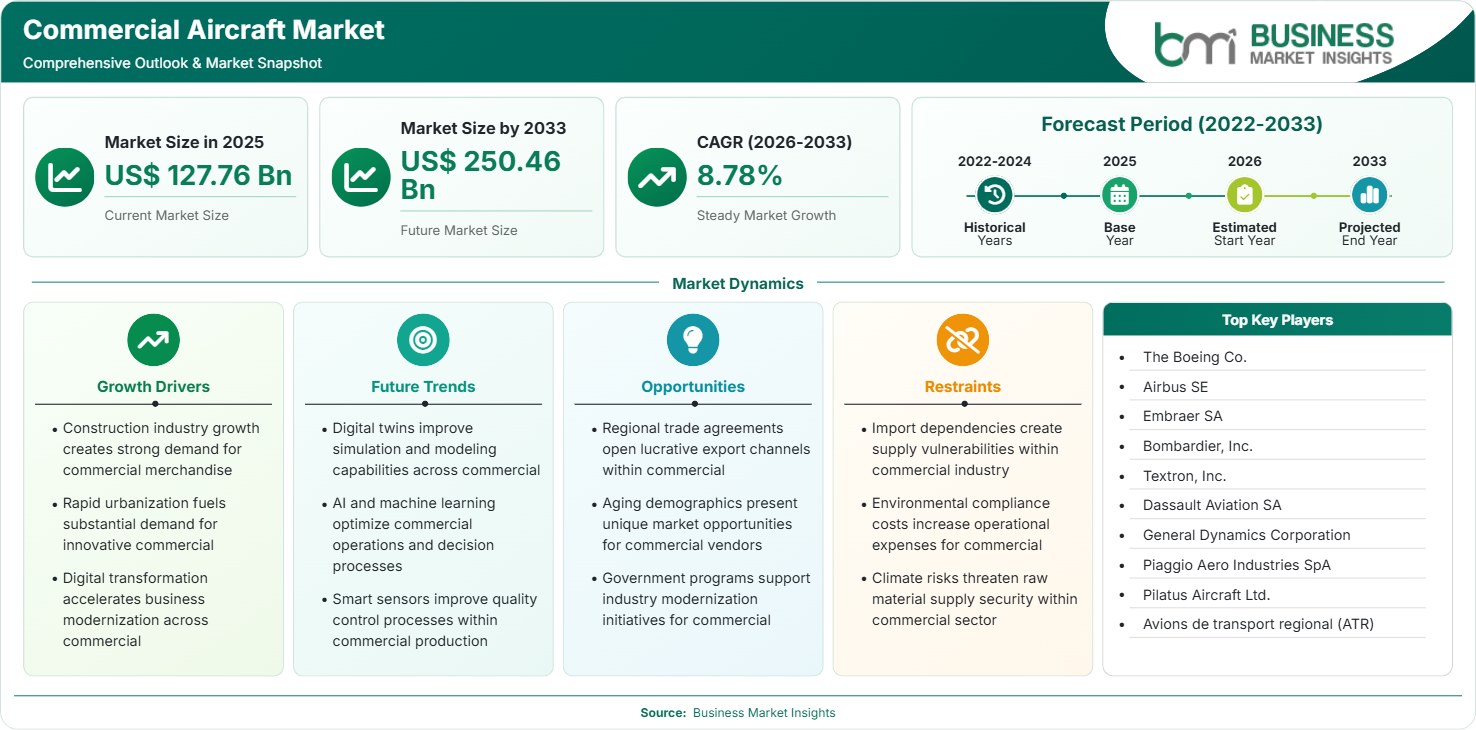
The Commercial Aircraft Market size was valued at US$ 127.76 Billion in 2025 and is projected to reach US$ 250.46 Billion by 2033, growing at a CAGR of 8.78% during 2026–2033. Fleet modernization, rising global passenger traffic, sustainable aviation initiatives, and expanding low-cost carrier networks continue to strengthen demand, while investments in next-generation aircraft technologies and emerging aviation markets create long-term growth opportunities.

Report Coverage
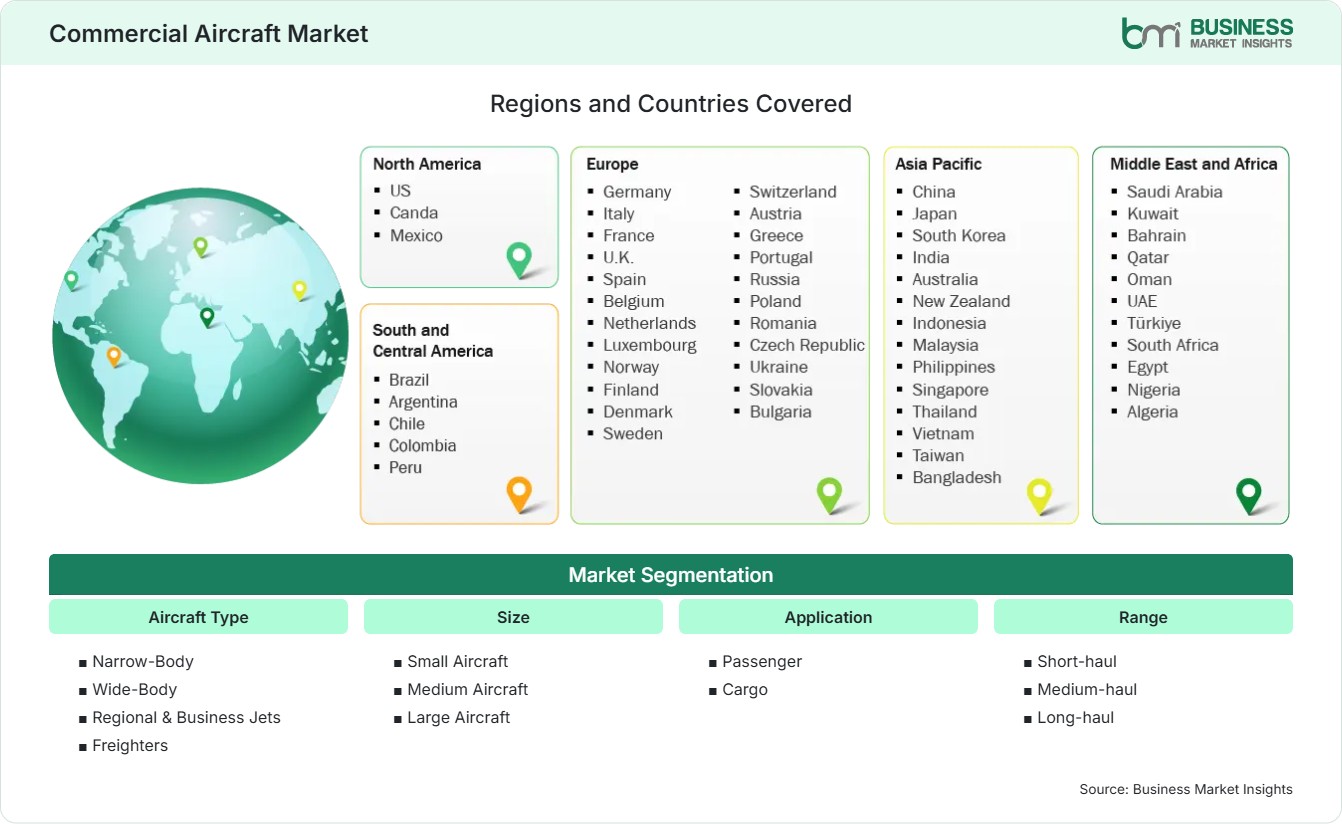
  • Aircraft Type: Narrow-Body, Wide-Body, Regional & Business Jets, Freighters
  • Size: Small Aircraft, Medium Aircraft, Large Aircraft
  • Application: Passenger, Cargo
  • Range: Short-haul , Medium-haul , Long-haul
US$ 127.76 Bn Market size in 2025
US$ 250.46 Bn Market Size by 2033
8.78% CAGR, 2026 - 2033
2026-2033 Forecast Period

AI Overview

Commercial Aircraft Market Summary

  • North America Region: North America holds a 36%–39% market share in 2025, growing with a CAGR of 7.8%–8.4% during 2026–2033, supported by strong aircraft manufacturing capabilities, defense-linked aerospace innovation, fleet replacement programs, and increasing airline investments in fuel-efficient narrow-body aircraft for domestic and international operations. The U.S. dominates regional aircraft manufacturing and airline fleet expansion, supported by advanced aerospace infrastructure and a projected CAGR of 7.9%–8.5%.
  • Fastest Growing Region: Asia Pacific accounts for 26%–29% market share in 2025 and is projected to expand at a CAGR of 9.8%–10.5% through 2033, driven by rising air passenger volumes, airport infrastructure expansion, airline fleet modernization, tourism growth, and increasing government support for domestic aerospace manufacturing.
  • Leading Segment: Narrow-Body aircraft represent 48%–52% market share in 2025 with a CAGR of 8.9%–9.5% through 2033, supported by increasing short-haul passenger demand, expanding low-cost carrier fleets, fuel efficiency improvements, and growing replacement of aging aircraft across major aviation markets.
  • High Growth Segment: Cargo application accounts for 18%–21% market share in 2025 while advancing at a CAGR of 9.5%–10.2% during 2026–2033, fueled by expanding e-commerce logistics, express freight demand, resilient global supply chains, and investments in dedicated freighter aircraft capacity.
  • Key Market Opportunity: Expanding sustainable aviation initiatives, production of fuel-efficient aircraft, digital aircraft maintenance platforms, and increasing replacement of aging fleets provide significant opportunities for manufacturers, suppliers, airlines, and aerospace technology providers worldwide.
  • Major Market Players: The Boeing Company, Airbus SE, Embraer S.A., Bombardier Inc., Textron Inc., Dassault Aviation SA, General Dynamics Corporation, Piaggio Aerospace S.p.A., Pilatus Aircraft Ltd., ATR (Aerei da Trasporto Regionale).
Strategic Insights

Commercial Aircraft Market: Strategic Insights

Commercial Aircraft Market Strategic Framework
FREE PDF
Request your free sample
Request free sample
Stakeholder View

Key Takeaways

  • Aircraft manufacturing increasingly depends on resilient global supply chains integrating advanced materials suppliers, avionics manufacturers, propulsion system developers, maintenance providers, and digital software companies, creating stronger collaboration across the aerospace value chain.
  • Narrow-body aircraft and cargo operations present the strongest commercial opportunities as airlines expand regional connectivity, low-cost travel, and e-commerce logistics, generating sustained procurement demand across mature and emerging aviation markets.
  • Artificial intelligence-enabled predictive maintenance, digital twins, lightweight composite structures, sustainable aviation fuel compatibility, and next-generation propulsion technologies are becoming central investment priorities for manufacturers seeking long-term competitive differentiation.
  • Asia Pacific offers one of the strongest investment destinations owing to expanding middle-class air travel, airport development projects, government aviation initiatives, and increasing aircraft procurement from rapidly growing regional carriers.
  • Strategic partnerships, supplier diversification, production capacity expansion, and long-term aircraft purchase agreements continue shaping competitive positioning as manufacturers seek to address record order backlogs and strengthen delivery capabilities across global markets.
  • Growing emphasis on environmental compliance, lifecycle cost optimization, digital fleet management, and sustainable manufacturing practices is encouraging aerospace companies to accelerate innovation while strengthening long-term operational resilience and shareholder value.
Geographic Outlook

Commercial Aircraft Market Regional Highlights

North America Commercial Aircraft Market

North America accounted for 36%–39% of global revenue in 2025 and is projected to register a CAGR of 7.8%–8.4% during 2026–2033. Strong aerospace manufacturing capabilities, high commercial fleet replacement rates, advanced avionics integration, and continuous aircraft procurement by major airlines support regional leadership. The region also benefits from mature maintenance, repair, and overhaul (MRO) infrastructure and sustained investments in sustainable aviation technologies. The Commercial Aircraft Market share remains the largest globally due to extensive OEM presence and long-term aircraft order backlogs.

  • The United States leads regional aircraft production with continuous investments in composite manufacturing, digital engineering, sustainable aviation fuel compatibility, and next-generation engine technologies, strengthening aircraft delivery capabilities and improving production efficiency across commercial aviation programs.
  • Fleet modernization initiatives by major airlines continue replacing aging aircraft with fuel-efficient narrow-body and wide-body models, reducing operational costs while supporting passenger traffic recovery and environmental compliance objectives across domestic and international routes.
  • Advanced aerospace suppliers maintain integrated supply chains for engines, avionics, structures, and aircraft systems, enabling faster production cycles despite component shortages and increasing global aircraft delivery commitments.
  • Government support for aerospace innovation, airport modernization, and research collaborations accelerates commercialization of lightweight materials, autonomous maintenance technologies, and digital aircraft lifecycle management across commercial aviation.
  • Expanding cargo aviation operations driven by e-commerce logistics strengthen freighter demand, encouraging airlines to invest in converted cargo aircraft and new-generation freighter fleets.

US Commercial Aircraft Market

The United States represented approximately 74%–78% of North American Commercial Aircraft Market revenue during 2025 and is anticipated to expand at a CAGR of 7.9%–8.5% through 2033. Strong domestic passenger demand, global aircraft exports, aerospace R&D investments, and extensive airline fleet modernization programs continue reinforcing national leadership. Major OEM manufacturing facilities, highly developed aviation infrastructure, and advanced supplier ecosystems support continuous innovation while increasing aircraft production capacity and export competitiveness.

  • Leading aircraft manufacturers continue expanding production facilities and supplier partnerships to reduce delivery backlogs while improving manufacturing resilience through automation, digital quality control, and predictive production systems.
  • Airlines increasingly invest in fuel-efficient aircraft capable of lowering emissions, operating costs, and maintenance requirements while improving passenger comfort and operational flexibility across domestic and international routes.
  • Federal support for aviation safety, aerospace innovation, and sustainable aviation fuel initiatives strengthens long-term aircraft manufacturing competitiveness and environmental performance across the aviation sector.
  • Rising demand for maintenance, repair, and overhaul services supports aircraft lifecycle management while creating additional opportunities for aerospace component manufacturers and technology providers.

Europe Commercial Aircraft Market

Europe captured 24%–27% of global Commercial Aircraft Market revenue in 2025 and is expected to grow at a CAGR of 8.1%–8.7% during the forecast period. Regional growth is supported by advanced aircraft manufacturing, sustainability regulations, strong export capabilities, and collaborative aerospace research initiatives. France and Germany remain leading production centers, while Spain demonstrates one of the fastest growth trajectories with an estimated CAGR of 8.8%–9.4% due to expanding aerospace investments and supplier development.

  • European manufacturers continue investing in lightweight composite structures, hydrogen aviation research, and advanced propulsion technologies to achieve ambitious aviation decarbonization objectives and improve aircraft efficiency.
  • Strong aerospace collaboration between manufacturers, suppliers, and research organizations accelerates commercialization of digital manufacturing technologies and next-generation aircraft platforms across the region.
  • Fleet replacement programs among European airlines increase demand for fuel-efficient narrow-body aircraft, supporting long-term production pipelines and sustainable airline operations.
  • Government funding for clean aviation research and airport modernization encourages innovation while strengthening Europe's competitive position within global aerospace manufacturing.
  • Expanding maintenance, repair, and overhaul capabilities enhance aircraft availability while supporting long-term operational efficiency for commercial airline operators.

Asia Pacific Commercial Aircraft Market

Asia Pacific accounted for 26%–29% of global revenue in 2025 and is forecast to record the fastest CAGR of 9.8%–10.5% through 2033. Rising disposable incomes, expanding middle-class populations, airport infrastructure investments, and increasing airline fleet expansion support robust demand. China remains the largest regional market, while India records the fastest growth with a projected CAGR of 10.6%–11.2%, supported by rapid aviation infrastructure expansion and increasing domestic passenger traffic.

  • Rapid urbanization and tourism growth continue increasing passenger volumes, encouraging airlines to procure fuel-efficient aircraft for regional and international connectivity while improving operational economics.
  • Government investments in domestic aerospace manufacturing, airport construction, and aviation infrastructure strengthen regional production capabilities and supply chain localization across emerging economies.
  • Low-cost carriers expand aggressively across Southeast Asia, creating sustained demand for narrow-body aircraft and supporting long-term fleet modernization initiatives.
  • Growing aircraft leasing activity improves financing accessibility, enabling airlines to accelerate fleet expansion while optimizing capital allocation and operational flexibility.
  • Increasing cargo transportation driven by cross-border e-commerce supports freighter aircraft procurement and expansion of integrated logistics networks throughout the region.

Rest of World Commercial Aircraft Market

The Rest of World region represented 10%–13% of global Commercial Aircraft Market revenue during 2025 and is projected to expand at a CAGR of 8.3%–8.9% through 2033.

South & Central America benefits from expanding tourism, airline modernization, and improving regional connectivity. Brazil remains the leading market, while Colombia demonstrates relatively faster expansion with increasing airline investments and airport upgrades.

The Middle East & Africa continue strengthening global aviation connectivity through strategic airline expansion, airport megaprojects, and fleet modernization. The UAE leads regional demand, while Saudi Arabia records one of the strongest growth rates at 9.2%–9.8% through major aviation development initiatives.

  • National aviation strategies encourage fleet expansion, airport development, and international connectivity, strengthening commercial aircraft demand across emerging aviation hubs.
  • Cargo transportation, tourism recovery, and increasing regional passenger traffic improve airline profitability while stimulating aircraft procurement and long-term fleet modernization investments.
  • Strategic investments in airport infrastructure support higher passenger handling capacity, creating favorable conditions for commercial airline expansion and aircraft acquisitions.
  • Public-private partnerships strengthen aviation ecosystems through financing support, maintenance capabilities, and aerospace technology adoption across developing economies.
  • Expanding international airline alliances improve route connectivity while increasing demand for efficient narrow-body and wide-body aircraft across regional networks.
Global Market Geography
FREE PDF
Request your free sample
Request free sample
Segment Analysis

Commercial Aircraft Market Segmentation

Aircraft Type

Aircraft Type accounted for the largest revenue contribution, holding 48%–52% market share during 2025 while advancing at a CAGR of 8.9%–9.5% through 2033. Fleet modernization, operational efficiency, and increasing airline investments continue driving demand across aircraft categories. The Commercial Aircraft Market scope continues expanding through diversified aircraft deployment strategies addressing passenger mobility, cargo transportation, and specialized aviation services.

  • Narrow-Body: Dominates airline fleet expansion owing to superior fuel efficiency, lower operating costs, and extensive deployment across domestic and regional passenger routes by both legacy and low-cost carriers.
  • Wide-Body: Supports long-haul international connectivity through higher passenger capacity, improved operational economics, and increasing demand for intercontinental travel among full-service airlines.
  • Regional & Business Jets: Enable regional connectivity, executive transportation, and access to underserved airports while benefiting from technological improvements and flexible operational capabilities.
  • Freighters: Experience sustained demand from expanding global e-commerce, pharmaceutical logistics, and express cargo transportation requiring dedicated aircraft with enhanced payload capabilities.

Size

The aircraft size segment held approximately 33%–36% market share in 2025 while registering a CAGR of 8.5%–9.1% through the forecast period. Airline route optimization, passenger capacity planning, and operating economics continue influencing aircraft size selection across domestic and international aviation markets.

  • Small Aircraft: Support regional operations, pilot training, business aviation, and short-distance commercial connectivity while offering lower acquisition and operational costs.
  • Medium Aircraft: Balance passenger capacity and operating efficiency, making them suitable for expanding domestic and medium-haul airline networks across growing aviation markets.
  • Large Aircraft: Serve high-density international routes where airlines prioritize maximum passenger capacity, cargo capability, and long-distance operational efficiency.

Application

Application-based demand contributed 71%–74% of the Commercial Aircraft Market share during 2025 and is projected to expand at a CAGR of 8.6%–9.2% through 2033. Rising passenger mobility, expanding tourism, and increasing international business travel continue strengthening airline fleet investments across commercial aviation.

  • Passenger: Represents the largest application owing to rising global air travel demand, expanding airline networks, fleet modernization initiatives, and increasing adoption of fuel-efficient aircraft technologies.
  • Cargo: Benefits from sustained e-commerce growth, pharmaceutical transportation, global trade expansion, and investments in dedicated freighter aircraft supporting resilient logistics operations.

Range

Range-based aircraft deployment accounted for approximately 45%–48% of industry demand during 2025 while growing at a CAGR of 8.8%–9.4% through the forecast period. Airlines increasingly optimize aircraft deployment based on route economics, operational flexibility, and fuel efficiency to maximize profitability. The Commercial Aircraft Market trends indicate continued investment in aircraft capable of serving diversified route networks efficiently.

  • Short-haul (< 1,500 km): Experiences strong utilization because of expanding domestic travel, low-cost airline operations, and increasing airport connectivity across metropolitan and regional destinations.
  • Medium-haul (1,500–3,500 km): Supports regional international connectivity by balancing operational efficiency, passenger comfort, and airline profitability across medium-distance routes.
  • Long-haul (> 3,500 km): Driven by international tourism, global business travel, and growing demand for fuel-efficient wide-body aircraft capable of extended operations.
Market Forces

Commercial Aircraft Market Dynamics

Key Market Drivers

Rising Global Air Passenger Traffic and Fleet Modernization

Global passenger traffic continues to exceed pre-pandemic recovery trends, encouraging airlines to expand and modernize their fleets with fuel-efficient aircraft. According to the International Air Transport Association (IATA), long-term passenger demand is expected to remain resilient, particularly across the Asia Pacific and the Middle East. The Commercial Aircraft Market growth is supported by increasing aircraft replacement cycles, growing low-cost carrier networks, and rising international tourism. Airlines are prioritizing next-generation narrow-body and wide-body aircraft that reduce fuel consumption and maintenance costs while improving operational flexibility. Aircraft manufacturers are simultaneously increasing production capacity and strengthening supplier collaboration to address record order backlogs, ensuring sustained demand throughout the forecast period while supporting improved airline profitability and operational resilience.

Advancements in Fuel-Efficient Aircraft and Digital Manufacturing

Aircraft manufacturers continue investing heavily in lightweight composite materials, advanced aerodynamics, digital engineering, and high-bypass turbofan engines that significantly improve fuel efficiency. Automated assembly systems, artificial intelligence-enabled quality inspection, and digital twin technologies are reducing production lead times while enhancing manufacturing precision. The Commercial Aircraft Market trends increasingly reflect the industry's transition toward sustainable aviation through aircraft compatible with Sustainable Aviation Fuel (SAF) and lower carbon emissions. Constant innovation in avionics, predictive maintenance software, and smart manufacturing helps airlines decrease their costs and increase the reliability of their fleets. Such innovations help airlines differentiate themselves from other airlines through technological advancement.

Expanding Airport Infrastructure and Government Aviation Investments

Governments across emerging and developed economies continue investing in airport modernization, aviation infrastructure, and aerospace manufacturing capabilities. Large-scale airport expansion projects increase passenger handling capacity while supporting higher aircraft procurement by commercial airlines. Aviation policies at national levels that favor local manufacturing, research in aerospace, and partnerships between the public and private sectors build production ecosystems at regional levels. More investment in MRO infrastructure contributes to the efficient support of aircraft throughout their lifecycles. There is a more integrated approach with growing cooperation between defense and civil aviation, which improves technology development in the production of commercial aircraft. Such investments provide a conducive environment for aircraft demand over the long run.

Key Market Opportunities

Growing Adoption of Sustainable Aviation Fuel Compatible Aircraft

Airlines worldwide are accelerating sustainability initiatives to meet increasingly stringent carbon reduction targets established by international aviation organizations and national regulators. Aircraft manufacturers capable of delivering next-generation models optimized for Sustainable Aviation Fuel (SAF) compatibility gain significant competitive advantages. Commercial Aircraft Market Forecasts indicate that fleet replacement programs will increasingly prioritize aircraft with lower emissions, improved engine efficiency, and lightweight structural materials. Research on hydrogen fuel-based aircraft, hybrid-electric propulsion engines, and aerodynamics provides many future prospects for original equipment manufacturers (OEMs) and parts suppliers. With the increased government incentives for green aviation, the manufacturers of environmentally friendly aircraft are anticipated to improve their positions and benefit from increasing worldwide procurement efforts.

Rapid Aviation Expansion Across Emerging Economies

Growing economies have been showing remarkable developments in terms of income generation, urbanization, tourism, and business travel, hence providing a great potential market for the production of aircraft. Countries such as India, Indonesia, Vietnam, Saudi Arabia, and others in Africa are spending huge sums on building airports and expanding their fleets of aircraft. There is an increasing presence of low-cost airlines. Government-backed aviation development programs and improved financing mechanisms enable airlines to modernize fleets while expanding domestic and international route networks. Manufacturers capable of localizing supply chains, strengthening regional partnerships, and providing aftermarket services are well-positioned to capture growing demand across these high-potential aviation markets throughout the forecast period.

Digital Aviation Services and Predictive Maintenance Solutions

Digital transformation creates substantial commercial opportunities beyond aircraft manufacturing by expanding demand for predictive maintenance, connected aircraft platforms, real-time fleet monitoring, and artificial intelligence-enabled maintenance analytics. The trend in the aviation industry is for the deployment of cloud solutions for operational management to enhance aircraft availability and minimize unplanned maintenance tasks. With the implementation of IoT sensors and advanced diagnostics, components can be changed in a timely manner to optimize the use of the aircraft. Digital service offerings from aerospace firms provide a revenue stream and enhance customer relations for the long term. The trend towards digital aviation ecosystems presents new business opportunities for software vendors, component makers, and aircraft manufacturers.

Market Restraints and Challenges

Supply Chain Disruptions and Component Shortages

Factor: Global aerospace manufacturing continues facing shortages of engines, semiconductors, titanium, forged components, and specialized aerospace materials due to geopolitical uncertainties and supplier capacity constraints.

Impact: Production schedules remain vulnerable to delivery delays, limiting aircraft output despite strong order backlogs. The need for diversification of suppliers, creation of buffer stocks, and investment in resilient supply chains adds to their cost structures and delays aircraft deliveries. The small suppliers face challenges related to capital requirements for capacity expansion, thus making the procurement process even more difficult. These restrictions not only hamper production flexibility but also delay fleet renewal initiatives by airlines.

Stringent Environmental Compliance and Aircraft Certification Requirements

Factor: Commercial aircraft manufacturers must comply with increasingly rigorous environmental regulations, safety certification procedures, emissions standards, and noise reduction requirements established by international aviation authorities.

Impact: Compliance increases research and development expenditure, certification timelines, and engineering complexity before aircraft enter commercial service. The companies must continue to invest in technologies and lighter-weight materials as well as testing programs while adhering to stringent safety requirements. Delays in the certification process will cause delays in launch time, increased risks in development, and decreased returns on investment. The smaller players in the aerospace industry will feel the economic impact more when it comes to new regulations.

Company Analysis

Competitive Landscape

The Commercial Aircraft Market analysis reflects an industry characterized by high entry barriers, extensive certification requirements, long product development cycles, and significant capital investment. Competition is driven by fuel-efficient aircraft development, production scalability, aftermarket services, digital aviation technologies, and strategic partnerships. Manufacturers continue investing in sustainable aviation solutions, advanced materials, autonomous manufacturing, and predictive maintenance platforms to strengthen long-term competitiveness.

Company Name

Overview

Products and Services Relevant to this Market

The Boeing Company

Global aerospace leader with extensive commercial aircraft manufacturing, engineering, and lifecycle support capabilities serving airlines worldwide.

737 MAX, 767 Freighter, 777, 787 Dreamliner, aircraft support services, digital aviation, maintenance solutions, pilot training, fleet optimization.

Airbus SE

One of the world's largest commercial aircraft manufacturers with strong global production, engineering, and customer support operations.

A220, A320neo Family, A330neo, A350, freighters, aircraft services, digital maintenance, flight operations support, sustainability solutions.

Embraer S.A.

Leading regional aircraft manufacturer specializing in efficient commercial jets and aftermarket aviation services.

E-Jets E2 Family, regional aircraft, maintenance services, fleet management, training solutions, engineering support, aviation software.

Bombardier Inc.

Aerospace manufacturer recognized for advanced aircraft engineering and premium aviation technologies.

Business aircraft, maintenance services, engineering support, digital aircraft solutions, aftermarket support, aircraft modernization.

Textron Inc.

Diversified aerospace company serving commercial aviation through innovative aircraft platforms and support services.

Cessna aircraft, aviation systems, maintenance solutions, pilot training, technical support, fleet services.

Dassault Aviation SA

French aerospace manufacturer known for advanced aircraft technologies and engineering excellence.

Business jets, aviation support services, maintenance, engineering, digital aircraft solutions, customer support.

General Dynamics Corporation

Aerospace and defense company supporting aviation through specialized aircraft manufacturing and lifecycle services.

Business aviation platforms, aircraft support, engineering services, modernization, maintenance, aviation technologies.

Piaggio Aerospace S.p.A.

Italian aerospace manufacturer specializing in innovative aircraft design and aviation maintenance capabilities.

Business aircraft, maintenance, overhaul services, engineering support, aviation components, technical services.

Pilatus Aircraft Ltd.

Swiss aircraft manufacturer focusing on reliable, high-performance aircraft for commercial and business aviation.

Utility aircraft, business aviation platforms, maintenance services, training, technical support, engineering solutions.

ATR (Aerei da Trasporto Regionale)

Global leader in regional turboprop aircraft serving short-haul commercial aviation markets worldwide.

ATR 42, ATR 72, regional aircraft, customer support, maintenance, spare parts, digital fleet services, training solutions.

Trust & Transparency

Research Methodology

The market analysis combines proprietary research with secondary data from government agencies, company disclosures, regulatory filings, industry databases and expert interviews. Market estimates are validated through data triangulation, cross-market benchmarking and analyst review.

View Full Research Methodology

Questions Answered

Frequently Asked Questions

What does the Commercial Aircraft Market Report cover?

The report provides detailed analysis of market size, regional trends, segmentation, competitive landscape, growth drivers, opportunities, challenges, company profiles, recent developments, and long-term industry forecasts.

What challenges affect aircraft manufacturers?

Manufacturers face supply chain disruptions, shortages of critical aerospace components, lengthy aircraft certification procedures, stringent environmental regulations, and increasing production costs associated with advanced aircraft technologies.

Which region is expected to grow the fastest?

Asia Pacific is projected to record the highest growth due to expanding middle-class populations, rapid airport infrastructure development, rising tourism, increasing airline fleet expansion, and supportive government aviation policies.

Which aircraft type dominates the market?

Narrow-body aircraft lead the market because they offer lower operating costs, higher fuel efficiency, and greater flexibility for domestic and regional routes, making them the preferred choice for both full-service and low-cost airlines.

What is driving the Commercial Aircraft Market?

The primary growth drivers include increasing global air passenger traffic, airline fleet modernization, expanding low-cost carrier operations, fuel-efficient aircraft demand, airport infrastructure investments, and advances in digital manufacturing and sustainable aviation technologies.

Access the Full Commercial Aircraft Market Report

Get segment-level forecasts, regional estimates, competitive benchmarking, company profiles and downloadable Excel datasets.

Access the full Commercial Aircraft Market Report
350 pages PDF & Excel | 2026-08-18